
Begging bowls, gated enclaves and a 99-year reset: the Rasmalé leaks
What four officials privately told clerics about the Eagle Hills deal.

Artwork: Dosain
1 hour ago
India and the tourism industry are driving the opposition to the Rasmalé project, senior government officials told religious scholars behind closed doors. The industry "is trying to control the entire political system" and India wants to ensure "this state can never be freed from them," Ahmed Nazim Mohamed, state minister for infrastructure, housing and urban development, told the scholars.
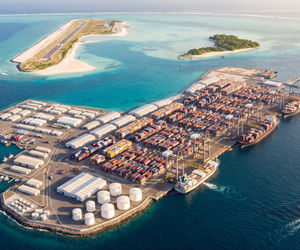
Short clips from their meetings with Nazim, Infrastructure Minister Dr Abdulla Muththalib, Attorney General Ahmed Usham and Economic Minister Mohamed Saeed were leaked in early November. Full recordings, posted on X by the anonymous account Jubraan Shareef last week, capture the four taking questions from members of Ilmuveringe Gulhun, a network of 100 clerics, about the government's deal with Abu Dhabi's Eagle Hills to build a gated community for foreign buyers on 500 hectares at Rasmalé. The meetings took place before the government sent a real estate bill with a chapter on "integrated real estate zones" to parliament.
Over several hours, the officials revealed that a dispute between Eagle Hills and the citizenship advisory firm Henley & Partners over who runs residency-by-investment has stalled the government's Pearl Residence visa. They described a state that "emptied" the national bank to repay a sukuk in April and had to plead futilely with India to roll over a US$50 million bond. Muththalib and Nazim conceded that a 99-year lease in Rasmalé would restart every time a property is sold.
"The most confusing part is how much the things said by different officials contradict each other," one of the scholars told Saeed at the last of the four meetings, referring to answers on inheritance, alcohol and whether there will be more such projects.
Across the four leaked recordings, the clerics raised concerns about what an enclave of non-Muslim foreign residents could do to the country’s nine-century-old 100 per cent Muslim status. Several pointed to Dubai as a cautionary tale. Counting foreign residents, it had gone from over 80 per cent Muslim in the 1960s to about 75 per cent non-Muslim today, with Indians alone making up more than a third, one told the ministers, warning that the same change “will come to us”. Another reminded the attorney general that a vast Hindu temple had been built in Abu Dhabi and inaugurated by India’s leader, seeking assurances that Rasmalé would not have any temples, casinos, pork or Christmas celebrations. One said that “if even a handspan falls under the control of unbelievers, jihad becomes obligatory” and compared the project to Palestine, where land was bought up under “a master plan” from the early 1900s.
After the meetings, the network’s scholarly studies and research committee produced a 93-page report on the deal. It concluded that the project "is not impermissible in itself under Islamic law" but that leases restarting on every sale, marketing that links homes to residence visas and an unpublished agreement carry "serious and potentially irreversible risks". The group urged the government to pause and renegotiate, or withdraw from the letter of intent if its conditions could not be met.
Using the sales and tax figures Muththalib gave them, the report calculated the state’s revenue at US$5.7 billion to US$7.3 billion over 10 years, lower than the US$11 billion the government has claimed.
No referendum
The President’s Office did not respond to questions sent on Monday regarding the authenticity and content of the recordings. The ministers and attorney general have not publicly commented since the leaks.
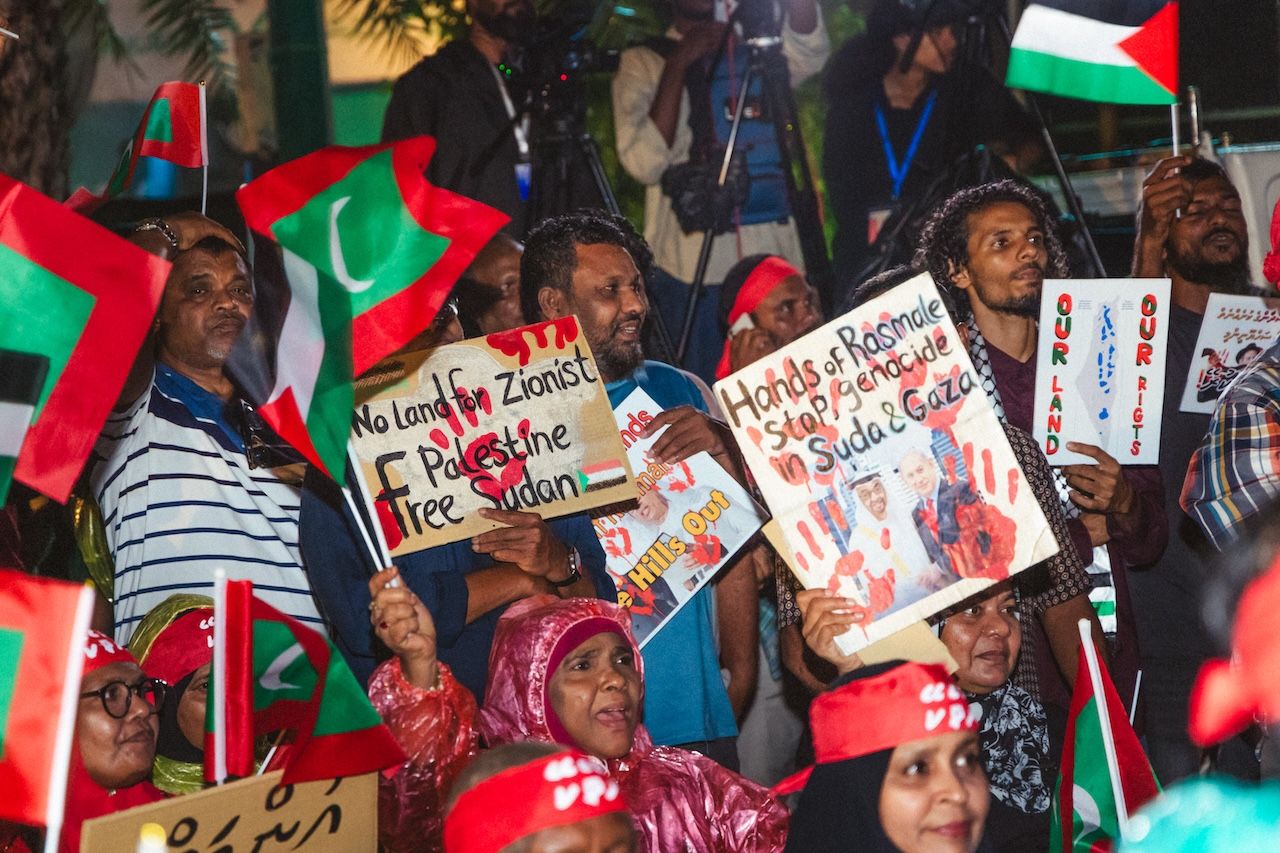
The recordings were leaked ahead of a rally held by the “Maldivian land for Maldivians” campaign against the deal last Friday. The campaign led by former home minister Sheikh Imran Abdulla is planning a rally in Hulhumalé Phase 2 next Friday night (20 November) and a nationwide gathering in Malé on 4 December with people from other islands. The main opposition Maldivian Democratic Party’s national council voted earlier this month to take to the streets alongside other parties and civil society groups if the government went ahead without a referendum. President Dr Mohamed Muizzu has refused. “This is not a matter on which we will hold a referendum,” he told the press last week.
Muizzu addressed the Rasmalé controversy in his 90-minute speech at Tuesday night’s event marking the third anniversary of his administration. He called the opposition “very practiced” at misleading the public, dismissed concerns as “baseless” and assured that the government would not pursue any policy or project contrary to Islam.
"So no investment would come to the Maldives that would disrupt or damage our independence and sovereignty,” he said last night, adding that the Rasmalé deal would not harm the country’s social fabric or values either. The proposed real estate bill prohibits the sale of alcohol or pork and the operation of casinos, he noted.
On the exemption for a resort to be developed on a separate island reclaimed from the lagoon within a real estate zone, Muizzu said that was “nothing new” as resorts already exist in the same lagoon as inhabited islands. “So that’s not the same landmass that’s connected to an inhabited place…people who come to invest with us would accept these standards.” Eagle Hills have been informed as much, he said.
'Two parties'
Nazim, who was previously state minister for tourism, said the opposition with the exception of former President Abdulla Yameen supports the project "because they know they are the ones who will benefit if they come to power."
The resistance comes from resort owners who fear losing their hold on government, he said. "The tourism industry believes the government's dependence on them will shrink." Previous governments "sought their help in political matters and did what they said".
"It is a strange situation. We can't live with them and we can't live without them. They don't listen. They don't give anything. The moment you ask them to give, they cry," he said. After the government told resorts to exchange 40 per cent of their foreign currency earnings, "they are spreading the word that investors should not come to the Maldives".
In September, Mohamed Khaleel, CEO of Manta Air and Managing Director of Pulse Hotels and Resorts, told Mira Business FM that he resigned as tourism adviser because President Muizzu rejected his advice on requiring resorts to convert dollars. Khaleel said his company’s board had decided never to invest in the Maldives again, saying that the passage and enactment of laws within periods as short as 24 hours undermines confidence among investors.
Nazim said his personal, more "radical" view was that the state should seize Khaleel's property.
The Maldives Association of Tourism Industry, a group representing resort operators that has been at loggerheads with the current administration over policies such as dollar surrender, declined to comment when contacted.
"One party that would want the most to stop this is India," said Muththalib. Nazim accused India of "economic slavery".
Successive governments have relied on Indian financial support to avert a debt crisis. India has rolled treasury bills over year after year, turned US$50 million into a grant and covered US$45 million in accrued interest, Adhadhu reported. A US$400 million currency swap in 2024 was followed by a 30 billion rupee facility worth about US$312.7 million.
In early September, the Indian government rebuffed pleas to roll over the final tranche of US$50 million in treasury bills out of a total US$150 million subscribed by the State Bank of India, Nazim said. "Who were we pleading with? An ambassador here. The country head of a small bank of theirs here. That day I thought, how small we are."
To repay India, the Bank of Maldives raised money by selling a US$350 million sukuk to Cargill, a private US commodities trader, he revealed. “With great difficulty, we got through these two years,” he said. For the rest of Muizzu’s term, “there is no money to be paid to India. None.” The Rasmalé deal is crucial to prepare for foreign debt repayments that come due after the 2028 presidential elections, he said.
In public, the finance ministry said on 17 September that it had prepared “well in advance” to settle the Indian bond, including by “accumulating funds in the Sovereign Development Fund and putting in place the necessary arrangements”. It said the debts had been honoured “on their respective due dates”. It did not say where the money came from or mention any request to roll the debt over. Indian officials told Adhadhu that the Maldives had asked for another rollover but India had refused without giving a reason.
"It is better for them the poorer we are," Nazim said.
Muththalib made the same case in milder terms. "We are now going around with a begging bowl even to repay loans," he said. India has not committed to building 4,000 flats in Gulhifalhu after two years of asking, he added.
Nazim also claimed India was lining up an ally in the opposition. “The Indian government is preparing to back someone who will give them Hanimaadhoo airport,” he said. Indian officials had met candidates for the MDP’s presidential primary, he said, naming former foreign minister Abdulla Shahid and former vice president Faisal Naseem. Former president Ibrahim Mohamed Solih "is still silent," he said.
The Indian High Commission dismissed the allegations as “baseless, malicious and devoid of any truth.” The Indian government "has always been and will continue to be a steadfast developmental partner in the best interest of the Maldives," the High Commission told the Maldives Independent.
Henley, Eagle Hills and the stalled Pearl visa
The attorney general told the scholars that the Rasmalé project and the Pearl Residence visa, a residency-by-investment programme the government has been developing with Henley & Partners, are separate and that the two companies behind them are at odds.
"The people trying to invest in Rasmalé do not want the Pearl Residence visa at all. That is the problem," Usham said. "They do not want this taken forward by handing it to Henley & Partners."
On the other hand, Henley wants the law that would create the programme to grant it exclusivity: "That only they can run a residency programme of this kind. Henley is asking for it to be written into the law that way."
"The reason the Pearl visa is still not finished is that the people investing in Rasmalé do not agree in any way to what Henley & Partners is trying to do," he said. "It is still unresolved."
Buyers in Rasmalé would instead be eligible for the existing corporate resident visa, he explained. "We will certainly not put it inside the Pearl Residence being done with Henley & Partners." He recalled a 10-year term in the draft. At last week's press conference, President Muizzu said the investor visa would have to be renewed after five years.
Nazim said the arrangement with Henley had divided the government. "That is where we differ inside the government. One ministry, another ministry," he said. "I personally do not accept it either, the way it has been given."
The Pearl Residence visa is a residency-by-investment scheme designed with Henley & Partners and agreed in Singapore on 1 July 2025. The launch has been delayed from April to the second half of 2026 and has yet to launch. The minimum investment and visa terms have not been announced. Henley says the government does not pay for the design, marketing, implementation, management or operation of the programme.
Muththalib also distanced himself from special economic zones. "SEZ is not something I support," he said. "There is no need to do things in the Maldives by exempting tax." He said he has advised the president not to grant more townships under the revised SEZ Act.
Ayla, the first project approved under the "sustainable townships" category added to the SEZ law in November 2025, is a cluster of artificial islands in Dhigufaru lagoon, Noonu atoll, leased by the previous government in late 2022. When one scholar said the project was now "in the hands of Jews with Russian passports," Muththalib replied: "The problem there now is that what is going in there is very shady businesses." Properties were being sold to buyers who come and operate "very secretly", he said.
Nazim told the scholars he was "very much against" the Noonu project and did not know who its investors were. The local leaseholder is Crystal Holdings, whose Dubai-based shareholder BluRock does not disclose its investors or ultimate owners.
Henley & Partners declined to comment on what it called "purported leaked recordings or on confidential contractual terms and discussions" with the Maldives government.
The firm said it remains engaged "in relation to the Maldives Pearl Residence programme, and our agreement with the government remains in force," reiterating that the visa scheme is subject to parliament passing an enabling law, the "timing and enactment" of which was up to the government.
"More broadly, Henley & Partners remains ready to fulfil its mandate in relation to Pearl Residence once the necessary legal and regulatory framework is in place," the firm told the Maldives Independent.
'The Zionist matter'
Much of the opposition to the deal has centred on Eagle Hills chairman Mohamed Alabbar and his past dealings with Israel. The scholars pressed Muththalib and Usham on it. One cited a 2005 meeting with Ariel Sharon, then Israel’s prime minister, which he said photographs showed. He also claimed, citing Arab news channels, that Alabbar had spent “170 million” on Jewish settlements. “From what I see of this man, I am wary and worried,” he said.
In 2005, Alabbar briefly met Sharon after meeting Israel’s vice premier Shimon Peres in Tel Aviv to discuss buying structures in the Gaza settlements Israel was about to evacuate. He said at the time that Palestinians wanted the buildings preserved rather than demolished. The visit drew harsh criticism in the UAE. After the UAE normalised relations with Israel in 2020, he called for closer ties between Emiratis and Israelis. In 2021 an Israeli business daily named him among the donors to an Israeli food-aid programme.
Muththalib said he had raised "the Zionist matter" with Alabbar directly and that those ties dated from "a bit earlier, not now." Alabbar’s answer, as Muththalib relayed it, was that Emaar was funding 1,000 homes in Gaza. “His interest now is to do something transformative for the people of whatever country he goes to,” Muththalib said, describing him as a wealthy 70-year-old man with no ill intentions. “He is not coming to the Maldives because they will make more money.” When Muththalib asked for 5,000 social housing units for Maldivians, Alabbar agreed "on the spot," saying he had grown up in social housing, seven siblings to a room.
"If it were white people we would not get this leverage,” he said. “The UAE is a place where everything is controlled.”
Usham said he had met Alabbar "twice or so" and that Alabbar had called him two days earlier. He had asked him about the Israel claims circulating on social media. "He is a good person," Usham said. He relayed Alabbar’s answer: "I am someone who has given a lot of assistance to Palestine. The reason I maintain ties with them is, whether you believe it or not, if you want to help Palestine, it has to be done through them." That was true for delivering food or building a home, Usham said. "So if we don’t keep relations with them, we can’t provide any assistance to Palestine. So that’s why I keep relations. I am not someone who supports Israel or America at all," he said, quoting Alabbar.
Alabbar has said publicly that Eagle Hills will follow Maldivian law, including the ban on Israeli passport holders: "The laws of a country are its laws. They must be respected."
The Ilmuveringe Gulhun report recorded Alabbar’s 2005 meeting with Israeli leaders and his 2023 speech at a gala for Israel’s Sheba Medical Center, calling his ties to Israeli institutions "a legitimate concern" for a country that bars Israeli passports. But it found no evidence that Rasmalé is an Israeli project. Claims of planned Israeli settlement "are unsupported," the report concluded.
The proposed real estate law bars Israeli citizens or companies from purchasing Rasmalé property.
The scholars’ fears were not only about Israel. If the MDP returned to power, one asked Nazim, what would stop it doing the same with India? “On this side of Rasmalé, a Dubai company is building. Then an MDP government comes and gives the other side to, say, [Mukesh] Ambani. That can’t happen,” a scholar said. Nazim said the government had argued over that question too. “Especially because India is there, we wanted to prohibit it.” He said a condition from Eagle Hills was that the rest of Rasmalé cannot be given to any foreigner.
'We emptied the whole state'
Three of the four officials presented Rasmalé as the way out of a fiscal crisis.
"People do not grasp how much US$500 million is," Nazim said. "When we came to pay the sukuk in April, we emptied the whole state. What we paid, we paid by emptying Bank of Maldives. US$350 [million] from Bank of Maldives and the rest taken from the state reserve."
Bank of Maldives pays the Chinese retailer Temu US$300,000 a day, which is why caps were imposed on online shopping, Nazim said, suggesting that the Eagle Hills investment would alleviate the persistent foreign currency shortage.
Saeed explained the perennial revenue shortfall as a daily expenditure of US$4 million from income of US$2 million: "So the meter keeps running negative. Into debt, into debt, into debt." Due to the conflict in the Middle East, fuel imports now cost US$1.2 billion to US$1.5 billion a year, he said. "All the value tourism adds to the country in this period goes on oil."
"If we go to a bank they will not give us a new loan. The cap has been reached," he said.
Muththalib said the fuel subsidy had quadrupled from an estimated MVR500 million to MVR2 billion as oil prices tripled. Aasandha costs MVR400 million a month. "One way to meet state spending is to beg, as we are doing now," he said. "The other is to use the blessing Allah has given us."
The ministers argued that large-scale investment is necessary to achieve "economic independence" and end reliance on Indian support or foreign loans. Real estate tourism or the sale of holiday homes to ultra-high-net-worth individuals is the only realistic avenue available to diversify the tourism-dependent economy, Muththalib said.
"When the state starts getting a billion dollars, when we become rich, we won’t have to go pleading with people, saluting them," he said.
Saeed said the tourism industry needs to evolve in order to avoid stagnation and losing market share to competitors. "A bird in flight whose wings tire: at the moment it weakens, a bigger hawk comes and strikes," he said. "Without strength, what power of independence is there?"
'Not the share Maldivians are due'
Muththalib and Nazim both argued that 54 years of high-end tourism and a series of lagoon leases have brought the state little value. Rasmalé is the first such deal to be priced properly, they said.
"What Maldivians are getting now is not the share Maldivians are due. This is being done to get that due share," Muththalib said. "An investment coming in is not in itself a benefit to the country. The country benefits from tax."
Unlike projects in special economic zones, the Rasmalé deal carries no tax or duty exemption, he said.
Nazim said the tourism industry "has now given all it is going to give". Resorts are financed by foreign banks that take the revenue and "about 20 per cent" comes into the country. "They hide all their money outside the Maldives," he said.
"US$20 million, US$10 million dollars is little money in the Maldivian context," he said of past lagoon leases. "There is a culture of selling."
The Rasmalé project’s 8,800 properties, about 30,000 rooms, would bring a million tourists and US$2 billion a year, Muththalib said, compared to US$5.6 billion from 2.3 million tourists across 187 resorts now. “Ten per cent of 31 billion is US$3.1 billion,” he said of the state’s share of sales.
"From that place, over 99 years, the rent comes to US$198 million," Nazim said of Crossroads, the multi-island integrated resorts developed in the Emboodhoo lagoon south of Malé.
Muththalib’s case to the scholars was that Rasmalé would open no door that was not already open. Resort villas are already sold to foreigners on long leases and the SEZ law allows more, he said. “We’re not doing anything new,” he said. “What we’re trying to do is to make a big place at scale.”
“Holiday homes are not new in the Maldives,” he went on, pointing to resorts that sell a “luxury villa model”. “But even when those are sold, the state gets nothing.” In Rasmalé, the state would take 10 per cent of first sales and rents and four per cent of every later sale, in addition to tourism goods and services taxes and revenue from selling electricity, water and other services, in contrast to resorts on private islands that build and operate their own utilities.
In 2024, the Supreme Court ruled that long-term leases of resort villas fell outside T-GST. The case was brought by Bunny Holdings, the leaseholder of Soneva Fushi. Economic Minister Saeed named Soneva Fushi when he made the same point to the scholars.
Asked for a register of strata-leased villas under the Right to Information Act, the tourism ministry told the Maldives Independent that it does not make the list public, citing section 25(c) of the RTI law.
Muththalib’s starkest example was in Vaavu atoll, where a 750-hectare lagoon had been handed out, outer reef included, for 54 villas. “What do we get in tax? Fifty-four villas. What tax? It’s not as if many people come,” he said. The state gets US$2 million a year in rent “from that big place”.
The previous government leased the lagoon under cross-subsidy rules in return for investments for airports. Aman, the Swiss-based ultra-luxury hotel group, is building its first Maldivian resort, Amanolu, in the Fotteyo lagoon. The 52-key resort and 16 branded residences taking shape in Vaavu Atoll are due to open in 2028.
The 99-year question
The scholars pressed all four officials on the feature of the deal that most troubles them: a buyer gets a 99-year lease, and when the property is sold, the new buyer gets a fresh 99 years.
One scholar used the analogy of a chocolate bar. "If I get 99 years and use up 70, I have 29 left. I should not be able to sell 29 as 99. You should not be able to eat a chocolate and sell the last piece as a full chocolate."
Muththalib said the reset is the point. People will not invest if property does not gain value, he said: “So we’re creating a market, a mechanism where the value wouldn’t fall.” On each sale, the old lease is cancelled, the government takes a fee and issues a new one. “The government has the power to say yes or no,” he said. “It doesn’t concern the master developer.”
He called it stricter than the 99-year leases Singapore and the UK extend for a fee. “We can’t extend to the same person. In the event that he sells, the government will take a fee and, if the buyer is someone the government approves, the government will provide a new lease.” By contrast, resort leases are effectively endless because when one expires the state cannot afford to buy back the island. “How can the government provide compensation and take a property worth hundreds of millions of dollars?” he asked, noting the Waldorf Astoria resort's estimated value of US$2 billion as an example. “You could really say that you have perpetuity there more easily.”
What Rasmalé property buyers really want is “a piece of paper that says, ‘we own this,'" he said.
But Nazim conceded the problem. "Technically that is right. If he sells in the 97th year, the next person gets 99 years again. But we are negotiating to overcome that," he said. "I am going beyond what I am supposed to say. I should not really be talking about a negotiation. I might even be punished." He suggested a cut-off after "a maximum of 10 to 20 years".
Both Nazim and Muththalib suggested that most buyers would not seek long-term residency. They would buy holiday homes for family vacations and sell on for a profit after a few years, they said. Wealthy individuals would not seek to settle their families in the Maldives permanently, Muththalib said. Asked about schools to be developed in the zone, he said they were intended for the children of employees in the service sector.
Muththalib estimated that the zone would eventually be home to “about 30,000” people, within a range of 20,000 to 40,000.
On inheritance, Usham said an heir would get "what is left of the lease. If 50 years of the lease remain, he gets a 50-year lease." Muththalib and Nazim said an heir could also get a new lease upon paying the four per cent transfer fee.
Muththalib described a surrender-and-re-grant model. On each approved sale, the seller would hand the lease back to the state without compensation. The buyer would get a fresh 99-year lease for a fee of four per cent of market value. The clock restarts with every sale instead of running down. But the government would have to approve the sale after due diligence, Muththalib stressed.
The bill submitted to parliament has no cut-off and does not address inheritance. Section 89 says the authority "shall issue" a new 99-year leasehold to the buyer each time a sale is registered.
Marassi, the model
Nazim and Muththalib repeatedly pointed to Marassi, a gated resort town built by Emaar on Egypt's north coast, as the template. "I copied that same model," Nazim said. Muththalib urged the scholars to visit.
What impressed them was the surveillance. "A very powerful surveillance system with AI integrated. They know from the camera if the driver is a child under 18," Nazim said. Cameras reach "right up to the doorstep" with "no dark corner, no grey area" and the system can tell "if someone is going around the island dressed improperly".
But when a scholar asked how the Maldivian state would enforce its laws inside the gates, Nazim said: "I cannot give a direct, clear answer to that." The developer runs security and has offered police and the military access to its camera system, he said.
Muththalib said the gates are part of the product. If anyone could walk into a place where ultra-high-net-worth buyers keep holiday homes, “the market wouldn’t be created”. “What I’m saying is it’s not a place where Maldivians live. It’s a separate gated protected place,” he said. “Meaning it’s not a place like a bikini beach on an inhabited island where [Maldivian] people go swimming.”
He compared the zone to an apartment building where the private developer provides security. Residents could do as they liked inside their homes, he said, but the government could instruct the master developer on what is allowed in public and breaking the rules would be harder there than in Malé or Hulhumalé.
A scholar said Egyptian police cannot enter Marassi without permission. Muththalib's answer was that police there "come when called," an arrangement he attributed to corruption in the Egyptian force. In Rasmalé, "if the police want to, they can go in. There is no restriction."
"Maldivians will be on the other side, cut off. It will be a gated community," Muththalib said. "But the mall and the hospital must be before you enter their part. So if you have an appointment, you’ll be able to go. You can go to the mall.”
A tertiary or multi-specialty hospital was a component that the government insisted upon in light of the high expenditure on subsidising treatment abroad, Muththalib said.
Nazim said 70 per cent of Marassi's owners are Egyptian. Rasmalé is being sold to foreigners and the bill caps any one nationality at 25 per cent with no minimum for Maldivians.
Why now
Several scholars asked why a deal on this scale was negotiated in secret and why it was happening at all. One told the attorney general he was uneasy that former President Mohamed Nasheed was "very keen" on it.
"It is something every government has wanted to do," Usham replied. Previous administrations tried to attract investors with special visas but failed, he said. President Yameen's administration introduced corporate resident visas for investments of US$1 million. His successor President Solih reduced the investment threshold to US$250,000, "but even then it didn't work," Usham.
According to Immigration, 122 corporate resident visas have been issued since new rules took effect on 25 November 2020: 79 before November 2025 and 43 since then through a new e-visa – four in the rest of 2025 and 39 so far this year. In response to a separate RTI request, the economic ministry said corporate resident visas have been issued to 174 recipients, 154 of whom still hold active visas.
What has changed after the current administration took office was the developer's interest: property is seasonal in the Gulf and Europe, "but the Maldives is a place where this business can be done all year round. So I think they came to diversify their business."
"This is not something that will come along again and again," Usham said.
Nazim said talks with Eagle Hills have been going on for the past year. Muththalib said it was kept under wraps to avoid the involvement of other local parties or officials. There are "no middlemen or agents" and he communicates directly with Alabbar, Muththalib assured. "Leaks started" shortly after it was shared with the cabinet's economic council, he said.
"The reason this had to be done very secretly is that we understood the level of backlash that would come," Nazim said.
Muththalib said his ministry had been studying holiday homes as a route out of debt when "the war actually started" and the choice was made to work with "a party we can trust". Nazim said the investors who came during the resort boom of 2010 to 2018 "do not come now", citing Covid, "these wars in the Gulf and the actions of the US".
Muththalib also said a deal with a UAE company of this size would bring help from the UAE government during the country’s financial difficulties. This was already happening, he said.
The scholars' fear was less about this government than the next. A law written for Eagle Hills, they told the attorney general, would be used by others. Muththalib accepted the point: "That is something to be done by improving governance, raising public awareness and having good people in government." But possible future scenarios were not a reason to pass on a potentially transformative deal, he said.
What was said in the room and what the bill says
Several assurances given to the scholars are not reflected in the real estate bill now before parliament. Others go further in the bill than the officials did.
Usham said hotels would be separate like Maafushi’s guesthouses and they could be licensed to sell alcohol but not to Maldivians. Section 76(e) of the proposed law puts tourism facilities on islands reclaimed in a zone’s lagoon fully under the tourism laws.
Nazim and Muththalib both said Eagle Hills had not asked to sell alcohol or pork. "There has been no such request even from their side," Nazim said. Hotels and resorts in the zone would come under the tourism law, Muththalib said, and any alcohol would be served only “in a controlled setup”.
The officials did not agree on whether more projects could be approved. Nazim told the scholars he wanted no similar projects for 10 years to ensure that Rasmalé could succeed. Muththalib said if the Rasmalé project flourishes, "we could run something like this in the north and the south as well." The real estate bill does not set limits on new zones.
The bill was debated in parliament on Monday. Ruling party MP Ibrahim Shujau said it would not be passed immediately and that the public would have an opportunity to submit their views.
Ambani, the Indian billionaire who chairs Reliance Industries, came up again during the meeting with Usham. A scholar urged him not to write the real estate law with only Eagle Hills in mind, but for the worst case: "India’s Ambani coming to run real estate in the Maldives."
Discussion
No comments yet. Be the first to share your thoughts!
No comments yet. Be the first to join the conversation!
Join the Conversation
Sign in to share your thoughts under an alias and take part in the discussion. Independent journalism thrives on open, respectful debate — your voice matters.
Support Independent Journalism
Help us keep the news free and fearless
Give once
$
or
Become a memberfrom $5/month