
Sponsored silence, anonymous noise: the state of Maldivian press freedom
A parallel whistleblowing ecosystem on X is filling the vacuum.
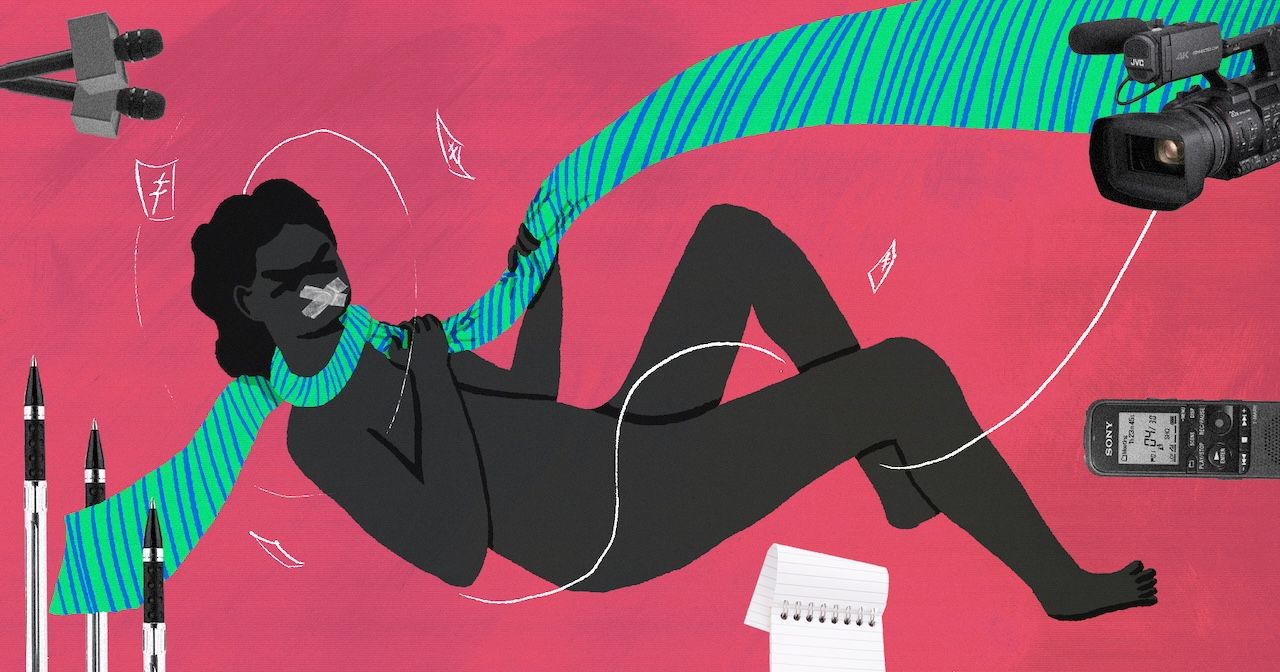
Artwork: Dosain
04 May, 16:02
On a Batik Air flight from Kuala Lumpur to Malé on March 19, passengers were woken up mid-journey by screaming. The cabin lights came on. A middle-aged Maldivian man appeared to be heavily intoxicated. He assaulted two cabin crew members, slapping a male attendant and kicking a female attendant in the stomach several times. He tried repeatedly to rush the cockpit. A Russian passenger who stepped in to de-escalate the situation was bitten on the arm.
"The man continued shouting that he held a diplomatic passport and that nothing could be done to him. His family, who were seated in business class, were visibly distressed throughout," a passenger who watched the incident unfold recounted to the Maldives Independent.
Upon arrival, passengers were instructed to remain seated while police boarded the aircraft to escort him off. He was detained for questioning and freed a few hours later.
The man was released on health grounds, police told the media. No further details were disclosed. Several outlets reported the incident. None named him. None questioned why he was allowed to walk free despite conduct that constituted serious offences under the civil aviation law and the Tokyo Convention. In contrast, ordinary Maldivians are prosecuted on alcohol consumption charges alone.
Social media filled the vacuum. A fuller account and videos taken by passengers were posted by Hassan Kurusee, an anonymous X user with more than 69,000 followers, whose account has become the country's loudest informal whistleblower channel. Kurusee named the man as a shareholder of a major Maldivian company. He published a photograph of the diplomatic passport, suggesting that the man's status and alleged ruling party affiliation were behind the police's decision to release him. He pointed to the company's 2021 published financials of MVR 110 million (US$ 7 million) in post-tax profits and speculated that their advertisements or corporate sponsorships explained the lack of coverage.
But Kurusee's claim of the man groping a female cabin crew was an embellishment, according to the eyewitness who spoke to the Maldives Independent. "That did not happen. The truth was already bad enough, there was no need to fabricate or exaggerate it any further," she said.
What struck her more was the mainstream media's silence. "One passenger had initially shared the information with a newsroom, out of concern that the man’s status might prevent proper accountability, but nothing came of it," she said.
The failure to expose him or examine the dubious release decision laid bare how Maldivian media organisations operate under financial constraints that undermine editorial independence. Over recent years, a parallel ecosystem of anonymous accounts has stepped into that gap, doing the naming and the documenting the press will not, but with no right of reply and no consequence when it gets things wrong.
Strings attached
Unable to fund operations through private advertising in a market of fewer than 300,000 adults, media outlets depend heavily on either advertising from state-owned enterprises or financial support from politically connected business figures. The International Federation of Journalists' most recent South Asia Press Freedom Report flagged revenue allocated with no transparency, oversight or merit-based criteria. Editors were "regularly instructed to remove offending articles, laud government initiatives, or refrain entirely from covering sensitive subjects."
Reporters Without Borders, which ranked the Maldives 108th of 180 countries in its 2026 index, identified the same pattern: "the allocation of government subsidies and advertising from state-owned companies has been weaponised."
Midhuam Saud, an independent commentator who has covered state-owned enterprise corruption on his own X account, diagnoses the foundation of the problem in plainer terms. "It's not a social service, not an NGO. It's a business," he said of Maldivian newsrooms. Commercial constraints will outweigh almost any other factor, he observed.
In April this year, an unverified document posted on social media listed the Maldives Airports Company Limited's media disbursements for December 2025. About MVR 5.5 million was spread across 30 outlets with annual allocations totalling MVR 66 million. The largest beneficiary was MMTV, a private broadcaster reportedly operated by communications officials from the President's Office, at MVR 900,000 for the month and MVR 10.8 million annually. Public Service Media, the state broadcaster, collected MVR 500,000. Mihaaru, the country's only daily print newspaper, received MVR 300,000. The smallest recipients on the list received MVR 15,000. MACL has not publicly disputed the document.
In February 2025, Moosa Rasheed, a senior journalist at Mihaaru, resigned in protest. In a resignation letter that was leaked online, he alleged that editors were taking instructions from the President's Office, that articles critical of the government were being softened or pulled, and that he had been told of phone calls from the president himself. A culture of in-depth reporting had been replaced by "making small news, increasing lifestyle articles and getting ahead in numbers," he wrote.
Political or business influence has grown since the IFJ's last fact-finding mission in 2022, said Junayd Mohamed, executive director of the Maldives Journalists Association. "It is very widespread," he told the Maldives Independent. "Since then I think it's safe to say the situation has worsened dramatically."
On Saturday, an anonymous X account known as Jubraan Shareef posted a leak about Housing Development Corporation, the state-owned developer of Hulhumalé and other reclaimed land near Malé. The source had first approached news outlets but was turned away. "He went to news outlets but news outlets wanted the sponsorship of [a major furniture retailer]. They couldn't write on it," Jubraan told the Maldives Independent.
Junayd proposed sponsorship transparency as the remedy.
"Beyond the bottom line, media outlets have the power – because the media is a very powerful tool – to say no to funding that has strings attached, and whenever strings are attached, to make that information public. To say publicly that 'due to this story we have been threatened by these organisations regarding our funding.' That sort of transparency needs to happen, not just at the level where a threat like that exists or becomes apparent, but also at the level of the initial funding," he said.
Adjacent to the press
A study commissioned by the IFJ and conducted across 11 atolls and Greater Malé found that 87 percent of Maldivians held the media accountable for political divisions in the country. The vast majority believed the ownership of television stations and websites compromised coverage in favour of owners' business or political interests. Television and online news outlets were perceived to carry the highest levels of sensational or biased coverage.
Nearly 70 percent saw fake news as prevalent on social media and online outlets. Almost half thought it prevalent in "sources or persons known only through the internet."
Junayd described a feedback loop in which the consequence of mainstream silence is amplified by the parallel ecosystem. "The public sees this information on social media and have expectations that the mainstream media will also report it," he explained. "And when the media doesn't report it, whether that lack of reporting is due to legitimate reasons or not, it is seen as symptomatic of the wider distrust in the media."
Midhuam, who posts under his own name, distinguishes between the press deliberately failing to hold SOEs accountable and being incapable of doing so. Most journalists are not trained to scrutinise audit reports. They also lack the familiarity to instinctively recognise red flags in bidding processes. Some call him to ask how to write up findings he has posted. "Writing an article is not as easy as sending out a tweet," he said.
Beyond individual journalists, editorial policy is dictated by political backing. "All the mainstream media is aligned with one or the other of the major political parties, always," he said, adding that most outlets function as "a PR wing of a political party."
Midhuam's own exposure differs from that of the anonymous accounts. He can be sued for defamation. He has received intimidation calls from self-proclaimed gang members about three of his posts.
Where sources go
Last December, using consent forms and submission protocols, Jubraan Shareef compiled accounts from more than two dozen Maldivian students overseas who said the higher education ministry had left them facing expulsion over unpaid tuition. The compilation moved into mainstream coverage and a parliamentary question.
"I talked to a lot of students and they didn't have that trust with journalists," Jubraan said. "To deal with this, I decided I would create a big compilation of everything as a PDF and share with all the journalists and MPs." About 30 submissions came in through a form, which carried an asterisked note that submissions would be shared with media and parliament.
Other anonymous accounts are less scrupulous. "For example, there seems to be an increase in a lot of posts that are misogynistic and also harmful to public discourse, trying to frame things to fit a particular narrative," said Junayd.
"That’s not to say there isn’t reporting as well. But with this reporting the issue is for media outlets who don’t have access to these documents or the source of these documents, how does the media outlet report on those stories without the firsthand information from sources. I think in instances where media outlets have been able to verify information there has been some amount of reporting."
When the Maldives Transport and Contracting Company launched a state taxi app in early April, the country's developer community on X cracked open its security failures within hours of the launch ceremony, exposing user ID cards leaking from an unprotected database. That work was conducted in public on a social media platform by people with no media credentials. It then provided the material for accountability reporting, including the procurement scandal underneath the security one with the questionable awarding of an MVR 13 million contract to a sole proprietorship with no app development experience.
Junayd argued that the MTCC scandal was different from other social-media-led stories. "We actually saw the developer community in the Maldives coming together and sort of crowdsourcing the information that they were able to find based on open source information," he observed. "I don't think that is the same as some of the other leaks that we have seen on social media."
The distinction was verifiability. The developer community was working with material readers could check themselves.
None of these actors call themselves journalists. Several explicitly reject the label. Asked whether he considered himself to be part of the press, Jubraan hedged and landed on "adjacent." It depends how the press is defined, he suggested.
"For someone that defines the press as making other branches of the government accountable – report on what they do and report on what they don't do, and in that reporting, citizens can participate – yeah, you could say I see myself as part of the press. But from how it's normally defined, I wouldn't say I'm part of the press."
The other side
Jubraan also drew a distinction between himself and Hassan Kurusee, who has a history of personal attacks, deleted posts and unverified claims. "Hassan Kurusee, I think he has loyalties and hidden agendas," Jubraan said. "I don't think I have any kind of hidden agenda. I'm not in contact with people from a specific faction."
Jubraan said he tries to cite sources where possible and mark uncertainty where not. "There will be situations where the sources cannot be cited. For example, yesterday's HDC case – I can't just say my source is this person, then he'll be fired from the job. So in cases like that, I just try to include markers in the tweet itself."
But Jubraan is also unambiguous about anonymity and the asymmetry of being able to make allegations without facing legal ramifications.
"You can't really hold an anonymous account accountable. You can't take an anonymous account to court. They're not going to face any repercussions no matter what they say," he said. "The biggest thing that could happen is the account being suspended. They can just go on with their life. And then for example, they made an allegation at someone's sister or just at a company. That allegation would always stick. There's nothing you can do."
Jubraan added: "I don't think anyone should trust an anonymous account. I'm saying this as an anonymous account myself. There's no such thing as a trustable anonymous account. There's nothing to base that trust out of."
Midhuam's view of Hassan Kurusee was more ambivalent. Being anonymous and being identified make "a huge difference," and sources self-select between the two based on the protection they need. But Kurusee could not be dismissed as "a bot account" either, he said.
"There are cases where allegations turned out not to be true. But then it's not an easy thing with a government that is not transparent, to source and check information like this and verifying it." Kurusee has corrected himself on corruption posts, he noted.
"So I don't consider us to be in the same category, but he's also a great inspiration for me," Midhuam said.
The structural question
Last week, police raided Adhadhu's office over a report alleging an affair between President Dr Mohamed Muizzu and a former staffer. A week before World Press Freedom Day, the raid marked the first use of qazf – the criminal charge of falsely accusing someone of unlawful sexual intercourse – against a news outlet as well as the wholesale seizure of computers and storage devices.
After last year's Press Freedom Day, the Maldives Independent reported how President Muizzu was personally telephoning editors and journalists to demand the alteration or removal of stories, a practice multiple newsroom sources confirmed had continued from his time as mayor of Malé into his presidency. Hussain Fiyaz Moosa, editor of Adhadhu – the principal source of adversarial journalism against the Muizzu administration – had reported one such call to police as a threat.
In the year since, the conditions have hardened into law. In a 31-day sprint last September, the ruling party's supermajority in parliament passed the Maldives Media and Broadcasting Regulation Act – a bill journalists dubbed the "media control bill" – creating a new regulator with powers to fine outlets, withhold licences, and shutter them. A code of ethics issued in December gave the seven-member body the power to penalise journalists for content that fails to "protect national security."
In a statement released on Sunday, the Maldives Journalists Association issued nine demands of the government. They include the repeal of the media regulation law and its replacement through consultation with the media community; the withdrawal of all charges against Adhadhu and the lifting of travel bans on its editors; an end to the criminalisation of journalism; the publication of the long-delayed reports of the Presidential Commission on Deaths and Disappearances regarding abducted Maldives Independent journalist Ahmed Rilwan and murdered blogger Yameen Rasheed; amendment of the Evidence Act provisions that compel journalists to reveal sources; and reform of the media grants so that distribution is "independent, fair, and transparent."
Asked what a healthy Maldivian media ecosystem would look like in five years, Junayd focused on newsroom culture rather than law.
"Right now there is a high demand for quantity over quality. What I would like to see is a situation where we stop looking at the number of stories we produce and start looking at the quality of it," he advised.
"Some of the stories that lead to distrust are very short, pointless stories – sometimes based off one tweet or a couple of tweets. Journalists in the country actually have the capacity to produce more quality journalism than that. But because of the constraint of meeting a certain number of articles per day, there's a difficulty in actually producing quality journalism."
Jubraan, who operates the anonymous X account, also offered an answer that did not start with the law or the regulator.
"These businesses and these sponsors – government influence, I think the businesses influence the press more. There are many stories the press is not reporting on, not because the government's media commission might take action, but because of the sponsor," he said. "So I think for press freedom, the press must be free of the sponsor first."
Discussion
No comments yet. Be the first to share your thoughts!
No comments yet. Be the first to join the conversation!
Join the Conversation
Sign in to share your thoughts under an alias and take part in the discussion. Independent journalism thrives on open, respectful debate — your voice matters.
Support Independent Journalism
Help us keep the news free and fearless
Give once
$
or
Become a memberfrom $5/month