
Inside the Adhadhu raid: qazf, seizures, and a state closing ranks
An unprecedented religious charge against a newsroom and what followed.
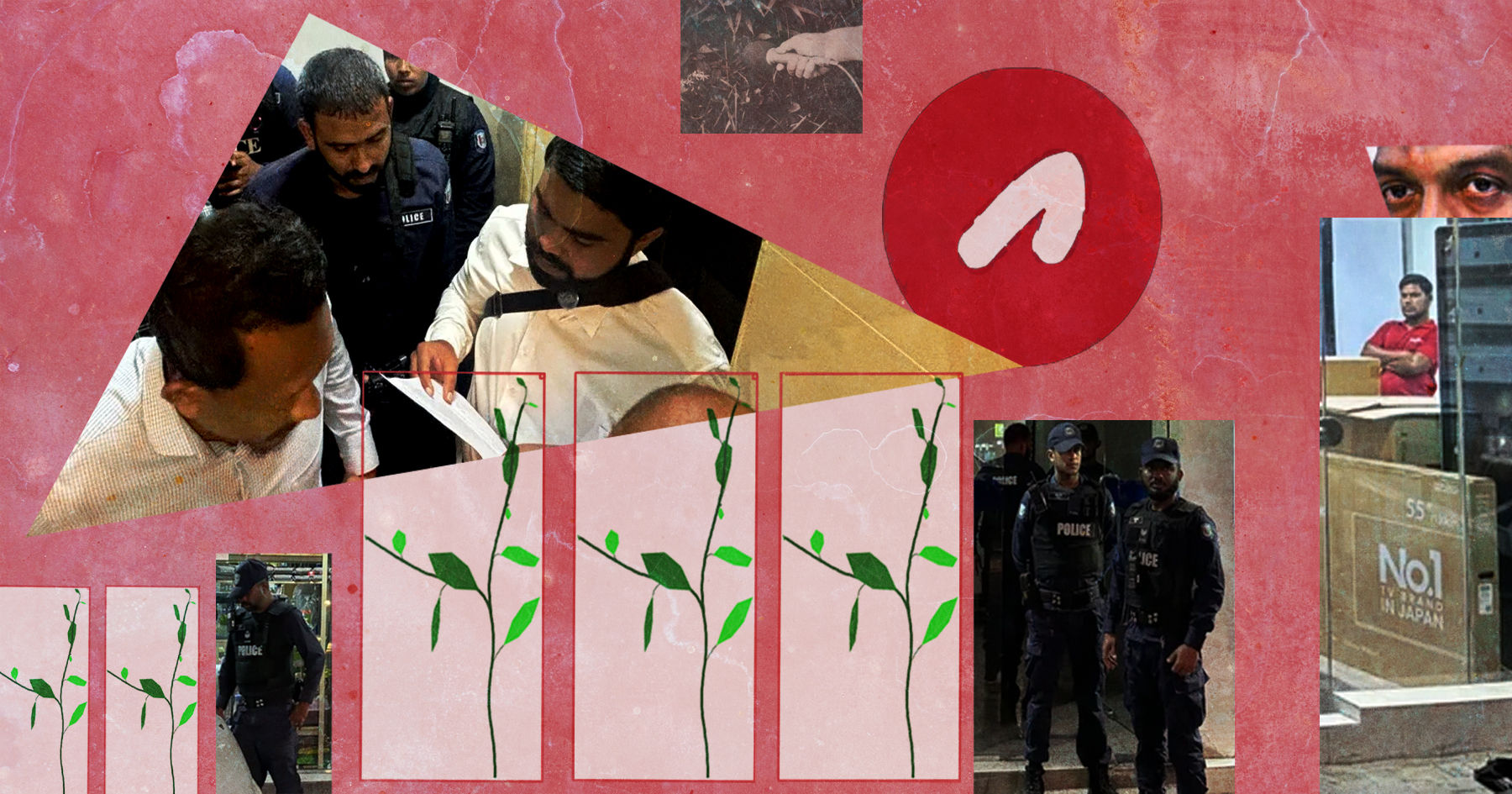
Artwork: Dosain
28 Apr, 19:05
Police have entered newsrooms before. But Monday night's raid on Adhadhu's office over a report alleging an affair between President Dr Mohamed Muizzu and a former staffer was unprecedented in Maldives history. It marked the first use of qazf – the criminal charge of falsely accusing someone of unlawful sexual intercourse – against a news outlet as well as the wholesale seizure of computers and storage devices.
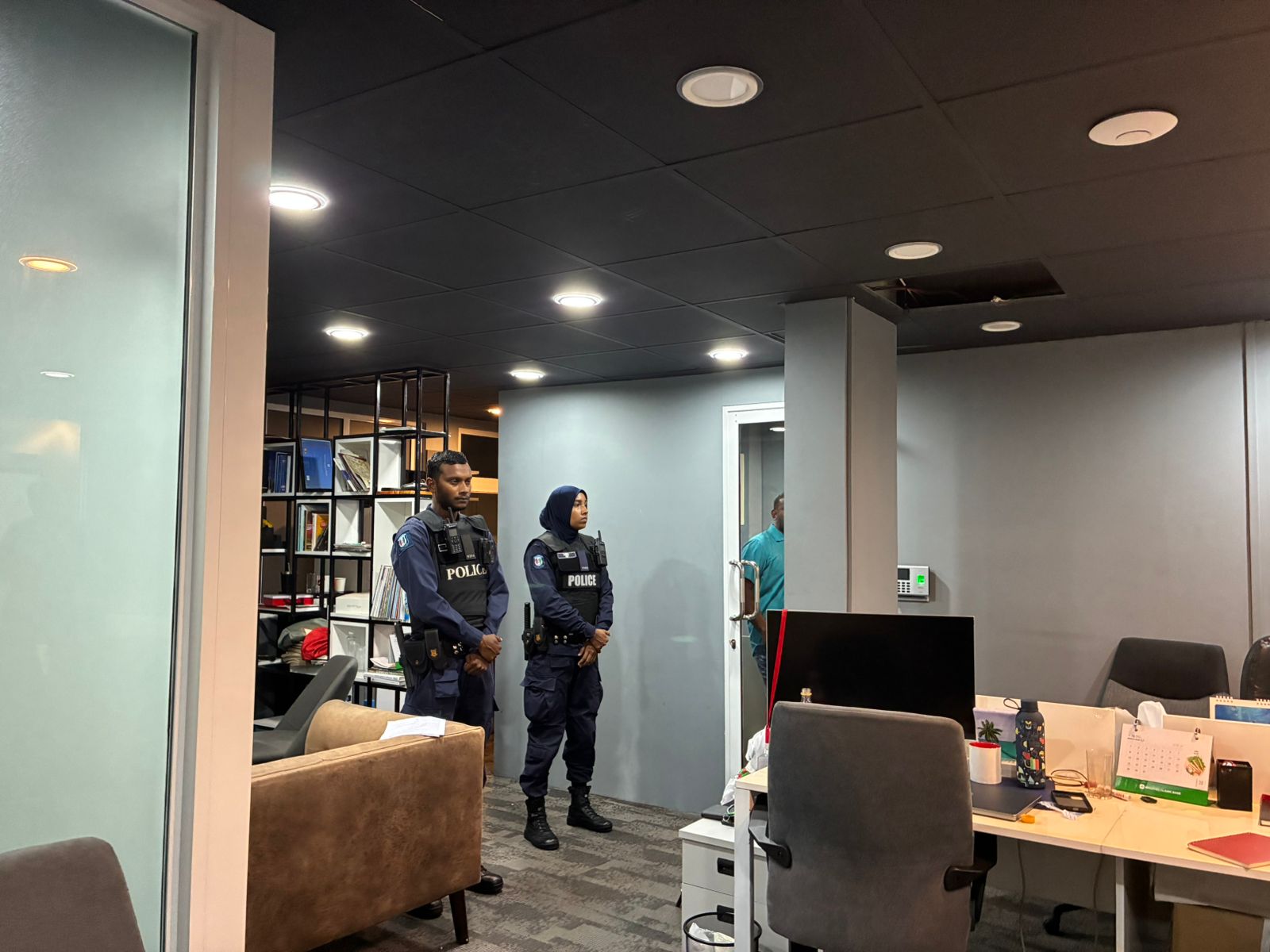
Officers from the Serious and Organised Crime Investigation Division arrived at the Adhadhu office at around 8pm and searched the premises for more than four hours. They left with the laptops of journalists, marketing staff and administrators, along with hard drives and pen drives. Separate court orders imposed travel bans on CEO Hussain Fiyaz Moosa and Managing Editor Hassan Mohamed, both of whom were barred from leaving the country until July 26.
On Tuesday evening, police summoned Fiyaz and Hassan to appear for questioning on Wednesday as suspects in the qazf investigation. The former President's Office staffer at the centre of the allegations was also summoned. Her passport has reportedly been seized.
The raid came hours after Muizzu categorically denied the allegations at his weekly press briefing on Monday morning, condemning the report as "completely false" and warning of legal action.
"I call on relevant authorities to press charges against all parties who spread such false information," he said in response to Adhadhu journalist Mohamed Shahzaan. "You are the same outlet that made the Dhon Amaa video too, aren't you? It doesn't surprise me that you could make another video like that."
On Tuesday morning, Home Minister Ali Ihusan defended the police operation in a post on X, saying they were "right to investigate and raid the news outlet over false 'Zina' allegations against the President." He cited constitutional provisions on freedom of expression, media freedom, and the right to protect one's reputation, contending that press freedom was "not a free pass to destroy reputations with lies."
"Search and inspection"
The Criminal Court warrant seen by the Maldives Independent accused Adhadhu and its staff of qazf under section 612(a) of the penal code. The offence is a class four felony with a baseline sentence of one year, seven months and six days. The maximum is four years in prison. As a hudud offence under Islamic law, the penalty can also include 80 lashes.
The grounds set out in the warrant state that the report "contained allegations against Dr Mohamed Muizzu" and that, because the report was prepared and disseminated through Adhadhu's X account, "all persons involved in the preparation and publication of the report are suspected of being accomplices in qazf." Investigators told the court they had reason to believe that evidence relevant to the investigation was stored on computer storage at the Adhadhu office. The supporting evidence cited for the warrant included a police intelligence report and a letter from the Maldives Media and Broadcasting Commission.
But the regulator – established under the controversial "media control law" passed in September – denied seeking or authorising the raid.
"I don't believe they did this to find evidence. Without asking us any questions related to any investigation into this – a month, a month and a half into this – they came here and took all of our things like casting a net," Adhadhu CEO Hussain Fiyaz Moosa told the Maldives Independent.
Police seized equipment despite repeated objections from the outlet's lawyers. The warrant authorised search and inspection of the premises, but did not appear to authorise confiscation.
"When our lawyers pointed this out, the police officers did not respond, and continued to confiscate everything – our laptops, our pen drives, everything was being taken," Fiyaz said. "We told them if they want evidence related to the Aisha documentary, we can give it to them. We do not believe they want to find evidence. President Muizzu and police want to stop Adhadhu."
Adhadhu's lawyer Ali Hussain, who was at the office during the search, said police had been told explicitly that the warrant did not extend to seizure.
"So we told them you can search and inspect all you like for 10 hours but you cannot confiscate anything, any laptop from here. That power is not given in the court warrant, and you cannot do what the court warrant does not allow," the former lawmaker explained.
"We told police that you are confiscating assets without a court warrant and we will take action. Since assets are dignified and protected, taking them without an order can be challenged in court, and we will press charges against police."
The criminal procedure code contains special provisions on the search and seizure of computer data tied to journalism and other privileged professional fields. Under amendments to the code, courts issuing warrants for such data are required to take its privileged nature into account. The data can only be searched and inspected in the presence of a professional organisation representing the field – in the case of journalists, an industry body – and police are required to take steps to ensure that only material relating to the investigation is accessed or confiscated.
Adhadhu's lawyers said no such organisation was present during Monday night's search.
In a statement issued on Tuesday, Adhadhu called the raid "an act of intimidation and control aimed at silencing independent media", characterising the seizure of materials as "an unlawful act aimed at stopping the functioning of our office."
Adhadhu, broadly aligned with the opposition Maldivian Democratic Party, has been the chief adversarial outlet for the Muizzu administration. The outlet's journalists received death threats following the publication of the "Aisha" report. The raid comes "just days ahead of World Press Freedom Day," Adhadhu noted.
The 'Aisha' documentary
The video at the centre of the criminal investigation was published on Adhadhu's X and Facebook accounts on March 28, a week before local council elections and a constitutional referendum.
President's Office Spokeswoman Heena Waleed dismissed the allegations of the sexual affair as "baseless lies."
The "Aisha" report featured an interview with a former President's Office staffer – a woman in her early 20s whose identity was concealed – who said she had had a sexual relationship with Muizzu lasting more than seven months.
The staffer said she had first messaged Muizzu asking for a job and was called to a meeting at the President's Office, at which she said Muizzu held her hands and spoke to her. He then began calling and texting her at all hours and she was hired as an executive administrator at the President's Office. At a second meeting, Muizzu hugged her, she alleged. He later called to apologise, telling her he liked her and could not control himself.
The alleged sexual encounters took place in multiple parts of Muizzu's office, including on an L-shaped sofa in the president's cabin and on the large round table. Adhadhu reported reviewing chat logs of messages exchanged between her and Muizzu from his personal number, including 58 calls on Signal between January 6, 2025 and April 29, 2025. According to the report, Muizzu had used a setting on the messaging app that automatically deleted messages after a fixed interval. He later instructed her to reply within five minutes when he was at home.
Cash envelopes and a transfer
The staffer worked at the President's Office for about a week before being transferred, the documentary alleged, after First Lady Sajidha Mohamed grew suspicious. She was moved to a senior political director post at the gender ministry, working out of Israhvehinge Naadhee, a building a few blocks from the President's Office.
Muizzu then began supplementing her government salary with what the documentary described as financial gifts. She said she received a fixed sum of MVR 50,000 (US$ 3,240) in cash each month, on one occasion received MVR 75,000, and was given an unspecified amount as a Ramadan gift. The cash was delivered by Muizzu's personal assistant, Hassaan Fuad, the staffer said. It was allegedly the same channel through which loyal MPs and other allies were said to receive payments.
According to the documentary, Muizzu sought to keep the relationship going and to build a rapport between the staffer and his wife with the aim of taking her as a second wife. The staffer was later transferred again, to the higher education ministry, after she said a senior gender ministry official began harassing her. The relationship reportedly soured at this point. Muizzu complained of late replies and reduced attention after the move to her new role in Hulhumalé.
The relationship ended after seven months when Sajidha found out, the documentary alleged. Muizzu told the staffer not to see any of his friends or anyone in government and continued to exert pressure on her after the relationship ended, including indirect job threats through his personal assistant, who told her to "behave."
According to the report, a government minister who began pursuing the staffer was taken on Hajj by Muizzu, who told him to repent and return pure. The head of a state-owned enterprise was removed from his post after starting a relationship with the staffer, the documentary alleged.
The qazf question
Fiyaz challenged the legal basis of the qazf charge. Qazf under Maldivian law requires the false accusation of zina – sexual intercourse outside marriage – against a specific person. Fiyaz said any honest investigation into whether such an accusation was false would have to begin elsewhere.
"If an investigation is being conducted, it should first be conducted on the sofa, then the individual making the accusation," he said. "This is what we told the police as well. They should take a sample and check if there is anything related to those accusations on the sofa – what we aired is visible, we are not denying any of it – and after that, they should come here and search the place only if we are refusing to hand over anything needed for the investigation."
Fiyaz, who had returned to Malé from an overseas trip shortly before the raid, said the basis for his travel ban made no sense. "I have just returned from being away from the Maldives. What our lawyers are saying is, a passport cannot be withheld like this. There are legal reasons for this."
Fiyaz said the raid had reached into journalists' families. His own child, a student, had called him during the four-hour search, frightened that their computer might be among the equipment seized.
"When the police were conducting their search, my child called and said their computer cannot be taken. This is a student, but there is fear that it might also be seized," he said. "When the police search and seize, they always take only what is related to the accusation. They only cast a net and take everything if there is a political element to it. So the concern is there. I think if Sajidha and Muizzu love family, they will understand that."
"Crossing a clear red line"
British High Commissioner Nick Low said the raid was "troubling" and sat "uneasily with Maldives' commitment to Commonwealth standards." In a post on X, he said the UK had "consistently raised concerns about media freedom" and that "free and independent media are essential to healthy democracy."
The Committee to Protect Journalists called on the government to return the seized equipment and lift the travel bans. "The raid on Adhadhu and subsequent travel bans are an attempt to criminalise investigative journalism under the guise of religious and national interests," CPJ Asia-Pacific Programme Coordinator Kunal Majumder said. "Using religious laws to bypass civil media regulations sets a chilling precedent. Authorities must allow the press to hold government offices accountable."
Former President Mohamed Nasheed was speaking at a campaign rally for his bid to chair the opposition Maldivian Democratic Party a few blocks from Adhadhu's office when the raid was under way. He addressed it from the stage.
"Faya [former MDP chairman Fayyaz Ismail] just told me that the police have gone to the Adhadhu office to find the L sofa. I don't know what state their furniture is in," Nasheed told the crowd, before turning serious. "But let me tell the government: no, do not dare to confront us, do not try to do what you are doing, do not try to mess with press freedom. We will not step back, we will go forward."
He later wrote on X that "press freedom is a hard-won right that Maldivians secured through the pain, isolation, stress and suffering of many. Police entering Adhadhu's office and obstructing the work of the free press is an entirely unacceptable act."
"I am deeply concerned about the raid in the Adhadhu office in a manner that obstructs press freedom. The police must operate independently, free from political influence, but that is not what we are seeing today. This is deeply worrying and runs counter to the very foundations of democracy," former President Ibrahim Mohamed Solih posted on X.
Former President Abdulla Yameen also weighed in, after the broadcasting regulator separately ordered private broadcaster Channel 13 to halt live coverage of protests by his People's National Front on Monday night. "Do not blame the media; reform your actions," Yameen said in a message shared with the PNF media group, calling on Muizzu to reform his administration's conduct rather than target the press.
The Maldives Journalists Association said the government was "crossing a clear red line" with the travel bans on the Adhadhu editors. "We demand an immediate end to the intimidation of journalists and the suppression of press freedom," the MJA said.
While opposition leaders and press freedom advocates condemned the raid, the response from the government bench was strikingly uniform. By Tuesday afternoon, almost every cabinet minister had posted in support of the president on X, many echoing similar talking points about reputation, religion and the limits of press freedom.
Adhadhu reported that the choreography was directed from the top. According to the outlet, Muizzu questioned members of the ruling People's National Congress parliamentary group chat on Tuesday morning, asking why they had remained silent while he and his family were targeted. PNC Parliamentary Group Leader Ibrahim Falah told the president the group was preparing to mobilise. Cabinet ministers, senior political appointees and heads of state-owned enterprises were also directed to defend Muizzu publicly, Adhadhu reported.
Discussion
No comments yet. Be the first to share your thoughts!
No comments yet. Be the first to join the conversation!
Join the Conversation
Sign in to share your thoughts under an alias and take part in the discussion. Independent journalism thrives on open, respectful debate — your voice matters.
Support Independent Journalism
Help us keep the news free and fearless
Give once
$
or
Become a memberfrom $5/month