

Comment: A line drawn against the Maldivian press
The case against Adhadhu fails every test. The journalists are in prison anyway.
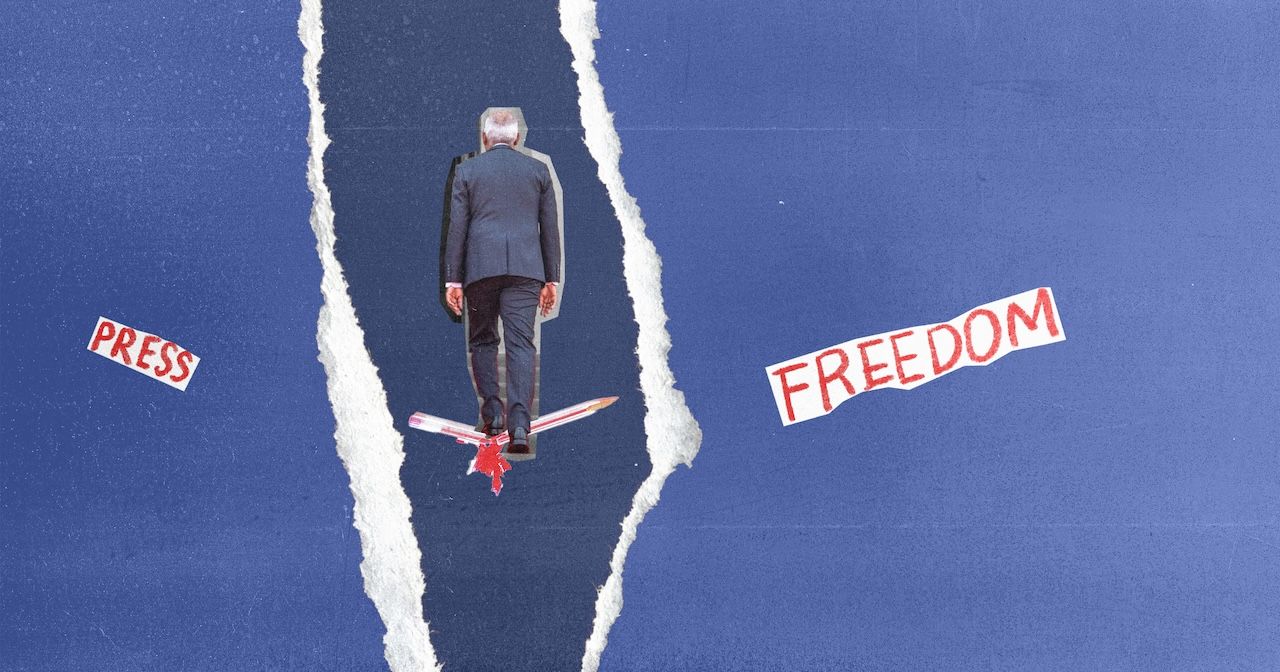
Artwork: Dosain
18 May, 15:34
Two Adhadhu journalists remain in prison. Mohamed Shahzan is serving 15 days for a question he put to President Mohamed Muizzu at last Monday's press conference. Leevan Ali Nasir is serving 10 days for reporting that the Criminal Court had issued a gag order. Neither had legal representation at their hearings. Both were sentenced behind closed doors.
The sweeping gag order and the swift reprisals against Adhadhu journalists mark a dangerous turning point for public-interest journalism in the Maldives.
The order prohibits discussion of a documentary released by Adhadhu on social media, featuring a former President’s Office staffer’s alleged intimate relationship with Muizzu, who was accused of sexual exploitation, harassment and abuse of power.
According to the young woman, whose identity was concealed, the alleged affair began when she approached the president seeking a job. She claimed to have worked on Muizzu's 2023 presidential campaign. After two meetings, during one of which the woman claims that Muizzu hugged her without consent, she was hired to work as a presidential aide.
Muizzu is alleged to have offered to marry the woman. The affair started in early 2025 and lasted for several months. The woman named a personal assistant of the president who acted as an intermediary sending messages and money on behalf of the president.
Things took a turn for the worse when the first lady found out, according to the anonymous woman. She was then moved from the President's Office to two other politically appointed positions before she was ultimately fired. During this period, Muizzu attempted to thwart her other relationships and in some cases abused the powers of the presidency to do so, the woman claimed.
The woman's first-hand claims are backed by chat logs and call logs, reported Adhadhu, which also corroborated the timings of her political appointments.
President Muizzu has since denied the allegations on multiple occasions, accusing Adhadhu and its journalists of a personal vendetta against him. However, what has unfolded since the release of the documentary and the timing of state action raises grave concerns about the nexus between the executive, prosecutors and the judiciary.
In a letter sent to the Prosecutor General, the Bar Council of Maldives raised these same concerns.
“While freedom of speech and the media are the most fundamental rights in a democratic society, the way the prosecutorial powers of the Prosecutor General’s office have been used in this instance gives space to question about the independence and autonomy of the office,” Bar Council President Hussein Siraj wrote.
The Adhadhu newsroom raid, seizure of journalistic material without the legally mandated safeguards, the gag order preventing all forms of public discourse related to the documentary, the arbitrary detention of journalists Shahzan and Leevan for doing their jobs, the criminal charges against Adhadhu CEO and managing editor and an indefinite ban on Adhadhu news from presidential briefings amount to the executive, prosecutors and the judiciary colluding to punish journalists for doing their jobs.
The gag order fails the constitutional test
A gag order is similar to any other form of restriction on free speech. It must meet the thresholds stipulated in article 16 of the Maldivian constitution and the Maldives' obligations under relevant international instruments. This includes the three-part test, which requires any restriction to be in conformity with the law; to have a legitimate, achievable purpose and that the restriction is only limited to achieving this purpose and does not exceed beyond that.
Article 16(c) includes provisions specifically for the courts to refer to when ruling on whether a restriction meets the constitutional guarantees. This includes consideration of whether the legitimate purpose of restricting a fundamental right can be achieved by limiting the right or freedom to a lesser degree.
However, the Criminal Court seems to have bypassed all these safeguards in issuing the sweeping gag order that, as remarked by the former deputy speaker of parliament Eva Abdulla, "is also utterly impractical; the order is unenforceable."
The purpose of the gag order is to shield Muizzu from criticism and any discussion whether "direct or indirect" about the allegations raised by the former presidential aide. This is the reasonable conclusion to be drawn from the sweeping nature of the gag order.
But this is not a legitimate purpose for the restriction of a fundamental right and it goes far beyond the questions of achievability, necessity, proportionality and conformity with the law. The order fails every limb of the test.
On Sunday, the High Court rejected the Maldives Journalists Association’s appeal of the gag order, claiming that MJA is not qualified to appeal it as the association is not a defendant in the qazf trial. According to the constitutionally guaranteed right to appeal, “everyone related to a matter” has the right to appeal, qualifying everyone affected by the gag order to appeal the matter. Yesterday, I raised the question whether the High Court is suggesting that MJA and its members are not related to the gag order, by rejecting the appeal.
The qazf charge does not fit
For nearly a month since the release of the "Aisha" documentary, there was complete silence from the government. After a few days of public interest, the story seemed to have died a quiet death until journalist Mohamed Shahzan questioned Muizzu about the documentary at an official press briefing.
Muizzu denied the allegations.
"You have just confessed that you made the video. A video that is blatantly false. I request all relevant authorities to prosecute everyone who has spread these lies," Muizzu said.
That night, the police conducted a search and seizure operation on the Adhadhu offices, confiscating several laptops, hard drives and pen drives under a warrant that referenced a criminal investigation over qazf charges.
In Islamic law, qazf is criminalised speech accusing a chaste Muslim of unlawful sexual relations. According to the government, the Prosecutor General initiated the investigation, marking the first time charges have been brought under these provisions since the new Penal Code came into effect in 2015.
Some Islamic scholars have questioned whether qazf is applicable in this instance.
Sheikh Ilyaas Jamaal, a state minister during the former Maldivian Democratic Party government, notes that in order to prove qazf the wording has to clearly indicate that the accusation is of sexual intercourse. If it falls short of this, the accuser has to be questioned about their intention, he said.
In the Adhadhu case, no such clear language is used. In the documentary the woman alleges an intimate relationship.
Another important question that seems to have been skipped over by the investigators and prosecutors is whether Adhadhu is liable for allegations made by the subject of the documentary.
Of course, Adhadhu has an obligation to verify and corroborate the claims and to seek a response from the person facing the accusations. Adhadhu met those obligations by verifying the claims through phone records and seeking a response from the president.
Under these circumstances, it is absurd that Adhadhu's CEO Hussain Fiyaz Moosa and Editor Hassan Mohamed are facing charges of qazf.
The investigation did not ask
There are several issues with the fast-tracked investigation itself. Between the launch of the investigation and the filing of charges it only took 13 days. For an investigative and prosecutorial service that is always dealing with a backlog, the priority placed on this investigation is apparent.
During the investigation, Fiyaz and Hassan both refused to expose the woman in the documentary. However, police summoned a former presidential aide during the investigation and questioned her over the documentary.
MDP MP Mohamed Ibrahim remarked on the farcical nature of the investigation in an op-ed on Adhadhu. "To decide that the woman in question is this particular woman and to summon her for a statement, Muizzu must know who the woman is. Muizzu knows who the woman is because something had happened," he wrote.
According to her lawyers, even though the former staff wanted to cooperate with the police and share all the details, she was prevented from doing so.
Instead the police asked the questions and instructed her to respond only to those questions. Astonishingly, her lawyers demanded and the police agreed to include a line in her official statement noting that the police had refused to hear her full story.
No charges have been filed against the ex-presidential aide so far.
As things worsen, for Muizzu and the government, time is running out to reverse course. It might be a tall order, but prosecutors, courts and independent institutions must protect rights, ensure due process and follow the spirit of the constitution instead of shielding the powerful from critical reporting and public commentary.
Mohamed Junayd is the executive director of the Maldives Journalists Association and an experienced journalist who has reported on political, environmental and economic issues in the Maldives for nearly two decades. He is also the Maldives correspondent for Reporters Without Borders.
All comment pieces are the sole view of the author and do not reflect the editorial policy of the Maldives Independent. If you would like to write an opinion piece, please send proposals to editorial@maldivesindependent.com.
Discussion
No comments yet. Be the first to share your thoughts!
No comments yet. Be the first to join the conversation!
Join the Conversation
Sign in to share your thoughts under an alias and take part in the discussion. Independent journalism thrives on open, respectful debate — your voice matters.
Support Independent Journalism
Help us keep the news free and fearless
Give once
$
or
Become a memberfrom $5/month

