

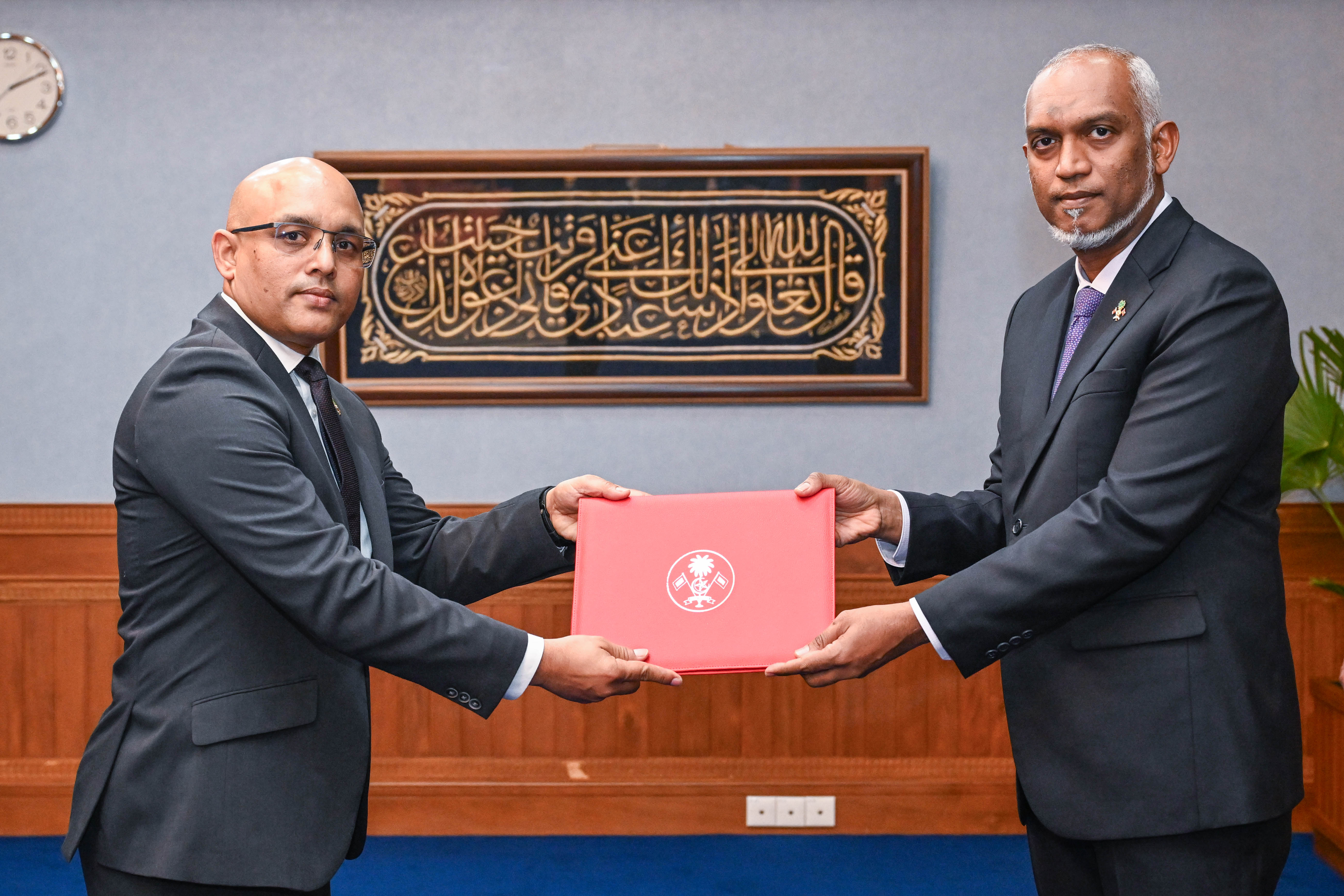
Finance Minister Moosa Zameer resigned from his post and was replaced by Hassan Zareer, who previously served as Commissioner General of Taxation. In his resignation letter to President Muizzu, Zameer reportedly cited health reasons for stepping down. Zareer is a chartered accountant. He previously held the positions of Deputy Commissioner of Taxation and various roles within the finance ministry. He has also served on the boards of several state-owned enterprises.
Fitch Ratings assigned Bank of Maldives a Long-Term Issuer Default Rating of "CCC-" with a stable outlook, following its June 3 upgrade of the Maldives to the same level. The rating is capped by the sovereign rating, which acts as a ceiling for domestic banks; Fitch also assigned a local-currency rating of "CCC+", two notches above the sovereign, reflecting BML's standalone strength. Fitch said BML's standalone profile faces significant funding and liquidity pressure from the structural foreign-currency shortage in the Maldives, and set its viability rating two notches below the implied level to reflect that drag. The agency assigned a government support rating of "no support" – noting that while the state's propensity to support the systemically important, majority state-owned bank is high, its ability to provide timely support is constrained by low foreign reserves relative to BML's foreign-currency liabilities. Fitch flagged rising asset-quality risks: the impaired-loan ratio rose to 7.8 percent by end-2025 from 6.9 percent, with loan growth accelerating to 22.8 percent in 2025 (from 3.7 percent in 2024), concentrated in the cyclical tourism, construction and transport sectors. It noted profitability declined but remained high, and identified BML's capitalisation – a 45.1 percent Common Equity Tier 1 ratio – as a key strength. CEO Mohamed Shareef welcomed the rating, saying it recognised the bank's market leadership, strong capitalisation and resilience in a small island economy.
Adhadhu CEO Hussain Fiyaz Moosa and editor Hassan Mohamed pleaded not guilty to qazf charges raised over a documentary in which a former President’s Office staffer alleged she had a sexual relationship with President Muizzu. During a closed-door hearing at the Criminal Court, prosecutors formally presented the charges, responded to questions from the defence, and submitted evidence against the two journalists. Fiyaz and Hassan were also given an opportunity to present evidence in their defence.
Former President Solih gave his most detailed public account yet of the internal MDP disputes and the factors behind the party's 2023 presidential election loss, blaming the biggest obstacle to his administration on Nasheed's push to change the system of governance to a parliamentary one with himself as prime minister. Speaking at a rally for chairperson candidate Meekail Naseem in Addu's Maradhoo, Solih said that things changed after the 2019 parliamentary elections, when some MPs decided the parliamentary group would operate separately from the government. Solih said this forced him to lobby for support on every bill, and that some MDP MPs attacked him and the government in parliament, calling them "thieves" and trying to discredit them more aggressively than the actual opposition. He said Nasheed called him within the first year asking to hold a referendum to switch to a parliamentary system; Solih said he replied that a coalition agreement was in place and the change could be pursued after his term ended, but Nasheed did not accept this. Nasheed later sent ministers and media a message saying he wanted a referendum before the 2023 election to become prime minister under a parliamentary system, Solih said, adding that research showed the parliamentary system had only 20-25 percent support, and that pursuing it before the presidential election would have cost MDP the vote. Solih said Nasheed had agreed that whoever lost the presidential primary would back the winner, but did not do so after losing. He also rejected later Nasheed proposals – including holding a referendum before the second round or before the new president was sworn in, and removing three cabinet ministers, among them former finance minister Ameer. Solih acknowledged the 2023 loss was driven by failure to campaign in the first round and to rebut allegations about stolen Covid ventilators, "selling the sea," and Indian troops in the Maldives, which he said are now known to be untrue. Solih said responsibility for the 2023 loss was largely his own, and called for the party to unite behind Meekail to win in 2028.
Azan Ahmed Zuhair resigned as chairman of Addu International Airport’s director's board after his father was removed as the director of Maldives Transportation Safety Board for attending an opposition campaign rally for Hithadhoo North by election. In a post on X, Azan said his father had been a lifelong supporter of the Maldivian Democratic Party but had refrained from attending party events after taking up the government role. He said his father attended the campaign event for Abdulla Sodiq because he is a family member and had informed the government of his intention to do so 15 days in advance. Azan further alleged that government officials sought to remove his father from his contractual position by abolishing the post altogether.
Abdulla Rameez, the victim of a fatal motorbike accident in Addu last week, died while receiving treatment at ADK hospital.
Police said a motorcyclist lost control of their vehicle in Hulhumalé Phase II and struck a pedestrian who was crossing the road on a zebra crossing. The accident was reported at 9:36 pm. The pedestrian, a Maldivian man, sustained multiple injuries and is currently receiving treatment at Indira Gandhi Memorial Hospital.
A total of 352 young men and women who registered for the National Service programme departed to begin a three-month training course at Lhaviyani Maafilaafushi, President Muizzu announced as the third intake of the scheme. Muizzu said the new batch comprises 64 girls and 288 boys, drawn from 115 islands across the country.
The High Court overturned a magistrate court decision that dismissed a case involving a man accused of sexually abusing his stepdaughter, ordering that the case be retried. A redacted High Court ruling stated that the magistrate court had previously thrown out the case and ordered the accused’s release after finding that police had failed to forward charges to the Prosecutor General’s Office within the legally required timeframe. However, prosecutors argued that this issue had not been raised by the defence during pre-trial proceedings, and was instead brought up by the magistrate judge during sentencing. The High Court noted that while judges may address clear legal errors on their own initiative, it found that the lower court had miscalculated the statutory timeframe. It ruled that, when accounting for permissible extensions and proper legal methods of calculating time limits, the charges had in fact been submitted within the required period.
The education ministry gazetted a guideline to set out the process for recruiting expatriate teachers to address shortages in areas where qualified Maldivians are unavailable. The policy requires a five-member recruitment committee to be established within a month, appointed by the minister, that must include two school principals and three ministry or departmental staff of rank eight or above; people who work directly in staff placement, or who are employees, shareholders or senior managers of recruitment agencies, cannot be appointed. Foreign staff must generally be brought in through an agency, though the committee may approve direct ministry recruitment where that is not possible. Charging any fee to place or recruit foreign staff under the policy is prohibited.
Subsidy spending has more than doubled since the start of the Iran conflict, raising the prospect that the MVR 2.8 billion (US$ 181.5 million) budgeted for the year could be exhausted within a month, according to an Adhadhu analysis of the finance ministry's weekly fiscal development reports. The ministry's data show MVR 509.3 million was spent on subsidies in the first eight weeks of the year, before the conflict, an average of MVR 63.6 million a week. Over the following 11 weeks, MVR 1.7 billion was spent, pushing the weekly average to MVR 159.9 million. By May 14, total subsidy spending had reached MVR 2.2 billion, or 78 percent of the annual budget. At the current rate, the remaining MVR 620.8 million would last about four weeks. If spending continues at that pace, MVR 5.2 billion would be needed for the remaining 33 weeks, bringing total subsidy spending to a record MVR 7.4 billion. Even if conditions stabilise and spending returns to pre-conflict levels, an additional MVR 2.1 billion would be required, taking the year's subsidy costs above MVR 4 billion. Successive administrations – including the current government and the previous two – have not moved to a targeted subsidy system that would direct aid only to those most in need.


