
"They shouldn't have gone in": the man who trained Sergeant Mahudhee on the dive that killed him
Wrong gas, no recompression chamber, no specialist team on standby.
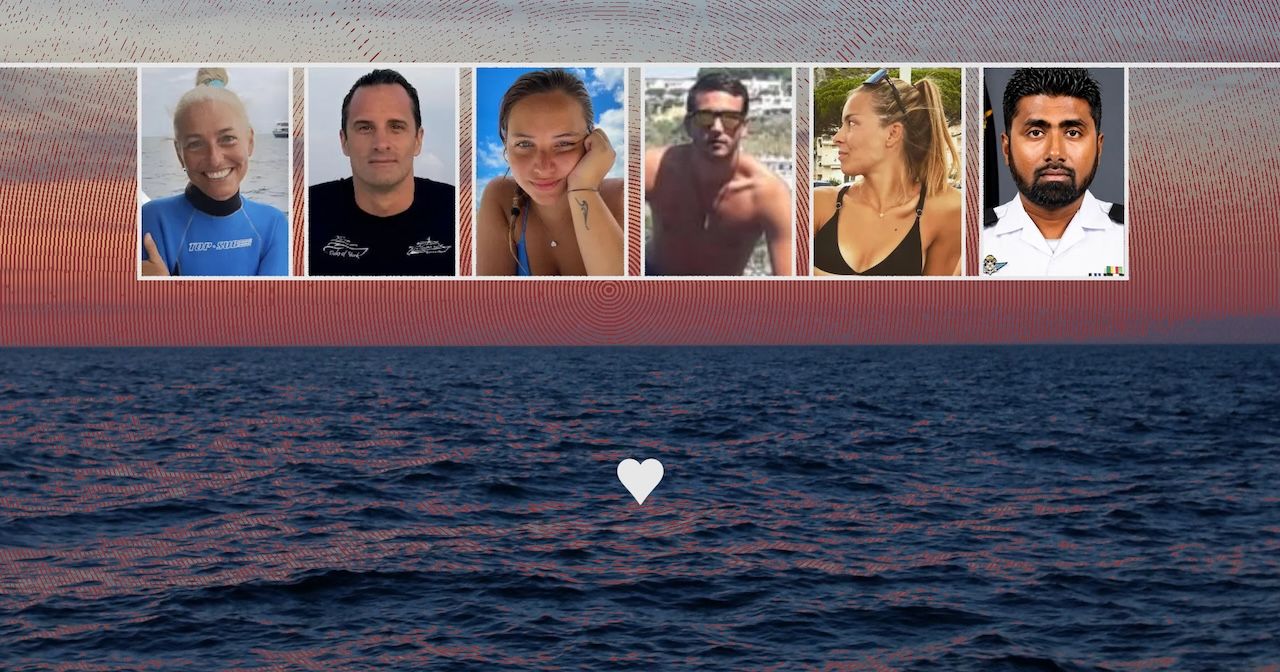
Artwork: Dosain
17 May, 18:40
Staff Sergeant Mohamed Mahudhee was sent into an underwater cave on Saturday breathing compressed air – not the trimix gas mixture standard for deep cave diving – and with no portable recompression chamber at the scene to treat the decompression sickness that killed him, the country's most accomplished cave diver has told the Maldives Independent.
Shafraz Naeem, a former military diver who now consults for the Maldives National Defence Force and the police, said the operation to recover the bodies of four Italian divers from a cave system in Vaavu atoll had been launched without the gas planning, equipment configuration or specialist team that the depth and overhead environment required.
"He was a student of mine," Shafraz said of Mahudhee. "He worked under me for a lot of years. He is one of the best."
Shafraz served in the MNDF dive unit from 1994 to 2003, and again from 2009 until February 2012, when he left the service. "I'm one of the people who made the unit what it is now," he said.
The European arm of the Divers Alert Network, the specialist diving organisation now coordinating with Italy on the recovery and repatriation, asked Shafraz to deploy to the Vaavu site to assist after the Italian divers went missing on Thursday. He declined for family reasons.
"MNDF went on normal air. They are not trained to go," Shafraz said of Saturday's operation. "They have rebreathers that the Japanese government donated to them, very good rebreathers, one of the best brands in the world. But they are still training on that – they can't go below 40 metres on that. So they didn't use it. They are not trained on open-circuit mix gas diving, so they used normal air. And they are not trained to go into caves."
Shafraz drew a clear distinction between the cave and the kinds of deep recoveries his team handled. "We also used to go, me and my old team, on air. We've taken bodies from even 70 or 80 metres," he said. "But those are not from caves – those were from reefs or lagoons. That, you can come up, if something goes wrong or you feel uncomfortable. Caves are very unforgiving and dangerous. You need special training."
Mahudhee, 43, was leading an eight-man MNDF recovery team that had penetrated the first two of the cave's three chambers on Saturday when he was found unconscious underwater. The other divers surfaced and only then realised Mahudhee had not come up with them, Mohamed Hussain Shareef 'Mundhu,' the chief government spokesman, told the BBC. They re-entered the water and found him blacked out. He was evacuated more than 100 kilometres to ADK Hospital in Malé, where he was pronounced dead.
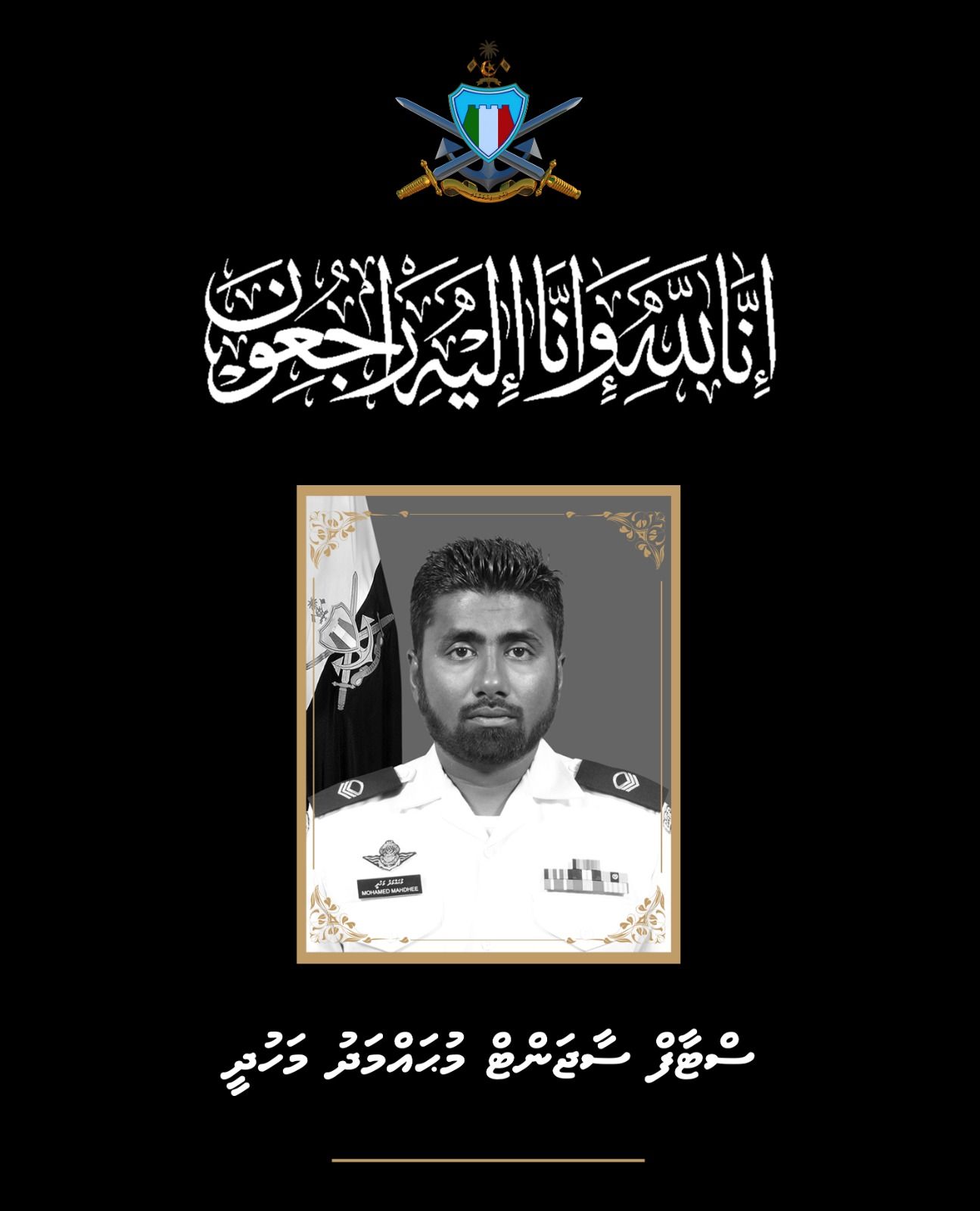
Homeland Security Minister Ali Ihusaan, who trained alongside Mahudhee, said the sergeant was among the country's most capable rescue divers, with thousands of dives over his career, including operations at 70 metres. "Divers carrying out search and rescue face dangers most people could never imagine," Ihusaan said. "Their real work begins when situations turn worst, when the danger is greatest. They are people who put national duty first and put their own lives on the line to save others."
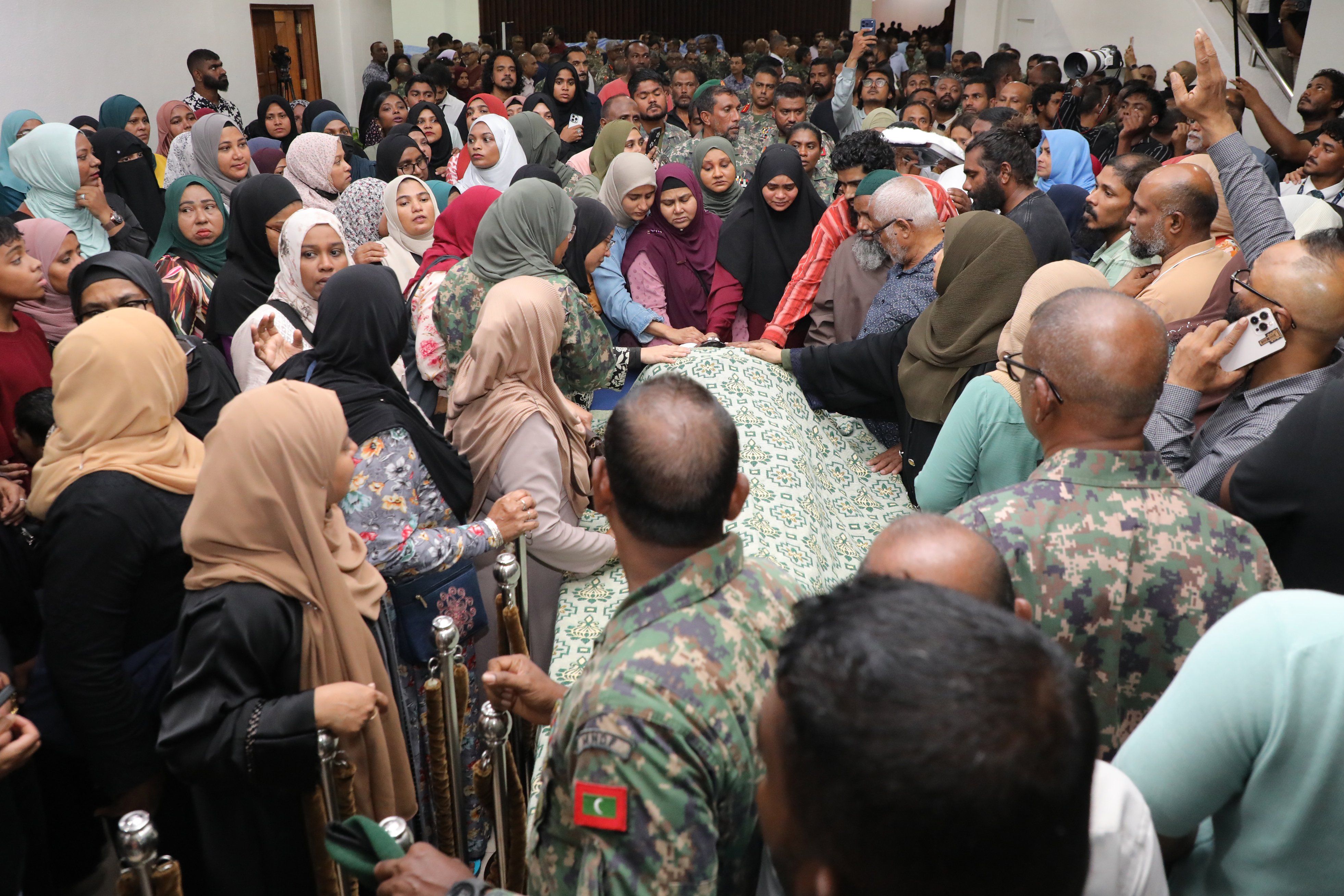
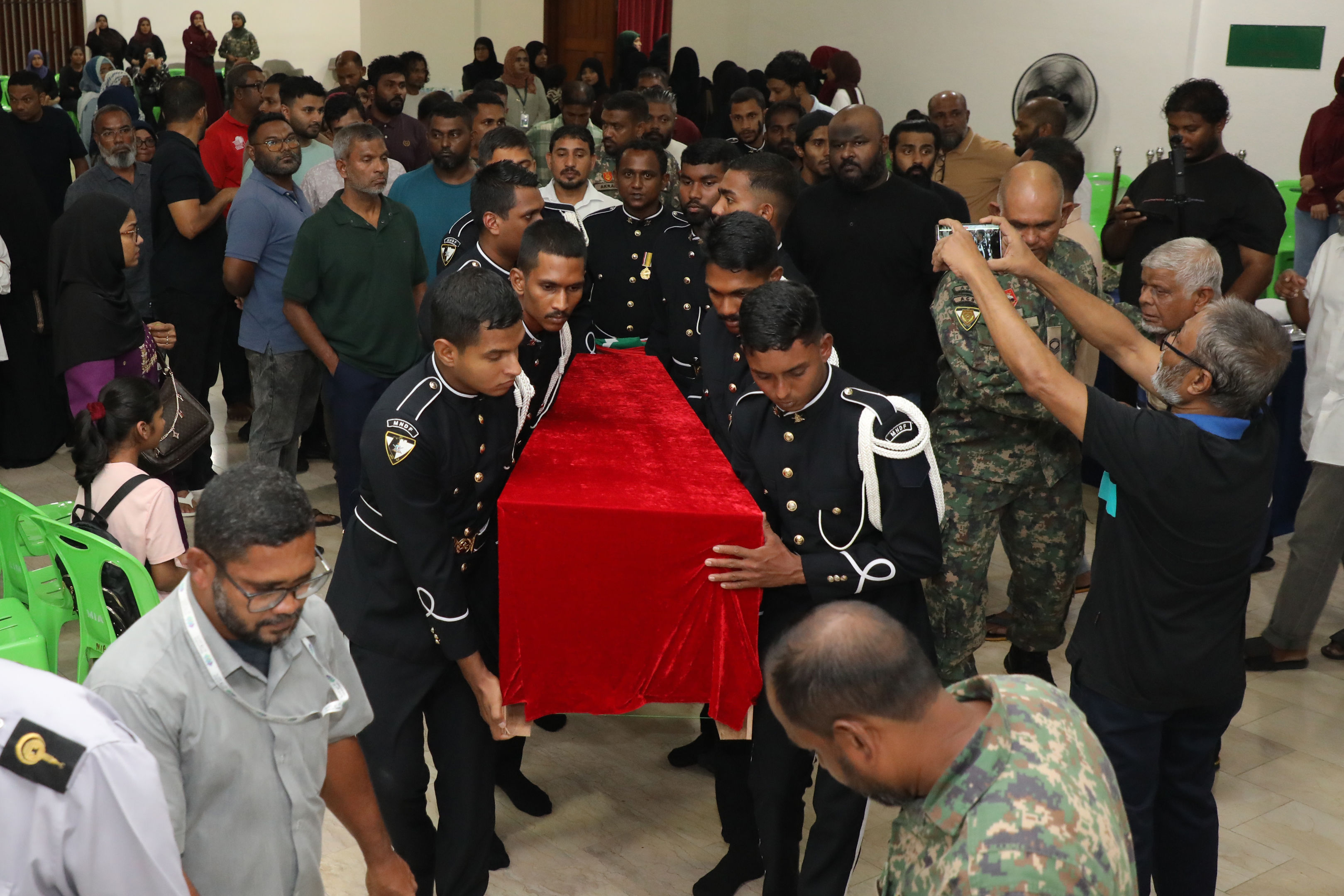
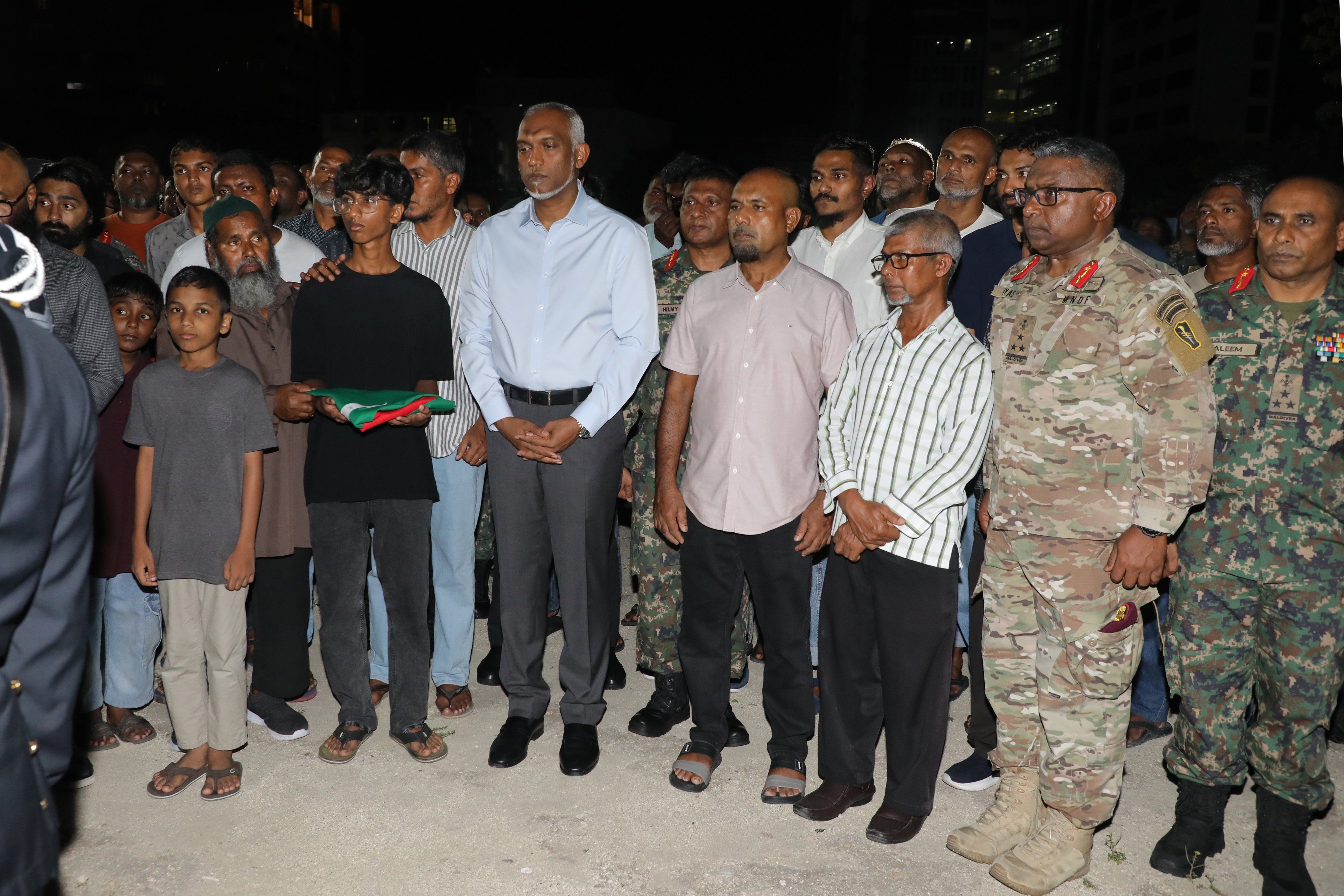
Mahudhee was buried with military honours on Saturday night in a funeral attended by President Mohamed Muizzu. He had been part of the team that briefed the president on the recovery plan when Muizzu visited the search site on Friday. He leaves two wives and two children.
Footage released by the President's Office of Mohamed Muizzu's visit to the search site on Friday shows Mahudhee among the divers briefing the president on the recovery plan. He died less than 24 hours later.
On Friday night, two senior MNDF officers appeared on the state broadcaster's news programme to explain what the army's divers needed in order to descend safely below 30 metres.
Speaking on PSM News' Raajje Miadhu, Brigadier General Mohamed Saleem said that the MNDF's Coast Guard divers were "currently qualified to reach depths of only 50 metres," and that a programme to extend their certification to 100 metres had been launched this year, with the second phase due to begin this month and training to be completed before the end of the year.
"Dives extending beyond 30 metres in depth are complex operations that strictly require the deployment of specialised equipment," said Lieutenant Colonel Ali Niyaz, appearing alongside Saleem. "Personnel must also acquire distinct, advanced training to execute them safely. When dives are conducted without adequate consideration for these critical prerequisites, adverse incidents do occur."
"Multiple risk factors"
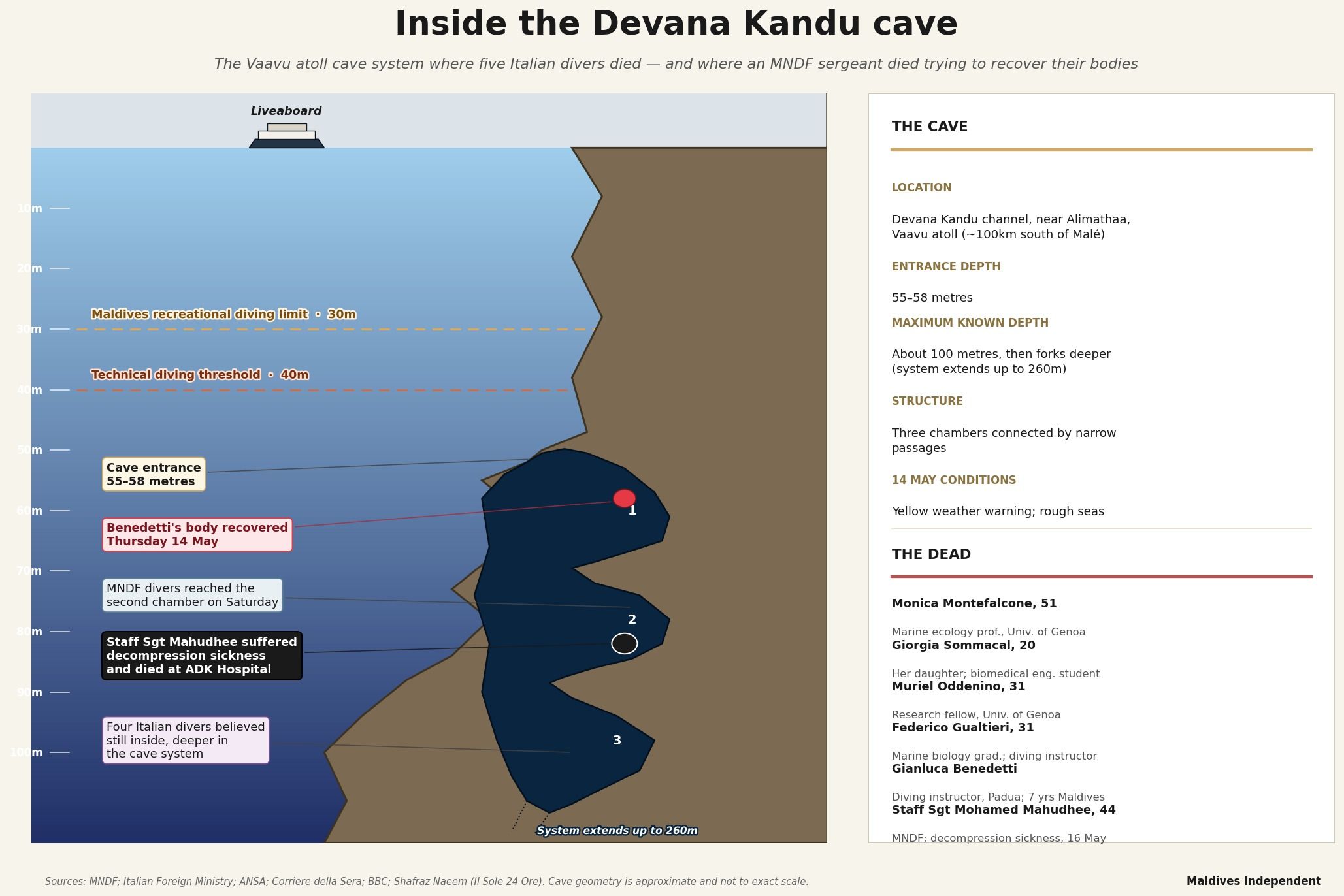
"It's a big cavern, the first chamber. The entrance is at around 55, and it gets deeper and deeper. Light penetrates to that first chamber because the opening is at 55 metres," he said. "After that there's a tunnel of sorts, a connection that leads onto the second chamber, which starts at 70 metres if I am not wrong and goes on to about 75 or 78 metres – that's also a big chamber. You cannot see the whole cave unless you have very good lights – you cannot see it from your normal dive light."
The likely fatal factor on Saturday was the gas, not the dive plan. "They had enough rest, they took enough time" with decompression, he said. "But that's what I mean – you don't know when oxygen toxicity will hit on normal air. I think that is what happened. On top of that, nitrogen narcosis will kick in. In such a dark, confined space, if you are untrained for such a demanding environment, no matter how good a diver you are, nitrogen narcosis is also a factor."
Normal compressed air "gets toxic at 55 metres, theoretically. But oxygen toxicity hits different people differently at different depths. It depends on the fitness level – you never know."
Oxygen toxicity happens when the body’s protective systems are affected by increases in oxygen partial pressure. It can cause tunnel vision, ringing in the ears, nausea, muscle twitching and confusion. Gas narcosis or nitrogen narcosis is caused by breathing in nitrogen at pressure, causing euphoria, impaired judgement, lapses in concentration and confusion.
The recreational diving limit under Maldivian regulations is 30 metres. Beyond 40 metres is internationally classified as technical diving, requiring mixed-gas breathing systems such as trimix, redundant equipment and structured decompression stops on the ascent.
"I'm not saying MNDF divers are incapable. They are capable, they are very good," Shafraz said. "Because I know. I trained Mahudhee, who passed away yesterday. I am saying they shouldn't have gone in, knowing that it's dangerous."
Speaking about the original Italian dive, Shafraz told the Italian news agency ANSA on Saturday: "A cave dive at almost 58 metres with normal air already presents multiple risk factors. At that depth, nitrogen narcosis can severely impair consciousness. Gas consumption increases rapidly and in an environment like a cave, ascending to the surface is very complex."
"A preventable disaster"
Shafraz's account echoed concerns raised over the weekend by other Maldivian divers, who said publicly that the Saturday operation should not have been attempted in the form it was.
"This operation should never have gone ahead under these conditions," diver Fahd Faiz wrote on Facebook. "The entire situation was screaming for disaster from the very beginning."
Sending divers on compressed air to depths approaching 60 metres in an overhead cave environment, Faiz argued, exposed Mahudhee to a compounding set of hazards: oxygen toxicity, nitrogen narcosis, decompression obligations, poor visibility, strong currents and the geometry of the cave itself. "Every single factor here multiplies the danger," he wrote. "Repeating such dives over consecutive days without proper technical diving support is beyond reckless."
"This was not a standard recovery dive," Faiz continued. "This required highly specialised technical cave divers, proper mixed-gas equipment, redundant systems, decompression planning, support teams, and extensive site evaluation before anyone even entered the water. Instead, what we witnessed appears to be an operation pushed forward in dangerous weather, without the proper expertise and equipment needed for a dive of this magnitude."
The government and MNDF should have called for international technical diving assistance immediately rather than attempting the operation with the resources at hand. "Pride and urgency cannot replace training, preparation, and proper equipment underwater. The ocean does not forgive mistakes," he added.
"A friend has died," Faiz continued. "A rescuer who went in to bring closure to families never came back himself. That should shake every single person responsible for approving this operation.…This was not just 'bad luck.' This was a preventable disaster waiting to happen."
In a second post on Saturday, Faiz attached the PSM clip of the Friday-night broadcast with Brigadier General Saleem saying MNDF divers would descend breathing compressed air. The clip has been circulating widely on social media.
The acknowledgement exposed "a painful contradiction" at the heart of the MNDF's own account, Faiz said.
"On one hand, they acknowledge that proper equipment was not used during the rescue attempt," he wrote. "On the other hand, they sent rescue divers into one of the most dangerous underwater environments imaginable fully aware of the risks involved."
Faiz invoked what he described as the first rule of rescue: "You do not create more victims."
"These were not reckless civilians," he wrote. "These were MNDF personnel who trusted the system, trusted their command, and entered that water believing every possible measure had been taken to protect them."
He posed three questions for the defence force to answer: Why was the operation allowed to proceed under those conditions? Who made the decision? And why were rescuers exposed to extreme danger without the necessary tools and safeguards?
"Courage alone is not enough in diving," Faiz wrote. "Bravery does not replace proper equipment. Discipline does not replace proper planning."
Diver Fayyaz Ibrahim said the depth involved made nitrogen narcosis and oxygen toxicity serious risks, and urged authorities not to repeat the dive a day later: "Don't take more risks."
What the President's Office says
The MNDF spokeswoman directed all inquiries to the President's Office.
Mohamed Hussain Shareef 'Mundhu,' the chief government spokesman, denied that President Muizzu gave any instructions to the MNDF. "It’s their legal responsibility, they are mandated by law to carry out certain tasks. MNDF will have 100 percent operational independence," he told the Maldives Independent.
On why divers were sent deeper than their trained limit, Mundhu said that was "a technical question" and that he could not comment on the MNDF's capabilities, training, limits and protocol.
Asked whether MNDF was pushed into exceeding their limits because President Muizzu visited the site, Mundhu said: "Absolutely not. That is not even an inference that should be made. The commander-in-chief’s sincerity and his presence there, on the contrary, shows a commitment and we gave them the assurance that any technical assistance or anything that they required will be provided."
The purpose of the president's visit was to "see if we could offer any additional assistance," he said.
"We place a high priority on providing MNDF’s equipment, training and anything needed for the development and modernisation of MNDF using the most of our available resources. Take a proper look at what this government has done and spent for the development of MNDF."
Two diving services, one operation
The MNDF was not the only state diving capability available on Saturday. The Maldives Police Service operates a Marine Police Wing and a Police Diving Unit, which completed its first international forensic diver course through the National College of Policing and Law Enforcement in July 2025. The programme covers open water, advanced open water, emergency rescue and forensic diving, with participants drawn from the Maldives, Saudi Arabia, Cambodia and Sri Lanka.
In a Medium post published on Sunday, former police commissioner Mohamed Hameed said a senior MPS officer had described the operational decisions around the Vaavu recovery to him in "deeply worrying terms." According to Hameed, the officer said police divers had developed what they considered a better operational plan, that an Italian instructor onshore had preferred that plan, and that police divers had been involved in recovering Staff Sergeant Mahudhee's body.
"His concern was not about credit," Hameed wrote of the MPS officer. "It was about mandate confusion and the lack of a settled joint operating arrangement for maritime search and rescue." Hameed, who served as Commissioner of Police from 2019 to 2023, said he could not independently verify every operational detail but recognised the institutional problem being described.
Hameed traced the underlying problem to the 2004 separation of the police from the military structure, arguing that "many within MNDF still appear to carry the mindset that the Defence Force must remain the superior security agency within the national architecture."
He also raised concerns about Mahudhee's funeral on Saturday night. The Commissioner of Police "was not treated with the level of respect due to the head of a major national security institution," he wrote.
A unit left to beg
Shafraz Naeem argued that the technical gap that killed Mahudhee is the consequence of two decades of declining investment in the MNDF's dive capability.
"The governments that came after 2008 did not prioritise the diving unit at all. Their goal was more special forces, more armoured carriers, drones," he said. "Before that, during [former President Maumoon Abdul] Gayoom presidency, we could get whatever we wanted. We could just request, and we would get it. But after 2008, if the diving unit needed something as simple as an O-ring for a cylinder, we'd have to beg for it. Quite recently, I heard from the diving unit that they had to beg for many days, write a lot of letters to even get an emergency oxygen cylinder."
The unit is based at the Coast Guard headquarters in Hulhumalé. Its specialist equipment is kept in shipping containers, according to Shafraz, who said a recompression chamber donated by the Japanese government "was taken to Thaa Guraidhoo during the council election campaign to get more votes and it was kept there left to rust."
Regulations that would have governed dives below 30 metres, covering permissions, equipment standards and operator obligations, were drafted in 2017 by Shafraz and a serving Coast Guard officer, he said. But the rules have yet to be approved by parliament.
"The draft regulation is there," Shafraz said. "The only thing that the parliament or this government should do is pass it. After that the regulation is made, and no one can say anything."
The Maldives' tourism goods and services tax, levied on all tourism transactions including diving, is one of the state's largest revenue sources. "We are the only dive destination – a country where diving is a main sport, where we are making a lot of money," he said. "But in a country that has such a big diving industry, the military diving unit is not capable, not funded to rescue even tourists. Where is the tax that's taken from diving, from TGST? They are ready to give up their life, but they are not well equipped. The government is not giving the funds to train and equip them."
The 24-hour gap
On Friday, the Maldives government secured international assistance for the recovery operation. Three Finnish cave-diving specialists requested by the Maldivian government landed in Malé on Sunday morning and met with the MNDF team, Shareef told the press. The team includes divers who took part in the recovery of two Finnish technical divers from Norway's Plura cave system in 2014, one of the most technically demanding deep-cave body recoveries in diving history. No timeline has been announced for resuming the operation. They are due to be joined by an Italian deep-sea rescue expert and an Italian cave-diving expert.
Italy, the United Kingdom and Australia had all offered technical assistance. The Italian Foreign Ministry was coordinating with the Divers Alert Network, the specialist diving organisation, on recovery and repatriation.
Shareef said the operation had been suspended pending the international specialists' arrival and a reassessment of strategy. "The death goes to show the difficulty of the mission," he said.
The original dive
The five Italian divers – University of Genoa marine ecology professor Monica Montefalcone, 51; her daughter Giorgia Sommacal, 20, a biomedical engineering student; research fellow Muriel Oddenino, 31; marine biology graduate Federico Gualtieri, 31; and diving instructor Gianluca Benedetti, who had lived in the Maldives for seven years – entered the cave at Devana Kandu on Thursday morning. They were reported missing at 1:45pm when they failed to resurface.
Benedetti's body was recovered at 6:13pm on Thursday. The Italian foreign ministry has confirmed the other four are believed to remain inside the cave. (Earlier reporting attributed the recovered body to Montefalcone; both the Maldivian government and the Italian foreign ministry have since confirmed the body is Benedetti's.) According to Italian press reconstructions citing Corriere della Sera, Benedetti was found in the second chamber with an empty tank.
Montefalcone and Oddenino were in the Maldives on a University of Genoa scientific mission monitoring marine environments and climate-change effects on tropical biodiversity. The university has stated the Thursday dive was undertaken privately and was not part of the official mission. Sommacal and Gualtieri were not part of the scientific programme.
The Italian tour operator that marketed the cruise, Albatros Top Boat, has denied authorising the dive. Its lawyer Orietta Stella told Corriere della Sera that the operator "did not know" the group planned to descend beyond 30 metres – the threshold above which special permission from Maldivian maritime authorities is required – and "would have never allowed it." Stella also said the divers had used standard recreational equipment rather than the technical gear suited to a deep cave dive, and that Albatros only marketed the cruise: it did not own the Duke of York or employ its crew, who were hired locally.
"The Italian group didn't have a permit. They did not have a permit to dive below 30 metres," Shafraz told the Maldives Independent. Permits for research dives at recreational depths are issued through the Maldives Marine Research Institute and the fisheries ministry, he said. Cave-dive permits would have gone through the hydrographic unit under the Coast Guard.
The Maldives tourism ministry has indefinitely suspended the Duke of York's operating licence pending an investigation. Italy has reportedly opened a parallel investigation.
Italian Foreign Minister Antonio Tajani extended his condolences for Mahudhee's death. "These days of grief for Italy are compounded by the news that one of your brave soldiers died while attempting to dive to reach the bodies of our fellow Italians," he said on Saturday. "This tragedy unites Italy and the Maldives in grief and respect for the victims."
Update, 6 August: Sergeant Mahudhee's family has publicly disputed the recorded cause of death, and hospital records show he had no pulse from the moment he surfaced. Read our investigation.
Discussion
No comments yet. Be the first to share your thoughts!
No comments yet. Be the first to join the conversation!
Join the Conversation
Sign in to share your thoughts under an alias and take part in the discussion. Independent journalism thrives on open, respectful debate — your voice matters.
Support Independent Journalism
Help us keep the news free and fearless
Give once
$
or
Become a memberfrom $5/month