
Society

Stranded students left to fend for themselves abroad

Scholarship and loan recipients describe systemic neglect by higher education ministry.

Artwork: Dosain

Artwork: Dosain

2 hours ago
On a weekday morning earlier this year, a Maldivian student on a government loan stood at the higher education ministry’s reception, seeking answers about a payment that had been approved but never sent. The student went to the office in person after weeks of trying to reach the ministry by email and phone call, all of which went unanswered.
The semester was already underway at the overseas university. But the student couldn’t afford a ticket to get there. 
"I was standing there at the ministry reception from 8am to 2pm, literally begging them. There was no empathy or response from the loan section," the student later recounted. At the close of working hours, staff finally arranged the overdue payment. The family scraped together money for a ticket and the student left three weeks into the semester.
This account was one of more than two dozen compiled over the past week by Jubraan Shareef, an anonymous X user who invited Maldivian students abroad to share their experiences with the higher education ministry. Their messages revealed a clear pattern of dysfunction: stipend payments delayed for months, tuition fees left unpaid until universities block students from class, emails and WhatsApp messages ignored or met with vague assurances.
Last week, Mohamed Ibrahim, MP for Galolhu North, took the complaints to Higher Education Minister Dr Ali Haidar, and submitted a report detailing the ministry's "negligence" toward the students. 
Based on numerous complaints, the opposition lawmaker, known as Kudu, outlined the concerns over administrative delays and systemic failures:

Stipend delays of up to four months

Reimbursement for tickets and other expenses taking months

No response to emails and unclear answers on WhatsApp

Difficulties covering living costs such as rent due to long delays

Inadequate stipends that are unadjusted for inflation

Australian universities suspending students' accounts and blocking enrolment to classes due to ministry's failure to pay course fees

Loss of documentation, repeated instructions to resubmit same document and inability to meet relevant staff

Impact on students' mental health and loss of confidence in official mechanisms

Not answering phone calls and not responding to "seen" messages
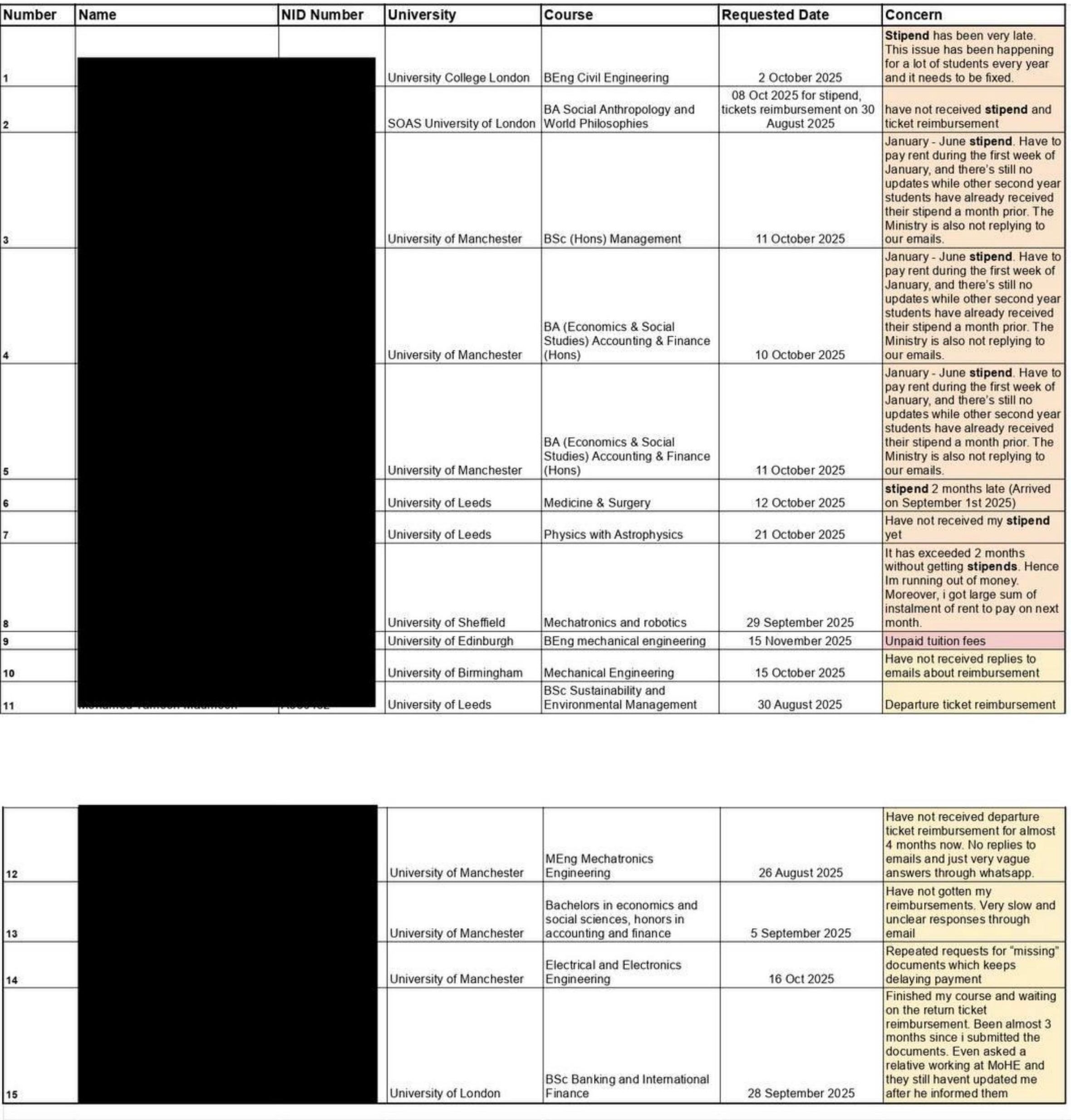
On Thursday, Kudu went to the ministry in person to press for answers. But he, too, was forced to wait at the reception before a meeting was set up with State Minister Dr Abdul Raheem.
"I didn't receive a [satisfactory response]," he told the Maldives Independent.
"At that meeting they said everything is [going] well, everything is good, funds are provided well."
Kudu became involved after 15 students studying in the UK contacted him directly. The rest of the complaints in his report were compiled by Jubraan. "Even at this level, these people are saying, 'no, there's no [problem].' That cannot be believed, right?" he said.
A day before Kudu's visit, a ministry official denied having received any complaints about payments owed to Australian universities. But on Sunday, Haidar told Sun that that the ministry was working to resolve stipend delays "this week." The minister said students who had submitted complete documentation would receive their payments.
But Kudu was skeptical. "The issue remains the same," he said, referring to the case of a student who received the stipend for June on Sunday, and stressing that the broader problem was the lack of a proper mechanism. "Shouldn't there be a portal for these students to do this. At this day and age, their [ministry's] belief is for someone to make and manage a WhatsApp group with 100 students," he added.  
From the report shared by MP Mohamed Ibrahim.

A pattern across continents

The accounts shared by the Maldivian students span Australia, the United Kingdom, Malaysia, and Spain. They came from students on standard loans as well as prestigious High Achievers scholarships. 
According to students in Australia, tuition fees are invoiced directly to the government.
A scholarship student's account at Curtin University in Perth was sanctioned due to non-payment in two out of their three years of study. "Every year it's the same stress," the student  wrote. "I get emails from the university saying my fees are overdue. My account gets restricted. At one point, I couldn't even see my results."
At the University of New South Wales, a student said two terms of fees remained unpaid: "I am now unable to enrol in classes for next year. I am also blocked from seeing my results and accessing essential student services."
The scholarship was cancelled outright for a student at Monash University in Australia. Despite the ministry claiming to have paid for one semester, neither the student nor the university has any record of the payment.
"The ministry has even asked me to tell the university to provide me access and to let them know that the ministry will pay the fees," one student wrote. "Does the ministry not realise that this is not how professional institutions operate, and that the world does not work this way?"

Below the threshold

Students in Australia also face a more fundamental problem than late payments.
Australia's Department of Home Affairs requires international students to demonstrate access to at least A$ 29,710 per year for living expenses. The figure was updated in May 2024 to reflect rising costs. The Maldives government scholarship provides A$ 2,070 per month, or A$ 24,840 per year.
Students must account for the shortfall of A$ 4,870 annually, about MVR 50,000 (US$ 3,240), to satisfy visa requirements.
"I am worried that I won't be able to apply for Australian universities in the next scholarship cycle because of this," one prospective student wrote. "My concern and many others have fallen on deaf ears by the ministry."
"The stipend may no longer be enough to apply for Australia," another noted. The students say the ministry has not acknowledged the gap.

Frozen in time

Other say stipend rates have not kept pace with reality.
"The fixed stipend provided is insufficient to fully cover the living expenses of a university student," wrote a scholarship recipient in Malaysia. "I recently learned that the stipend amount has remained unchanged for nearly ten years, without any adjustment for the rising cost of living and inflation."
A student heading to the UK described receiving a stipend worth "less than half" of what the British government recommends for international students, which forces recipients to take on work or rely on family support. 
In Malaysia, students described stipends that once covered a room now barely covering shared accommodation. Students in Australia wrote about choosing between rent and food. In the UK, they arrived to find the numbers on their loan agreements did not match the reality of actual price tags.
"The stipend rates seem to be from a decade back," one student wrote. "It is not enough to cover living expenses and even just a room – please note, not even an apartment, even a room – with the current rates."

Left behind

The accounts included one from a parent whose son completed A-levels in 2024, passing four Cambridge subjects in addition to Dhivehi and Islam. He was the top student in his O-level cohort and won an Outstanding Cambridge Learner Award.
He wanted to study aerospace engineering and secured a place at the University of Glasgow. When the loan application opened, the family discovered aerospace engineering was not on the approved list. The son scrambled to change courses, but by then UK universities had closed applications.
They found a place at Monash University in Malaysia for mechanical engineering, a course that was on the list. But the ministry rejected the application, saying it was "something that could be done in the Maldives."
"The rejection was very disheartening for him," the parent wrote. "He is currently working since we could not arrange the finance for him yet."
The parent added: "I know for sure that these loans are not merit-based and mostly given out to people who have contacts."

The other side of the bond

Students who are awarded government scholarships sign a bond committing them to work in the Maldives for five years after graduation, a requirement intended to ensure benefits from the taxpayer-funded investment in their education.
But as one student at UNSW put it: "If the ministry cannot fulfil its responsibilities – paying tuition and stipends on time – they should not expect students to fulfil theirs, including the five-year bond we were asked to sign."
The student added: "No student should have to live in fear that their education will be disrupted because of delays or miscommunication from a sponsor."
"Why do we have to beg for the money more than we study?"
According to the latest fiscal update, a total of MVR 548.2 million out of MVR 768 million budgeted for the student loan scheme this year was disbursed by December 18, down from MVR 688.8 million in the same period last year.
Critics have blamed "cash-flow pressure, competing expenditures, and poor fiscal prioritisation" for the failure to release funds on time. The finance ministry has released payments to cover travel costs and President's Office expenses – including car purchases – "well over the approved budget" and prioritised those over time-sensitive student loans, Midhuam Saud, a commentator on public policy observed.   
The higher education ministry was not responding to calls during working hours on Monday. The Maldives Independent has filed a right to information request asking for data on stipend rate history, payment delays, and communications from students.

In their own words

The following accounts have been lightly edited for length and clarity:
Scholarship student, University of New South Wales, Australia:
"First, my stipend was not paid until four months after my arrival in Australia. Now, the issue is with my tuition fees. UNSW operates on a trimester system where fees are due every term, and I have completed two terms without a single term's fees being paid. When I contacted the ministry, I was told the fees are being processed. When I visited in person, I was told payments could not be sent because not enough signatures were obtained. Because of this delay, I am now unable to enrol in classes for next year. I am also blocked from seeing my results and accessing essential student services. The ministry has even asked me to tell the university to provide me access and to let them know that the ministry will pay the fees. Does the ministry not realise that this is not how professional institutions operate?"
Scholarship student, Curtin University, Australia:
"I've been studying in Perth for three years now, and in two out of those three years, my university account has been sanctioned because my tuition fees were paid late – even though I'm on a scholarship and the fees are supposed to be covered. Every year it's the same stress. I get emails from the university saying my fees are overdue. My account gets restricted. At one point, I couldn't even see my results. My parents literally have to go to the ministry months in advance, every single year, just to make sure the payments are processed. And even then, it still gets delayed most of the time."
Scholarship student, Monash University, Australia:
"The university has blocked my account for failure to pay tuition fees on time. The scholarship has been cancelled as the sponsor did not pay tuition fees on time. Upon asking, ministry told semester one has been paid, but there is no documentation received from students' side or university's side. This is a huge failure from the ministry's side. It starts from the root – political appointees who are taken into the ministry who do nothing but eat, get fat, go on coffee breaks and God knows what else. They are unable to do the bare minimum."
Loan recipient, Malaysia:
"The student loan was applied in late 2023 and the intake began in January 2024. We are applying to student loans due to financial difficulties to get a better, quality education. However, the stipend rates seem to be from a decade back. It is not enough to cover living expenses and even just a room – please note, not even an apartment, even a room – with the current rates including miscellaneous expenses for field trips, research, and so on. The prices have risen especially after Covid in Malaysia. The ministry does not seem to even want to consider rectifying the issue."
High Achievers Scholarship recipient, Malaysia:
"This is my second year studying abroad under the High Achievers Scholarship Scheme. The fixed stipend provided is insufficient to fully cover the living expenses of a university student. I recently learned that the stipend amount has remained unchanged for nearly ten years, without any adjustment for the rising cost of living and inflation in Malaysia. This situation is therefore unfair and no longer reflective of current economic conditions."
Loan recipient, United Kingdom:
"I am going to the UK on a student loan and it doesn't even cover most necessities properly. They have this thing called announced countries—if you aren't going to one of those countries you have to select a country among them and you'll get stipends and tickets allocated to that country. The highest one in the list is Saudi, where the stipend is $800 per month. But the UK's recommended rate is £1,455 per month outside London. There's a huge difference. I'll barely have anything to spend on food and other necessities after paying my tuition fees and accommodation."
Prospective scholarship applicant:
"I just wanted to raise a concern that I've been receiving from a large number of students planning to apply for scholarships for this A-level cycle, particularly those hoping to study in Australia. Many of them are worried that the current scholarship stipend rate is below the minimum financial requirement set by Australian immigration for student visas. I've checked the Australian immigration requirements myself, and based on the current stipend value, it does appear that it may not meet the visa threshold. If students are still able to apply to Australian universities and obtain visas under the current stipend, then I don't have an issue – the main concern is whether this has been reviewed. Of course the ministry is as untrustworthy as ever and will not acknowledge anything as of right now."
First-year student abroad:
"I have been contacting the ministry for almost four months now to get my ticket reimbursement. I haven't gotten a proper answer to any of my questions regarding when I will receive my reimbursement even though I have sent all the necessary documents properly in order. The only answer I get is 'your reimbursement is being processed by section.' Talking to the ministry is like talking to a wall. You literally don't get an answer to any of your questions and the times you get an answer they never answer the question you ask them. Their WhatsApp number is the only way we can communicate with them directly as they don't reply to any of the emails sent to them and half of the time they seenzone you on WhatsApp."
Loan recipient:
"I had to take a loan from a family friend to cover my visa costs because the ministry said that they would reimburse that amount. It's been well over a year now. I mailed them a lot when I first started and they would give me the cold shoulder. I've given up on getting my money back at this point. To this day I have no idea why they don't put it in the initial fee structure."
Parent of A-level graduate:
"My son did A-levels in June 2024. He did four Cambridge subjects plus Islam and Dhivehi and passed all. He wanted to do aerospace engineering and got a placement from Glasgow University in the hope of getting the student loan. When the loan application opened we found out that the government did not provide loans for this particular course. My son panicked and tried to change the course but at that point all the UK universities were closed for placements. We tried Malaysian universities and got a placement from Monash for mechanical engineering since it was on the loan list. Applied and waited for over a month to receive a 'rejected' reply from the ministry. Their reason being it was something that could be done in the Maldives. We complained formally and informally. At first they said it's being reviewed and stretched it without an answer and finally said there was nothing more that could be done. My son was the school topper in O-levels and also won an Outstanding Cambridge Learner Award that year. The rejection was very disheartening for him and he is currently working since we could not arrange the finance for him yet. I know for sure that these loans are not merit-based and mostly given out to people who have contacts."
Couple who applied for loans:
"My wife and I both got selected for student loan. The ministry refused to reply for weeks, sometimes months, and eventually decided not to give us the loan this year. My wife even quit her job in anticipation of leaving because the ministry kept saying they'll call us to sign the contract – until the deadlines passed and they didn't."
Scholarship student, Australia:
"No student should have to live in fear that their education will be disrupted because of delays or miscommunication from a sponsor. If the ministry cannot fulfil its responsibilities – paying tuition and stipends on time – they should not expect students to fulfil theirs, including the five-year bond we were asked to sign."
Loan recipient:
"I submitted my loan disbursement form on 30 October 2025. Ministry staff and state ministers told me that the process would take two to three weeks. The ministry did not attend to my application at all until I started messaging them repeatedly on 7 December. My university offer expires on 31 December, and I have to pay my initial deposits and insurance fees before that. I am running out of time. Every time I go there they tell me it's being 'processed'. The whole thing feels like a humiliation ritual. Why do we have to beg for every single thing in this country?"

Discussion

No comments yet. Be the first to share your thoughts!

No comments yet. Be the first to join the conversation!

Join the Conversation

Sign in to share your thoughts under an alias and take part in the discussion. Independent journalism thrives on open, respectful debate — your voice matters.

Support independent journalism