
Holiday homes, Israeli bans, libel suits and the noose: four bills before parliament
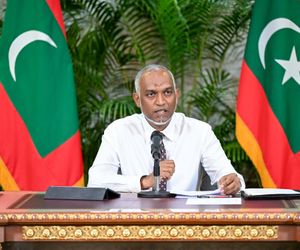
What each bill would change and how President Muizzu defended it.

Artwork: Dosain
Real estate bill
A Property Regulatory Authority would be established under the housing ministry. The president would appoint its chief executive on the minister's advice. The minister would answer to parliament. It would register developers and agents, keep the property register and designate escrow banks.
All payments from a buyer for an unbuilt unit must go into a project escrow account at a Maldivian bank. The developer could draw it down as construction progresses. Five per cent would be held back for a year after units are registered to buyers.
No project can be advertised or sold before it is registered with the authority. Booking fees would be capped at 10 per cent of the sale price
Estate agents must be Maldivians aged 21 or over. Valuers would need a recognised qualification.
The authority can fine violators between MVR100,000 and MVR1 million.
The buyer must pay the authority three per cent of the sale price or the market value, whichever is higher, as a lease registration fee. Without it the sale will not be registered. It is not refunded if the registration is later cancelled.
The president designates a zone on the minister's advice. It can be an island, a lagoon or both. Parliament has no role.
A zone needs an approved master plan worth at least US$1 billion on at least 200 hectares (Rasmalé is 500 hectares).
The master developer can be chosen in three ways: a public call for proposals, picking "the best proposal" to carry out the policy set for the zone, or handing the zone to a majority state-owned company on the president's decision with the cabinet's advice. On the second route, the ministry must send details in writing to the Anti-Corruption Commission and the Auditor General after the lease is signed. The master developer can be wholly foreign-owned.
The zone is leased to the master developer for up to 99 years.
Properties are sold as 99-year leasehold rights under a "surrender and re-grant model". When a sale is registered, the old lease is surrendered and the authority issues the buyer a new 99-year lease. Leases already sold survive the end of the master developer's own lease. Buyers can resell and mortgage. But a mortgaged property cannot be sold until the mortgage is discharged.
The master developer must first provide a tertiary hospital, mosques, shops, parks, roads and sea or air links. The authority can suspend sales until it does
As a land premium, the state could take either a lump sum set under regulations, paid at once, or at least 10 per cent of each of four streams: the price of properties the master developer builds and sells, the price of land rights it sells on, its rental income and its income from businesses named in regulations. The shares are of sale prices and income, not profit.
Gains from property sales in a zone are exempt from capital gains tax and non-resident withholding tax. Goods and services in a zone are taxed at the tourism rate of GST, though regulations can apply the general rate to businesses serving Maldivians. All other taxes apply in full.
A four per cent transfer fee applies to every sale in a zone. It would be three per cent elsewhere.
No more than 25 per cent of a zone's land or properties can go to citizens of any one foreign country, or to companies they control. Dual citizens count against the quota of each of their countries. Trusts and nominees must be declared and are counted against the beneficiary's country. Israeli citizens, companies with any direct or indirect Israeli shareholding and anyone acting for them are barred outright. So is anyone barred from entering the country under the immigration law. The authority must verify a buyer's nationality before registering a sale. Sales that break these rules are void. A buyer who knowingly gives false information or fronts for someone else can lose the property to the state after a hearing, with 30 days to go to court.
Gambling, places of worship for other religions and anything contrary to Islamic sharia are prohibited. Pork and alcohol cannot be imported, sold or used. The Maldives police and army will provide security. The developer must build facilities for state agencies to be stationed inside the zone. The developer must give priority to Maldivian workers and firms.
The master developer maintains and manages common facilities. It can levy a "usage charge" on owners and developers once the authority approves its budget. An owner who has not paid cannot sell.
Immigration bill
The list of people barred entry to the Maldives includes anyone holding an Israeli passport with no conditions attached. The existing law states that the ban will remain in place as long as Israeli atrocities continue in Gaza.
People charged by the International Criminal Court or subject to its arrest warrants, people listed by Interpol, people accused of crimes under international law and fugitives from other countries' justice systems will also be denied entry. This would cover Israeli Prime Minister Benjamin Netanyahu. The ICC issued a warrant for his arrest in November 2024.
The list also covers people seen as a threat to sovereignty or national security, people linked to terrorist groups, nationals of countries the government designates among those with which the Maldives has no diplomatic relations, and people believed likely to undermine "social or religious unity".
Section 48 sets out visitor, work, transit, business/investor, student and special residence visas. Schedule 1 puts a corporate resident visa and an investor visa in the business/investor category, and a visa for people admitted under special government programmes in the special residence category.
The bill sets no investment thresholds and does not mention property. Conditions and durations are left to regulations. That neither creates nor rules out residency for property buyers.
Defamation bill
Defamation remains a civil wrong, not a crime. It covers saying or publishing something false about a person, deliberately or without due care, that lowers them in the eyes of reasonable people, exposes them to hatred or isolation, or causes them loss.
Speech, writing, drawings, photos, broadcasts, songs, films, stage shows, effigies and gestures all count, whether the meaning is direct or implied. A statement can refer to someone without naming them.
Individuals, companies, registered media, social media platforms, hosting services and other online intermediaries will be subject to the law. Private messages between two people are excluded unless they reach a third party.
The author, the publisher and anyone who spreads the material further are liable. For an online news outlet, the editor and the owner bear responsibility. Internet service providers do not.
The law applies to acts abroad if the material can be accessed in the Maldives and harms someone here. Online material counts as published in the Maldives if it is read here or if the person defamed is a Maldivian or lives here .
Truth and honest opinion based on true facts can be taken as a defence. The defendant must prove it in court.
Absolute privilege covers what is said in parliament and in court. Conditional privilege covers accurate reports of parliament, courts, official inquiries, state announcements, public meetings and public company documents . It is lost if the subject asked for a reply to be published and was refused.
Media and platforms must keep "a reasonable standard of care" over accuracy and fairness and run systems to correct or retract false information quickly.
The person defamed can send a written notice giving at least seven days to respond and cannot sue until that period ends. The other side can offer a correction, an apology or compensation. A notarised settlement ends the matter.
A claim must be filed within a year. Courts must rule within six months .
Compensation for material loss is capped at MVR500,000. Compensation for non-material harm to reputation is set at between MVR50,000 and MVR500,000 and can be claimed without proving material loss. Courts can also order an apology, a correction or removal. An apology or correction can reduce the award.
Government institutions and the state's independent commissions and offices cannot be sued. The bill does not permit a defamation action against them.
Death penalty bill
Death can be imposed for offences that the Penal Code or another law makes punishable by death and only after the case has gone through the two appeal courts to a final judgment.
Courts must confirm the accused had full access to a lawyer at every stage of investigation and trial. If not, a death sentence cannot be passed
In murder cases, decisions on retribution and pardon by the victim's heirs follow sharia rules (section 10). If heirs file a case, the execution is put on hold until the court rules.
A seven-member panel that includes a prosecutor named by the Prosecutor General and a nominee of the Supreme Council for Fatwa must be set up. Four members form a quorum. The panel issues the execution order and reviews dates.
An execution is postponed if the convict is pregnant, until two years after the birth, or is nursing a child under two. It is also postponed while a court case is pending, or if the convict is seriously ill or mentally ill.
The convict has the rights to seek a pardon or a lighter sentence, to have a lawyer, to meet family and to make a final will.
The method will be hanging. It is to be carried out by the Maldives Correctional Service. Technical standards for the equipment are left to regulations.
The Prosecutor General or a representative and senior officials of the relevant agencies. Broadcasting or showing images or sound of an execution is banned.
The body is to be handed to the family. If they decline it, the state must arrange an Islamic burial.
If an exception fails or cannot be completed, it must be stopped at once and reported to the panel.
The law would apply to people sentenced to death before it takes effect.
Discussion
No comments yet. Be the first to share your thoughts!
No comments yet. Be the first to join the conversation!
Join the Conversation
Sign in to share your thoughts under an alias and take part in the discussion. Independent journalism thrives on open, respectful debate — your voice matters.
Support Independent Journalism
Help us keep the news free and fearless
Give once