
Explainer

Death penalty for drug traffickers: What the new law says

Sweeping changes to sentencing, scheduling and rehabilitation.
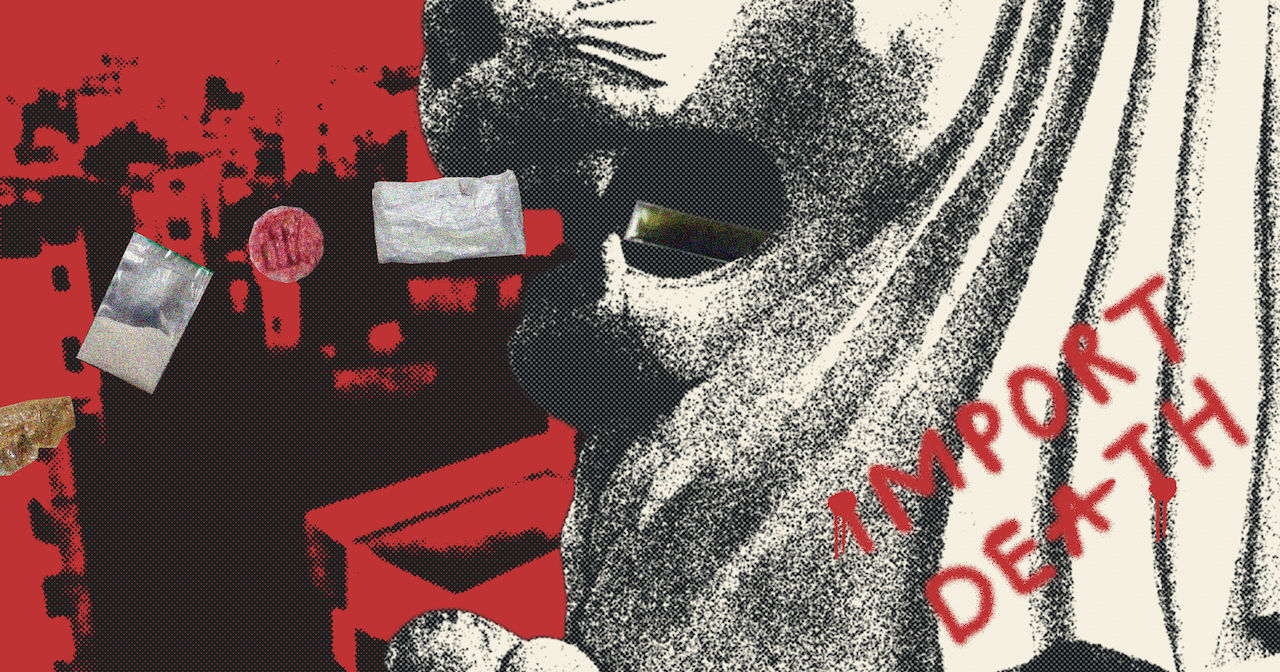
Artwork: Dosain

Artwork: Dosain

10 hours ago
The third amendment to the Drug Act of 2011, ratified on Saturday, represents the most significant overhaul of the Maldives’ drug laws in over a decade. Most significantly, the changes introduce capital punishment for large-scale drug trafficking – making the Maldives one of the few countries to retain the death penalty for drug offences.
Other provisions create a new mechanism for rapidly scheduling emerging substances and expanding rehabilitation options beyond institutional care. The revised law introduces new sentences for the operation of “drug cafés” and a fourth schedule for drugs that are temporarily listed as illicit or controlled.
The death penalty could now be handed down for persons found guilty of importing more than 350 grams of cannabis, more than 250 grams of diamorphine or more than 100 grams of any Schedule 1 drug. It applies when: (1) the drugs were imported by the person physically travelling into the country, (2) all appeal stages have been completed, and (3) the Supreme Court bench unanimously upholds the guilty verdict.
Former Supreme Court justice Husnu Suood observed that the new law represents "a major policy shift aimed at tackling narcotics in the country," but added that he did not believe "this is the right approach."
Crime and punishment 

Attempting, aiding or abetting in the import of any of the listed drugs will now carry a life sentence and a fine between MVR 100,000 (US$ 6,895) to MVR 1 million 

Attempting, aiding or abetting in the import of other drugs will result in a 20-year prison sentence (previously 18) and a fine of MVR 75,000 to MVR 750,000

Possession of a schedule 2 drug (controlled substances of medical utility) without a prescription or more than the prescribed amount is a crime punishable by three to 15 years in prison and a fine of MVR 100,000 to MVR 1,000,000 

A pharmacy in possession or found to be selling a Schedule 2 drug without a permit will be in violation of the law. The offence is punishable by seven to 11 years in prison along with a fine of MVR 35,000 to MVR 750,000

Manufacture, possession, supply, delivery, import or export of a Schedule 3 precursor substances (substances with utility in producing drugs) is a crime punishable by 10 to 15 years in prison (up from three to five years previously)

Providing drug use services (in ”drug cafés” or dens) is a crime punishable by five years in prison and a fine of MVR 50,000 to MVR 100,000. This includes providing drugs, tools and paraphernalia used for the intake and consumption of drugs

An owner, tenant, resident or a caretaker who allows the use of their property for drug use is committing a crime punishable by 10 years in prison and a fine of MVR 100,000 to MVR 200,000

Providing a space for the sale and trafficking of drugs is a crime punishable by 20 years of jail and a fine of MVR 200,000 to MVR 1,000,000

An owner, renter, resident or a caretaker of a property who allows the use of the property for drug sale and trafficking commits a crime punishable by 15 years of jail and a fine of MVR 200,000 to MVR 1,000,000

Financing drug trade is a crime punishable by 20 years of jail with a fine of MVR 200,000 to MVR 1,000,000

The law expands the list of people who will receive the harshest punishment to include:

Any employee of the security services (police and military) 

Drug court judges, court officers, prosecutors, staff involved in drug rehabilitation and any staff working at an office with a mandate under the drug law

A member of an organised crime group (previously defined as gang members)

New schedule
An Annex 4 was added for a Schedule of Drugs and Substances that are temporarily controlled, if it is a drug that is widely used in the Maldives, if medical and scientific
evidence show that it is addictive and can pose a danger to public health, and if it is not yet listed in Schedule 1 or 2 or until it could be listed as a Schedule 1 or 2 drug.
A drug listed in Schedule 4 will remain on the list for 12 months or until it is included in Schedule 1 or 2.
A minister must include such drugs in the list after seeking advice from the National Drug Control Council via an order or notice published in the government gazette. Within 14 days of the order, it must be submitted for approval by parliament, which must make a decision within 14 days.
The homeland security minister, police or the health minister can ask the Drug Control Council for permission to include a drug in Annex 4.
The minister is also required to update drugs and substances listed in Schedule 1 and 2 along with precursor substances in Schedule 3 in line with the Single Convention on Narcotic Drugs of 1961, the Convention on Psychotropic Substances 1971 or the Convention Against Illicit Trafficking In Narcotic Drugs and Psychotropic Substances.
The Schedules will need to be updated within three months of the amendments coming into force.
Under special circumstances, the president will also have the power to add drugs and substances to Schedule 1, 2 and 3 based on recommendations by the National Drug Control Council and approval from parliament.
Drug council and court
The National Drug Council will include an additional member representing the ministry in charge of ensuring children's rights (currently the ministry of family and social development). Previously ministry representatives needed to be state or deputy ministers, but they can now  be technical staff nominated by the minister.
Changes to the operation of the drug court’s work: 

Drug offence suspects who are also accused of sexual offences will not fall under jurisdiction of the drug court

Judges must have experience with rehabilitation programs

Judges are required to efficiently process cases to prevent backlog

The court must closely monitor rehabilitation orders and issue subsequent orders related to rehabilitation enforcement

The amendments detail different kinds of drug rehabilitation and care. The care systems are to include:

Community-based screening, referral and care including counselling and home-based care

Non-residential treatment and rehabilitation to include outpatient services from health facilities and specialised drug treatment facilities 

Screening services, detoxification, drug dependency treatment, counselling, rehabilitation and related medical services

Residential treatment and rehabilitation to include inpatient services in specialised facilities to provide screening, detoxification, dependency treatment, counselling, rehabilitation and related services. (Treatment was previously limited to mostly institutionalised treatment at detox centres, treatment and rehab centres, including centres for women and children, halfway houses and drug offender remand centres.)

Specialised facilities to provide:

Dependency screening and assessment

Detoxification

Dependency treatment

Rehabilitation and reintegration

Health facilities must provide:

Healthcare services for dependency treatment

Psychological services

Residential treatment facilities must include separate residential blocks for women and children. The Drug Offender Remand Centres established under the previous law was abolished. Instead, police custodial centres and remand jails under the Maldives Correctional Service are required to have adequate facilities to provide detoxification and rehabilitation services to detainees who need them.
The revisions encourage the Prosecutor General to prioritise treatment for first-time offenders and those who are not accused of serious crimes.
The drug court also has the discretion to fine those enrolled in a rehab program for non-compliance. The court could impose fines between MVR 500 to MVR 10,000 for failure to follow the program. 
Law enforcement powers
The Maldives police and Customs are primarily responsible for preventing the import and export of drugs through airports, seaports or maritime borders.
The law grants police powers to:

board and inspect vessels travelling in and out of the country if there is sufficient evidence to reasonably believe that it is carrying drugs or that any crime in the law is being carried out 

inspect the vessel

order those on board to provide identification documents

question those on board, search the person and take their samples 

retrieve and retain evidence 

detain suspects 

tow the vessel

Customs officers will also have the same powers to conduct inspections, confiscate drugs and halt vessels. But customs officers are required to inform police. Their powers only apply in airports and seaports under the purview of the Maldives Customs.
Customs officers can also stop and frisk travellers arriving and departing from the Maldives if screening via X-ray or other tools give reasonable grounds for a customs officer to
believe they are carrying drugs. Any inspections beyond a simple frisk and search must adhere to guidelines in the criminal procedure code. Customs officers have the power to stop or hold a trafficking suspect without a court warrant if there is reasonable grounds to believe they have committed or will commit a crime. (The law previously allowed arrest without a warrant).
Police officers will meanwhile have the power to conduct “controlled delivery” operations to investigate suspects involved in smuggling and trafficking drugs. Controlled delivery refers to allowing the delivery of drugs under a monitored and supervised operation led by a police officer, customs officer or any authorised official. The law specifies the circumstances and procedures for conducting a controlled delivery operation. 

Discussion

No comments yet. Be the first to share your thoughts!

No comments yet. Be the first to join the conversation!

Join the Conversation

Sign in to share your thoughts under an alias and take part in the discussion. Independent journalism thrives on open, respectful debate — your voice matters.

Support independent journalism