

As El Niño builds, Maldivian reefs are running out of time to recover
A global report cites their recovery but bleaching events are now coming faster.
Artwork: Dosain
10 Sep, 17:07
Forecasters warn the El Niño building in the Pacific could be the strongest on record. A 1997-98 event of similar strength killed 90 per cent of shallow water coral in the Maldives. The recovery that followed was so convincing that a global assessment released last week holds up the Maldives as proof that coral reefs can bounce back from mass bleaching.
But a closer read of the fine print suggests the country has less reason for comfort than the report's recovery figures alone imply.
Coral reefs, which form the foundation of the Maldives islands, are vulnerable to marine heatwaves, and reefs are getting less time to recover between major disturbances, the Global Coral Reef Monitoring Network found.
Global coral cover has seen a relative decline of nearly 10 per cent from a historical reference period of 1980–2009, largely from marine heatwaves, which are increasing in frequency. The effects are compounded by other anthropogenic stresses.
There have been four global mass bleaching events in the past three decades: 1997–1998, 2010–2012, 2016–2017 and 2023–2024. Each event caused relative decline.
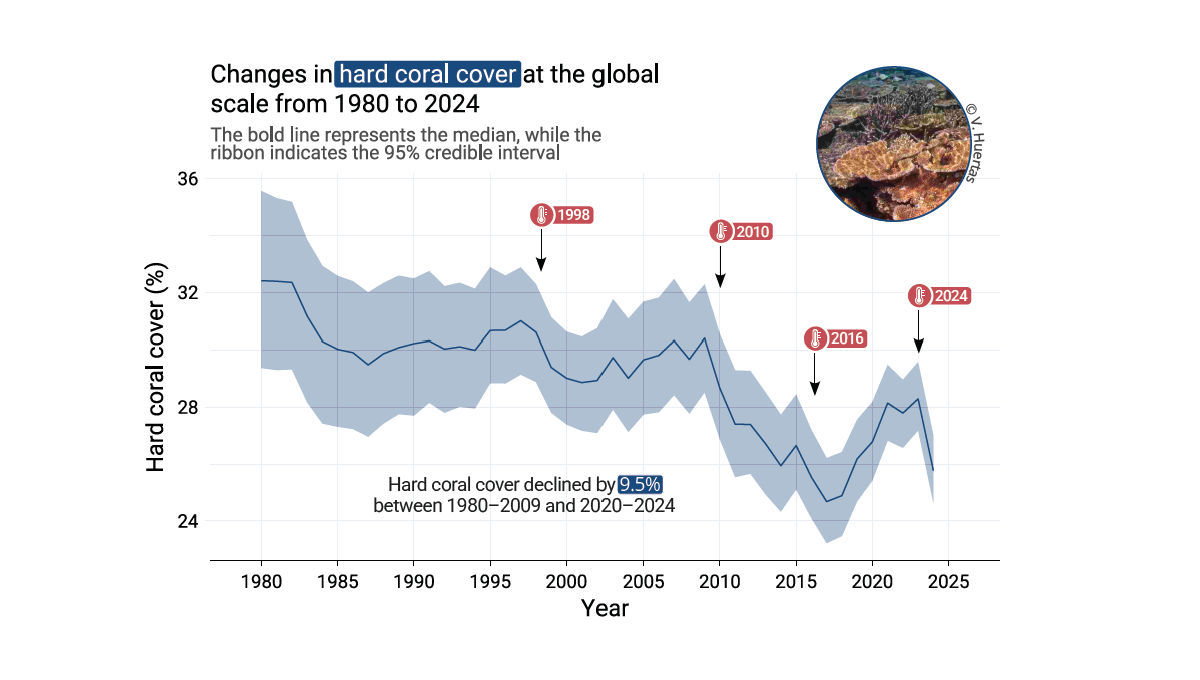
“The fourth global bleaching event is on track to be the most severe event recorded to date," the report stated.
As the event unfolded in 2024, Derek Manzello, coordinator of the US National Oceanic and Atmospheric Administration's Coral Reef Watch, told Reuters it could be “the worst bleaching event in the history of the planet”.
The 2024 event's impacts, which carried into 2025, were not captured in the GCRMN report. A relative decline of 8.9 per cent was estimated from 2023 and 2024, which would make it the largest single-year decline ever.
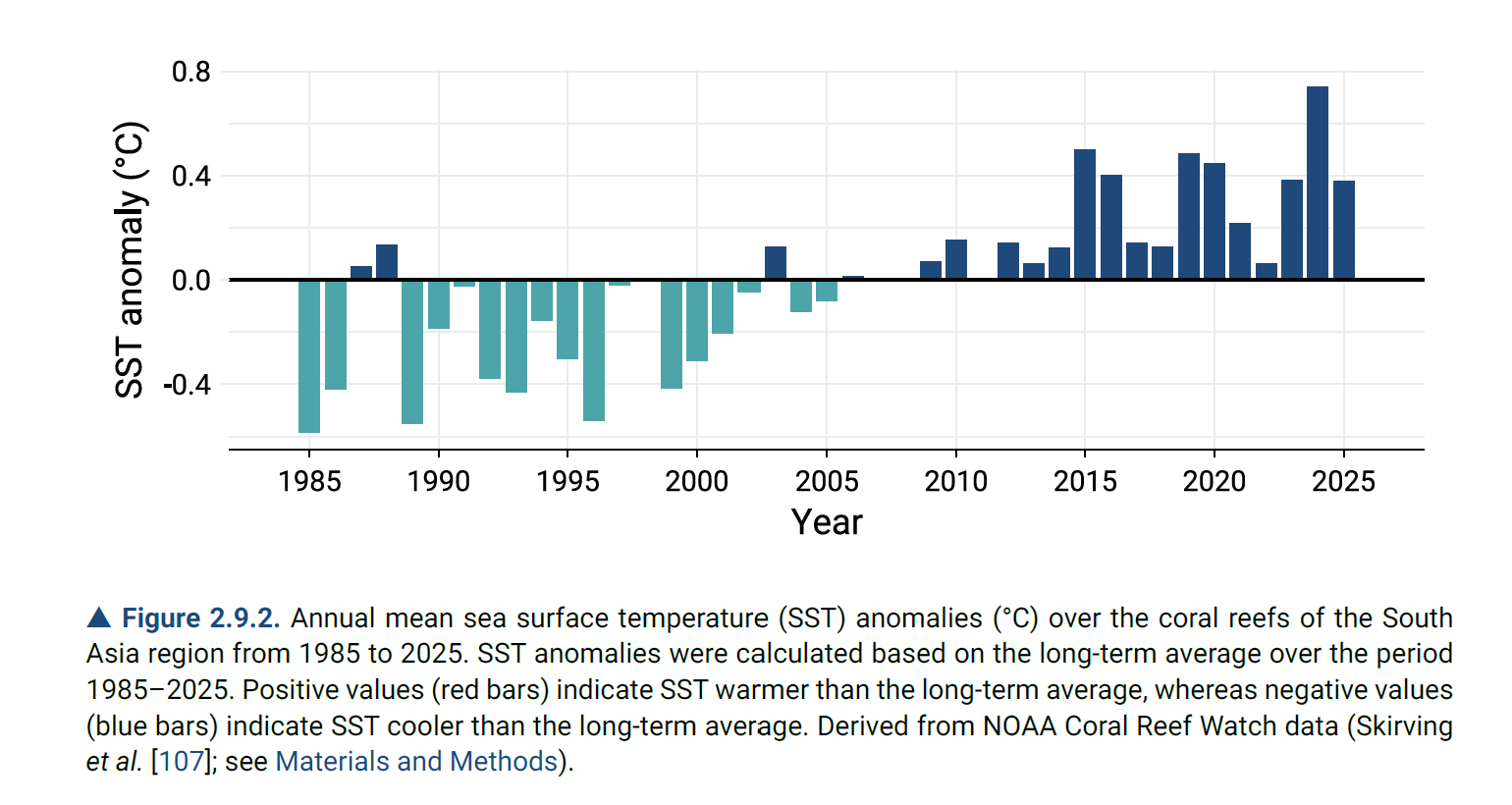
These events, amplified periodically by the El Niño Southern Oscillation, are occurring alongside global temperature rise driven by human-induced global warming. Sea surface temperature over coral reefs increased by 0.81°C between 1985 and 2025.
Following the three hottest recorded years since 2023, the ongoing El Niño is expected to drive up temperatures again next year.
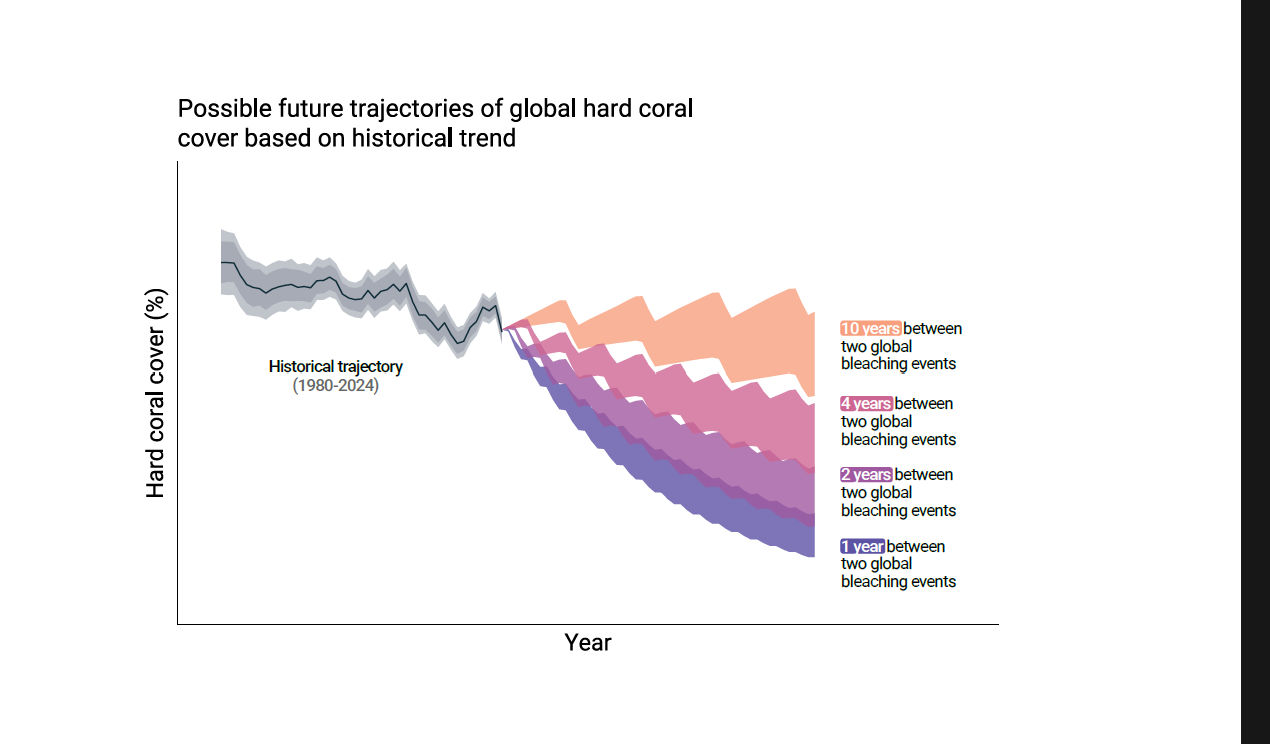
The report’s main argument is that coral reefs have the capacity to recover following bleaching events. But the rapidly closing windows between major disturbances are not allowing recovery fast enough to avoid a global decline. Major disturbances that used to happen once in a decade are now happening every four to six years.
The report was clear that marine heatwaves will persist and intensify if temperatures surpass 2°C without significant cuts in carbon emissions.
A "rebound to reference levels is unlikely" under future climate scenarios and a continued decline in hard coral cover is "expected with shorter recovery periods".
What about the Maldives?
On paper, the outlook is brighter for reefs in the Maldives.
The South Asia region is one of only two that recorded a recovery: 16.2 per cent recovery relative to the historical reference period.
After the first bleaching event, hard coral cover decreased in the Maldives from 44.9 per cent in 1997 to 7.3 per cent in 2000. Since then, coral cover steadily increased and remained stable until 2015, reaching 35.5 per cent.
The second decline came after the third bleaching event in 2016. But the magnitude of loss was lower than after the first event. The report notes that both events modified the composition of the coral reefs with a decline in branching and tabular corals.
The report singles out Maldives based on strong evidence of hard coral cover increasing from the historical reference period (1980–2009) to the modern period (2020–2024), even though it masked alternating periods of recovery and decline between the two periods.
The overall increase in the South Asia region was largely driven by Chagos and the Maldives, which together account for 83 per cent of total regional reef extent.
The findings "suggest that continental reef systems may be more affected by global and local anthropogenic pressures than oceanic archipelagos such as the Chagos, Maldives and Lakshadweep," the report observed.
Why is monitoring and science important?
As optimistic as these findings may appear for the Maldives, it must also be taken with a grain of salt. The data provided from the South Asia region for the historical baseline (1980-2009) only started in 1997, right before the major bleaching event.
"The increase largely reflects low baseline values during the first period and rapid recovery recorded in the second period," the report noted.
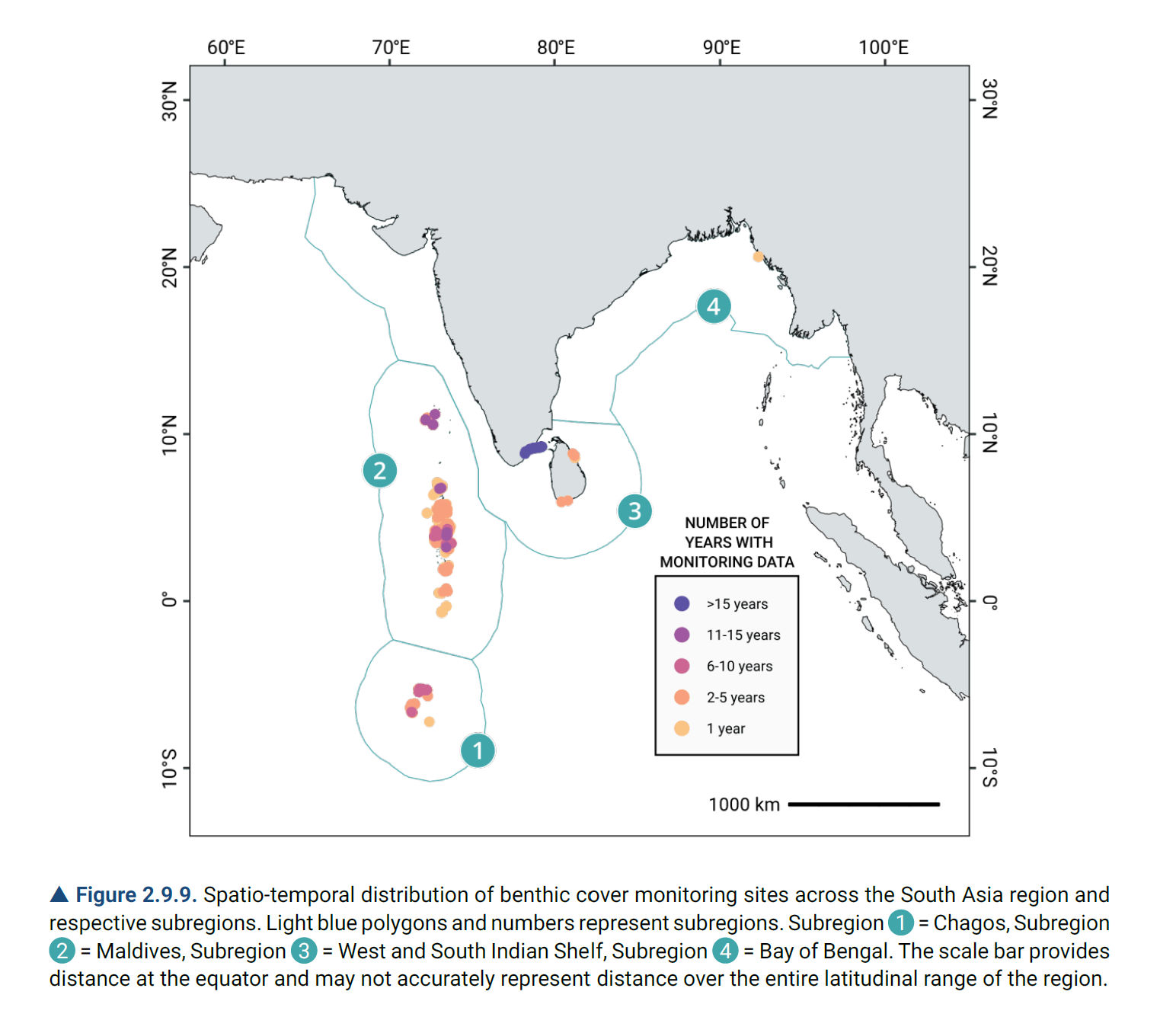
In the case of Maldives, this is expected because coral reef monitoring and research was very limited before the 90s.
The Marine Research Section was first founded on 24 July 1984 as a research arm of the fisheries ministry. Its primary goal was conducting fisheries research. The mandate was later changed to include all marine resources, including coral reefs. But it focused research on impacts from coral mining and crown of thorns outbreaks in the earlier years. In its first ever research bulletin, MRC noted lack of qualified staff as a major barrier for conducting research during the first decade.
The 1998 bleaching event devastated Maldives coral reefs and prompted a government response. The office was renamed the Marine Research Centre. The event led to consistent monitoring of 15 permanent monitoring sites that had been surveyed prior to 1998. A National Coral Reef Monitoring Programme in partnership with the regional body CORDIO (Coral Reef Degradation in the Indian Ocean) was launched in 1999.
Studies into coral reefs have expanded since with several publications examining the impact of the 1998 bleaching event, the 2004 tsunami, crown of thorns outbreaks and the 2016 bleaching event.
Although the new report does not show a decline in coral cover in the Maldives, there are a few important points of note, especially for a low-lying small island state with existential stakes on the health of coral reefs.
First, reducing local stressors can make the difference in helping reefs recover as more frequent and intense marine heatwaves are to be expected. "Coral reefs subjected to lower local pressures are better able to resist, survive, and recover from climate impacts," the report noted.
"Management interventions such as effectively enforced marine protected areas, sustainable fisheries management (including herbivorous fish protection), integrated coastal zone management, improved land-sea planning, and reductions in land-based sources of pollution are therefore essential complements to climate mitigation, and represent proven, readily deployable management tools for supporting reef resilience."
After visiting the Maldives in April 2024, David Boyd, then the UN special rapporteur on the right to a healthy environment, noted that environmental impact assessments were carried out for individual reclamation projects, but found no apparent assessment of their cumulative risk to reef health, biodiversity and livelihoods across the country, "despite the escalating pace and magnitude of development".
Second, the report makes clear the importance of continued monitoring and looking beyond coral cover. The coral reef compositions of Maldivian reefs are reported to have changed following the decline and recovery periods.
The Maldives section of the GCRMN report did not include a single Maldivian author, although three Maldivians were credited for data contribution. The authors included Monica Montefalcone, the University of Genoa marine ecologist who led coral reef research in the Maldives from 2013. The section opens with a tribute to her. She was one of five Italian divers who died in the Devana Kandu cave in Vaavu Atoll in May.
Local monitoring of coral reefs and large scale studies are also important because the Maldivian reef system covers a significant area of the Indian Ocean. Differences in atoll reef dynamics and regional geography affect reefs differently.
Last month, Biosphere Expeditions published a report with findings from a Reef Check survey conducted in October 2025 in three central atolls. It described a "phase shift" in degraded inner atoll reefs to non-coral organisms. Outer reefs benefit from strong water circulation and cooling oceanic upwellings, it said, citing previous research.
The report called for an "immediate moratorium on coastal dredging and resort construction during critical bleaching windows" alongside reforms to fisheries monitoring, decentralised governance and empowering the then-Environment Protection Agency to halt and fine developers who violate mitigation measures mandated with the approval of environment impact assessments.
Alongside monitoring, research that breaks ground on trends, patterns and innovations for reef rehabilitation and restoration is now being conducted in the Maldives.
The Sixth Maldives Marine Science Symposium, held in Malé last month, offered no shortage of such science. The oral presentations included research studying the scaling up of coral reef restoration, whether acoustic playback can improve settlement success rates, and the survival bottlenecks in restoration efforts. Other studies investigated coral spawning and monsoonal transitions, spatiotemporal analysis of historical heat stress, and variations in mesophotic coral reef ecosystems across depths
The most recent comprehensive study of coral bleaching published by the Maldives Marine Research Institute is a 2021 study by Hana Amir. One of the takeaways from that study is that regional geography is the strongest factor for variations in recovery across Maldivian reefs.
It found that reefs in northern atolls and central atolls experienced devastating losses after the 2016 bleaching event, in comparison to the southern atoll of Addu, which recovered rapidly.
Why does this matter?
The Maldives hosts the seventh largest coral reef system in the world. What happens in the Maldives can be instructive for the future of coral reefs.
A healthy reef system is crucial as extreme weather causes more storm surges and flooding every year. The GCRMN report states that coral reefs dissipate ocean wave energy by 97 per cent, and have protected 5.3 million people and US$109 billion in global GDP from storm impacts over decadal periods.
Tuna is the main source of protein in the Maldivian diet and exports from the country's fisheries industry bring in much-needed foreign currency income. Fish catch fell to historic lows in 2024 as global temperatures overshot 1.5°C and fishing appears to be poor again in 2026. Fishermen point to declining availability of bait from shallow reefs as a major reason. A decline of coral reefs would also heavily impact tourism as dive tourism is a crucial segment for the industry.
Feels-like temperatures are soaring in the Maldives. The National Disaster Management Authority on Wednesday advised businesses and institutions to formulate continuity plans in anticipation of the negative impacts of this year's El Niño.
Both the NDMA and Health Protection Agency also issued advisories on heatstrokes this week. The risk of heatstrokes has been a public health concern in both the Maldives and neighbouring countries. For four months between March and August this year, school students were instructed to wear their activity uniforms to better handle the heat. The government is also running a project dubbed "Cool School" to install air conditioners in classrooms.
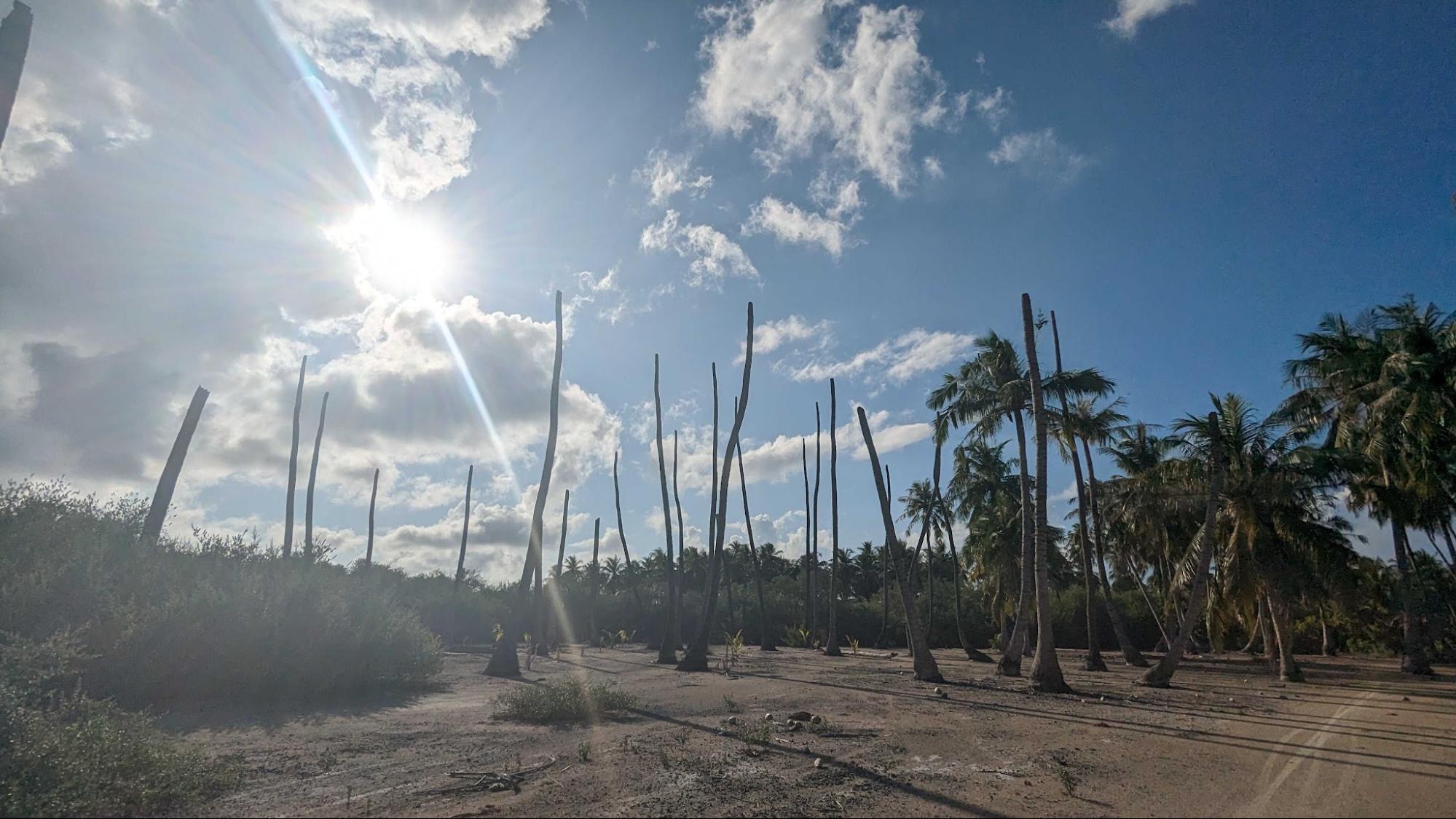
As much as the heat is felt on land, the heat at sea could also be equally important in the Maldives.
The ongoing El Niño has experts sounding the alarm over the potential for coral bleaching. Conservationists have long advocated to halt dredging and coastal development around bleaching windows.
In 2024, on the advice of the Maldives Marine Research Institute, the Environmental Protection Agency ordered a halt to dredging and reclamation during the bleaching window. But an exception was granted for the reclamation of a lagoon for a US$343 million Rosewood resort developed by Qatar's Estithmar Holding to spare the developer daily penalties owed to contractors, Environment Minister Thoriq Ibrahim told local media at the time. The halt was lifted on 10 June, even as the bleaching alert was raised.
Weeks earlier, the UN expert had said that reclamation to build resilience "should be distinguished from projects done for luxury tourism".
The EPA has since been rebranded as the Environmental Regulatory Authority. What regulatory power it had has been rendered largely symbolic. In May, the ERA acknowledged a surge in complaints about permit violations at dredging sites. But the government's "priority projects" have continued.
“There’s not much that can be done to combat bleaching…The only thing that can be done is to reduce the amount of stress that humans put on the corals during bleaching,” Ibrahim Naeem, then-director general of the EPA, said in May 2024.

Discussion
No comments yet. Be the first to share your thoughts!
No comments yet. Be the first to join the conversation!
Join the Conversation
Sign in to share your thoughts under an alias and take part in the discussion. Independent journalism thrives on open, respectful debate — your voice matters.
Support Independent Journalism
Help us keep the news free and fearless
Give once
$
or
Become a memberfrom $5/month

