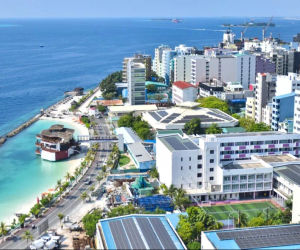

Maldives celebrates Eid under shadow of war
Missiles fly toward Diego Garcia and oil tops US$ 110 a barrel.
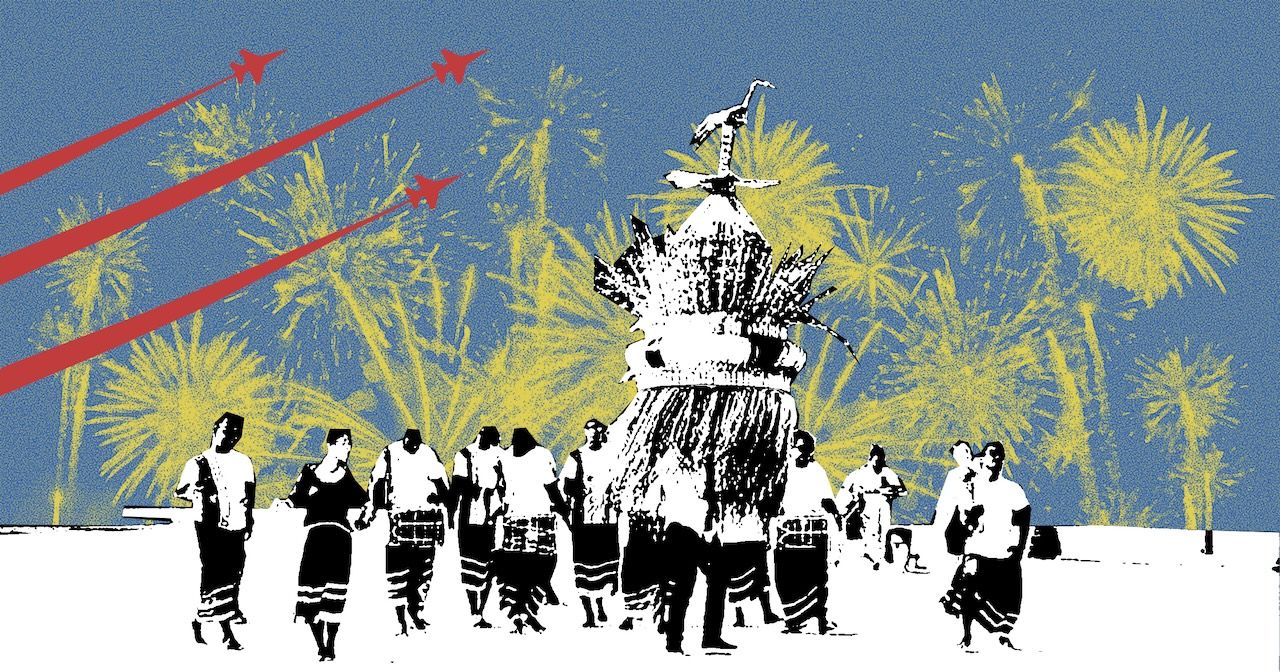
Artwork: Dosain
22 Mar, 15:59
The Maldives celebrated Eid al-Fitr over the weekend with the customary festivities – mass prayers, decorative lights, and children's evenings – even as the US and Israel's war on Iran entered its fourth week with no ceasefire in sight and anxiety grew over proximity to the widening conflict.
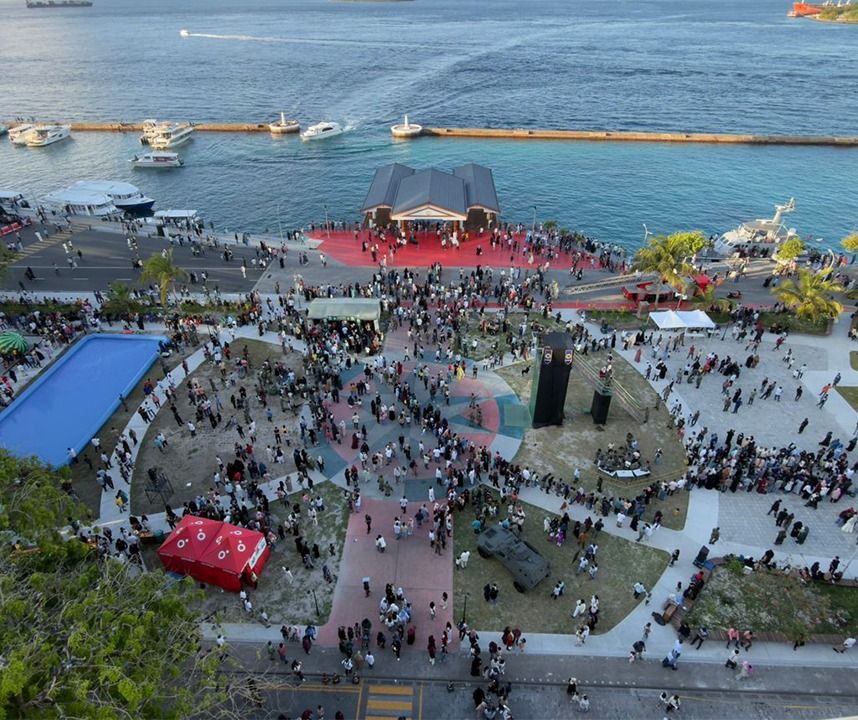
Eid lights went up in Malé and other cities, and communal gatherings proceeded as planned. President Dr Mohamed Muizzu and First Lady Sajidha Mohamed welcomed the public to the presidential residence for Eid greetings on Friday morning. Children's evenings in Malé, Villimalé and Hulhumalé featured rappelling towers, Coast Guard boat rides, and the perennially popular photo opportunities with snipers in ghillie suits and displayed weaponry. Planned by the Maldives National Defence Force in partnership with the police and state-owned enterprises, the events are due to continue across Greater Malé for a third day on Sunday ahead of the reopening of government offices on Monday.
But the celebrations were marked by an undercurrent of unease after reports emerged about Iranian ballistic missiles fired toward the US-UK military base at the Diego Garcia island in the contested Chagos archipelago.
Iran fired two intermediate-range ballistic missiles at Diego Garcia, some 4,000 kilometres from Iran and about 500 kilometres south of Addu City, the Wall Street Journal reported on Friday. Neither missile hit the base. One reportedly failed in flight while a US warship fired an interceptor at the other. The UK's Ministry of Defence confirmed the "unsuccessful targeting" of the base and Iran's semiofficial Mehr news agency initially reported the strike.
But a senior Iranian official told Al Jazeera on Sunday that Tehran was "not responsible" for the attack.
On social media, Maldivians speculated whether the missile's trajectory would have taken it through or near Maldivian airspace. The Maldives government had earlier disclosed that it had been rejecting requests to use Maldivian airspace for military operations. Foreign Minister Dr Abdulla Khaleel did not say who made the requests.
On the eve of Eid, the foreign ministry condemned Israel's strikes on Iran's South Pars gas field as a "blatant violation of international law" that posed "threats to global energy security," while also condemning Iran's attacks on commercial and energy facilities in Saudi Arabia, the UAE, Qatar and Kuwait. It was the government's fourth statement since the war began and its strongest language yet on the Israeli strikes.
Reflecting a foreign policy stance that favours the Gulf bloc, President Muizzu has refused to condemn the assassination of Iran's Supreme Leader Khamenei, saying the Maldives would follow "Arab Islamic nations," a stance that drew sharp criticism from Maldivians who expressed solidarity with Iran as a Muslim nation under attack.
Fuel supplies arrive
On the home front, the government sought to reassure the public over fuel supplies. Two new fuel shipments arrived this week and further deliveries are scheduled under the State Trading Organisation's pre-agreed "nomination" arrangements with suppliers, Economic Development Minister Mohamed Saeed said on X.
The government has been "taking swift and planned measures" under President Muizzu's leadership to minimise the impact on the Maldivian people, Saeed wrote, offering "complete assurance" that fuel, cooking gas, and basic staple foods would continue to be available without disruption.
STO's latest shipment contained enough diesel and petrol for 17 days, Dhauru reported, citing a company official. A gas shipment also arrived and was being unloaded. Further deliveries were scheduled as planned.
But despite STO's promise that it would sell diesel at the old subsidised rates to fishing boats, the Union of Yellowfin Tuna Fishermen said on Friday that boats in the Malé region had not been able to get fuel at the promised prices.
Without affordable fuel, fishermen simply cannot go out to sea, the union said, describing the current prices as the highest in the country's history. It warned that the entire fishing industry could grind to a halt.
"We call on the government to provide immediate assurance that fishing boats will be able to get fuel at a fair price," the union said in a statement.
The government had announced on March 18 that the state-owned Maldives Industrial Fisheries Company would maintain subsidised diesel prices for fishermen under the "Fahi Hakatha" programme, reversing an earlier price increase. Boats selling catch to MIFCO would pay MVR 16.54 per litre, compared to the new retail price of MVR 17.54 for the general public, the government said.
The economic damage so far
On March 16, STO nearly doubled wholesale fuel prices to businesses. Diesel prices in Malé jumped 65 percent. An earlier fuel price rise on March 5 – petrol up 18 percent and diesel up 26 percent in the largest hike in recent history – was already feeding through the economy, raising the cost of electricity, transport, and goods distribution across every atoll, former economic minister Ahmed Mohamed observed in an analysis published on Saturday.
While tourist arrivals were down 21 percent as about 20 flights continue to be cancelled daily out of transit hubs in the Gulf, jet fuel prices at Velana International Airport had risen 42 percent – the highest rate in recent years – prompting airlines to add surcharges that risk making the Maldives a more expensive destination, he noted.
Tourism ministry data shows 81,200 tourists arrived in the first 16 days of March, down from 102,900 in the same period last year, a shortfall of more than 21,700 visitors. The worst day was March 2 when 4,107 tourists arrived, about half the previous year's figure. Weekday arrivals have since stabilised around 4,500 to 5,000.
With petroleum products accounting for nearly a fifth of total imports – some US$ 710 million out of US$ 3.6 billion in 2025 – and 80 percent of fuel sourced from Oman and the UAE, the Maldives remains acutely exposed to disruption in the Gulf. Rising oil prices are estimated to add around US$ 1 million a day to the import bill at a time when public debt stands at roughly 133 percent of GDP and over US$ 1 billion in external repayments fall due this year, including a US$ 500 million sukuk on April 8.
The government response so far had been "muted and fragmented," Ahmed Mohamed wrote. Referring to many countries building fuel reserves, securing alternative supply routes, and deploying targeted support, he argued that the Maldives was "not being asked to do anything unusual but to apply the same kind of timely and coordinated response."
He called for a permanent, means-tested income support system, an unemployment insurance scheme, a formal priority framework for foreign exchange allocation, and the establishment of a Sovereign Resilience Fund. "Resilience must be built before crises occur; not in the midst of one," he advised.
While countries across Asia have imposed emergency measures, including closing schools and universities and rationing fuel and cooking gas, the Maldives has confined its public response to assurances by a ministerial crisis committee. At a press briefing on March 12, Finance Minister Moosa Zameer said the government was seeking US$ 100 million in emergency financing from two multilateral agencies to cover the additional fuel costs. STO's anticipated MVR 1.5 billion annual revenue would also be used to "absorb" the price shock, he noted.
While budgeted expenditures such as the Ramadan electricity bill discount – capping charges at MVR 400 for the month – will continue, Zameer said it was "not business-as-usual" and that the government was proceeding very cautiously. He said spending had been "rationalised" but declined to specify what had been cut. The only visible austerity measure announced was limiting Eid festival lights to designated locations in five cities.
A day after the briefing, the ruling People's National Congress staged a motorcycle rally through the streets of Malé in support of its candidates for the April council elections. Dozens of motorcycles paraded through the capital.
Even if the war stopped tomorrow, the economic pain was already locked in, social commentator Midhuam Saud warned. "Fuel alone could take months, if not a year, to stabilise. Travel won't resume instantly. And with oil prices rising, the cost of goods will inevitably go up," he wrote on X.
"My guess is the government knows how serious this is. But with elections around the corner, they don't want to show weakness."
Discussion
No comments yet. Be the first to share your thoughts!
No comments yet. Be the first to join the conversation!
Join the Conversation
Sign in to share your thoughts under an alias and take part in the discussion. Independent journalism thrives on open, respectful debate — your voice matters.
Support Independent Journalism
Help us keep the news free and fearless
Give once
$
or
Become a memberfrom $5/month