
Asia declares emergency. Maldives says it won't run out of oil.
The damage from the oil price shock is baked in.
Artwork: Dosain
11 Mar, 17:52
Pakistan closed schools. Bangladesh shut down universities and started limiting fuel sales. Sri Lanka's president addressed parliament and disclosed levels of oil stocks. India invoked emergency powers to direct refineries to prioritise domestic fuel, introducing rationing on cooking gas.
The Maldives – which relies entirely on imports for electricity and transport, has foreign reserves covering a month of imports, and must repay a US$ 500 million Islamic bond in less than a month – has done none of this.
The last official communication came at a press briefing on March 3 where the economic minister repeated President Dr Mohamed Muizzu's assurance that the government "will not allow any challenge to be faced with food, fuel and any commodity."
Twelve days into the war in the Middle East, oil prices remain highly volatile and scheduled flights have yet to resume from transit hubs in the Gulf, the primary gateway for up 35 percent of tourist arrivals to the Maldives.
Brent crude, which traded at US $67 a barrel before the United States and Israel began strikes on Iran on February 28, soared to US$ 119 on Monday, the highest in four years. The price pulled back to around US$ 87 after the G7 signalled a possible release of strategic reserves and President Donald Trump said the war would end "very soon."
But even a ceasefire announced today would not bring immediate relief to the Maldives. Energy analysts estimate it would take two months from the reopening of the Strait of Hormuz for oil supply chains to return to normal. The waterway has now been effectively closed for 10 days – the longest major disruption since the Suez Crisis – and Gulf producers including Iraq, Kuwait, Qatar and Saudi Arabia have been forced to cut production because they have run out of storage.
For the Maldives, that means an elevated fuel bill is baked in through May.
The Maldives' fuel imports are primarily sourced through Oman, whose ports lie outside the Strait of Hormuz, through which a fifth of the world's oil supplies flow. But Oman itself has come under Iranian fire, and global oil prices are surging regardless of shipping routes. The country's fuel storage capacity is limited. Muizzu said stocks at the time could last "nearly a month" and that this was "the maximum amount that can be stocked in the country."
Ahmed Mohamed, a former economic minister, calculated that the price spike could add US $1 million a day to the import bill compared to pre-crisis prices. At oil prices above US$ 100 a barrel, the annual expenditure of about US$ 710 million could exceed US$ 1 billion this year, he explained.
If the price fluctuates between US$ 95 and US$ 120 a barrel, "that would mean an extra expenditure between US$ 60 million and US$ 120 million over the next two months," he told the Maldives Independent. "Even in the best-case scenario [where the war ends soon], it would cost US$ 1 million a day more than it did last year," he noted.
In 2022, when Russia's invasion of Ukraine pushed oil past US$ 100, government spending on fuel subsidies rose sixfold to MVR 3.2 billion (US$ 207 million) as the administration kept electricity tariffs unchanged.
The timing of the current oil price shock coincides with an existing commitment. Ahead of Ramadan, which began on February 18, the State Electricity Company announced that electricity bills would be capped at MVR 400 for the month.
The bulk of the Maldives' fuel imports go towards electricity generation. Diesel powers the generators that provide electricity on every inhabited island and resort. When diesel prices exceed a base rate set by the energy authority – MVR 8 per litre for the Greater Malé region and MVR 8.10 for the atolls – utility companies STELCO and Fenaka impose a fuel surcharge on electricity bills.
Ahmed Mohamed questioned the government's ability to sustain blanket fuel and electricity subsidies. "That's why we always talk about targeted support – giving it to the people who need it the most," he advised.
"Our company could go into liquidation"
Resorts are meanwhile taking a double hit with falling revenue and rising costs from more expensive diesel. Seaplane operators, speedboat transfers, and inter-atoll ferries face the same squeeze.
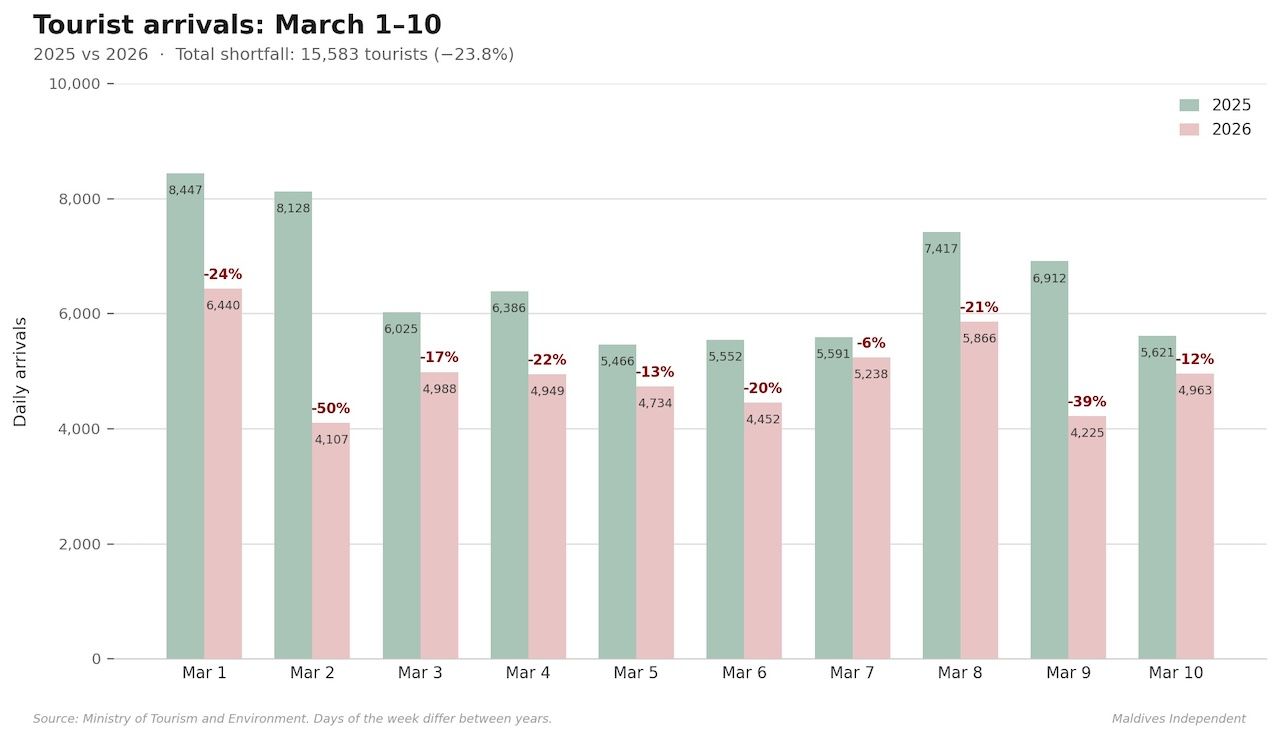
A total of 49,962 tourists arrived in the first 10 days of March, down from 65,545 in the same period last year. The shortfall of more than 15,500 tourists represents a drop of 23.8 percent.
The worst day was March 2, the first full weekday after strikes began. Just 4,107 tourists arrived, down from 8,128 the year before – a 50 percent collapse. The numbers partially recovered mid-week. Last Sunday, arrivals climbed to 5,866. It was the strongest day since the war began. But any hope of a sustained recovery was dashed on Monday, when arrivals dropped back to 4,225. This was nearly 39 percent below the same date last year and the second-worst day of the ongoing crisis.
Gulf aviation is beginning to resume, but far from normalcy. Emirates, the largest Gulf carrier, was operating roughly 60 percent of its network by March 7, carrying about 30,000 passengers out of Dubai daily – a fraction of the 280,000 the airport handled daily before the war. But Qatar Airways remains grounded for scheduled services. It is operating only limited repatriation flights through narrow corridors authorised by the Qatari military. Bahrain and Kuwait airports have been closed for the duration. The European aviation safety agency has advised airlines against operating anywhere in the airspace of 11 Middle Eastern countries, including the UAE, Qatar, and Saudi Arabia. The partial reopening is fragile, subject to the next Iranian missile barrage, and nowhere close to restoring pre-war connectivity.
The VIA arrivals board on Wednesday afternoon offered a real-time portrait of the disruption. Of the international flights scheduled over the following three days, 25 were marked cancelled. Almost all of them were Gulf carrier services. Every Qatar Airways flight to Malé remained cancelled through Friday. Both daily Etihad flights from Abu Dhabi were cancelled on Thursday and Friday. All Gulf Air services from Bahrain were cancelled. Emirates was the only Gulf carrier operating at any volume. Some Dubai flights were landing while others were scrapped.
What remained on the board told the story of what the Maldives' air connectivity looks like without the Gulf: Colombo, Mumbai, Delhi, Bangalore, Trivandrum, Cochin, Kuala Lumpur, Singapore, Bangkok, Shanghai, Moscow, Istanbul, and London on British Airways and Virgin Atlantic.
For tour operators who sell the Maldives to European travellers, the crisis is existential.
The Maldives welcomed a record 2.25 million tourists last year. Europe accounted for more than half of tourist arrivals. The UK, Germany, Italy, and France were among the top source markets. The vast majority flew through Gulf hubs: Qatar Airways via Doha, Emirates via Dubai, Etihad via Abu Dhabi.
Purely Maldives, a UK-based operator that has been selling holidays to the Maldives for 38 years, said the conflict has created a crisis that could threaten the company's survival.
"We are being hit hard by the Middle East conflict," said Richard Eyre. "The major problem is a mismatch between the refund policies of Maldivian islands and the law in the United Kingdom."
Airlines are cancelling flights with as little as six days' notice. Under UK consumer protection law, operators must offer full refunds on package holidays when flights are cancelled. But Maldivian resorts are refusing refunds, insisting instead on date changes within 2026.
"If we try to cancel any island with only seven days until arrival, the islands are refusing refunds and insist on date changes within this year which is contrary to UK law.," he told the Maldives Independent. "This refusal of refunds by islands could mean our company goes into liquidation and ceases trading."
Alternative routes exist, including British Airways, Sri Lankan Airlines, Singapore Airlines, Oman Air. But at four times the cost of a Gulf carrier flight. "Booking a direct flight is now an extortionate uplift in cost," Eyre said.
"People are not concerned about Maldives as a destination – they know it is safe," he noted.
Direct return flights from London to Malé for Easter week were listed at nearly £ 7,000 on Virgin Atlantic, according to Google Flights data. The usual price range for similar trips is £ 1,150 to £ 2,000. Routes via Gulf hubs remain far cheaper – as low as £ 849 via Abu Dhabi – but require transiting through a region where airports have been struck by missiles and governments are advising against travel.
The UK Foreign Office updated its travel advice for the Maldives on March 5, warning that Middle East airspace restrictions "may affect your travel plans even if your journey does not transit the Middle East." The advisory told British nationals to check with airlines and tour operators before travelling, review their insurance, and monitor the situation.
Asked how long the disruption could last, Eyre's answer was blunt: "It depends on what Mr Trump decides to do. This could last seven days or seven months. Nobody knows."
One category of arrivals remained unaffected. At least 16 private jets were scheduled to land at VIA last Wednesday, a level of traffic normally associated with the Christmas and New Year peak.
"The Middle East has a significant number of business jets, and with the current situation, many of them may be repositioning out of the region," Mohamed Firaq, CEO of tour operator Inner Maldives, wrote on Facebook, calling on authorities to introduce temporary parking incentives, streamline permit procedures, and position Gan and Hanimaadhoo airports as safe Indian Ocean aviation hubs: "We need to open our minds and look at this strategically."
Dive liveaboard operators are also carrying on. Blue Force Fleet, a Spanish-owned company with more than 30 years in the Maldives, told travel agents its weekly departures are "fully guaranteed" and offered stranded guests a 50 percent discount to remain on board until their flights resume.
Failure to communicate
As countries across Asia impose austerity measures to conserve energy supplies, the Maldives government has been facing growing criticism over its silence.
Ahmed Mohamed said the formation of a cabinet subcommittee fails to address the concern over the lack of clear communication. “What do they do? What will they do? What has been done? That much has to be disclosed,” he said.
He referred to India’s ministry of petroleum announcing rationing plans. “Every measure taken might not be news that satisfies everyone. But the government needs to clearly communicate the measures and difficulties," he said.
At an opposition rally on Sunday night, former President Ibrahim Mohamed Solih said it was incumbent upon the government to educate and inform the public. "We are a country that's completely dependent on imports. Whether that's tourists, food, or fuel, this is a completely import-dependent country," he said. "What's most important is disclosing true information to the public. To stop misinformation. That can be done by the government. It's the government that would have complete information."
Hussain Amr, a former managing director of STO – the state-owned company that imports the country's fuel – echoed the call: "The high oil price is putting pressure on USD liquidity, pushing food prices up and increasing pressure on the reserve for the debt repayments/ The government should communicate clearly with the public about its assessment and preparedness. This is not a time to be silent."
At his press conference last week, Economic Development Minister Mohamed Saeed told reporters that despite oil price hikes of up to 30 percent, there was "no concern yet" and that the Maldives "will not run out of oil."
The ministerial committee has been "working day and night," exploring alternative markets and routes, Saeed said. While he acknowledged the extreme vulnerability of the tourism-dependent economy to external shocks, Saeed said the Maldives has previous demonstrated resilience by becoming the first to recover after global crises such as the Covid-19 pandemic, which he said was "perhaps the best omen."
Saeed and the president's spokeswoman Heena Waleed were not responding at the time of publication. Government offices are closed during the last 10 days of Ramadan.
Six-month window
At a press conference by the opposition Maldivian Democratic Party's economic committee on Wednesday, Amr warned that the real financial impact of the oil price shock will hit the Maldives much later because STO pays for fuel imports about six months after delivery. "That means we are currently paying for fuel imported about six months ago," he explained. "So we do have time right now to get things in order."
But that window is closing. Even if the war ends soon, the bills for fuel purchased at US$90 to US$ 120 a barrel will arrive in August and September. If the government does not act now, the consequences will be far worse later, he said.
"Before the war, the government said there were two months of reserves. But that figure was based on the amount of dollars that would go out at the oil price at the time. When the price of oil suddenly doubles, two months of reserves instantly becomes one month," he said.
"The biggest concern is the black market dollar rate rising, and import costs increasing as a result, and with that the cost of living becoming unbearable for the people." Larger economies have already begun taking emergency measures, Amr noted. "We are not seeing that from the Maldives. That is a concern."
As anxious citizens of neighbouring countries queued up for cooking gas amid fears of shortages, the Maldives military announced a three-day Eid festival across the Greater Malé area, organised with 10 state-owned companies including STO, the fuel importer, and STELCO, the electricity provider. Decorative lights are being strung along the streets of Malé and other islands.
The tourists who can't leave
A British couple whose "once in a lifetime" trip to celebrate a 40th birthday turned into an open-ended stay at a Holiday Inn at £ 500 a night after Gulf Air cancelled their flight via Bahrain. Their travel insurance does not cover war. "At the start we thought it was exciting to be there a few more days," Lauren Higgins told the Yorkshire Post. "But once you realise how long you could potentially be here, it does get quite scary. I'm putting everything on my credit card, but once that's maxed out, what do we do?"
Earlier this week, Firaq, the local travel agency operator, recommended the formation of a task force "to monitor and control any overcharging of hotel rooms or services." He urged hotels to "consider offering special extension rates instead of increasing prices under FIT rates" to about 1,500 tourists who were forced to extend their stay. "This will protect both our guests and the reputation of Maldives tourism," he suggested.
On March 7, the Visit Maldives Corporation, the government's tourism promotion agency, said it had facilitated eight repatriation flights, including dedicated services to Germany and France, and set up a help desk at VIA in coordination with the state-owned Maldives Airports Company Ltd and the tourism ministry.
Repatriation flights over the past week included a charter flight that carried 120 Bulgarians, hundreds of Polish tourists rescued by the national LOT Polish Airlines, 28 Italian tourists who departed on Costa Deliziosa, and Danish tourists taken back by travel company TUI. A Japanese air force plane arrived on Sunday to support the evacuation of Japanese nationals from the Middle East.
The Visit Maldives statement outlined a pivot in marketing strategy: targeting India, China, Russia, and other Asian markets "where travel disruptions have been comparatively less severe" to offset the loss of European arrivals.
"Looking toward long-term recovery, Visit Maldives is developing a coordinated Crisis Response Strategy for the destination. The corporation intends to convene an industry-wide discussion shortly to share insights, align recovery tactics, and identify practical measures to support the sector," the corporation said.
The macro picture
Regardless of the pace of tourism recovery, in less than a month, the government must repay an US$ 500 million sukuk, the Islamic bond issued in 2021 at a near-10 percent profit rate.
At a press conference on March 2, President Muizzu said US$ 650 million was available: US$ 320 million in the Sovereign Development Fund and US$ 330 million in usable reserves. He said the sukuk could be repaid even without refinancing.
Muizzu projected confidence about the economy. "We have no concern over foreign debt. No concern at all," he said. He claimed the economy was "in a very healthy state" and that there was "no cause for concern yet," while adding that the government was "preparing for the worst case scenario as well."
Appearing on Dhauru's podcast, Ahmed Mohamed challenged those figures. The SDF held US$ 172 million in usable funds at the end of 2025, he said, citing published data. By February, it had grown to just US$ 190 million, an increase of $18 million in two months. "Can $300 million have been accumulated in a single month?" he asked.
Even taking the president's figures at face value, paying the sukuk from reserves would wipe them out. "Usable reserves right now cover one month of imports," he said. "We are talking about emptying the usable reserves entirely."
Speaking to the Maldives Independent, Ahmed Mohamed noted that the government would have options including other financing mechanisms.
He stressed the importance of financial discipline. Oil shocks and geopolitical repercussions arrive in the form of rising oil prices and dwindling foreign exchange reserves. “If we aren’t ready to receive the shock, we’ll face hardship very soon. But if we try to organise through good financial discipline, we can maintain things at a manageable level for a longer period," he said.
Muizzu's press conference – his first in 304 days – was dominated by questions about the assassination of Iran's Supreme Leader and the government's refusal to condemn it.
The government's economic dependence on Gulf states shapes its diplomatic posture. Muizzu told journalists he had spoken to the UAE president to convey solidarity. Calls were also planned to Saudi, Qatari, Bahraini and Omani leaders.
Gulf investors are among the largest in the Maldivian tourism industry. Qatar's Assets Group owns the Waldorf Astoria Ithaafushi and the recently opened Rosewood Ranfaru. A joint venture between Qatar's Assets Group and Dubai's Kazbah International is building the Atlantis resort, an investment estimated at over a billion dollars.
Under former President Abdulla Yameen, the Maldives severed diplomatic ties with both Iran and Qatar in line with Saudi wishes. Both relationships were later restored.
Eleven days into the war, the foreign ministry issued a second statement on Tuesday, going further than its initial call for de-escalation on February 28.
"The Government of Maldives strongly condemns the attacks by Iran against Saudi Arabia, UAE, Qatar, Kuwait, Bahrain and other brotherly countries," it read, expressing "particular concern" over strikes on civilian locations including airports and oil facilities, and noting that these Gulf states had not retaliated.
It also explicitly condemned the US and Israeli strikes on Iran, including the attack on a girls' school that killed more than 100 civilians. The statement called for an immediate ceasefire.
The foreign ministry released a third statement on Wednesday, this time condemning an attack on the UAE consulate in Iraqi Kurdistan and expressing "full solidarity with the Government and the brotherly people of the United Arab Emirates."
Writing in Dhauru, economist Ibrahim Athif Shakoor warned that hoping for a swift resolution does not remove the obligation to prepare for the worst.
"Even while praying that such a situation does not arise, preparing for it cannot be anything other than a necessity," he wrote. "And such preparation is not the responsibility or duty of governments alone. I believe that it is necessary for the government and private companies, families, and individuals to start thinking about the situation today and begin tightening their belts."
Discussion
No comments yet. Be the first to share your thoughts!
No comments yet. Be the first to join the conversation!
Join the Conversation
Sign in to share your thoughts under an alias and take part in the discussion. Independent journalism thrives on open, respectful debate — your voice matters.
Support Independent Journalism
Help us keep the news free and fearless
Give once
$
or
Become a memberfrom $5/month