

Middle East war leaves Maldives exposed on every front
Flight cancellations, surging oil prices and a US$ 500 million debt deadline collide.
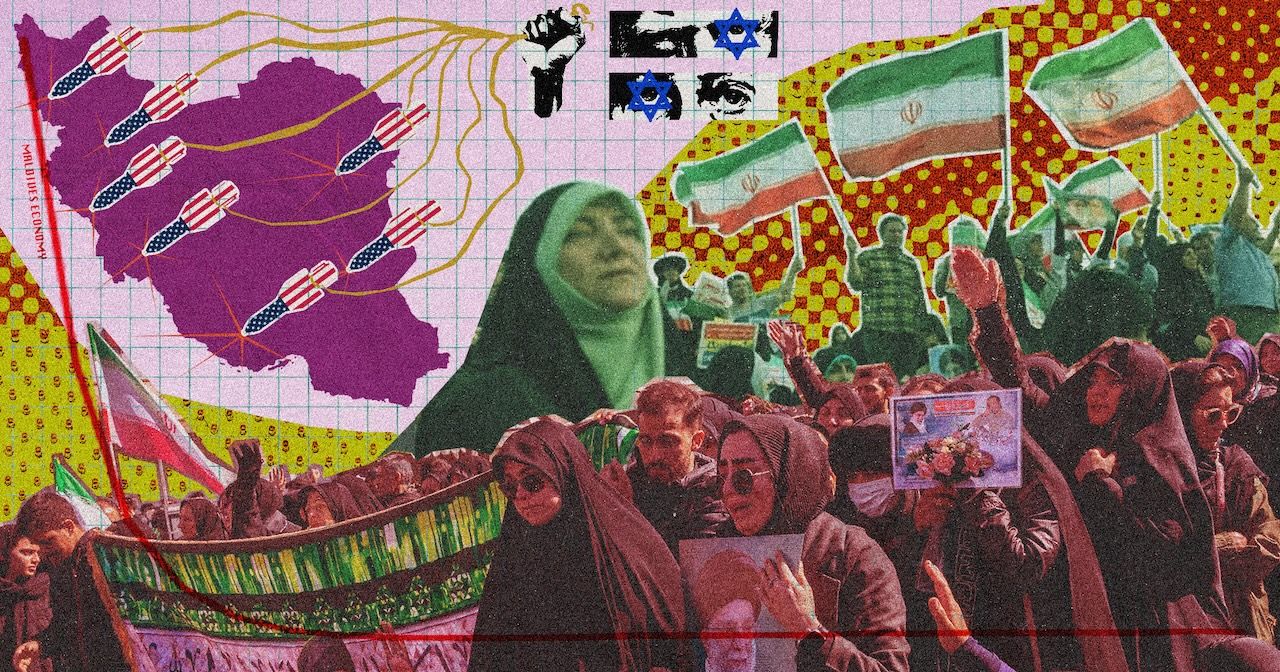
Artwork: Dosain
02 Mar, 12:29
The departure board at Velana International Airport told the story on Saturday night. Every flight bound for transit hubs in the Gulf – Emirates to Dubai, Etihad to Abu Dhabi, Qatar Airways to Doha, Gulf Air to Bahrain – was marked in red. Thousands of tourists were left stranded. Private jets were forced to turn back after UAE airspace closed beneath them.
The Maldives' connection to the world beyond South and East Asia remained severed two days later. Fifteen inbound flights from Middle Eastern airports, which serve as the primary gateway for tourists, were cancelled on Monday.
In February, the Maldives welcomed 8,800 tourists a day on average. "When we looked at the figures, roughly 30 to 35 percent arrived on Middle Eastern flights," Tourism Minister Thoriq Ibrahim told the press on Sunday. "However, we are looking at what options we have to bring tourists to the country and what other markets there are, and to minimise the coming slump as much as possible."
The emergency response includes focusing on Asian markets, seeking alternate routes and increasing direct flights from Europe and Russia. "We are looking to increase the frequency of flights that do not transit through the Middle East. The China and India markets are ones where increased frequency could help us fill the gap," Thoriq said.
When every route through the Gulf was cancelled, the VIA departure board on Sunday showed what remains: flights to Colombo, Cochin, Shanghai, Chengdu, Hong Kong, Bangkok and Mumbai were operating as normal. China is the largest single source market, representing 16 percent of arrivals. Russia is the second largest at 11 percent. Both have direct connections. Tourists from India, the seventh largest market, fly direct from multiple cities.
However, European tourists accounted for more than half of all arrivals in January, roughly 127,000 out of 225,000 visitors (excluding Russia). Nearly all of them reached the Maldives by transiting through Dubai, Doha or Abu Dhabi. Six of the top 10 source markets are European: Italy, the UK, Germany, France, Poland and Switzerland together account for over a third of the 473,000 tourists who arrived during the first two months of 2026.
Grounded
According to the Maldives Airport Company Ltd, the state-owned operator of the Velana International Airport, nine flights were cancelled on Saturday, affecting 1,716 passengers. The cancellation of 19 flights on Sunday affected 3,530 passengers. A FlyDubai flight was forced to turn back mid-air on Saturday. Two private jets, a VistaJet bound for Slovakia and a Qatar Executive flight heading to Cyprus, met the same fate.
MACL established a Disruption Management Centre and set up dedicated service counters for airlines with cancelled flights. Essential support was provided to 130 passengers by the end of Saturday night, the company said.
Thoriq said most tourists wanted to return to their resort. Some chose hotels in Malé, others flew back on different routes, and the rest stayed at the airport. The government is facilitating departures, coordinating with airlines, and providing accommodation, water and internet services at the airport, he said.
"Tourists are seated quite comfortably inside the terminal. In addition to that, MACL is now providing blankets and other items on the floor so that tourists can get some sleep. The government, the industry, and MACL are all working to see how we can best assist the stranded tourists to spend tonight comfortably, and to continue supporting them until they are able to depart," Thoriq told state media after visiting VIA on Saturday night. "We are also looking at arranging additional comforts for families. We plan to open and clean the former Island Aviation lounge and make it available for families to stay in."
The old domestic terminal and the ground floor beneath the restaurants were cleared for their use. Airport staff laid out sleeping bags and blankets as tourists bedded down. The tourism ministry advised resorts and other establishments to carefully verify departure details and airline schedules prior to check out. MACL urged passengers to check their flight status before heading to the airport.
"This clearly shows how fragile the current situation is and how quickly external factors can affect us," observed Mohamed Firaq, who runs top local tour operators.
Oil, food and supply chains
The crisis was triggered by joint US and Israeli strikes on Iran on Saturday. Iran's Supreme Leader Ayatollah Ali Khamenei was killed in an airstrike on his Tehran compound, along with the head of the Revolutionary Guards and other top security officials. Iran launched waves of retaliatory missile and drone attacks targeting Israeli cities and US military installations across the Gulf.
The conflict has spread far beyond Iran and Israel. Iranian missiles and drones struck targets in the UAE, Qatar, Bahrain, Kuwait, Saudi Arabia, Oman and Jordan. On Sunday, Israel launched fresh large-scale strikes on Tehran. President Donald Trump said the operation could take "four to five weeks."
Unlike the 12-day war between Iran and Israel last June – which ended in a ceasefire that allowed the Maldives to breathe a sigh of relief – the current conflict has no apparent off-ramp. Gulf airspace remains closed with no timeline for reopening. The Strait of Hormuz, through which a fifth of the world's oil passes, has been effectively shut down. Iran's Revolutionary Guards warned that no ship will be allowed to transit the waterway. Major shipping lines have suspended operations in the Persian Gulf.
According to the Maldives finance ministry, oil imports to the country are primarily sourced through Oman, whose ports lie outside the Straits of Hormuz. The government is working with the State Trading Organisation to ensure an uninterrupted supply, it said.
However, Oman itself has come under Iranian fire and global oil prices are set to surge regardless of shipping routes. When markets opened on Monday, Brent crude jumped to above US$ 82 a barrel before settling around US$ 76, up from Friday's close of US$ 73. Analysts warn that prices could reach US$ 90 if the conflict drags on and over US$ 120 if Iran enforces a full blockade of the Strait of Hormuz chokepoint.
The Maldives spends an average of US$ 443.6 million per year on diesel imports, most of it for electricity generation. When Russia’s invasion of Ukraine drove up oil prices beyond US$ 100 per barrel in 2022, government spending on fuel subsidies to keep electricity tariffs unchanged rose sixfold, ballooning to MVR 3.2 billion (US$ 207 million).
Ahead of Ramadan, which began on February 18, the State Electricity Company announced that bills would be capped at MVR 400 for the month, an annual discount that now collides with a surging oil import bill.
Unlike fuel, food and other essential imports route through Dubai's Jebel Ali port or other Gulf logistics hubs that are inside Hormuz.
The economic ministry said it is working to ensure that essential stocks remain available, identify potential disruptions to shipping routes, and explore alternative markets.
In light of the impact on tourism and aviation, the finance ministry said it will adjust fiscal policy "to maintain the Maldives' macroeconomic stability and ensure the uninterrupted delivery of public services".
The ministry claimed foreign currency reserves were at an unprecedented level, citing record-high gross official reserves of over US$ 1 billion, which it suggested could be used to "overcome external economic shocks, arrange funds needed to import goods, and strengthen necessary economic measures".
However, according to central bank data, usable reserves stood at about US$ 220 million in January, less than a month's import cover.
The crisis comes as the Maldives prepares to repay a US$ 500 million Islamic bond due in April. The government's plan hinges on refinancing US$ 350 million and drawing down the Sovereign Development Fund to cover the rest.
"No concern at all"
At the first of his new weekly press conferences on Monday morning, President Dr Mohamed Muizzu said a nine-member ministerial committee formed to coordinate the government's response has been active since Saturday afternoon, seeking to "minimise the impact on tourism" and monitor the situation of Maldivians studying or residing in the Middle East.
Muizzu projected confidence about the impact on the tourism-dependent economy. There is no cause for concern about food or fuel supplies over the coming days, he assured. "It's mainly fuel, food and tourism – these are the three areas that we are addressing in relation to this," he said.
A fuel shipment left Oman on February 28, Muizzu revealed. The government is also trying to secure a further shipment, he said. "At the moment, we have enough fuel for nearly a month," he said, adding that this was "the maximum amount that can be stocked in the country."
The government will be able to meet upcoming debt obligations, he declared. "To put it briefly, we have the money to pay the sukuk even if it's to be paid today," he said, adding that US$ 650 million has been saved for the payment on April 8.
This includes US$ 320 million in the Sovereign Development Fund as of Sunday night and US$ 330 million in the usable reserve, he revealed. The gross reserve stands at a record US$ 1.27 billion, which he said would help with "managing the impact" of the Middle East conflict.
But central bank data as of January showed usable reserves of about US$ 220 million after accounting for forward swap commitments, while the Sovereign Development Fund stood at US$ 126 million in November according to Moody's.
Muizzu went on to say that successful negotiations are nearing conclusion on other financing sources. "So we have no concern over foreign debt. No concern at all," he repeated.
The president made it clear where the Maldives government's sympathy lies. Muizzu said he spoke to the UAE president on Sunday night to convey the Maldives' support and solidarity. Phone calls have been scheduled with the Saudi Crown Prince and Qatar's Emir as well as leaders of Bahrain and Oman this afternoon, he added.
"I will give this same message, that the Maldivian people stand with the people of all those countries in this ongoing, very dangerous war," he said.
The foreign ministry meanwhile urged Maldivians living in Middle Eastern and Gulf countries to remain vigilant, avoid going outdoors and follow the guidance of local authorities, and advised them to register with the nearest embassy to ensure they can receive consular support.
The higher education ministry said it is monitoring the safety of Maldivian students in affected countries and maintaining communication with diplomatic missions and educational institutions. The Islamic ministry said it is tracking the situation of Umrah pilgrims in Makkah and urged Maldivians travelling for the pilgrimage to exercise extra caution with all travel arrangements.
"The Maldives denounces attacks from all sides and urges an immediate de-escalation of tensions," the foreign ministry said, calling for "the restoration of peace and stability, and for all parties to act in full respect of international law and their obligations under the United Nations Charter."
Discussion
No comments yet. Be the first to share your thoughts!
No comments yet. Be the first to join the conversation!
Join the Conversation
Sign in to share your thoughts under an alias and take part in the discussion. Independent journalism thrives on open, respectful debate — your voice matters.
Support Independent Journalism
Help us keep the news free and fearless
Give once
$
or
Become a memberfrom $5/month

