
The week the state moved: rebuilding a mental health system mid-crisis
1,300 on the waitlist and a hospital a year away.
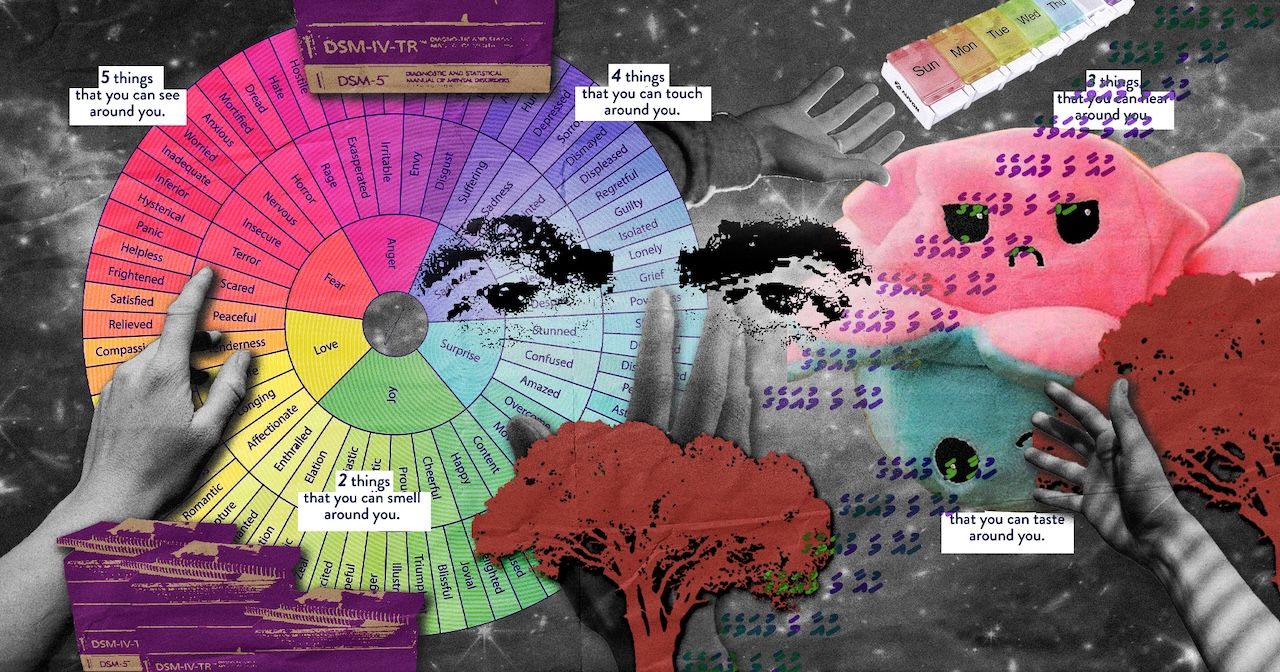
Artwork: Dosain
30 Apr, 17:54
If you or someone you know is struggling, the National Mental Health helpline is available at 1677. A list of additional support services is available at mhsgmv.org/get-help.
Over the past five days, the government announced a series of measures on a slow-burning public health crisis.
A mental health hospital was fast-tracked. The health minister met the police commissioner to coordinate support services that have long operated in parallel. The National Mental Health Department advertised 12 new posts. The department's director and a deputy health minister appeared on state TV to discuss government policies. A school counsellor followed to discuss bullying.
On Monday, President Dr Mohamed Muizzu began his weekly press conference by acknowledging that the mental health support infrastructure was not "at the desired level". Instead of waiting for foreign loan assistance as previously planned, the hospital pledged during his campaign will be built with government funds, he announced.
The president characterised mental health as "a big problem that has been growing in the country and one that has reached a point where it needs additional assistance."
The decision to quickly proceed with a dedicated facility in the Greater Malé Region – without scrapping a separate mental health hospital project designated for Laamu Gan – "[underscores] the growing urgency of addressing mental health issues in the Maldives," the President's Office said.
Muizzu pointed to insurance coverage for mental health treatment with effect on January 1. Since then, 10,953 patients have sought psychiatric consultation and psychological therapy as of April 24, he said.
The figure is a measure of the policy working by removing a fee barrier that kept people out of formal care. But it is also a measure of the unmet need.
This week's announcements followed the death of an 18-year-old student in a Maldives National University dormitory in the early hours of Monday, April 20.
On Wednesday, 10 civil society organisations issued a joint statement on the state's handling of the case, describing the architecture the deceased moved through in her last hours – police victim support, university dormitory staff, and the wider mental health response – as fragmented and under-trusted for years.
Much of what the system needs cannot be built in a week. Mental health and psychosocial support services have been shaped by decades of underinvestment, geography and stigma, a mapping study published by the Asia Foundation in November observed. In February last year, the Muizzu administration endorsed a five-year National Mental Health Strategic Action Plan intended to retrofit and develop the inadequate architecture.
The hospital
The new hospital will take a year to build, the president said. In the meantime, the focus would be on increasing capacity at existing facilities – therapists and other staff at the Malé Group hospitals, regional and tertiary hospitals – alongside improvements to the helpline and to inter-agency protocols on how cases are handled.
The National Centre for Mental Health at Malé's Indira Gandhi Memorial Hospital is the country's main public provider. The centre opened in 2019 with a multidisciplinary team. A nine-bed inpatient psychiatry unit was added in 2022. Its existing facilities remain stretched.
"There's five or six rooms in the psychiatric ward, which is very limited," said a counsellor at a private mental health clinic in Malé, who asked not to be named. "I know patients who likely needed hospitalised care have been sent home after prescribing medication."
Aminath Shahuza, director of the health ministry's National Mental Health Department, said this week that the waitlist reflected both rising awareness and a structural problem in how services are organised. Appearing on PSM's Komaakoalhi programme on Tuesday night, she suggested the answer was not simply more capacity at the centre but a redistribution across tiers. "Everyone is going to a psychiatrist," she said. "We end up on a waitlist because we don't have the right information. Instead, we need to broaden these services at different levels within our health services."
The action plan highlighted the tension between the manifesto-pledged hospital and a more decentralised, community-based model recommended in earlier planning documents. Building a dedicated rehabilitation facility "could lead to institutionalisation of [people with lived experience]" against current global best practices. WHO guidance is for mental health services to be integrated into primary care and for individuals to be treated in the community, it noted.
The Asia Foundation report stressed the gap that keeps people in crisis is the absence of tiered care: community-level first response, school-level support, and primary-care integration.
The surge
The 10,953 consultations recorded since January likely represent the release of latent demand. The trajectory is not new. NCMH consultations rose from 7,246 in 2019 to 17,708 in 2020. It has continued to climb. A 2023 Human Rights Commission study found that 26,627 people had accessed Aasandha for mental health treatment in the preceding five years, 63 percent of them in the Greater Malé area. The number of people taking mental health medication for the first time rose from 203 in 2017 to 9,163 in 2021.
Of the 10,953 consultations from January 1 to April 24 this year, 8,125 were in Malé.
Appearing on PSM, Deputy Health Minister Aminath Ismail suggested the broader trajectory reflected a change in public attitudes rather than a sudden spike. "In the past, people were frightened or found it hard to talk about this because they might get labelled, or people didn't know what the treatment was," she said. A WHO STEPS survey had found that one in five people in the Maldives suffered from depression, she said, including 13 percent of teenagers.
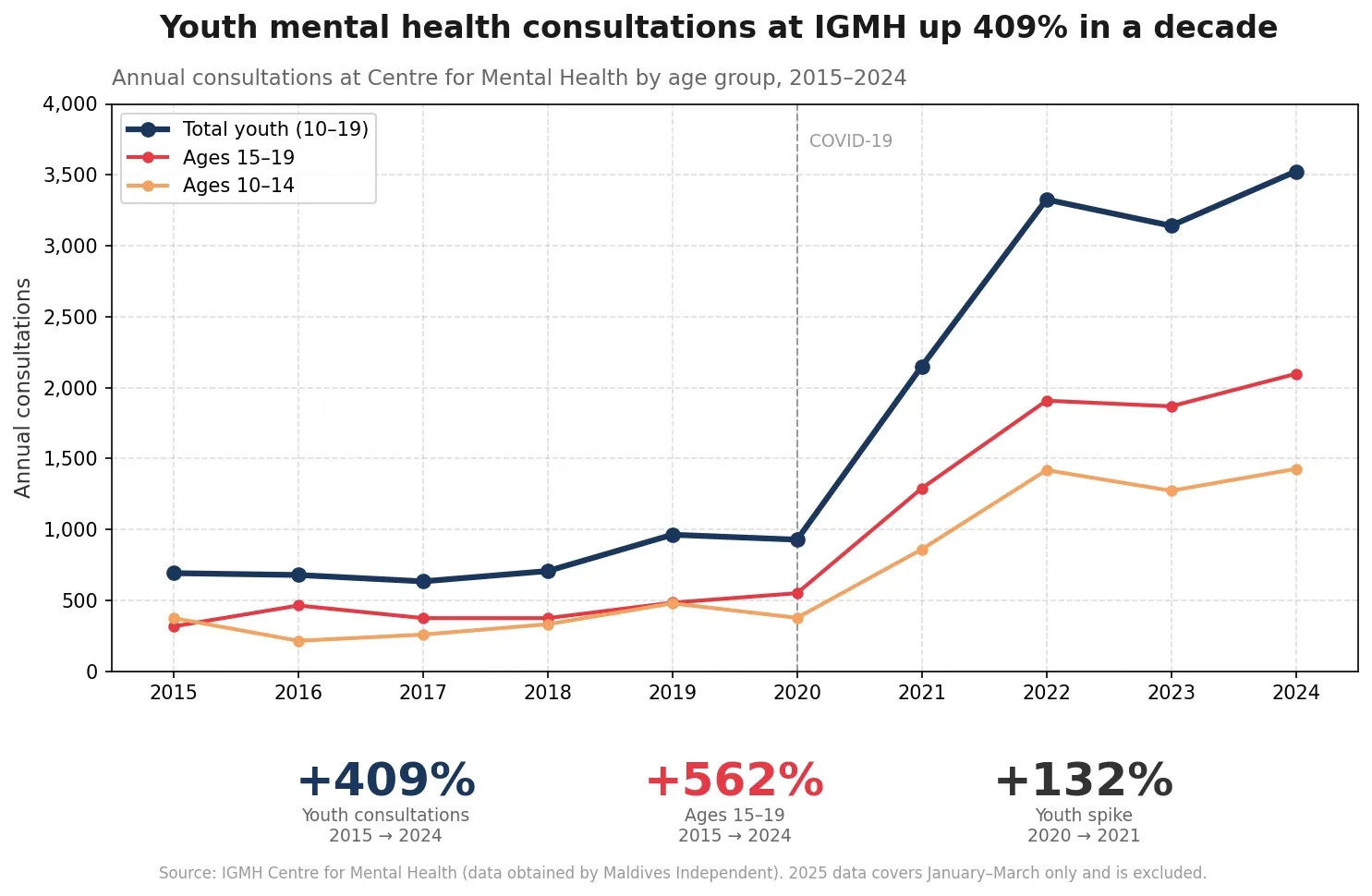
Data obtained by the Maldives Independent from IGMH showed youth mental health consultations for patients aged 10 to 19 increased by more than 400 percent or about fivefold between 2015 and 2024.
The Maldives Independent checked IGMH's online appointment portal on Thursday. A person requesting a first appointment would be placed 1,300th on the waitlist, unlikely to be seen within the next year at current wait times.
Private providers are absorbing part of the overflow. "Accessing mental health support through NCMH takes a long time," said the counsellor at the private clinic. "There's a long waitlist. It could take somewhere from three months to several more months. For people requiring immediate help, this is difficult, which is why we get a lot of people coming to private clinics."
Her own clinic has about 100 people on the waitlist for its two psychiatrists. Aasandha covers part of the cost: MVR 100 (US$ 6.5) of an MVR 600 initial consultation, MVR 200 of follow-ups, and MVR 1,500 of an MVR 3,800 psychological assessment.
"Starting Aasandha has made it a bit more difficult for our operations," she said, citing payment delays from the finance ministry, including outstanding sums from last year. "But we keep it going because it helps the public."
Abyan Ali, 19, said the cost is what most of his peers run up against. "If you go to IGMH there's like a thousand people on the waitlist, and if you go to a private clinic it's MVR 600 for a single session," he told the Maldives Independent. "If you do an actual assessment I think it's even higher, something like MVR 3,000."
Last Friday (April 24), the health ministry released a statement expressing concern over recent tragic incidents and appealed for empathy and compassion. The National Mental Health Helpline 1677 offers 24-hour psychological first aid, it noted.
The dozen posts in a single week speak to the staffing shortfall documented in the action plan, the baseline of which counted 14 psychiatrists nationally as of 2021, with a target to train 25 additional specialists by 2028.
The coordination
On Tuesday, Health Minister Geela Ali met Commissioner of Police Ahmed Mohamed to discuss strengthening the country's mental health response. According to the police, the pair discussed the importance of all relevant institutions working together, the quality of services, and the operational challenges police face when responding to mental health cases.
The Asia Foundation report noted that the system was a set of parallel structures – police victim support, the helpline, the Family and Children Service Centre, primary health care, NCMH – that do not function as a chain.
National Mental Health Department director Shahuza, on the same state TV appearance, said the country lacked an adequate referral mechanism for people calling the helpline: "Where would that person go next, which centre could they go to? How would people at regional hospitals be referred if they're going to another hospital?" Callers might also be living with co-occurring conditions, she noted, including substance use or other social difficulties.
"Some of my friends have called the national helpline," Abyan said. "They said it was good for the support they needed for that time, but it's not a long-term help. For the long-term what we need is facilities that can provide accessible and affordable help and not somewhere with a queue of 1,000 people or is insanely expensive."
Geographic access compounds the structural problem. "There's very few mental healthcare providers in the islands," the private clinic counsellor said. "Most people have to come to Malé for checkups."
Online sessions, expanded during the pandemic, have helped at the margins, but only around five percent of her clinic's clients use them. The action plan's target is a Specialist Mental Health Service in six regions by 2029. Five regional hospitals currently have psychiatrists. Only Ungoofaaru Regional Hospital has implemented the four-bed atoll-level unit envisaged in earlier planning.
The disclosure
The administration's broader push on mental health this week followed widespread outrage over Homeland Security Minister Ali Ihusan's decision to read out an 18-year-old's messages to the police victim support unit at a press conference the previous week.
Asked about the disclosure on Monday, President Muizzu defended the act and condemned it in the same breath.
"It's not proper under international standards," he said. "It's not something that those who work in this profession believes, and I don't believe either that it needed to be done like that, that the information should be disclosed."
But the disclosure had been "forced" by unfounded claims and gossip on social media, he contended. Police officers responding to such cases were being placed under pressure and their families faced danger, he said. In the future, Muizzu said he had instructed officials "not to give any details no matter how much pressure there is". When media and others sowed suspicion, "what spirals is a very dangerous thing".
The Asia Foundation study identified confidentiality fears as a primary reason young people in the Maldives avoid formal services, turning instead to AI chatbots and online platforms because, as one young respondent put it, "AI systems are a private chatbot, so there is no fear of leaking."
The civil society organisations – among them the Maldivian Nurses Association, co-author of the Asia Foundation report – called the disclosure a "grave violation of privacy" and warned that it would further erode trust.
"These are not isolated incidents," the coalition wrote. "It reflects a pattern in which the state has repeatedly failed to uphold the privacy and dignity of persons who have died allegedly by suicide. Such actions cause direct harm: they discourage help-seeking behaviour, erode public trust in mental health and psychosocial support services, and send a chilling message to those who consider reaching out for support."
In the days that followed Ihusan's press conference, demand for private mental health support increased. "Since the recent cases, we have been getting more calls, and messages on Instagram or Facebook or via email," the counsellor said. "People reaching out because they are overwhelmed and explaining why they need help." It is a pattern the clinic now anticipates after public incidents.
Abyan said the disclosure had hardened a pre-existing reluctance among his peers to involve the police at all. "I think it will make people more unlikely to seek help, especially from the police, because already people don't believe police can help when something happens and just deal with it on their own," he said.
He drew a connection to a previous case in which accountability had not materialised. "We need accountability from the police. We need awareness, yes, but we also need justice. We didn't get justice in Yumn's case either, it just fizzled away. Personally, I don't want this to fizzle away. We need to see the police held accountable."
The coalition's statement, endorsed by Journey, Project ThimaaVeshi, Uthema, The Eco Org, Blue Guild Foundation, the Neurodiversity Association, the Maldives Local Councils Association, Hope for Women, the Maldivian Nurses Association and WINGS, set out six demands.
The government should issue a public apology to the family; open a formal investigation into how the home minister obtained and disclosed the messages; investigate bullying allegations that have surfaced in connection with recent deaths; convene civil society consultations on mental health and psychosocial disability policy; enact a legal framework on data privacy in cases of alleged suicide consistent with the Convention on the Rights of Persons with Disabilities; and establish an oversight mechanism for psychosocial service providers, with a mandate to monitor, investigate and hold providers to account.
Online
On Reddit's Maldives forum, threads on bullying, suicidal thoughts, the loss of family members, and the police response to the MNU case have drawn hundreds of comments. Redditors have offered each other support and shared what mental ill-health and crisis look like from the inside.
In one thread, a poster who survived a past attempt described the disclosure of the MNU student's messages as something they had begun to imagine in their own case.
"Since the suicides, I have been going through flashbacks of my own attempt and how the police saved my life. Not always does the system fail," they wrote. "I kept reliving the moments and wondering if I was successful, how the state would publish my last communication."
They added: "I'm only here alive because of a few who stuck around."
The Asia Foundation report identified the migration to online platforms as a marker of trust deficit in formal services.
The bullying bill
Also on Monday, the president announced plans to submit an anti-bullying bill to the People's Majlis. On Wednesday evening, Fathmath Natasha, senior counsellor at the Centre for Higher Secondary Education, appeared on PSM to discuss bullying and youth mental health.
The Asia Foundation report identified the dominant proximate drivers of distress among young Maldivians as stigma, isolation, family dynamics, the absence of accessible support and the breakdown of trust in formal services.
Of the children and adolescents arriving at private mental health clinics with self-harm – some as young as 12 – the counsellor said the presenting issues are "bullying, family issues and relationship with parents" along with "a significant number of cases involving abuse".
About half of her clinic's caseload is now under the age of majority.
The strategic action plan sets measurable targets: integrating mental health services into 70 percent of primary healthcare facilities, training 90 percent of primary healthcare providers, establishing community-based programmes in six regions, all by 2029. Several of this week's announcements move the country toward those benchmarks.
But the harder questions of whether the workforce can be built, whether the system can be trusted by those who need it most, and whether the state will protect the privacy of those who reach out, have yet to be answered.
If you or someone you know is struggling, the National Mental Health helpline is available at 1677. A list of additional support services is available at mhsgmv.org/get-help.
Discussion
No comments yet. Be the first to share your thoughts!
No comments yet. Be the first to join the conversation!
Join the Conversation
Sign in to share your thoughts under an alias and take part in the discussion. Independent journalism thrives on open, respectful debate — your voice matters.
Support Independent Journalism
Help us keep the news free and fearless
Give once
$
or
Become a memberfrom $5/month