
The Chagos dispute explained: colonial borders, displaced people, and a small nation defying international law
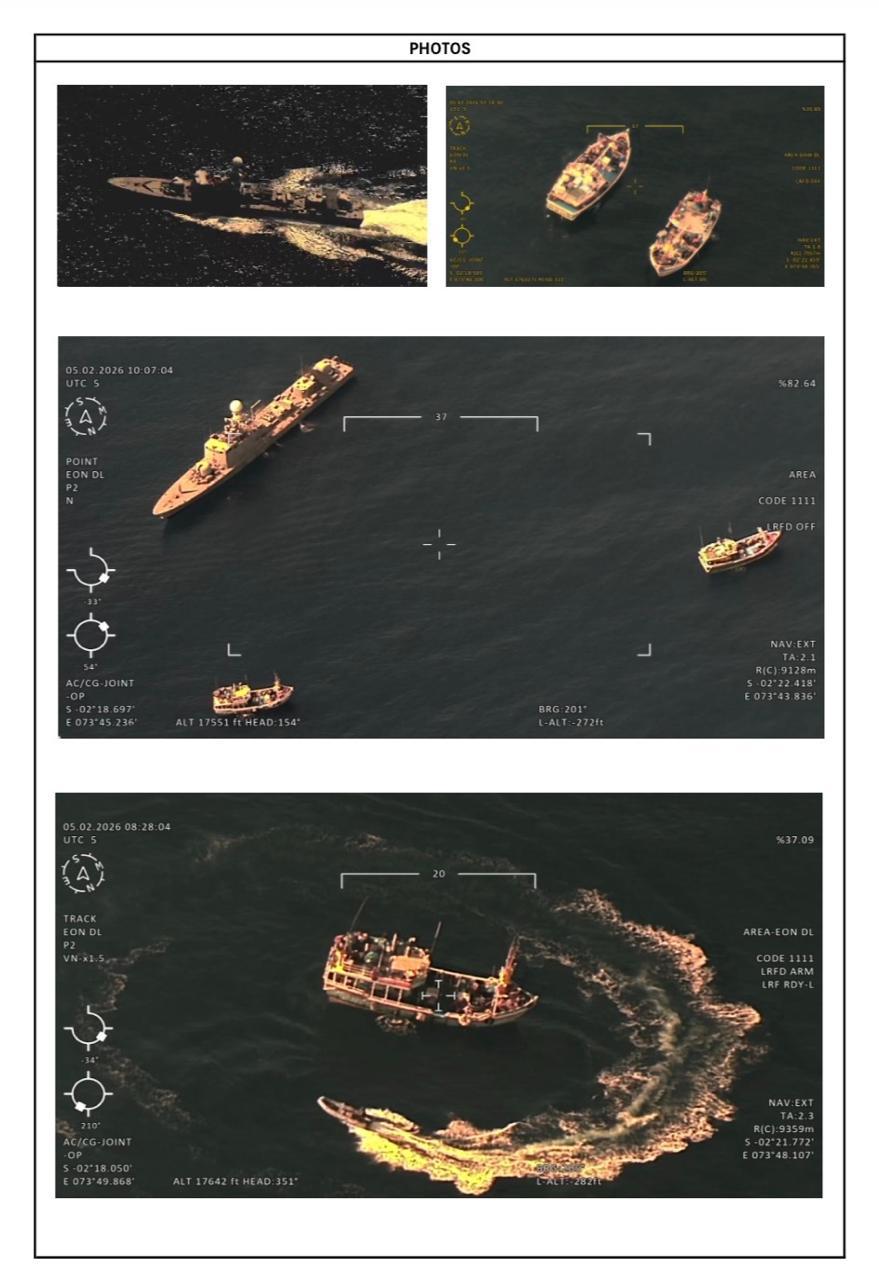
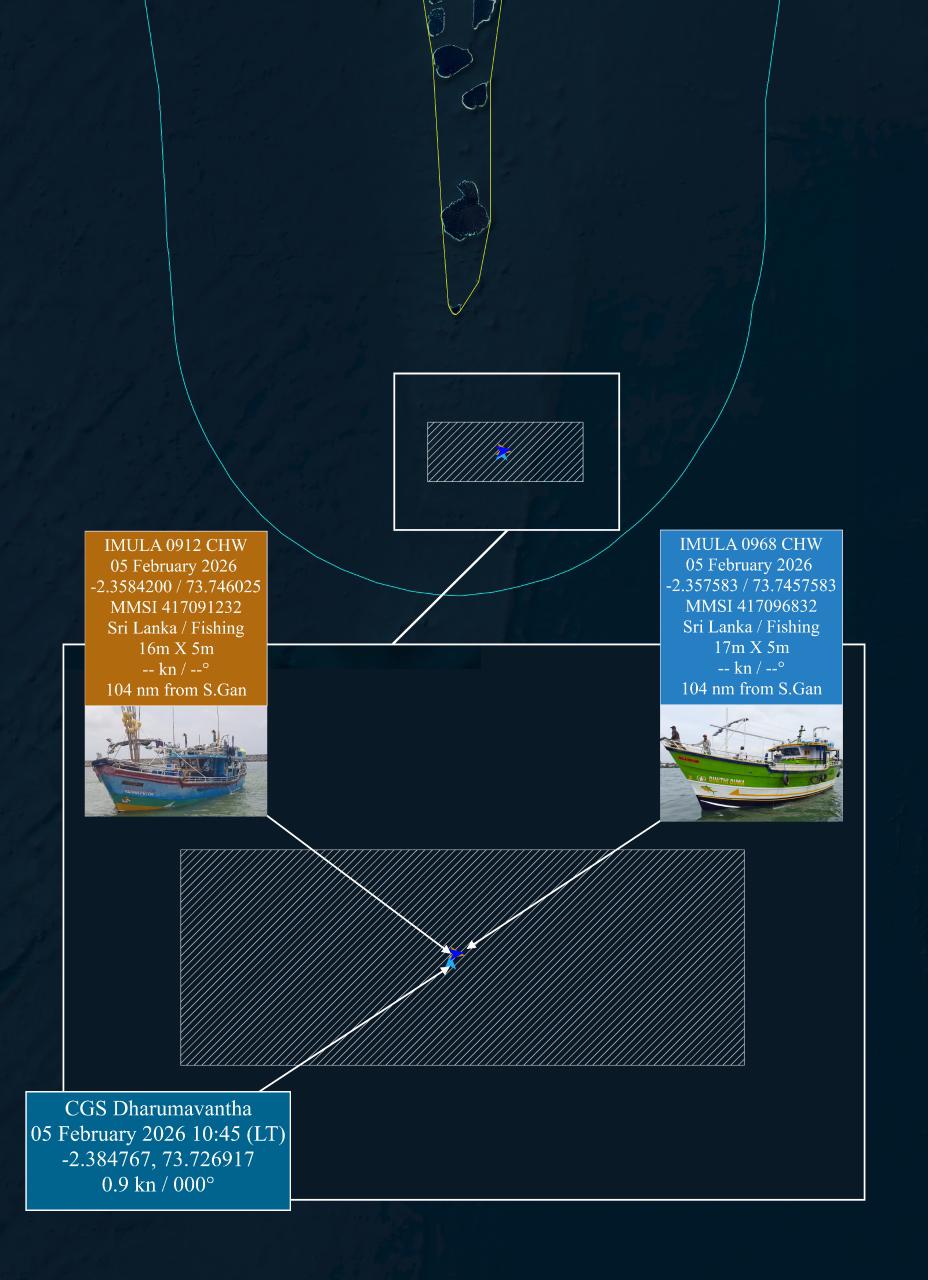
Why is the Maldives sending the Coast Guard to disputed waters?
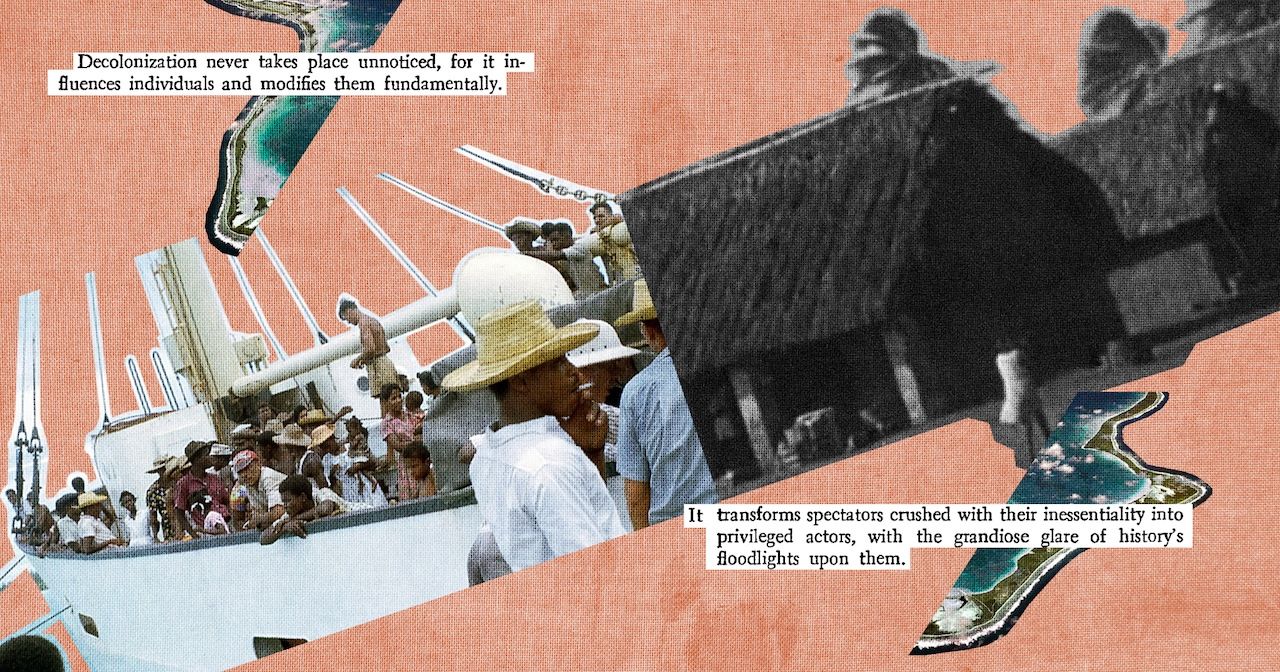
Artwork: Dosain
10 Feb, 17:26
What just happened?
President Dr Mohamed Muizzu declared in his state-of-the-nation address to parliament on Thursday that the Maldives' exclusive economic zone extends a full 200 nautical miles south, including waters that a UN tribunal allocated to Mauritius in 2023. He reversed the previous administration's recognition of Mauritius's sovereignty over Chagos – which hosts a joint US-UK military base on Diego Garcia – and asserted a Maldives counter-claim to the archipelago south of Addu.
The government plans to revise the 1996 Maritime Zones Act accordingly and to establish an "Office on Maldivian Territory" to determine coordinates and baselines, he announced. The Attorney General's Office is pursuing legal action to "recover forfeited territory."
Hours later, US President Donald Trump reversed his opposition to the UK's treaty to hand over Chagos to Mauritius, calling it "the best deal available right now" – an apparent blow to Muizzu, who had pitched the US on transferring sovereignty to the Maldives instead. "Let it be known that I will never allow our presence on a base as important as this to ever be undermined or threatened by fake claims or environmental nonsense," Trump posted on Truth Social.
A day later, Britain rebuffed the Maldives' objections. "Various courts, rulings and institutions have made clear that the question of sovereignty of the Chagos archipelago is between the UK and Mauritius," the Foreign Office told Türkiye's Anadolu Agency. It stressed that the Diego Garcia agreement has "robust security provisions" protecting the military base "for generations to come."
A "high-level delegation" from the US is meanwhile due to visit Mauritius in late February to discuss a proposed security partnership.
What are the three issues here?
Three separate but related questions that are often conflated:
1. The maritime boundary. In April 2023, the International Tribunal for the Law of the Sea drew a line dividing the overlapping exclusive economic zones of the Maldives and Mauritius around Chagos. The Muizzu government now rejects this border.
2. Sovereignty over Chagos. Muizzu claims the Maldives has the "strongest claim" to the Chagos archipelago. This is separate from the EEZ question. The Maldives did not claim sovereignty over Chagos at ITLOS.
3. The extended continental shelf. In 2010, the Maldives submitted a claim to the UN for seabed rights beyond its 200-nautical-mile EEZ, in waters between the Maldives and Chagos. This is a third, distinct legal process. The UN Commission on the Limits of the Continental Shelf has yet to reach a judgment.
What did ITLOS decide?
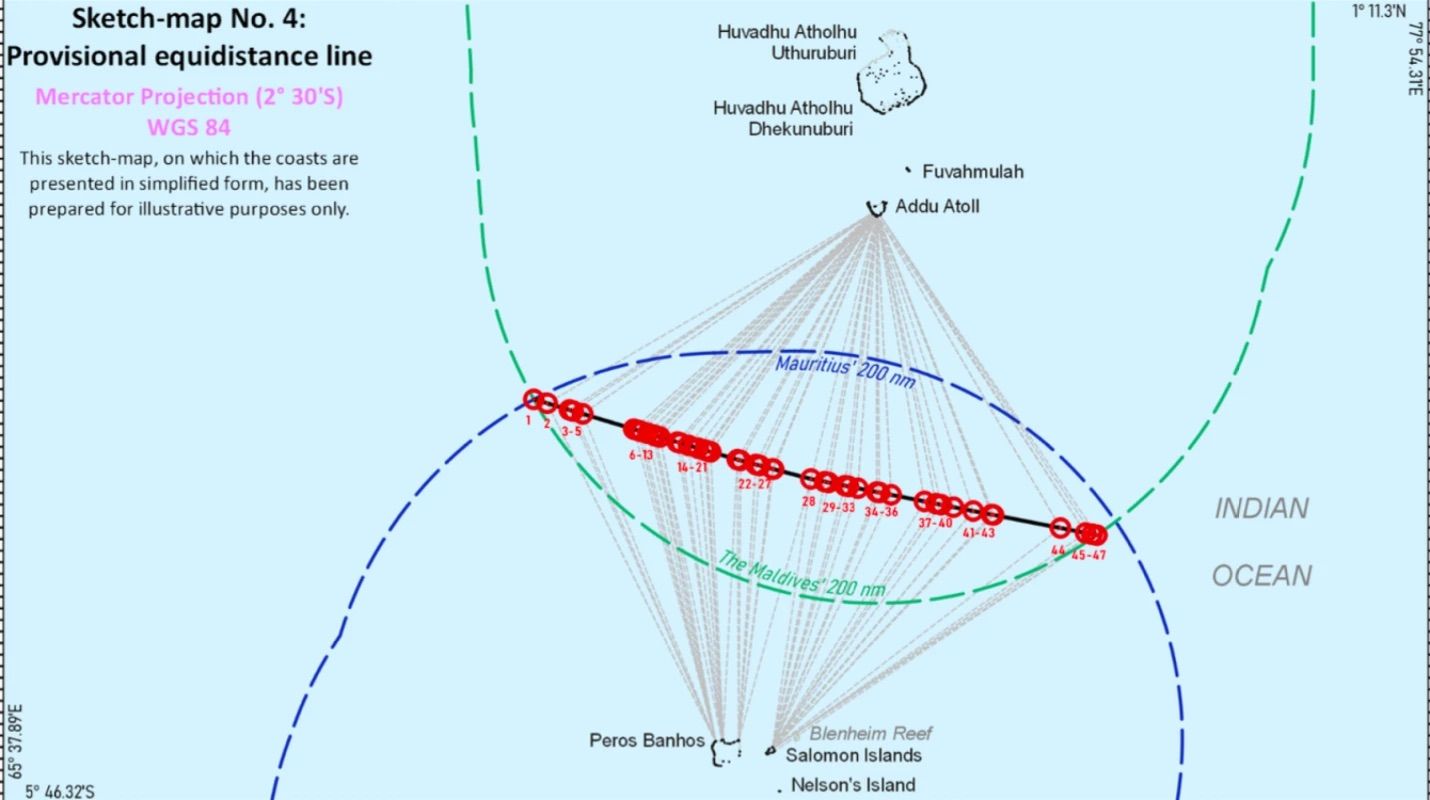
The court in Hamburg, Germany demarcated the maritime boundary between the Maldives and Chagos. The tribunal allocated 47,232 square kilometres to the Maldives and 45,331 square kilometres to Mauritius, a ratio of roughly 1:0.96 in the Maldives' favour. It also rejected Mauritius's claim to a continental shelf beyond 200 nautical miles.
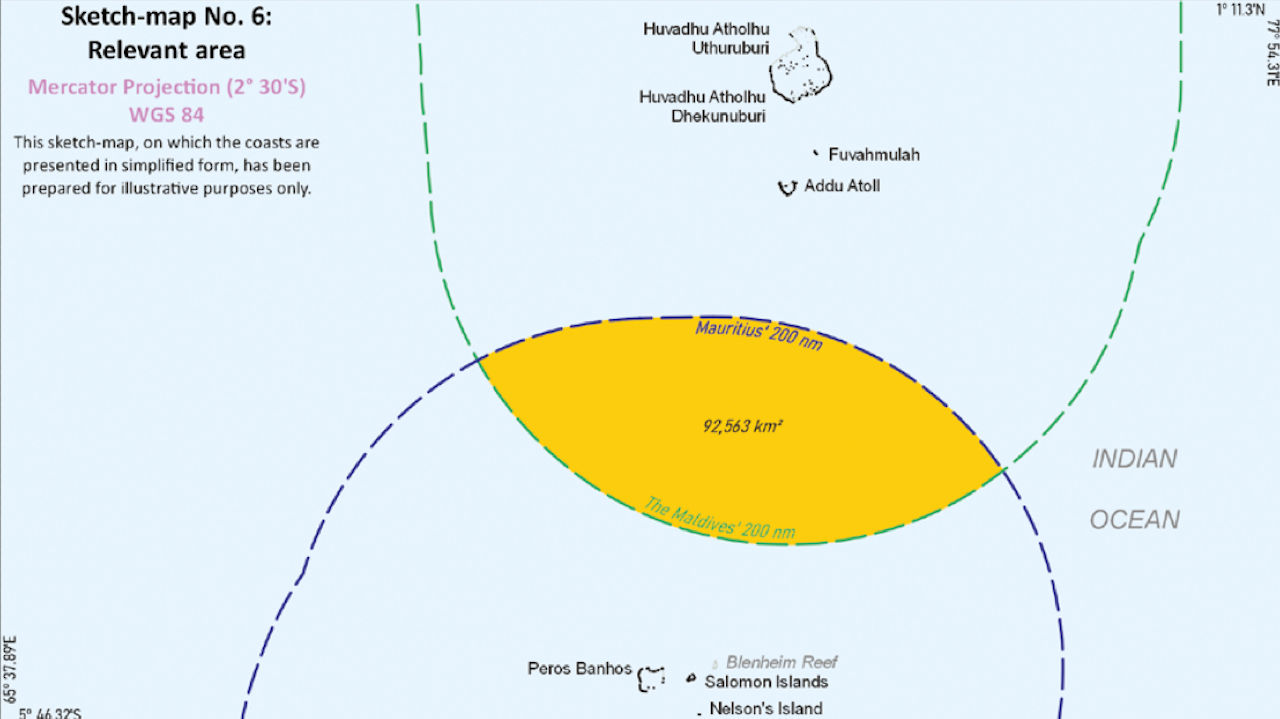
The parties had already agreed on 95 percent of the 92,000 square kilometre overlapping area before the judgment. The disputed five percent focused on technical questions, most notably the status of Blenheim Reef – a semi-submerged feature that Mauritius wanted to use as a base point for calculating its EEZ. The Maldives argued the reef should not count because it is underwater at high tide. The tribunal sided with the Maldives.
Was this a win or a loss for the Maldives?
The previous administration celebrated. Professor Payam Akhavan, senior counsel for the Maldives, called it a "great victory." Before the boundary was drawn, the Maldives only controlled 12 nautical miles from the southern shores, President Ibrahim Mohamed Solih contended. "No Maldivian government has ever claimed sovereignty over Chagos," Foreign Minister Abdulla Shahid stressed.
The opposition saw it differently. Social media lamented the "loss of 44,000 square km." Acting opposition leader Abdul Raheem Abdulla called on police and the military to topple the government. A rally was staged in Malé. The controversy became a defining issue in the 2023 presidential election, which Muizzu won on a promise to "recover the forfeited territory."
The Solih administration insisted that the Maldives went from having no defined boundary to getting the larger share. The opposition countered that the government should never have accepted a boundary that gave Mauritius any part of what it considers Maldivian waters.
Why is President Solih's letter so controversial?
For decades, the Maldives took no position on whether Chagos belonged to the UK or Mauritius, maintaining that maritime borders could not be drawn until the sovereignty question was settled. In 2019, the Maldives voted against a UN resolution calling on Britain to return Chagos to Mauritius.
At the time, the Progressive Party of Maldives – of which Muizzu was a deputy leader – called on the Solih government to apologise for voting against the resolution. The vote "violates the rights of the people of Mauritius," PPM said. But the party's own government under President Abdulla Yameen had voted against referring the matter to the ICJ two years earlier.
The second vote came after the International Court of Justice ruled that continuing British occupation was illegal. The UN General Assembly endorsed the advisory opinion with 116 countries calling on Britain to cede Chagos to Mauritius within six months. The Maldives voted No along with the UK, US, Australia, Israel, and Hungary.
The Maldives was "not in a position to support the resolution solely as a matter of decolonisation,” the permanent representative said at the time. “For the Maldives, any uncertainty concerning the issue of the Chagos archipelago will have serious implications for the sovereignty, territorial integrity and the wider security of the Indian Ocean region.”
In August 2022, President Solih privately told the Mauritius prime minister that the Maldives would vote in favour of the next such resolution. This shift became public two months later when Attorney General Ibrahim Riffath disclosed the letter in his opening statement at ITLOS.
The revelation set off a political firestorm. The opposition accused the Solih administration of "treason" and "selling" Maldivian territorial waters. Former President Yameen alleged bribery. Former President Mohamed Nasheed called for the Maldives to reject the ITLOS ruling.
In his address to parliament, President Muizzu announced a Commission of Enquiry to question former officials and take action over what he called "irreparable major damage to the Maldivian state."
Muizzu also withdrew Solih's 2022 letter to Mauritius. He formally communicated the decision to the Mauritius prime minister on the grounds that "the sudden and unexplained change in the position made by the previous administration, midway through the ITLOS proceedings, had an adverse and detrimental effect on the Maldives’ interests in the case."
How did the Solih government defend the letter?
Supporting Mauritius's claim to Chagos had nothing to do with the EEZ boundary case, which the government said was a technical matter of delimiting a maritime border. The southern boundary had "never been determined" before, and decisions on EEZ boundaries were within the government's authority, unlike changes to the 12-nautical-mile territorial sea, which require parliamentary approval.
Professor Akhavan explained that the decision to support the ICJ opinion was "the natural consequence" of the tribunal's binding judgment recognising Chagos as belonging to Mauritius.
Did the Maldives try to stop the ITLOS case?
Yes. The Maldives raised five preliminary objections challenging the tribunal's jurisdiction, including the argument that ITLOS could not draw a maritime boundary while the UK and Mauritius were still disputing sovereignty. In January 2021, ITLOS rejected all five objections, ruling that Mauritius should be considered the rightful owner of Chagos "for the purposes of drawing a maritime boundary."
This was a pivotal moment. The tribunal sided with Mauritius on the sovereignty question as a prerequisite to hearing the case. It happened before Solih's letter. The ruling effectively settled the question of whether the neighbouring state is the UK or Mauritius, Professor Akhavan told the local press at the time.
Are ITLOS rulings legally binding?
Yes. ITLOS judgments are final and binding under international law. They cannot be appealed. Parties can seek interpretation or revision only in exceptional circumstances, such as the emergence of new facts unknown at the time of the ruling. Muizzu said legal proceedings have been initiated but has not disclosed details.
However, there is no enforcement mechanism. China has ignored a 2016 tribunal ruling against its South China Sea claims for nearly a decade with few practical consequences. But unlike Beijing, which refused to participate in those proceedings, the government in Malé engaged fully in the case.
The Maldives ratified the UN Convention on the Law of the Sea in 2000.
What is the Maldives' historical claim to Chagos?
"The Maldives has historical connections to the Chagos Islands – known to us as Foalhavahi – which lie south of Maldivian waters," Muizzu told the Daily Express, a British tabloid, last month, "These connections are based on documental evidence, and we believe gives the Maldives a greater claim than any other country."
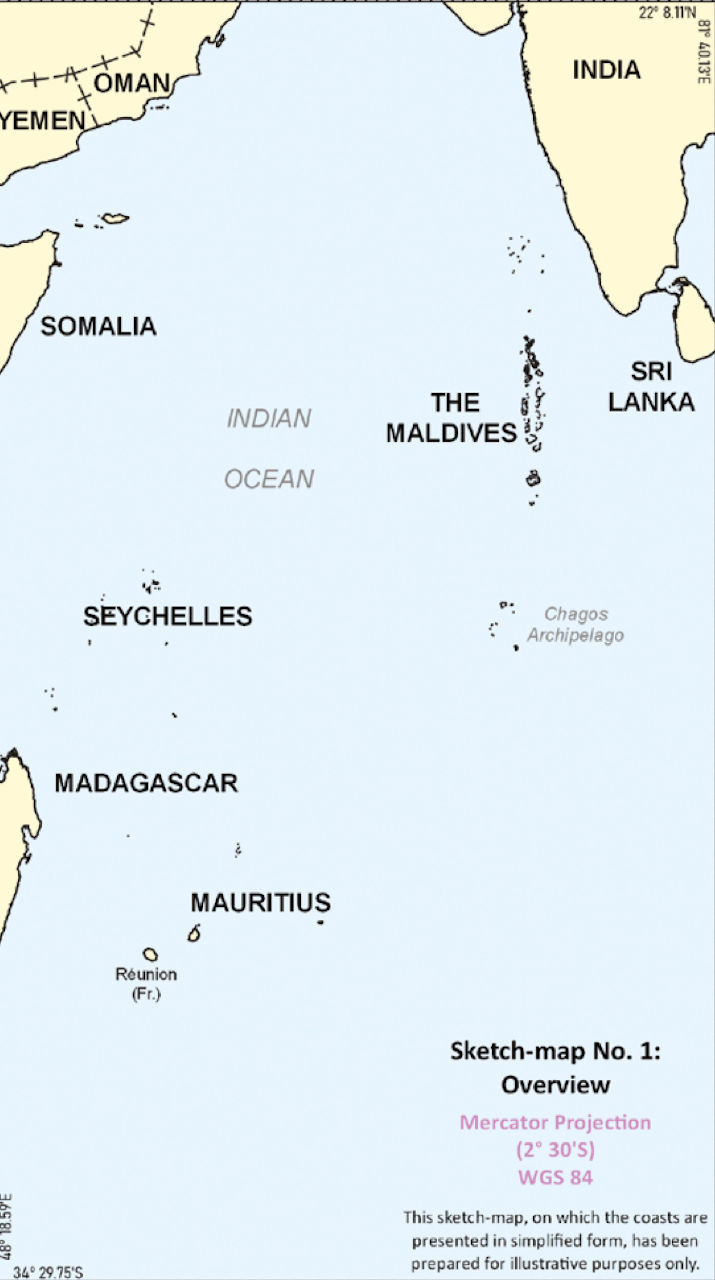
He cited 900-year-old gravestones on Chagos etched in the Dhivehi script, a 16th century patent from exiled King Hassan IX describing himself as owner of "Maldives islands, the three patanas of Suaadhoo and the seven islands of Pullobay," DNA evidence of Maldivian-Creole heritage in modern Chagossians, folk tales of stranded Maldivian seafarers, and geographic proximity. Malé is about 310 miles from Chagos compared to 1,300 miles from Port Louis.
What do historians say?
Historians have questioned the claim. Local historian Ahmed Najih noted that while King Hassan declared dominion over "Foalhavahi" in the 16th century, "no record of this area exists in Maldivian ancient records." Maldivian territory was traditionally described as extending from Maliku (now Minicoy, administered by India) to Addu, with no mention of Chagos.
According to Spanish anthropologist Xavier Romero-Frias, "Foalhavahi" was a generic name for all islands to the south and southwest, including the Seychelles, Mauritius, Reunion, and Rodrigues. "Maldivians only visited those remote islands by accident and by no means endeavoured to settle there," he wrote.
Professor Akhavan, the Maldives senior counsel at ITLOS, said in October 2022 that pursuing a sovereignty claim would be a "non-starter" because of the ICJ's 2019 judgment.
Sovereignty for Mauritius was a legacy of arbitrarily drawn colonial boundaries, he observed.
What deal did Muizzu offer Trump?
In a Newsweek interview published February 2, Muizzu offered Trump a deal: if the Maldives is granted sovereignty over Chagos, he would seek parliamentary approval to let the US maintain its Diego Garcia naval support facility.
The Maldives was better placed than Mauritius to steward the islands, he suggested, citing proximity and experience managing marine conservation areas. "We have never overpopulated, overdeveloped, or under protected marine conservation zones within our current borders – and we would not do so should those borders be expanded to include Chagos," he said.
The move came after Trump opposed the UK-Mauritius deal as "an act of great stupidity" that China and Russia could exploit.
But on February 5 – the same day as Muizzu's parliamentary address – Trump reversed course. His Truth Social post endorsing the UK-Mauritius agreement and warning against "fake claims" appeared to shut the door on Muizzu's overture.
What has the UK said?
Sovereignty over Chagos "is between UK and Mauritius."
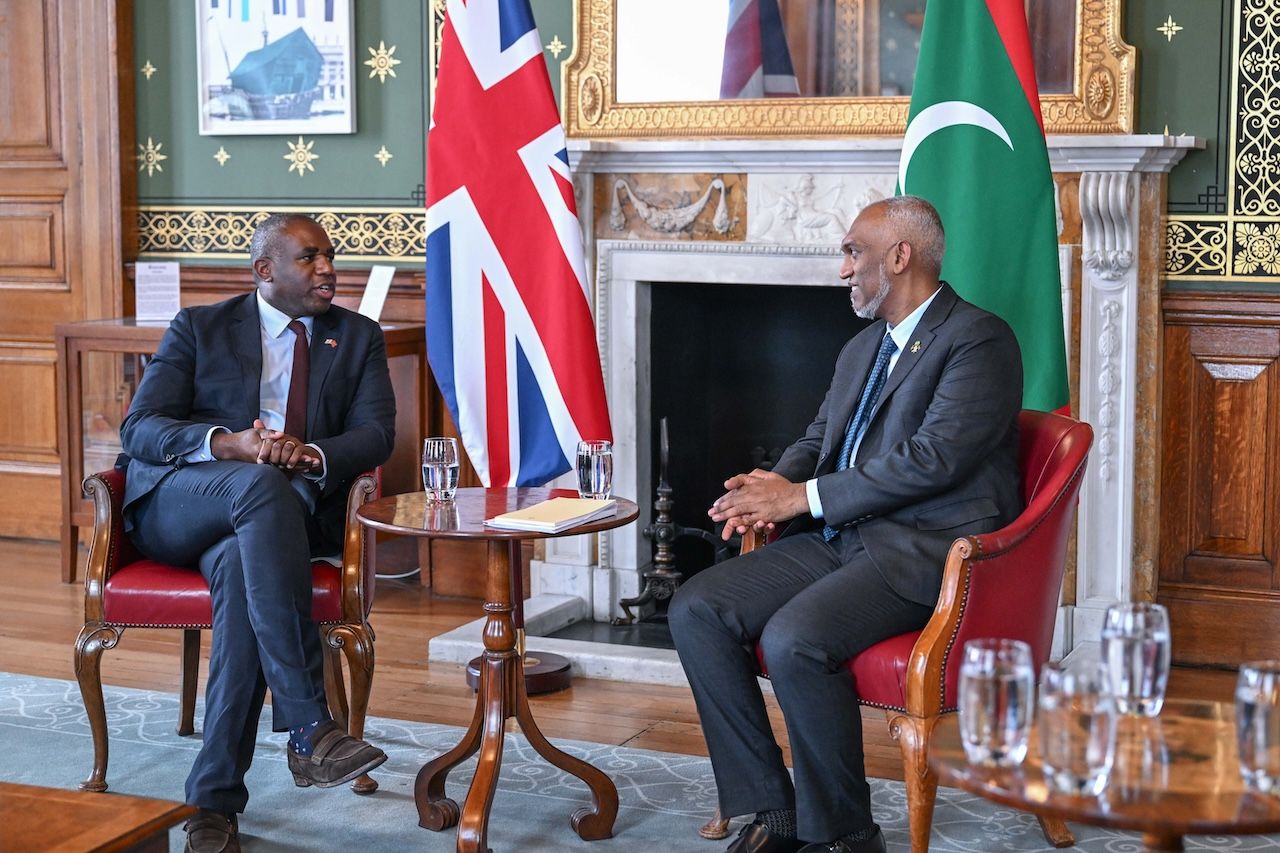
Muizzu told parliament the Maldives had formally objected to the UK on November 8, 2024 and January 18, 2026, and that he raised the issue with Deputy Prime Minister David Lammy by phone in December 2025.
The UK formally handed sovereignty of Chagos to Mauritius in May 2025, retaining control of Diego Garcia through a 99-year lease. The deal has not yet been ratified by the UK parliament.
Both Conservative and Labour governments pursued the handover. Rishi Sunak's government held 11 rounds of negotiations with Mauritius before Labour took office and signed the treaty. Prime Minister Keir Starmer argued the UK would "not have a realistic prospect of success" if Mauritius pursued further legal action and that without a deal, Britain would have no legal grounds to prevent China or other nations from establishing bases on the outer islands.
Why does Diego Garcia matter?
It is one of the most strategically significant US military installations outside North America and Europe. It has been used to launch operations in two wars in Iraq, serves as a landing base for long-range bombers flying missions across Asia, and has been linked to CIA rendition flights.
Where does India stand?
Firmly with Mauritius. India has historically backed Mauritius's sovereignty claim as part of its support for decolonisation, and has deepened its commitment since the UK-Mauritius deal was signed in May 2025.
Modi visited Mauritius for its National Day in March 2025, upgrading ties to an "enhanced strategic partnership," and called the Chagos handover "a historic milestone." India pledged US$ 680 million in economic support, agreed to help Mauritius surveil its expanded maritime zone around Chagos, and reportedly secured agreement to establish a satellite tracking station in the archipelago.
Four days after Muizzu deployed the Coast Guard, Modi spoke by phone with Mauritius Prime Minister Navinchandra Ramgoolam, reaffirming commitment to "peace and stability in the Indian Ocean Region." He invited Ramgoolam to India for a summit the following week.
India's interest is strategic. Mauritius is heavily dependent on Indian support. Ramgoolam has acknowledged that Mauritius lacks the capacity to patrol its newly expanded waters alone, and specifically requested an Indian rather than British vessel for a planned flag-planting visit to Chagos. For New Delhi, backing Mauritius extends a network of Indian Ocean partnerships – including a runway and jetty on Mauritius's Agaléga island – designed to counter China's growing presence in its backyard.
Who are the Chagossians?
The Chagossians are the people of the Chagos archipelago, descended from enslaved Africans and indentured labourers brought to the islands by French and British colonial powers in the late 18th century. Over roughly two centuries, they developed a distinct Creole-speaking culture and identity. In the late 1960s and early 1970s, the UK forcibly removed the entire population of around 1,500 to 2,000 people to make way for the US military base on Diego Garcia. Most were resettled in Mauritius, the Seychelles and the UK. They have never been allowed to return.
What do the Chagossians want?
They have spent decades fighting for the right to return, recognition as the Indigenous people of the islands, meaningful participation in decisions about their future, and reparations for the forced displacement. Many also want access to the graves of their ancestors on Diego Garcia.
How have Chagossians reacted to the UK-Mauritius deal?
Many have opposed it. In early January, London-based Chagossians protested outside parliament against being shut out of decisions about their homeland. "I'd rather die for my country than my country go to Mauritius," Misley Mandarin, who heads a Chagossian government-in-exile, told the BBC.
Frankie Bontemps, chair of the Chagossian Voices advocacy group, said the deal "perpetuates a long and painful pattern of deciding the future of our homeland without our input."
The UN Committee on the Elimination of Racial Discrimination warned in December 2025 that the agreement would "perpetuate longstanding violations of the Chagossian people's rights," noting that it prevents the return of Chagossians to Diego Garcia and was made without their consent. UN human rights experts noted the £ 40 million trust fund for Chagossians amounts to less than 0.5 percent of the estimated £ 10 billion the UK will pay Mauritius over the 99-year lease.
What does Muizzu say about the Chagossians?
Chagossians "must have a voice and a say in this debate," Muizzu told Newsweek, noting their partial Maldivian heritage. However, the Maldives' own sovereignty claim has not been endorsed by Chagossian groups.
What is the continental shelf, and why does it matter here?
The exclusive economic zone extends 200 nautical miles from a country's coast, granting rights over fishing, minerals, and other resources. The continental shelf refers to the seabed specifically. Countries can claim seabed rights beyond 200 nautical miles if the seabed is a natural geological extension of their landmass.
In 2010, the Maldives submitted a claim to the UN for about 166,000 square kilometres of seabed beyond its EEZ, based on the Chagos-Laccadive Ridge – the underwater formation connecting the Maldives, Laccadive Islands, and Chagos. This is a separate legal process from the ITLOS case, which dealt only with the overlapping EEZs within 200 nautical miles.
Continental shelf rights are not just about the seabed as it exists today. The deep ocean floor contains deposits of manganese, nickel, cobalt, and rare earth elements – minerals critical to batteries, electronics, and the global energy transition. As deep-sea mining technology advances and land-based reserves deplete, sovereign rights over the seabed could become enormously valuable. India is already exploring the Central Indian Basin for these resources.
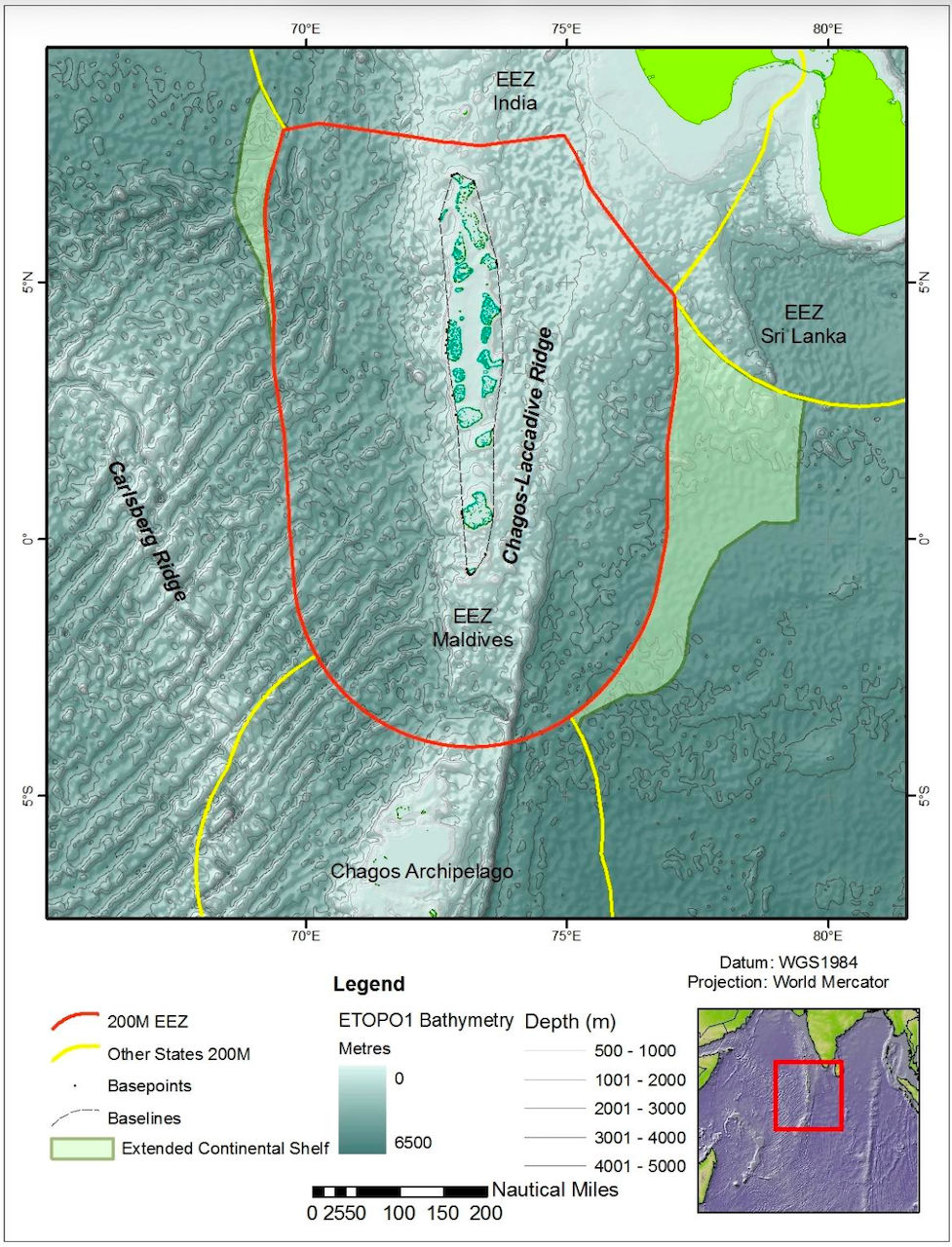
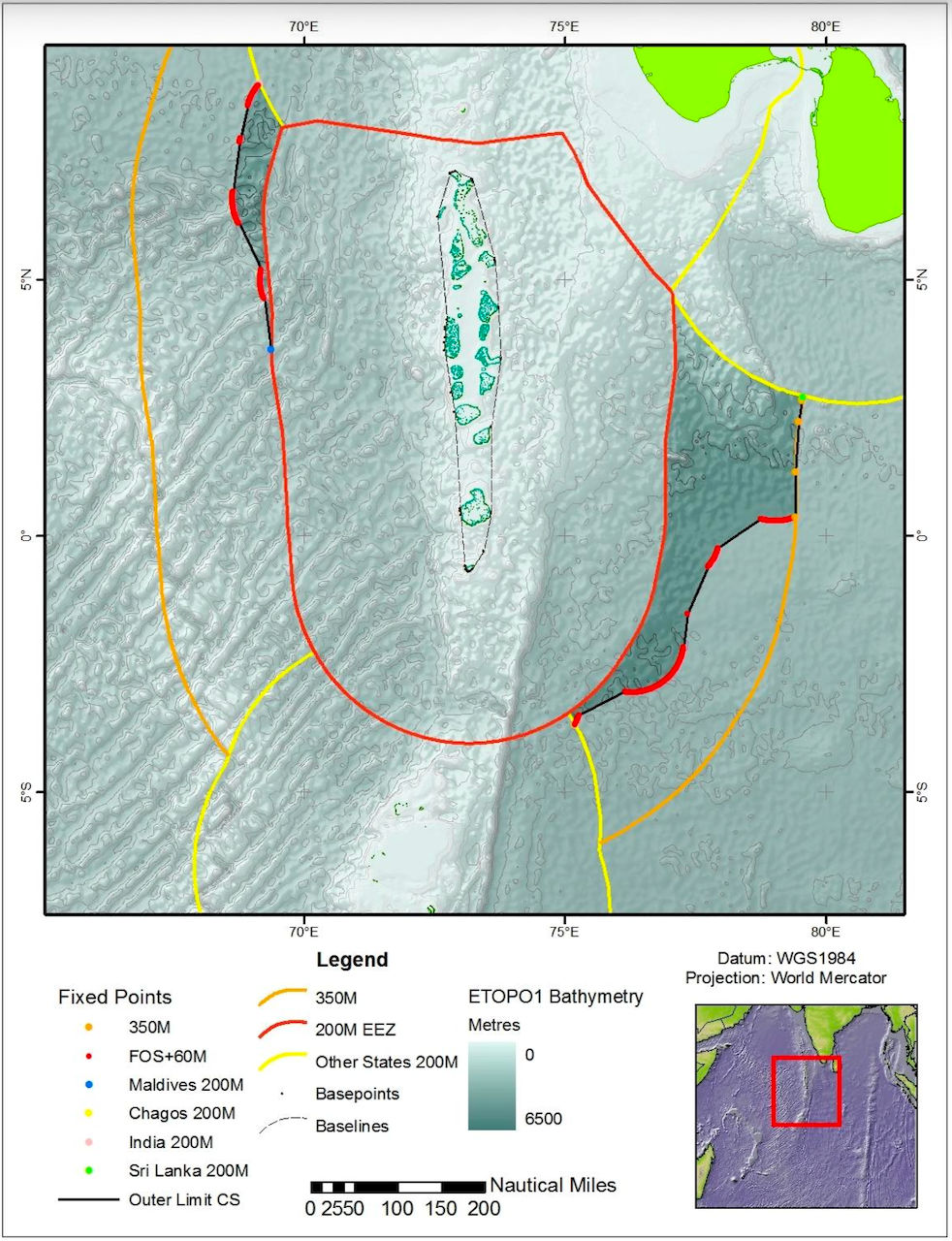
The Maldives sought the extension on the grounds that the UK had no right to claim a 200 nautical mile EEZ if the islands were considered uninhabited.
"We are saying that since there is no population benefiting from the area, the British government cannot claim it as their territory. We feel the [original] claim made by the British is not legally valid [under the Law of the Sea Convention],” former state minister for foreign affairs Ahmed Naseem told the Maldives Independent at the time.
Asked if the Maldives would be indirectly benefiting from the homelessness of the Chagos if it succeeded with the claim, Naseem said: “That’s not our issue – the fact of the matter is that there is no native population on the island.”
Discussion
No comments yet. Be the first to share your thoughts!
No comments yet. Be the first to join the conversation!
Join the Conversation
Sign in to share your thoughts under an alias and take part in the discussion. Independent journalism thrives on open, respectful debate — your voice matters.
Support Independent Journalism
Help us keep the news free and fearless
Give once
$
or
Become a memberfrom $5/month

