
Politics

Muizzu asserts Maldives has "strongest claim" to Chagos sovereignty

Trump and Chagossians also oppose UK handover to Mauritius.
Artwork: Dosain

Artwork: Dosain

3 hours ago
President Dr Mohamed Muizzu has told Britain that the Maldives and not Mauritius should hold sovereignty over the Chagos islands, escalating a regional dispute over the strategic archipelago after US President Donald Trump savaged the UK's planned handover as "an act of great stupidity."
"Through an exchange of official correspondence the British Government is fully aware of our concerns and our claim," Muizzu told the Daily Express, a British tabloid, in an exclusive interview published on Tuesday. "The Maldives has historical connections to the Chagos Islands – known to us as Foalhavahi – which lie south of Maldivian waters. These connections are based on documental evidence, and we believe gives the Maldives a greater claim than any other country."
Muizzu added that he could not disclose the content on the discussions, "except to reiterate our confidence that the Maldives has the strongest claim over the sovereignty of the Chagos Islands."
Despite the sovereignty dispute, Muizzu – who holds a doctorate from the University of Leeds – emphasised that the Maldives and Britain enjoy close ties. "The Maldives has been Britain's favourite dream holiday from the very beginning," he told the newspaper. "British tourists helped make the Maldives. Britons were the first visitors in large numbers, British architects, engineers and hoteliers were among our earliest advisers, and British hospitality standards are those we adopted."
The Muizzu administration has also refused to disclose the contents of his letter to local media. When Adhadhu requested a copy and accompanying documents through a right to information request, the President's Office declined to respond, prompting the outlet to appeal to the Information Commissioner's Office in September.
The Chagos question has been politically charged in the Maldives since a UN tribunal drew a new maritime boundary between the Maldives and Chagos, dividing overlapping 200-nautical-mile exclusive economic zones.
When the International Tribunal for the Law of the Sea (ITLOS) delivered its judgment in April 2023, the opposition accused President Ibrahim Mohamed Solih's administration of "treason" and "selling out" Maldivian territorial waters in an underhanded deal with Mauritius.
After defeating Solih and coming to power in November 2023, President Muizzu formed a committee to study the tribunal's judgment. The Attorney General's Office was taking action to "change the ITLOS decision," his administration announced in its first 100-day plan, citing the previous government's "irresponsible" failure to defend Maldivian interests.
But ITLOS decisions are final and legally binding. The UK's formal recognition of Mauritius's claim in May last year appeared to have rendered the campaign promise to "recover lost territory" legally and diplomatically untenable.
Last October, Attorney General Ahmed Usham told parliament that his office was still studying the matter with foreign lawyers, and that a steering committee report would be submitted to cabinet. 
Usham also dismissed allegations from ruling party MPs that former attorney general Ibrahim Riffath had leaked damaging state documents to foreign parties during the ITLOS case. "I don't believe any documents were given to foreign parties," Usham said. A clearer answer on bribery allegations would come once the AG Office's review was complete, he added.

Deal under fire

Muizzu's public appeal comes amid mounting opposition to the UK-Mauritius deal from both the US and Chagossians in England. Despite approving the deal in May 2025, with Secretary of State Marco Rubio calling it a "monumental achievement" at the time, President Trump has since reversed his support for the treaty, calling it a display of "total weakness" that China and Russia would exploit. "Shockingly, our 'brilliant' NATO Ally, the United Kingdom, is currently planning to give away the Island of Diego Garcia, the site of a vital U.S. Military Base, to Mauritius, and to do so FOR NO REASON WHATSOEVER," Trump posted on Truth Social.
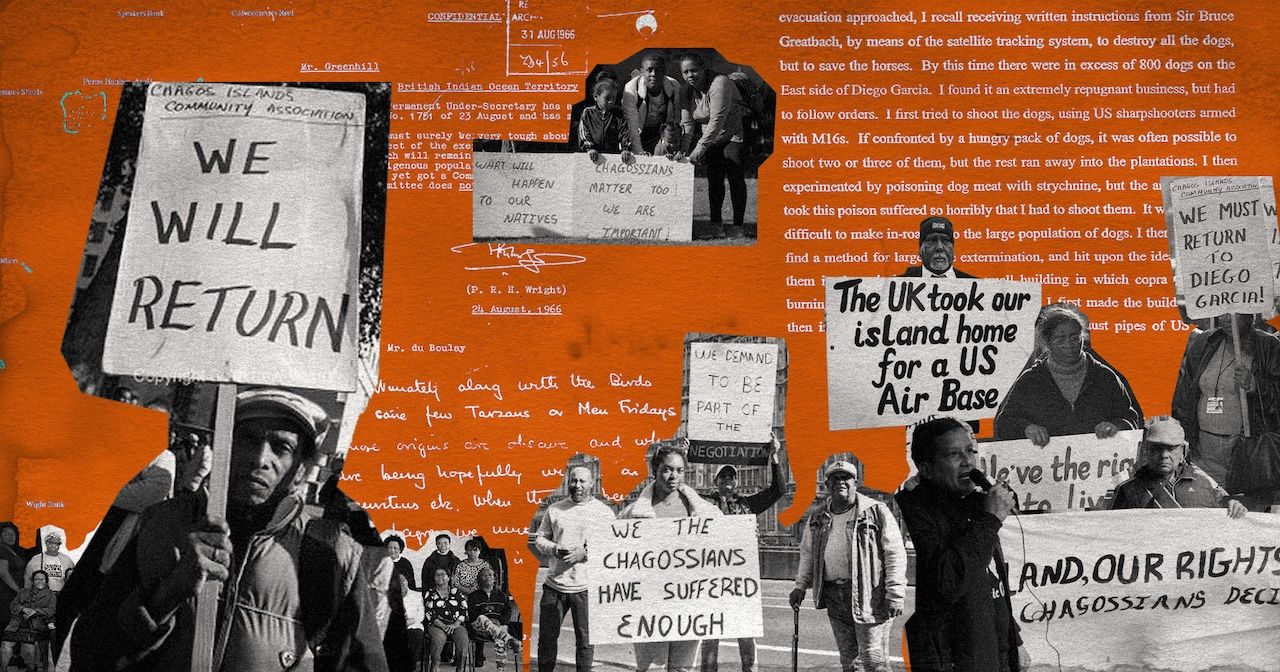
Earlier this month, London-based Chagossians protested against the plan, saying they are being shut out of decisions about their homeland.
"It seemed like the Labour government (want to) steam ahead with the treaty without considering the most important key component of that deal, which is the Chagossians," Misley Mandarin, a British Indian Ocean Territory citizen, told the BBC. "I'd rather die for my country than my country go to Mauritius. This is the type of angriness in me right now, and it's shared with all the Chagossians right now."
Foreign Office minister Seema Malhotra said on January 11 that the deal was "about securing our future" and that UK allies had approved the agreement. The deal was "about making sure we can secure the Diego Garcia base for our security," she said, noting that most negotiations took place under the previous Conservative government.
Vanessa Mandarin, also a BIOT citizen, said Chagossians wanted self-determination: "We don't want another state to come and talk on our behalf. We will be challenging, we will not surrender."
Conservative MP Andrew Rosindell called the deal "absolutely outrageous," arguing that Chagossians were being denied the right to decide their own destiny. "Not only did we take them away from their homeland, forced them away from their ancestral homes, now we are saying we are going to give away their country to a foreign land," he said.
In the late 1960s and early 1970s, the UK forcibly removed about 2,000 Chagossians to make way for the US military base on Diego Garcia. Many moved to Mauritius, the Seychelles and the UK.
The following explainer breaks down the tangled history of the Chagos dispute and why it matters to the Maldives.

What happened?

The United Kingdom formally handed sovereignty of the Chagos Islands to Mauritius on May 22, 2025, ending more than two centuries of British control over the Indian Ocean archipelago.
Under the agreement, Britain ceded sovereignty to Mauritius while retaining control of the critical Diego Garcia military base through a 99-year lease costing approximately £ 101 million annually (£ 3.4 billion over the full term).
The handover settled a long-running sovereignty dispute that had gone against Britain at the International Court of Justice in 2019 and the UN General Assembly, which voted 116-6 to call for decolonisation.

What is the Maldives' historical claim?

President Muizzu first revealed the diplomatic approach in his November 2024 Republic Day address: "When I heard about the British government handing over Chagos to Mauritius, since it is a place to which we very much have a historical connection, the Maldivian government has now sent a letter to the British government."
The letter noted a historical Maldivian claim to Chagos based on ancient documents and royal decrees, "since it could be seen historically that it could even be viewed as belonging to the Maldives, [which is] more deserving of it than any other country," he said.
In his Express interview, Muizzu cited several pieces of evidence:

Gravestones with Dhivehi script over 900 years old, predating Mauritius having any human population (Mauritius was uninhabited before the 17th century when Dutch, French, and British colonialists arrived)

A 16th century patent from a Maldivian King asserting sovereignty over the islands

DNA evidence showing modern Chagossians have Maldivian and Creole heritage

Folk tales of Maldivian seafarers and fishermen being stranded there

Geographic proximity: Maldives' southern border is about 300 miles from Chagos, far closer than Port Louis at 1,300 miles

Muizzu was likely referring to exiled King Hassan IX describing himself – nearly 463 years ago in Cochin – as the "owner of the Maldives islands, the three patanas of Suaadhoo and the seven islands of Pullobay."
The three patanas were the southernmost Maldivian atolls of Huvadhoo, Fuvahmulah and Addu. Pullobay most likely referred to the Chagos atoll known in Dhivehi as Foalhavahi, according to local historian Ahmed Najih.

How strong is the claim?

Historians have questioned its veracity.
"While King Hassan declared his dominion over Foalhavahi in the 16th century, questions arise as to why no record of this area exists in Maldivian ancient records," Najih wrote in 2022. "More questions arise when you consider that the Maldivian territory was called Kela-addu and when Maliku was part of the Maldives, it was described as Maliku-addu."
Maldivian territory was traditionally described from the northernmost to the southernmost points, starting from Maliku (before it became part of India) and ending in Addu with no mention of Chagos.
Historians agree that Maldivians knew about the Chagos islands. Oral traditions speak of fisherfolk who got stranded at sea and ended up in Foalhavahi.
Nevertheless, the actual location of Foalhavahi remained in question.
"Hoḷḷavai [Foalhavahi], according to Southern Maldivian old men, was a generic name for all the islands and island groups South and Southwest of the Maldives. These included not only the Chagos, but also Seychelles, Mauritius & Reunion and Rodrigues, all of which were uninhabited until as late as the 16th or 17th century," wrote Spanish historian Xavier Romero Frias.
"According to the island lore it is clear that Maldivians only visited those remote islands by accident and that they by no means endeavored to settle there," he concluded in his book 'The Maldivian Islanders.'
A Maldives claim to Chagos would also be "a non-starter" because of the ICJ judgment in 2019, Professor Payam Akhavan – senior counsel of the Maldives legal team at ITLOS – told the press in October 2022. 
Sovereignty for Mauritius despite the much larger distance than the Maldives was a legacy of arbitrarily drawn colonial boundaries, he observed.

What was the 2022-2023 political storm?

The question of Chagos dominated Maldivian political discourse from October 2022 to April 2023.
The controversy stemmed from a reversal of the Maldives’ decades-long neutral stance in the dispute between the UK and Mauritius. Successive governments maintained the stand that borders could not be determined until the sovereignty dispute was resolved. 
When the ICJ ruled that continuing British occupation was illegal in February 2019, the UN General Assembly endorsed the advisory opinion with 116 countries calling on Britain to cede Chagos to Mauritius within six months.
The Maldives voted against the non-binding resolution – along with the UK, US, Australia, Israel, and Hungary – on the grounds that it could undermine a 2010 bid to establish the outer limits of the continental shelf between the Maldives and Chagos.
Bolstered by the ICJ opinion in 2019, Mauritius asked ITLOS to delimit the maritime boundary in the overlapping EEZs.
In his opening statement  in October 2022, Attorney General Riffath declared that the Maldives had decided to vote in favour of the next General Assembly resolution on the return of Chagos to Mauritius. President Solih had relayed the decision to the Mauritius prime minister in August 2022, Riffath revealed.

What were the allegations?

"I will say that a large portion of Maldivian sea territories has been sold off. Those who took the money, must have already taken it. Many believe this now. It is not something which would be done for free," former President Abdulla Yameen  alleged.
“Maldives has lost part of its sea territory, because Maldives relinquished sovereignty over Chagos. I believe what is best for the Maldives is to reject this,” former President Mohamed Nasheed tweeted in the wake of the ITLOS judgment.  
Nasheed also promoted historical claims: “Maldivian captains count the Maldives territory with Foalhavahi. There is much evidence of historical and cultural ties to say that it is an island of the Maldives,” he contended.
Echoing Yameen's allegations of bribery, former attorney general Dr Mohamed Munavvar alleged that India must have dictated the U-turn in favour of its close ally Mauritius, as part of a grand strategy to gain power to block shipping lanes in the Indian Ocean.
The Solih administration insisted that “support to Mauritius’ claim on sovereignty over Chagos” was unrelated to the tribunal case concerning the southern EEZ, “whose boundaries have never been, up until the present moment, determined by the Law of Sea Convention,” and dismissed the opposition’s allegations about the president violating a constitutional requirement to seek parliamentary approval for territorial changes. That only applies to territorial boundaries of 12 miles from the coastline, whereas demarcating EEZ boundaries was “well within the mandate of government”.

What did ITLOS decide?

The Blenheim Reef issue – a technical disagreement over whether a semi-submerged reef could be used as a base-point for EEZ calculation – was decided in favour of the Maldives.
In the final allocation, the Maldives received 47,232 square kilometres. Mauritius received 45,331 sq km, a ratio of 1:0.960 in favour of the Maldives.
Mauritius's claim to continental shelf beyond 200 nautical miles (an additional 22,298 sq km) was rejected.
In a historic first, an international court resolved a maritime boundary dispute between two archipelagic states for the first time. The parties had agreed on 95 percent of the 92,000 sq km overlapping area before the judgment. The five percent disagreement became the focus of political controversy.
The government celebrated. Professor Akhavan called it a "great victory for Maldives." But the opposition was furious. Social media lamented the "loss of 44,000 square km." A rally was staged in Malé. Leaders vowed to impeach and imprison President Solih. Acting opposition leader Abdul Raheem Abdulla called on police and military to topple the government.
"Prior to boundary determination, Maldives only controlled 12 nautical miles. Now we have 200 miles," President Solih said, as his Foreign Minister Abdulla Shahid stressed: "No Maldivian government has ever claimed sovereignty over Chagos."

Why did the sovereignty question matter?

The question of whether the neighbouring state is the UK or Mauritius was settled when the tribunal rejected objections raised by the Maldives, which challenged ITLOS jurisdiction to proceed to border delimitation despite the unresolved sovereignty dispute.
Professor Akhavan explained that the president's decision to vote in favour of the ICJ opinion at the General Assembly was "the natural consequence" of the tribunal’s binding judgment that Mauritius should be considered the rightful owner of Chagos “for the purposes of drawing a maritime boundary,” 
Despite negotiations with both the UK and Mauritius, the lack of clarity in the past had precluded a boundary agreement such as the ones signed with India and Sri Lanka in the 1970s.

What happens now?

The UK's formal handover to Mauritius has settled the sovereignty question internationally, making any Maldivian claim to the islands extremely difficult to pursue through legal channels.
However, Trump's criticism of the deal has introduced uncertainty, though the British government maintains the US still supports the agreement. A foreign office minister said on Tuesday "the UK will never compromise on our national security" and that "this deal secures the operations of the joint U.S.-UK base on Diego Garcia for generations."
The deal has faced opposition from British Conservative politicians, including party leader Kemi Badenoch who said it "weakens UK security and hands away our sovereign territory." Reform UK leader Nigel Farage, an ally of Trump, said: "Thank goodness Trump has vetoed the surrender of the Chagos islands."
However, the treaty has been signed and legislation approved by the House of Commons. Whether Trump's criticism translates into concrete action remains unclear.
For the Maldives, control over the islands also concerns fishing access. The previous government welcomed Mauritius's intention to establish a Marine Protected Area surrounding the Chagos archipelago during the ITLOS proceedings, which would address fears over tuna stocks that could be threatened by industrial fishing.

Timeline:

1814-1968 - UK controls Chagos as part of Mauritius colonial administration
1965 - UK separates Chagos administration from Mauritius to create British Indian Ocean Territory
1966 - UK leases Diego Garcia to US for 50 years (in exchange for US$14 million discount on Polaris missile systems)
1968 - Mauritius gains independence without Chagos archipelago
Late 1960s-early 1970s - UK forcibly removes 1,500-2,000 Chagossians to make way for US military base on Diego Garcia
1970s - Maldives signs maritime boundary agreements with India and Sri Lanka
1982 - Maldives becomes signatory to UN Convention on the Law of the Sea (UNCLOS)
1992 - Maldives and UK reach technical-level agreement using equidistant rule for maritime boundary; draft agreement finalised but never signed
1996 - Maldives passes Maritime Zones Act declaring 200-nautical-mile EEZ from archipelagic baselines
2000 - Maldives ratifies UNCLOS
2009 - Mauritius submits preliminary information to UN Commission on Limits of Continental Shelf, claiming 200 nautical mile EEZ around Chagos
July 2010 - Maldives submits claim for extended continental shelf beyond 200 nautical miles, including overlapping Chagos territory
March 2011 - Mauritius officially protests Maldivian claim as encroachment on Chagos zone
2011 - President Nasheed visits Mauritius; both countries agree on diplomatic solution for overlapping continental shelf areas. No follow-up occurs.
2017 - UN General Assembly seeks opinion from International Court of Justice on Chagos; Maldives does not file intervention under Yameen administration
February 2019 - ICJ rules UK's continued occupation of Chagos illegal, violates international law
May 2019 - UN General Assembly adopts resolution calling for complete decolonisation of Mauritius by returning Chagos
2019 - Mauritius files case at ITLOS over maritime boundary delimitation
January 28, 2021 - ITLOS rejects all five Maldives preliminary objections, including challenge to jurisdiction based on unresolved sovereignty dispute
August 2022 - President Solih privately informs Mauritius PM of decision to support sovereignty claim
October 2022 - At ITLOS in Hamburg, Attorney General Ibrahim Riffath publicly announces Maldives will vote in favour of next UN resolution supporting Mauritius sovereignty
April 28, 2023 - ITLOS delivers judgment: Maldives receives 47,232 sq km; Mauritius receives 45,331 sq km
November 2023 - Muizzu assumes office after defeating Solih on campaign promise to reverse ITLOS decision
October 2024 - UK announces agreement to transfer Chagos sovereignty to Mauritius
November 2024 - Muizzu reveals in Republic Day address that Maldives has sent letter to UK asserting historical claim to Chagos
May 22, 2025 - UK formally hands over Chagos sovereignty to Mauritius
January 20, 2026 - Trump reverses support for deal; Muizzu tells Express that Maldives has "strongest claim" to sovereignty

Discussion

No comments yet. Be the first to share your thoughts!

No comments yet. Be the first to join the conversation!

Join the Conversation

Sign in to share your thoughts under an alias and take part in the discussion. Independent journalism thrives on open, respectful debate — your voice matters.

Support independent journalism