
The death of Sgt Mahudhee: what the records show
The death certificate names a cause. The evidence can't confirm it.
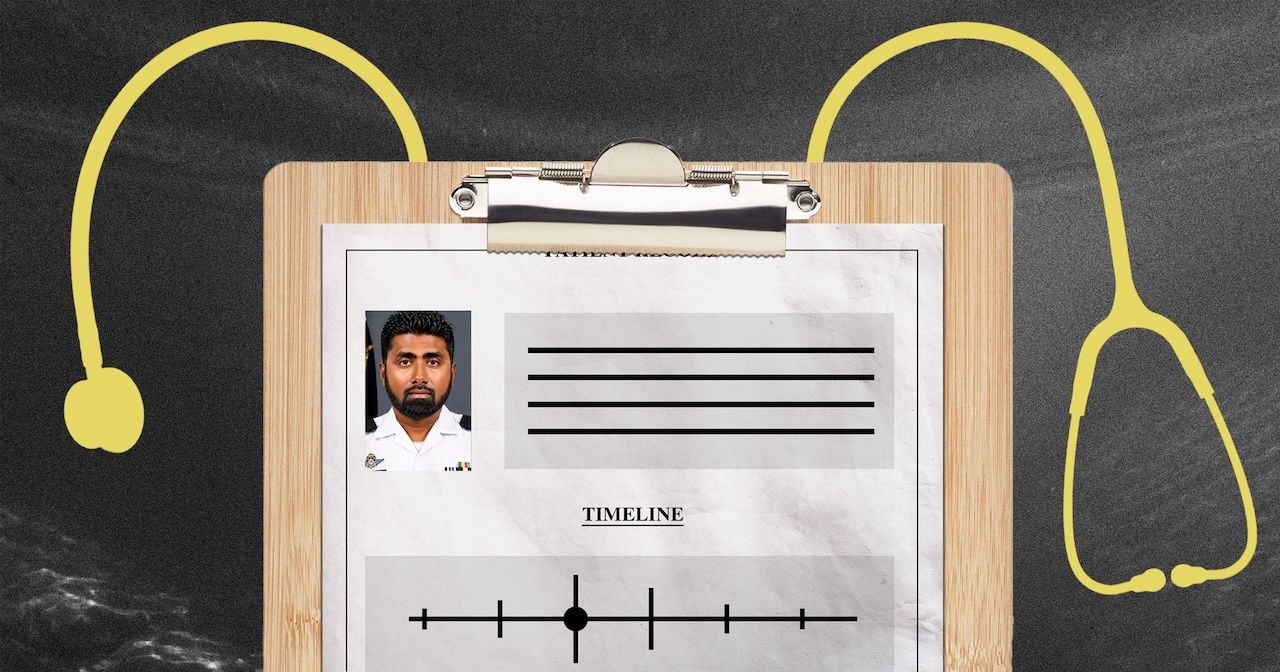
Artwork: Dosain
12 Aug, 19:22
Last week, the family of Sergeant First Class Mohamed Mahudhee – the diver who died during the recovery of five Italian divers from the Devana Kandu caves – publicly disputed the official account of his death. The family shared hospital records with the Maldives Independent. The documents support central parts of what they say.
Mahudhee, 43, was one of the Maldives National Defence Force's most experienced divers, a Coast Guard sergeant of more than 20 years' standing, a dive instructor who trained a generation of young personnel and the recovery diver the military turned to for its hardest operations. Known as "Boava" for his gift for catching octopus, he was, in his brother's words, "the big smiling face of our family." Before leaving for the recovery dive, he told his wife to keep the bottle of perfume she had packed for every previous trip and to save it for their children.
This explainer sets out what the records establish, what a dive doctor's review found and what remains unanswered.
What happened?
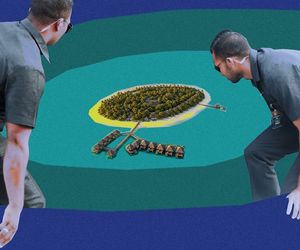
Mahudhee led an eight-man MNDF dive team into the Vaavu Atoll cave system on 16 May to recover the bodies of the Italian divers lost inside two days earlier. According to accounts given to his family by divers involved and dive footage shown to the family by the MNDF, the pocket holding the guide line that connected him to the other divers came loose. He became separated from the team inside the cave. Two divers were behind him. One panicked and froze. The other followed him into the cave's second chamber. But with his own line at its end and air running low, he also left.
The group ascended to do a decompression stop because their air was running out. Free divers near the surface were told he was missing. The marine police were informed. But the police divers had previously been asked to stay aside and not take part in the MNDF operation.
The police dive team recovered his body from the second chamber at a depth of 69 metres, his regulator out of his mouth and his tank empty.
Mahudhee was alone inside the cave for at least 75 minutes, based on a Maldives Independent reconstruction of a timeline of what was seen on the surface during the recovery operation:
11:40am - MNDF divers began their dive
11:43am - Mahudhee last seen well, according to the history an MNDF medical officer later provided to ADK Hospital
12:16pm - A surface marker buoy appeared at the dive site and free divers entered the water. This was likely the time that Mahudhee’s fellow divers at the safety stop informed the free divers that he was down in the cave
12:26pm - Marine police vessel was seen moving into the dive site and the divers began gearing up
12:50pm - Marine police divers entered the water and descended
1:00pm - A third surface marker buoy appears
1:10pm - Mahudhee was brought to the surface in an "unresponsive state" (ADK report)
1:15pm - CPR was started on the sea ambulance. A defibrillator showed a non-shockable rhythm (ADK report)
2:35pm - Mahudhee’s body was received by the ADK paramedic team at the jetty in Malé (ADK report)
2:41pm - Mahudhee’s body arrived at the ADK emergency room
3:00pm - MNDF announced that a diver involved in the recovery dive has been taken to ADK hospital in "critical condition" (haalu dheravegen)
3:11pm - Mahudhee was declared dead after 16 cycles of CPR and 10 doses of adrenaline
3:53pm - MNDF announced that Staff Sergeant Mohamed Mahudhee had passed away along with a message of condolence (Mahudhee was posthumously promoted to sergeant first class)
What did the government say?
The government told international media that he was found unconscious by fellow divers. Mohamed Hussain Shareef 'Mundhu,' the chief government spokesman, handled media inquiries after the cave dive tragedy and the subsequent recovery operation drew intense global attention. On the day Mahudhee died, he told international media that the Coast Guard diver was noticed missing when his fellow divers surfaced and that he was found blacked out during a search. Authorities believed he died from decompression sickness, he said.
A week after his death, Mundhu told reporters that Mahudhee was in fact found inside the cave. The information he provided on the day had been what he was told, the spokesperson said.
Was there a coverup?
Mahudhee’s brother believes the inconsistency was a result of miscommunication.
The first group of MNDF divers, of which Mahudhee was the leader, were in standard gear. They could only communicate using hand signals. A group of free divers were in the water when the Coast Guard divers ascended to a shallower depth for their decompression stop. The role of the free divers appeared to have been carrying messages between the divers doing decompression stops and the surface team on the vessels. The first report of a missing diver would have been relayed with hand signals to the free diving team. This is what would have informed the initial account.
Because three teams were involved - Mahudhee’s group, the free divers who were carrying the messages and the marine police divers - it is possible that the exact manner in which Mahudhee went missing and where he was found was not accurately communicated to MNDF officers at the surface and consequently to the spokesperson.
The marine police divers who recovered Mahudhee were doing their decompression stop underwater when the body was being transferred to Malé on the sea ambulance.
However, the public account was corrected only a week later, despite an accurate account – found inside the cave, no pulse upon surfacing – provided to the hospital by an MNDF medical officer. Nearly three months later, the death certificate has not been corrected at all.
What does his death certificate say?
“A search was carried out and he was eventually found unresponsive inside the undersea cave being searched by the rescue team. He was brought rapidly to the surface in an unresponsive state at 1:10 PM," reads a history provided by the MNDF medical officer to ADK.
He did not have a pulse and he was not breathing when he was brought up to the surface. A pink frothy sputum at his mouth and swelling over his upper limbs and neck were observed. CPR began at 1:15pm. A defibrillator showed a non-shockable rhythm. Heart monitoring showed no cardiac activity at any point through the 80-minute transfer to Malé or the 30 minutes of resuscitation at the hospital.
The certificate, issued by the hospital and shown to the Maldives Independent by the family, recorded the cause of death as cerebral arterial gas embolism, due to "rapid ascent from a scuba dive," due to "diver removed from depth."
A cerebral arterial gas embolism occurs when gas enters the arteries and reaches the brain. It usually happens when expanding air ruptures lung tissue during an ascent. The certificate's chain attributes the embolism to a rapid ascent, and the ascent to the diver's removal from depth.
Death was declared "based on absence of signs of life from no pulse (on surfacing) until 3:11PM." The report noted that Mahudhee's dive profile, the depth at which he was found, and how long he had been underwater "could not be determined at the time of examination."
It indicated that the investigation into the death is ongoing. Doctors told the family the recorded cause can be amended once investigators provide the full circumstances.
In its concluding remarks, the hospital recommended what the family is now demanding: "If the family, Insurance agency or any other authority requires a precise cause of death determination, a thorough medical post-mortem examination is recommended. Unfortunately, this service is not available at ADK Hospital." No post-mortem was conducted. Mahudhee was buried within hours of his death being announced.
When did Mahudhee actually die?
The certificate's time of death of 3:11pm is the time death was declared after resuscitation was stopped. The records showed no sign of life at any point after he left the water.
Based on the reported circumstances – found inside the cave with an empty tank, after more than an hour at depth – "I am sure he was already dead," a diving physician who reviewed the records concluded. At 69 metres, a diver breathes air from a single tank several times faster than at the surface. By Mahudhee’s brother's estimate, even a substantial reserve would have lasted his brother less than eight minutes at that depth.
Could the recorded cause of death be wrong?
The CT scan findings – extensive air in the arteries of the brain, air between the folds of the brain and within the eye sockets – are "typical for severe arterial gas embolism," the physician explained.
But the reason remains "unclear", the doctor said. A massive embolism of this kind, with air inside the skull cavity, is "more typical for a serious lung barotrauma" – the classic injury of a panicked ascent on a held breath – "but also possible post mortem during the ascent."
In other words, the same findings can be produced in a body brought rapidly up from depth after death, as the remaining air in the lungs expands. The radiologist's own impression in the report noted "post mortem changes" alongside the embolism findings.
The two explanations describe entirely different deaths. In one, a living diver ascends and dies of the ascent. In the other, a diver dies at depth and the recovery of his body produces the scan findings afterwards.
In a letter sent to the police in late June, Mahudhee's parents suggested that the air observed in the CT scan could have occurred "as a post-mortem artefact when a deceased body is brought to the surface" from a significant depth.
"As a result, attributing the death solely to a rapid ascent may unintentionally suggest that the recovery process itself was the cause of death," reads the letter, shown to the Maldives Independent.
"Furthermore, without a comprehensive forensic post-mortem examination, it may not be possible to conclusively determine the initiating cause of death at depth, whether due to factors such as equipment malfunction, hypoxia, nitrogen narcosis, or other causes."
What would it take to establish the cause?
"What is with his diving computer?" the physician asked. "Why did they not make an autopsy of the body and the equipment?"
A dive profile – the depth-and-time record from Mahudhee's dive computer – would show whether a rapid ascent occurred while he was alive. A forensic post-mortem could have distinguished gas that entered the circulation in life from gas that appeared after death. The body could have been examined for the signs of hypoxia or barotrauma. An examination of his equipment, including the regulator his brother had long warned him was unsuited to depth, could have established whether it failed.
Where is that evidence now?
In the state's hands, according to the family. Mahudhee's dive computer is held by the MNDF. His phone, which syncs with the computer and holds his dive profiles, depths and heart-rate data, is held by the authorities. Police have asked the MNDF for the computer. The family does not know whether it has been handed over. The diving equipment, along with meticulous video documentation made by the Finnish specialist team inside the cave, was handed to the marine police.
Was the operation itself negligent?
Sending a rescue diver into a cave at that depth on a single tank of air was "extremely negligent and unprofessional," the physician said. For a group of rescue divers to lose one of their own was "unbelievably unprofessional". For the team to surface "without him and without any idea what happened" was "totally unacceptable".
"From my point of view, a total disaster."
The criticism echoes what Shafraz Naeem, a former military diver who trained Mahudhee, told the Maldives Independent in May. The team was sent in on air, untrained for caves, without a recompression chamber on site, he said. Two days before Mahudhee died, two senior MNDF officers said on the state broadcaster that Coast Guard divers were certified only to 50 metres and that dives beyond 30 metres strictly required specialised equipment and advanced training.
What is the family asking for?
Mahudhee's parents requested a factual timeline of the incident. They asked for the cause of death to be reviewed and "recorded as Undetermined or Pending Further Investigation until sufficient evidence is available to establish a definitive conclusion."
"As grieving parents, we are seeking only an accurate and factual account of the events surrounding our son's passing," they wrote. "Obtaining clarity on the incident timeline and ensuring that the official records accurately reflect the available evidence would provide us with some measure of comfort and confidence that the matter has been handled with the thoroughness it deserves."
The police investigation continues. No timeline has been announced. The MNDF, the Maldives Police Service, ADK Hospital and the President's Office did not respond to detailed written questions sent last week.
"If they do the proper investigation, and if they change the certificate, and if they reveal the truth, I believe this is a miscommunication," Mahudhee's brother said. "If not, I will believe they are trying to cover this whole thing up."
Discussion
No comments yet. Be the first to share your thoughts!
No comments yet. Be the first to join the conversation!
Join the Conversation
Sign in to share your thoughts under an alias and take part in the discussion. Independent journalism thrives on open, respectful debate — your voice matters.
Support Independent Journalism
Help us keep the news free and fearless
Give once
$
or
Become a memberfrom $5/month