
'They knew he was dead': family disputes official account of Sgt Mahudhee's death

Hospital records show the Coast Guard diver had no pulse upon surfacing.
Artwork: Dosain

Artwork: Dosain

1 hour ago
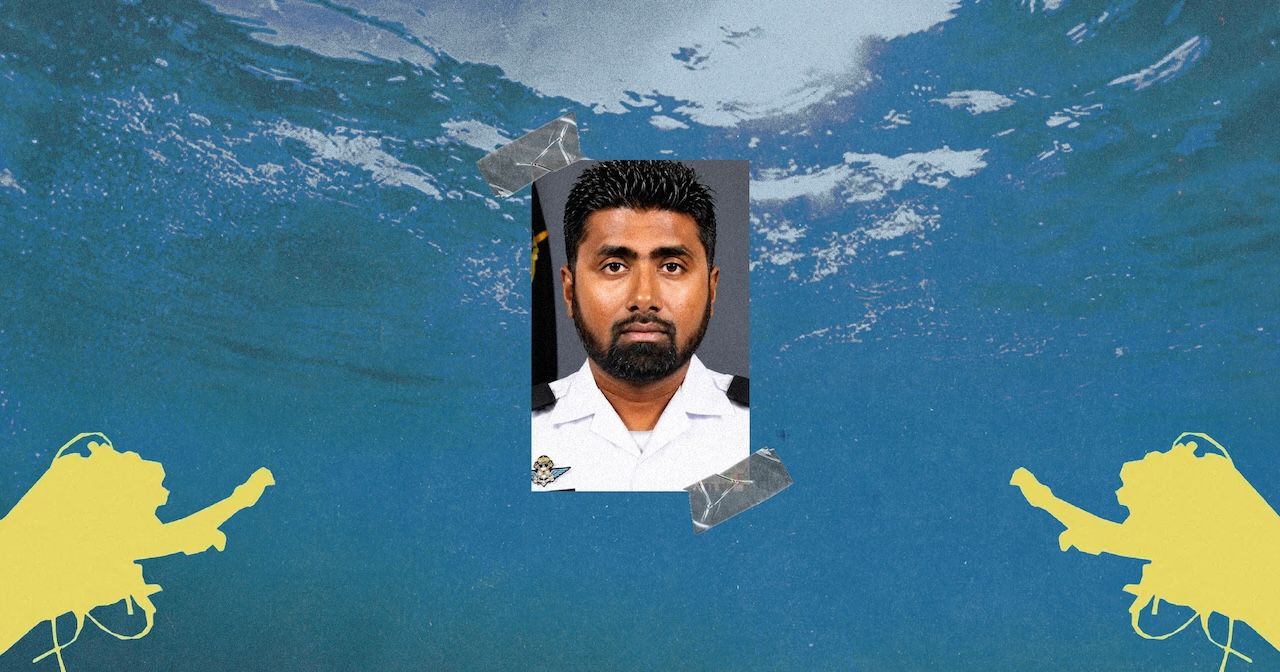
The family of Sergeant First Class Mohamed Mahudhee, the Coast Guard diver who died during the recovery of four Italian divers from the Devana Kandu caves in May, has publicly challenged the official account of his death, saying he ran out of air alone inside the cave after becoming separated from his dive team.
The family says Mahudhee was dead long before his body was brought to the surface.
The government told international media at the time that Mahudhee was found unconscious by fellow divers and died of decompression sickness during his ascent. His death certificate, issued by ADK Hospital and shown to the Maldives Independent by his family, records the cause of death as cerebral arterial gas embolism due to "rapid ascent from a scuba dive," itself due to "diver removed from depth."
But according to his brother – drawing on both dive footage shown to the family and accounts from Maldives National Defence Force and police divers who took part in the operation – Mahudhee was found by a police dive team lying in the cave's second chamber at a depth of 69 metres, his regulator out of his mouth and his single tank empty, more than 80 minutes after his team lost sight of him.
"They knew he was dead. They knew," Mahudhee’s brother told the Maldives Independent, recalling how an MNDF officer in the ambulance he boarded referred to "the body".
Hospital records shown to the Maldives Independent by the family corroborate central elements of their account: Mahudhee had no pulse from the moment he surfaced, the hospital certified the death without knowing his dive profile or how long he had been underwater, and ADK itself recommended a forensic post-mortem examination – which it could not perform and which was never conducted – for a precise cause of death.
In a letter to the Maldives Police Service in late June, shared with the Maldives Independent, Mahudhee's parents formally requested the factual timeline of the incident and asked for the recorded cause of death to be reviewed. The family asked for the death to be recorded as undetermined, pending further investigation.
"He was deceased before recovery efforts commenced," the parents wrote. "At the same time, the reports indicate that he was 'Rescued from Depth,' creating uncertainty regarding the actual sequence of events."
On Monday, Mahudhee’s brother Faris Ibrahim went public for the first time, writing on Facebook that the MNDF had said it would correct his brother's death certificate but had not done so, that the police investigation was being delayed, and that Mahudhee's phone remained confiscated by the government "as if he is a criminal."
"I want justice for my brother. To reveal the truth," he wrote, appealing to "all Maldivians and Italians" for help.

What the government said at the time

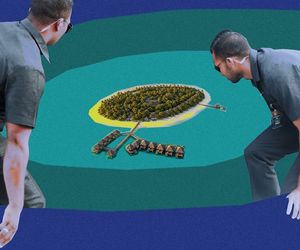
Mahudhee, 43, died on 16 May, two days after five Italian divers went missing inside the cave system on the morning of 14 May. The body of diving instructor Gianluca Benedetti was recovered that evening. The other four remained deep inside the cave (located near the Alimatha resort in Vaavu Atoll). By then the tragedy had drawn international media attention. President Dr Mohamed Muizzu visited the site on 15 May and met the MNDF dive team. Footage released by the President's Office shows Mahudhee among the divers briefing the president on the recovery plan, less than 24 hours before his death. Chief government spokesperson Mohamed Hussain Shareef 'Mundhu' handled media inquiries throughout the operation, rather than the military itself. 
At 3pm on 16 May, the MNDF posted on X that one of its divers had been evacuated to Malé after his "condition became critical" (haalu dheravegen) while diving. Almost an hour later, the MNDF announced that the diver had died.
Mundhu told the BBC that eight divers had entered the water, and that when they surfaced they realised Mahudhee had not come up. The other divers immediately re-entered the water and found he had "blacked out," he said.
He told CNN that Mahudhee "was diving in a pair, as per protocol, and returning to the surface when his partner realised something was wrong and the rest of the team jumped in to try and save him." Authorities believed he died from complications during decompression, he said. He told AP that Mahudhee died of decompression sickness after being transferred to hospital in Malé. "The death goes to show the difficulty of the mission," he said.
There was no suggestion in any official statement that Mahudhee had been found dead underwater or that he had been alone inside the cave for more than an hour. The account the MNDF gave the hospital was different: that Mahudhee was found unresponsive inside the cave and was brought rapidly to the surface with no pulse.
Mahudhee's funeral took place hours after his death was announced. He was buried with military honours in a service attended by President Muizzu. 
Briefing the press a week after Mahudhee's death, Mundhu acknowledged that the sergeant’s body was recovered from within the cave, though he could not say from which chamber. 
"I can provide information as I get it. And when it changes, I always say this is what I got now,” he said. “As a spokesman I can only give the information provided by those involved. When the information is updated, I provide the update."
The President’s Office, MNDF and police did not respond to detailed written questions sent on Wednesday.

'I would have stopped him'

For over two months, his family has grieved with a profound sense that closure remains out of reach – that the truth of how Mahudhee died has been left unacknowledged in the public record, and contradicted on the official one.
Mahudhee was "the happy face of our family," his brother Faris said.
Like his brother, Faris is a diver. He runs a commercial diving company. On his time off from the Coast Guard, Mahudhee would work alongside him. The pair were brothers by blood and in business.
"If he is not working in MNDF, he is working with me," he said. "He is like one of the best divers in our company."
He pushed back against suggestions that his brother was inadequately trained. "I know that people are spreading bad messages saying this guy is not trained, but he is a very trained guy. He even uses the rebreather, the things that the DAN team used," he said, though Mahudhee's rebreather training had qualified him to a maximum depth of 50 metres.
When Mahudhee was called up for the recovery operation, the brothers exchanged messages. Faris asked what equipment would be used.
"That's why I was asking him, are you using a rebreather, and he's saying no. So then I'm asking open circuit, so are you using trimix? I was hoping he was doing this. I didn't even know he was doing it on air. If [I knew] he was going inside on air, I would have stopped him."
The cave begins at a depth of around 50 metres, the limit of the Coast Guard's certified diving capability, as the MNDF itself acknowledged at the time. The MNDF sent its divers into the cave on compressed air rather than the trimix gas blend that is the international standard at those depths, without a portable recompression chamber on site, about 24 hours before international cave diving specialists arrived. 
The brother has also asked the MNDF for details of the equipment his brother used on the fatal dive. As a commercial diver, he had long been concerned about Mahudhee's regulator: an unbalanced model, unsuited to depths below 40 metres, which he had repeatedly told his brother not to use on their commercial dives, lending him a balanced regulator instead.
"I personally asked them to show me the gear," he said. "I haven't got any information. They just lowered their head when I asked them regarding this."

The dive

Mahudhee's brother recounted what happened during the 16 May dive based on conversations with MNDF and police divers who took part, and on dive footage shown to the family by the MNDF. 
Mahudhee led the group into the cave, each diver connected by a guide line for navigating the way out. The second diver behind him was filming with a camera. The footage shown to the family shows the pocket holding Mahudhee's guide line coming loose – without Mahudhee noticing – as he moved deeper into the cave, the brother said.
"He was the first diver, and the second diver had the GoPro, and he was shooting the video, so they were going very slow, and somehow the pocket came off," he said.
The second diver's torch remained fixed on the detached pocket. "So he was shooting the pocket, and after that, when he turned to look at Mahudhee, he was slowly getting inside the cave."
The second diver panicked, the brother said. "He panicked so much he couldn't even flicker his torch." The third diver followed into the second chamber through water clouded with silt, unable to see even with his light. He grabbed hold of a body – kneeling motionless on the cave floor – and pulled. There was no response. With his own guide line at its end and his air falling to 30 bar, the diver let go and made his way back. "The way he is telling, when he pulled Mahudhee, he thought it was a dead body," Mahudhee's brother said. But the diver said he could not be sure if it was Mahudhee or not, he noted. 
The divers who witnessed those final minutes are among Mahudhee's and his brother's own circle of friends in the police and military. In the weeks after his death, some struggled with their mental health, the brother said, describing how some would not leave their homes.

The recovery

It was a police dive team, not the MNDF, that recovered Mahudhee's body.
The police rescue team showed the family records from the operation, Mahudhee's brother said. They received the call about a missing diver at 12:22pm, unprepared, having been told they would not need to dive that day. After gearing up and briefing, they entered the water at 12:50pm. Their dive computers showed a descent to 69 metres within 18 minutes, and a return to their seven-metre decompression stop by around 1:19pm.
They found Mahudhee lying in the second chamber, his regulator out of his mouth and his tank out of air.
That timeline closely matches a reconstruction by the Maldives Independent based on photographs taken from the surface during the operation, which found: 

MNDF divers first began their dive at 11:40am. 

A surface marker buoy appeared and free divers entered the water at 12:16pm, likely when the surface team learned of the missing diver

The police vessel moved towards the site and began gearing up at 12:26pm

A huddled group of freedivers boarded a dinghy that drove towards the sea ambulance at 1:20pm 

Something concealed behind a white cloth was lifted from the dinghy onto the sea ambulance at 1:22pm.

Based on that sequence, 64 minutes passed between the surface team first learning of a missing diver and the body being brought up. Accounting for the time it would have taken the MNDF divers to exit the cave and reach their decompression stop, Mahudhee was likely alone inside the cave for at least 75 minutes.
"That is a very long time for someone to be inside the cave," the brother said. With even 70 bar in the tank, he would have had about six to eight minutes at that depth, he added.

A rejected death certificate

Faris received a call from the MNDF telling him his brother was in critical condition. The original plan, he was told, had been to take Mahudhee to Bandos, the nearest recompression chamber, the standard destination for a diver with decompression sickness. But management had decided instead to take him to the Indira Gandhi Memorial Hospital in Malé.
"I said, no, you can't take him to IGMH. IGMH doesn't have a chamber, they can't treat him if he is critical," he said. He refused and demanded his brother be taken to ADK, which operates a hyperbaric unit. After his repeated calls, the MNDF changed course.
At ADK, Dr Abdulla Niyaf was told a critical military diver was inbound. He asked the MNDF to describe the diver's condition, so the hospital would know whether it could treat him or whether he needed to go to Bandos. He got no answer, the brother said. When the doctor offered to send an ADK team to receive the patient, the MNDF said there was no need. He sent one anyway.
The ADK team reached the jetty before the sea ambulance arrived. When it did, "they confirmed they received a cold body," the brother said.
"I went to receive him, and after receiving Mahudhee, I got inside the ambulance, and a MNDF woman, she called her superiors, and she said, 'We are bringing the body to ADK.' So that phrase alone, I knew he was not alive. I had, like, a very small hope my brother will survive, but at that moment I realised he passed away."
Mahudhee was pronounced dead at ADK. A CT scan showed extensive air bubbles in his brain, heart, lungs and blood vessels, he said.
"This alone makes the doctor think it might be a problem with the ascent, because of the CT scan, because the doctor personally doesn't know what happened."
Mahudhee's brother refused to accept the death certificate and demanded the cause of death be changed. The doctors told him they could only amend it once investigators informed them of the circumstances of the death.
"When we spoke, they said, after this investigation, when police and MNDF give them the correct information, they will change it," he said.
"The doctor also said, if the doctor is informed Mahudhee was inside the cave for like more than 30 minutes, obviously they will put that Mahudhee died inside the cave."

What the hospital's records show

A copy of the ADK Hospital death report, shown to the Maldives Independent by Mahudhee's family, corroborates key elements of the family's account, including that Mahudhee showed no signs of life from the moment he reached the surface.
The history recorded in the report, given to the hospital by an MNDF medical officer, states that Mahudhee was last seen well at 11:43am. He was noted missing by fellow divers at a safety stop during the dive and was "eventually found unresponsive inside the undersea cave being searched by the rescue team. He was brought rapidly to the surface in an unresponsive state at 1:10 PM."
On surfacing, rescuers saw pink frothy sputum at his mouth and swelling over his upper limbs and neck, the report records. “On examination he was found to have NO spontaneous breathing and NO pulse,” the report stated.  
CPR was started in the sea ambulance at 1:15pm; a defibrillator showed a non-shockable rhythm. Resuscitation continued through the 80-minute transfer to Malé, where he was received by an ADK paramedic team at the jetty at 2:35pm and in the emergency room at 2:41pm. Heart monitoring showed asystole (no cardiac activity) throughout. After 16 cycles of CPR and 10 doses of adrenaline, death was declared at 3:11:06pm. The decision was "based on absence of signs of life from no pulse (on surfacing) until 3:11PM."
The time on the death certificate was the time death was declared, not the time Mahudhee died. At no point after he was brought out of the cave did he show any sign of life.
The report also confirms what the hospital did not know when it certified the death. The information on Mahudhee's dive profile, the depth at which he was found, and the duration of his submersion and ascent "could not be determined at the time of examination in ADK Hospital," it states.
A CT scan found extensive air in the arteries of the brain, air between the folds of the brain and within the eye sockets, and clotted blood in the venous sinuses. The radiologist's impression: "Features of Extensive Air Embolism, post mortem changes."
The death certificate records the cause in three linked entries, each followed by the form's printed words "Due to (or as a consequence of)": cerebral arterial gas embolism, due to "rapid ascent from a scuba dive," due to "diver removed from depth."
In its concluding remarks, the hospital recommended the examination the family is now demanding. "If the family, Insurance agency or any other authority requires a precise cause of death determination, a thorough medical post-mortem examination is recommended," the report states. "Unfortunately, this service is not available at ADK Hospital." 

What the gas bubbles show 

Mahudhee's family believes the gas found on the CT scan does not, in itself, prove death by rapid ascent. Gas bubbles can also appear as a post-mortem artefact when a deceased body is brought to the surface from significant depth, his brother said.
A diving physician with 15 years of experience working in the Maldives, who spoke on condition of anonymity for professional reasons, told the Maldives Independent that gas bubbles would be expected in a body recovered under these circumstances regardless of how the diver died.
"Absolutely. It is not just possible, it is more expected. If there were no gas bubbles, that would be more interesting," the doctor said. "Even in the arterial gas embolism, even in decompression sickness, after that duration at that depth and the air supply running out, all these circumstances, you have to find gas bubbles. But not just in the brain – everywhere."
But the doctor stopped short of endorsing any single explanation. The finding of extensive gas made an embolism diagnosis from an already-deceased body brought up from extreme depth "very suspicious," he said, but decompression sickness could not be excluded. Determining the cause would require knowing where exactly the bubbles were found. Gas in the blood vessels would point towards embolism, gas in the brain tissue and elsewhere in the body more towards decompression sickness. A recorded rapid ascent would be evidence for the certified cause.
The dive profile exists. Mahudhee's dive computer, a unit device linked by app to his personal phone, recording his depths, times and heart rate, remains held by the MNDF, according to Mahudhee's brother, while his phone is held by the authorities. Police have asked for the computer. The family does not know whether it has been handed over.
In their letter, Mahudhee's parents argued that attributing the death solely to a rapid ascent "may unintentionally suggest that the recovery process itself was the cause of death" and that without a comprehensive forensic post-mortem examination, the initiating cause at depth cannot be conclusively determined, "whether due to factors such as equipment malfunction, hypoxia, nitrogen narcosis, or other causes."
The dive doctor called it "very irresponsible" to have sent a rescue diver with an air tank. "Without rescue rope, without communication, for a rescue mission where so many people died already," he said. "Rescue means to send someone down to save human lives, but in that case it was not a rescue. It was only to find dead bodies."

'Miscommunication' 

Mahudhee's brother does not assert a cover-up. He said it depends on what the state does next.
"There's always a positive way and a negative way. If we think it in a negative way, they are trying to cover it up. If we are thinking it in a positive way, I believe there's a miscommunication – and this will be determined by the outcome. If they do the proper investigation, and if they change the certificate, and if they reveal the truth, I believe this is a miscommunication. If not, I will believe they are trying to cover this whole thing up."
The family is deliberately keeping its distance from those seeking political advantage in the case. "We are not with the government, we are not against the government," the brother said. "We don't want to let anyone take a big advantage in this case. So this is our family stand."
He was reluctant to say whether Mahudhee was under pressure from senior officials to do the dive. Mahudhee told his wife it was his responsibility, his brother said.
Within the MNDF, his brother was the diver called on for the hardest recoveries: "From our experience, and from all the conversations I had with my brother, more than 90 per cent of the dead bodies were recovered by him within MNDF. So he is like the guy you choose for the job."
Two days before Mahudhee's death, two MNDF officers said on state broadcaster PSM that Coast Guard divers were certified only to 50 metres, and that dives beyond 30 metres strictly required specialised equipment and advanced training.
On the question of what officials knew about the risk, Mahudhee's brother was unequivocal.
"Everyone knew the risk was more than 50 per cent. It's not a 50/50, it's much higher. But still they let them do it, and now some of the government officials are saying they didn't know that the Maldivian Coast Guard did not have this capability. This is a lie," he said.
"Because on the government television, they said we are doing these dives in air and this is the risk we are taking, and we don't have the technical equipment for this. So they knew what they were doing. They put the divers at risk and they lost the diver."
The family believes the evidence that could settle what happened exists. The Finnish specialists documented the cave meticulously – "if there is a torch inside the cave they do the proper video," he said – and their recordings, along with all the diving equipment, were handed to the marine police.
On the death certificate itself, the family noticed only recently a box they had overlooked: ticked, indicating the investigation is ongoing. The doctor told them the recorded cause could still change.
"Police will know what happened," Mahudhee's brother said, "if they do a proper investigation."

Discussion

No comments yet. Be the first to share your thoughts!

No comments yet. Be the first to join the conversation!

Join the Conversation

Sign in to share your thoughts under an alias and take part in the discussion. Independent journalism thrives on open, respectful debate — your voice matters.

Support Independent Journalism

Help us keep the news free and fearless

Give once
or
Become a memberfrom $5/month

Explore more