
Minister counters cost of living claims with TikTok videos and state TV forum
War and headlines blamed for record black market dollar rate.
Artwork: Dosain
11 Aug, 20:20
Essential commodity prices in Malé have risen six per cent in a year. The black market dollar exceeded MVR22 this week, more than 40 per cent above the official peg of MVR15.42. When the opposition seized on the rising prices and record rate to take its case to the streets, the government fought back with a media offensive.
Economic Minister Mohamed Saeed has been spearheading the campaign. On consecutive nights last week, he posted videos on TikTok disputing the opposition Maldivian Democratic Party's cost of living claims. On Monday night this week, he convened a forum on state television with representatives from the state trading company and three major importers, all of whom blamed price hikes on the Middle East conflict.
"The MDP gets triggered every August 12–13, don't they? The lie they are carrying this time is the tweet claiming that prices have actually gone up," Saeed said in the first video posted on 3 August, referring to the the 2004 crackdown on a pro-democracy gathering, which began on the evening of 12 August and was broken up the following afternoon.
Saeed accused the MDP of seeking to "fool Maldivians deliberately with ill intentions towards the country."
The tweet he was referring to was posted by former President Mohamed Nasheed earlier in the day. The MDP's chairperson shared a costed budget of essential items – rice, milk, cooking oil, eggs, fuel – that put a family of five's basic monthly needs in Malé at MVR33,525 (US$2,174). The party circulated the price list on social media in the buildup to the protest planned for next Thursday night.
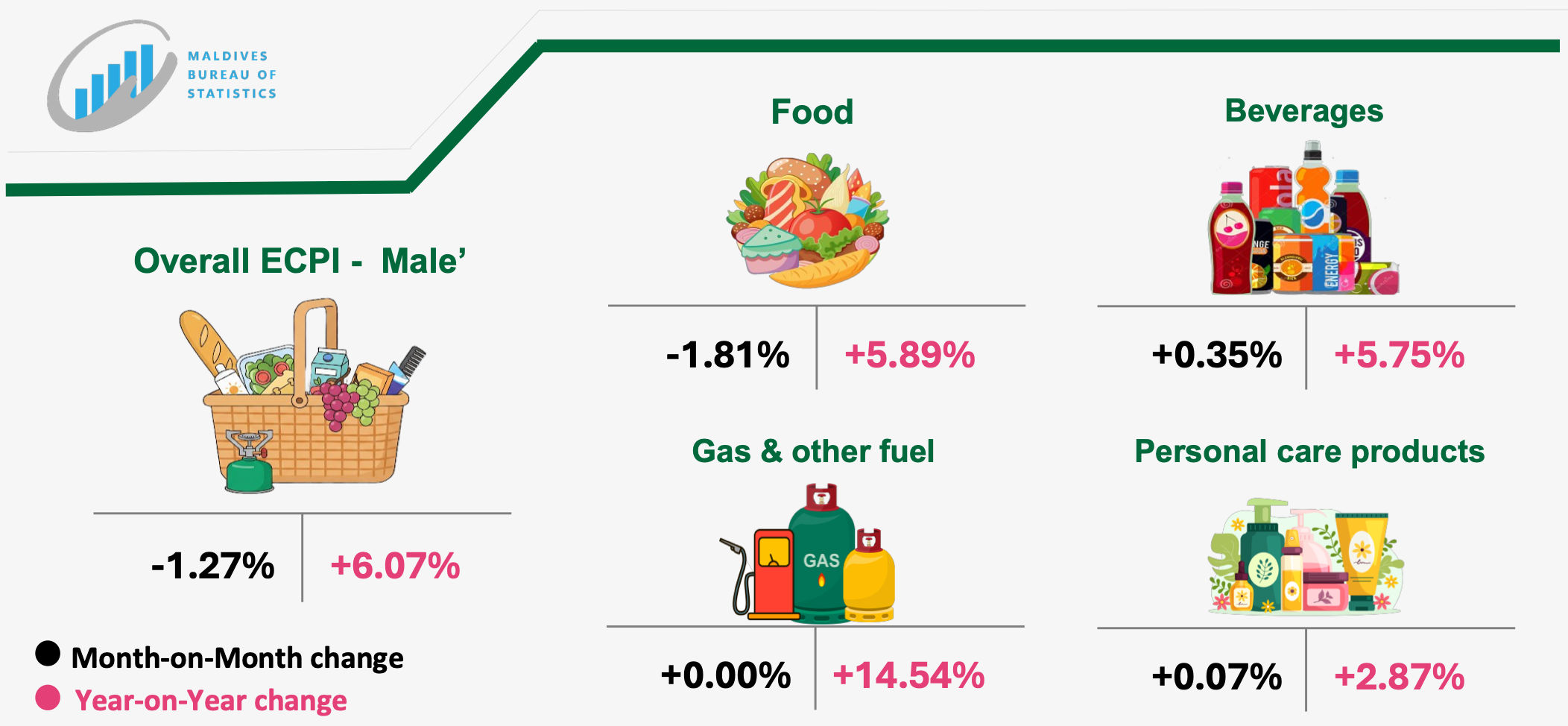
According to the Bureau of Statistics, essential commodity prices in Malé rose 6.07 per cent in the year to July, down from 8 per cent in June. Meat was up 21.43 per cent over the year, coffee 20.20 per cent, and milk, dairy and eggs 9.48 per cent. Prices fell 1.27 per cent month on month.
Saeed's case
Petrol in the Maldives costs MVR16.10 per litre and diesel MVR17.54 per litre, Saeed said, compared to MVR40.09 and MVR41.53 in Singapore. He also gave figures for Dubai and India. Petrol and diesel are both cheaper in Dubai than in the Maldives and diesel is cheaper in India. Of the six comparisons he offered, the Maldives came out ahead in three.
For some 60 years, every administration had treated only rice, sugar and flour as basic food items, he said. But this government added 10 types of fruit, 10 of vegetables and three further food items, arranged to be available at the lowest prices in the Maldives.
The backlash in the comment section was fierce. Commenters pointed out that the median monthly income in Singapore is about five times higher. One person recalled buying a packet of Coast Milk for MVR415, up from MVR310 in June. Others cited similar jumps in the price of pantry items such as olive oil. Residents of other islands flagged much higher prices outside the capital: "Petrol is available for MVR23 on this island. A big tin of coffee MVR430–480."
In the second video, posted the following night, Saeed said prices had begun rising between 2019 and 2023 and that the current rises were caused by freight costs driven up by the US-Israel war on Iran.
Every morning the market was thrown into panic and false stories spread about businesspeople "and the tag line at the end says come out to the protest". The opposition called people to the streets "at every opportunity" and "in connection with everything," he said.
What the MDP is claiming
The MDP costed a month in Malé for a family of five renting an apartment to arrive at the figure of MVR33,525.
"People do not buy things at a shop with political statements," said former State Trading Organisation managing director Hussain Amr, in a video shared by Nasheed. "A person goes to a shop and buys food with what they earn from the work they do. So the question is how much a family needs to spend to live, in Malé or on an island."
He said the government should answer the same way. "The government says prices have not gone up. Then show it with the numbers."
Nasheed also posted a second price list that named brands: Nescafé Classic 500g at MVR260, Dutch Lady full cream milk at MVR44 a litre, cucumber at MVR105 and a five-kilogram bag of basmati at MVR110.
The last Household Income and Expenditure Survey conducted in 2019 found the average household in Malé spent MVR37,013 a month, with a median of MVR35,026, and that the average Malé household had 5.1 members.
Amr said the HIES and the MDP household budget were not measuring the same thing. The survey recorded what households actually spent, including clothing, medical costs, maintenance, appliances, recreation and restaurants. The party's budget was an estimated minimum for basic needs, and excluded loans, medical expenses, clothing, maintenance, appliances and emergencies.
What we found
On the specific items, the pattern in Saeed's rebuttal was consistent. Where the MDP named a product, he answered with a smaller pack or a cheaper brand.
On infant formula, the most alarming figure in the MDP's budget, Saeed did not dispute the number. He quoted Enfamil at MVR575 and then pointed to MHA's Lactogen at MVR130 for a 300-gram packet. The first is an 800-gram tin. Per 100 grams, that is MVR71.88 against MVR43.33.
Milk followed the same pattern. The party's price list named Dutch Lady full cream, one litre, at MVR44; Saeed answered with Amul at MVR30 from STO.
The Maldives Independent compared prices at several shops in Malé on Monday. We found the same price for Enfamil at Villa Mart. We found Dutch Lady at MVR45 at Redwave and MVR50 at a small corner shop.
We also looked at the economic ministry’s AguMagu website, which lists daily essential-commodity prices with the most recent price and how it compares to the last 10 days, across shops in both Malé and other islands. It currently covers 117 items in 224 outlets across 16 atolls. The AguMagu average for Dutch Lady was MVR39.51.
Two of the prices Saeed named could not be verified. He cited pure olive oil at MVR150 at Villa Mart and cucumber at MVR35 at Redwave; neither retailer was stocking the item when the Maldives Independent visited.
The MDP meanwhile put frozen chicken at MVR54 a kilogram; the cheapest found was MVR75. The AguMagu average was MVR97.20. MDP put chilli at MVR200 a kilogram against prices of MVR346 to MVR500 and an AguMagu average of MVR394.80. On eggs, the party's MVR2 matched three of the four retailers visited.
We used the MDP's household budget, rather than the graphics that followed, to build the comparison below.
The importers' account
Appearing in Saeed's second video, Ahmed Nasir, managing director of Lily Enterprises, said a 20-foot container from the Gulf region had cost US$1,600 before the war and now cost US$2,750. A 40-foot container had gone from US$4,000 to US$8,000.
"It is not rising because of something the government is doing," Nasir said. "Because of global changes what increases, increases. Mainly freight increases it, and that affects oil because of the war."
Alim Adam, HR and admin manager at MHA, said long-standing supplier relationships had let the company absorb some of the change. "Because of that we are able to tolerate some of the changes in the market," he said.
Alim said the company had held Lactogen at MVR120 for three years. Redwave was selling the same 300-gram packet at MVR150.
At Monday night's forum, organised by the economic ministry and aired on PSM, Amir Mansoor, managing director of Lily International, said costs at UAE ports had risen fivefold and that shipments that once took a month now take two. Abdulla Savaadh, managing director of Leo Trading, said freight, shipping and operating costs had doubled, that free-on-board costs were up 30 per cent and logistics costs 30 to 40 per cent.
Ibrahim Shimadh, managing director of the State Trading Organisation, said the cost of importing oil had tripled. The sharpest rise came in May and June. Vessels carrying fuel from Oman now required war risk insurance sold in minimum one-week blocks regardless of voyage length. A vessel STO previously chartered for US$600,000 now cost US$950,000, an increase of 58 per cent.
"I have worked through four crises in an official capacity," he said. "I worked in the 2008 financial crisis. I worked through the Russia–Ukraine war. Then after Covid, now I am working in this situation. I do not think there has been a period with a bigger impact on the economy than this."

The dollar
Container rates, war risk premiums and free-on-board costs are billed in dollars. The same US$8,000 shipment costs MVR123,360 at the official peg and MVR178,000 at the parallel rate.
When the Maldives Independent inquired with a licensed exchange in Malé on Tuesday evening, the shop said it was no longer selling dollars because it was holding back for a sale. The most recent rate was MVR22.15. Two Viber groups were selling dollars at rates of MVR21.90 and MVR21.80.
"We are not struggling to get dollars. There is this artificial price for dollars. We are able to buy dollars with a 35 per cent [premium]," Mohamed Firag, managing director of Inner Maldives, said on the PSM programme.
Firag called for modernising monetary policy and suggested the country should "mature and migrate to a single currency economy".
On the cause of the shortage, Saeed returned to a familiar claim: that MVR8 billion printed under the previous administration had flooded the market with rufiyaa that dollars could not match.
Blaming the press
Mohamed Saeed, the Bank of Maldives' head of brand and marketing strategy (no relation to the minister), said attempts to undermine confidence in the financial system risked irreversible damage to the country and that false reporting about financial institutions and BML in particular would affect relationships with foreign banks. Losing even one such relationship would disrupt transfers abroad and the use of bank cards by students overseas, he warned.
The bank was selling an average of US$2.7 million a day and had sold US$570 million at the official rate so far this year, up from a monthly average of US$40 million in 2023, he said.
STO boss Shimadh said coverage of the exchange rate carried real consequences. "When those headlines create a negative image for the government, the effect is on the whole economy," he said.
Economic Minister Saeed argued that the market would react to media reporting that incorrectly put the rate at MVR22 instead of MVR21. If a headline declared the rate to be MVR23, it was very likely that a Viber group would start selling for that price, he said.
Headlines carrying those numbers were designed to create panic, spread "fake news" and manipulate the market, he alleged.
"Is that responsible?" he asked. "That is not how it happens in any country. To deliberately destroy an economy, saying today the dollar rate is MVR24, deliberately putting that in the news – is that the best democracy?"
Saeed said two newspapers had reported rates of MVR22 and MVR24. He did not name them. According to Adhadhu, which publishes a live parallel-rate tracker, no outlet had published a rate of MVR24.
Dhauru responded with a spoof report. The headline read: "Black market dollar falls to MVR 15.42 – why don't you bring the rate down now?"
Discussion
No comments yet. Be the first to share your thoughts!
No comments yet. Be the first to join the conversation!
Join the Conversation
Sign in to share your thoughts under an alias and take part in the discussion. Independent journalism thrives on open, respectful debate — your voice matters.
Support Independent Journalism
Help us keep the news free and fearless
Give once
$
or
Become a memberfrom $5/month