
Official rate, then the top-up: what a foreign worker paid for dollars
A licensed money changer quoted MVR23.50 for US$1.
Artwork: Dosain
10 minutes ago
An Indian truck driver who has worked in Malé for six years is paid MVR15,000 a month. Like most workers outside the tourism and aviation sectors, he is paid in rufiyaa. In late October, he spent MVR23.50 for each US dollar he bought to send to his family back home.
Five money changers in Malé told him that US dollars were unavailable. He managed to find one that was willing to sell, an outlet licensed by the Maldives Monetary Authority.
"The currency exchange representative instructed me to make two separate transactions," he told the Maldives Independent.
When he made two transfers from his Bank of Maldives (BML) account, the changer sent the dollars to his dollar account. The first payment was exactly what the dollars cost at the official rate of MVR15.42. The second took the total price to MVR23.50 a dollar, 52 per cent above it, according to bank records seen by the Maldives Independent.
The premium amounts to more than a fifth of his monthly pay.
Like foreign workers paid in rufiyaa, who can send only a fraction of their wages home through banks, Maldivians trying to shop online with cards linked to rufiyaa accounts face dollar rationing as well. On top of a longstanding cap of US$250 a month, BML imposes a collective daily allowance for the most-used websites, which runs out in less than a minute after it resets at 7am every morning.
On 24 August, after the parallel market rate passed MVR22.80, Homeland Security Minister Ali Ihusaan vowed to "crack down without fear or favour" on the black market. Police had identified seven exchangers who sold US$76 million in nine months with major resorts as their suppliers, he told the press.
Two days later, parliament doubled the share of foreign currency earnings that tourist establishments must convert through banks to 40 per cent of gross sales. Ihusaan later said money changers were selling fewer dollars because of the "shock" of enforcement.
The central bank has since acted against changers trading above the MVR15.42 rate. It revoked the licence of Express Money Exchange and suspended the license of MS Finance Currency Exchange with a fine of MVR500,000.
In mid-September, Economic Development Minister Mohamed Saeed said the black market rate had fallen. It was below its level when the government took office in November 2023, he said.
"The dollar is at MVR23 today, honourable Speaker," Maldivian Democratic Party MP Abdul Ghafoor Moosa said during the budget debate on Monday "How are the people of this country supposed to get by?"
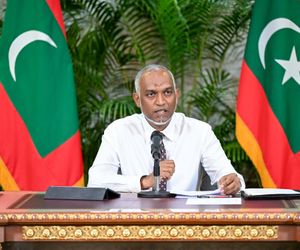
Asked about the persisting dollar shortage at his press conference on Monday morning, President Dr Mohamed Muizzu said efforts were ongoing "on many fronts" to resolve the forex crisis. The government is trying to attract foreign investment and boost foreign currency reserves through measures such as the tourism dollar surrender policy, he said.
"The result of efforts to bring down the demand for the black market will be seen," he said.
The capped routes
In October 2025, the State Bank of India (SBI) cut the monthly remittance limit on rufiyaa accounts held by Indian nationals to US$150. It said dollar inflows to the bank were too low. Transfers from dollar accounts were not affected.
At the official rate, US$150 is MVR2,313, about 15 per cent of the Indian truck driver's monthly pay.
India's foreign ministry told parliament on 5 December 2025 that the cap reflects the limited dollars the MMA allocates to banks each month for remittances abroad. Upon request from India, the MMA increased its dollar allocation to SBI in November 2025, raising the ceiling to US$300 for workers in education and health.
BML's limit is now MVR771 a month. That is about US$50. The truck driver said the fee per transfer was up from MVR60 to MVR250.
The service was not built for foreign workers. According to MIB's FAQ, it is a way for Maldivian customers to send money to Maldivian family members in India.
For foreign workers, that leaves informal transfer networks, which are mostly run by expatriate business owners. According to the driver, until recently, they gave about INR4.60 for each rufiyaa. They now give INR4.00. A bank selling rupees at MVR0.1650 each gives about INR6.06 per rufiyaa. At INR4.00, a family in India receives about a third less.
"We do not want to depend on unauthorised money transfer networks," he said. "We want to use legitimate banking channels, comply with financial regulations and transfer our salaries safely."
Many workers are afraid to speak publicly, some because they have relied on informal networks in the past, he said.
"We should not have to sacrifice more than a quarter of our earnings simply to send our own money home," he said.
Indian workers are not the largest group sending money home. Bangladeshis accounted for 54.2 per cent of remittance transactions by foreigners, according to MMA figures. In late October, Bangladeshi and Indian construction workers at Bolidhuffaru went on strike, mainly over remittances, according to their Maldivian employer. Aima Construction fired 23 of them. Twenty-one people who refused to board flights home were handed to Immigration.
Waiting for a fix
The MMA, BML and SBI did not respond to questions sent on Monday.
In October 2025, the Indian High Commission said it was discussing an INR–MVR exchange mechanism, UPI and wider use of RuPay cards. In an advisory dated 7 September, the High Commission told Indians considering work in the Maldives to weigh the remittance problem before coming. It blamed a severe dollar shortage and insufficient dollar allocations to SBI by the MMA.
The advisory said the limit for education and health workers had been only "marginally elevated" and that a comprehensive solution for all Indian workers may take time.
It also noted the MMA had indicated that the government wants all local transactions in rufiyaa by 2030, after which employers would have to pay foreign workers in rufiyaa rather than dollars. The MMA aims to de-dollarise by 2030, ending dollar salaries for resort and airline workers as well.
The High Commission's information officer said the advisory was "self-explanatory."
"We are trying to work with the government to find a possible way forward. Onboarding the UPI is one of the avenues which we were exploring," the official told the Maldives Independent. "It has not been very successful as yet. However, I am not at liberty of sharing the details of discussions with the government as it is an ongoing bilateral matter."
The High Commission's advice for Indian workers would be to "follow the legal processes," he said.
Discussion
No comments yet. Be the first to share your thoughts!
No comments yet. Be the first to join the conversation!
Join the Conversation
Sign in to share your thoughts under an alias and take part in the discussion. Independent journalism thrives on open, respectful debate — your voice matters.
Support Independent Journalism
Help us keep the news free and fearless
Give once
$
or
Become a memberfrom $5/month