

Gone in 60 seconds: the falling rate and the rationing bank
What the 7am scramble for dollars says about the shortage.
Artwork: Dosain
16 Sep, 16:05
In May, Maldivians learned of a per-website daily budget for rufiyaa accounts when their cards declined at checkout. The collective limit and reset time remained undisclosed. Since the Bank of Maldives finally announced both on Saturday, more than 70 transactions per second are now made at 7am as customers wait with pre-loaded carts. The daily allocation of US$100,000 for the 150 most-used merchants is exhausted in less than a minute.
“So do the math. That’s about US$17,500 going out from the bank in one second. So it would take a very short time for that day’s limit to be reached. For example, if it comes to us at that rate, if we’re to do the most simple math, US$100,000 would be reached in six seconds," BML Spokesperson Mohamed Saeed told PSM on Monday night, working on the assumption that each of the 70 transactions is made up to the full online shopping limit, which is fixed at US$250 a month for debit cards linked to local currency accounts.
Appearing on the state broadcaster, Saeed denied that the bank has reduced dollar support for rufiyaa cards, which he said is on course to surpass an annual record of US$390 million provided in 2025. The bank has separated "essential and non-essential" categories and capped shopping on e-commerce platforms in order to prioritise imports, medical travel and overseas tuition fees.
At present, more than 270,000 BML customers use rufiyaa cards for foreign transactions, up threefold from about 90,000 customers in 2021. Prior to the bank imposing the restrictions this week, Maldivians conducted transactions on 40,000 websites at a rate of 20,000 transactions a day, he said.
The bank capped spending on overseas e-commerce at US$16 million a month, divided into daily category limits that reset at 7am: US$6 million a month for travel and accommodation, US$3 million for the retail platforms, US$1.5 million for social media, US$3 million for essential subscriptions and US$1.8 million for other merchants. Customers buying airline tickets or booking hotel rooms are limited to three transactions each every three months.
Customers paying with rufiyaa cards are now drawing on these fixed national allowances. Shared across all customers, every cardholder will be blocked when the daily ceiling on online dollar transactions is reached.
"If the limit for a particular category or merchant is reached on a given day, customers may retry the transaction on the following day or, where available, use a US Dollar card to complete the purchase," the bank advised.
At the President's Office earlier on Monday, Economic Development Minister Mohamed Saeed (no relation to the BML spokesman) told the press that as a result of the government's coordinated efforts the black market rate has fallen below the level of November 2023 when the current administration took office. He cited "information we're getting" and reiterated the allegation that the previous rate had been "artificially manipulated" through collusion and speculation.
The parallel market rate exceeded MVR22.80, nearly 48 per cent above the official rate of MVR15.42, when the government commenced the crackdown in late August.
At the press briefing, Homeland Security Minister Ali Ihusaan acknowledged that licensed money changers are not selling dollars as before. The "shock" of the enforcement drive has thrown the foreign exchange market out of equilibrium, he suggested.
"I believe that if businesses carry on in the normal manner as before, it will become normalised. At the moment with this shock some people might not be exchanging at the previous volume," he said.
Attorney General Ahmed Usham said "positive changes" from doubling the conversion requirement for resorts and large businesses would be seen within a month. Amendments made to the forex law last month raised the mandatory exchange figure to 40 per cent of gross foreign currency sales.
The government initially proposed repealing the option of converting US$500 per tourist and fixing the conversion requirement at 20 per cent. After the bill was sent back to committee, the rate was doubled on the floor and passed on 26 August, two days after Ihusaan alleged that major resorts were among key suppliers to the black market. Seven money exchangers had sold US$76 million over nine months, he said. "One of [the suppliers], a resort chain, exchanged US$4 million in the black market over the past nine months," he said.
The Maldives Association of Tourism Industry, which counts 146 resorts among its 200 members, protested the justification for a "sweeping policy measure" on the alleged conduct of individual resorts. MATI called the hike to 40 per cent "an increase the industry does not consider viable because resorts already make substantial payments in USD for fuel, salaries, service charge, supplies, logistics, guest transfers, TGST, green tax, withholding tax, income tax, tourism land rent, and foreign currency loan obligations."
The conversion deadline for this month's revenue falls on 28 October.
What the bank said
BML said the amount of foreign currency needed for growing e-commerce spending has exceeded the US dollars available to the bank.
"This sustained demand has placed considerable pressure on the Bank's foreign currency liquidity and has affected our ability to provide other foreign currency services, particularly Telegraphic Transfers (TTs), which are currently facing delays. This has also resulted in increased customer complaints regarding these services," the bank said.
The daily transaction limits for rufiyaa cards are intended to "manage the Bank’s foreign currency reserves responsibly and ensure the uninterrupted procurement of essential goods and services," it added.
On PSM, BML Spokesman Saeed stressed that the highest demand is concentrated in the online shopping category. The bucket for travel and essential subscriptions still has dollars left at the end of the day, which he said offers relief for the everyday needs of businesses and freelancers. The limits remain unchanged for Maldivians travelling, living or studying abroad, all of whom could spend up to US$1,000 on POS machines and withdraw higher amounts with approval, he said.
What the list shows
Temu, Amazon, Alibaba, Shein and AliExpress lead the list of 150 merchants ranked by use in the US$3 million retail category. Last year, the bank imposed a 30 per cent fee on the main Chinese platforms along with eBay.
Below them the list stops looking like shopping. Supabase, Magnific, Suno and Anthropic's Claude were named alongside Fiverr, Preply and Starlink. Gaming was heavily represented: PUBG Mobile, Mobile Legends, Clash of Clans, Genshin Impact and Fortnite.
Preply and Coursiv, both learning platforms, are among the capped 150, as is UKVI, which is not a merchant but the British government's visa fee service. Many others read as payment descriptor strings rather than businesses.
The same US$100,000 a day covers all of the above.
'Declined at 7:01'
The reaction on X was mostly about arithmetic.
Hassan Kurusee, an anonymous account for whistleblowers, calculated that the entire national allowance of US$16 million would be gone in about five minutes if one percent of the bank's 390,000 customers spent an average of US$135 each. "This means every Maldivian citizen will get 5 mins, between 7 am - 7.05 am to try their luck on card payments," he wrote.
One user claimed the reset had previously been set at 5am and that the limit was exhausted in three minutes. "This is gambling our own money," he wrote. Another questioned whether the published figures matched the limits the bank was applying internally.
One person said she completed a payment on one site at exactly 7am but could not process on Temu or Shein. "Declined at 7:01," wrote another. "Take back the card you gave us. It is no use for anything."
Several reported that buying online appears to cost around MVR20 to the dollar rather than the pegged MVR15.42. Shehenaz Moosa, a content creator with a large following, accused the bank of providing dollars for medical expenses overseas at an effective rate of about MVR18.90. She said the bank deducted MVR37,790 on the first operation for her cataract surgery, which was billed at US$2,000 an eye. At 15.42 that sum should have been MVR30,840, a difference of MVR6,950. "What is the benefit of shutting down the black market if the bank itself is effectively charging us a rate that is far higher than the stated bank rate?" she asked. "This is not about politics. It is about ordinary people trying to pay for essential medical treatment."
A day before the caps were announced, pro-government outlet Khulaasaa News posted a video explaining why Maldivians should make their own currency more resilient. “We find cute things, household items, clothes and stuff, and we immediately buy it. Rather than doing that, can we pause and think about it? Are these items available here in the Maldives? If yes, buy it from the Maldives, from the shops here, because you immediately buying things online is creating an extra demand for foreign currencies. When we might actually don’t really need to spend that,” the presenter advised.
It drew more than 141,400 views and an irate reply thread. "Can you tell me how we can support the local currency when more than 90 per cent of the products here are imported?" asked one. Addressing the presenter directly, another wrote that whether you buy online or locally, "at the end of the day WE NEED DOLLARS".
The demand side
At Monday's press briefing, Home Minister Ali Ihusaan said the authorities have identified cases where goods corresponding to large telegraphic transfers had never arrived. The local businesses involved claimed the dollars were used for advance payments or balances owed on earlier shipments, but the invoiced goods never entered the country. He called it "trade-based money laundering." The same route was being used for drug payments and for remitting expatriate wages, he said.
Ihusaan also said expatriates are running unlicensed exchange businesses out of corner shops, depositing wages into business accounts held in the name of Maldivians, converting them daily and smuggling the dollars out. Some are now being intercepted at the border. Twelve people are under investigation and nine are in custody. Maldivians who sponsor foreign workers and leave them unsupervised face fines of MVR50,000 each, he warned.
"I want to note with regret that whenever we take one of them into detention, a Maldivian comes, saying 'that's the cook at our house.' But he's out on the street cooking dollars day and night," he said.
The shortage
The World Bank's 2024 Financial Sector Assessment attributed the persistent US dollar shortage in large part to the government's investment programmes, executed mainly by the Housing Development Corporation, which it reported as running a net foreign currency outflow of about US$160 million a year, equivalent to a fifth of the central bank's reserves at the time. The Maldives Monetary Authority earmarks the bulk of foreign exchange for government and select state-owned enterprises to service external debt.
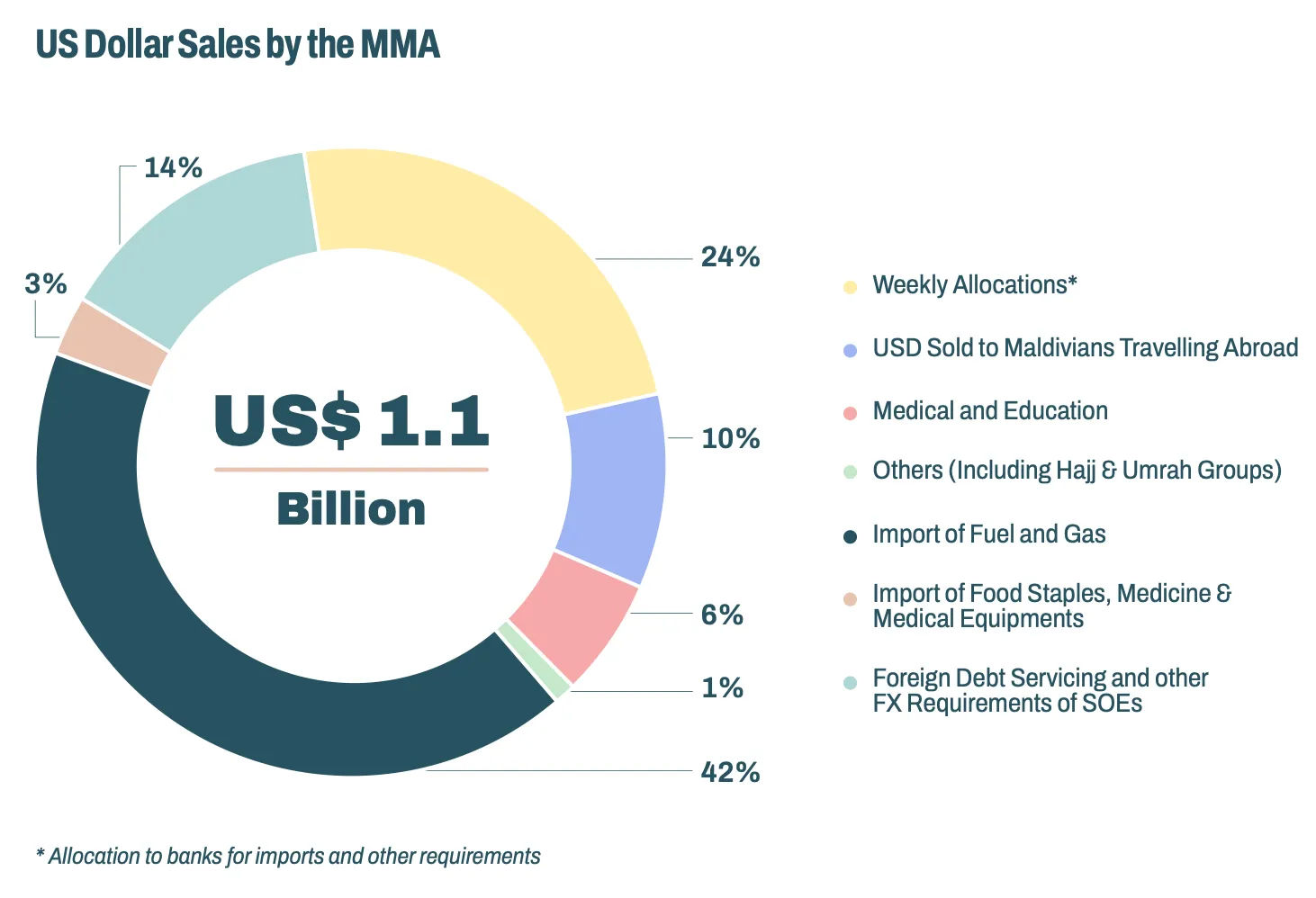
Of the foreign currency the MMA collected as of July this year, Governor Ahmed Munawar said 56 per cent went towards debt repayment. He acknowledged that banks could meet only about a fifth of business demand for telegraphic transfers, forcing importers to source dollars elsewhere to pay foreign suppliers.
The MMA's order is sovereign creditors first, government and SOEs second, and commercial banks third. What reaches BML is what is left over. The 7am categories are how it is divided among 270,000 customers.
Munawar said the central bank's long-term vision is for rufiyaa to be used for all transactions in the Maldives. Rufiyaa is the legal tender but the law currently allows exemptions for foreign currency use. The current dollar ratio is above 40 per cent, he noted.
"The truth is this change should have been brought 40 years ago," the governor said. But the change cannot be made "overnight" and business would have time to "absorb the shock". He said the MMA's goal is to de-dollarise by 2030, after which 100 per cent of foreign currency earnings must be converted and tourists must pay for goods and services in rufiyaa.
The shift must be accompanied by the collection of taxes in rufiyaa and the discontinuation of US dollar salaries for resort workers and airline employees, Munawar said.
"That’s really how the demand will grow for Maldivian rufiyaa," he said.
Discussion
No comments yet. Be the first to share your thoughts!
No comments yet. Be the first to join the conversation!
Join the Conversation
Sign in to share your thoughts under an alias and take part in the discussion. Independent journalism thrives on open, respectful debate — your voice matters.
Support Independent Journalism
Help us keep the news free and fearless
Give once
$
or
Become a memberfrom $5/month

