

'I'll finish this within two years': Malé's new traffic chief sets out his plans
Yoosuf Maaniu on cemetery car parks, AI cameras and fines.
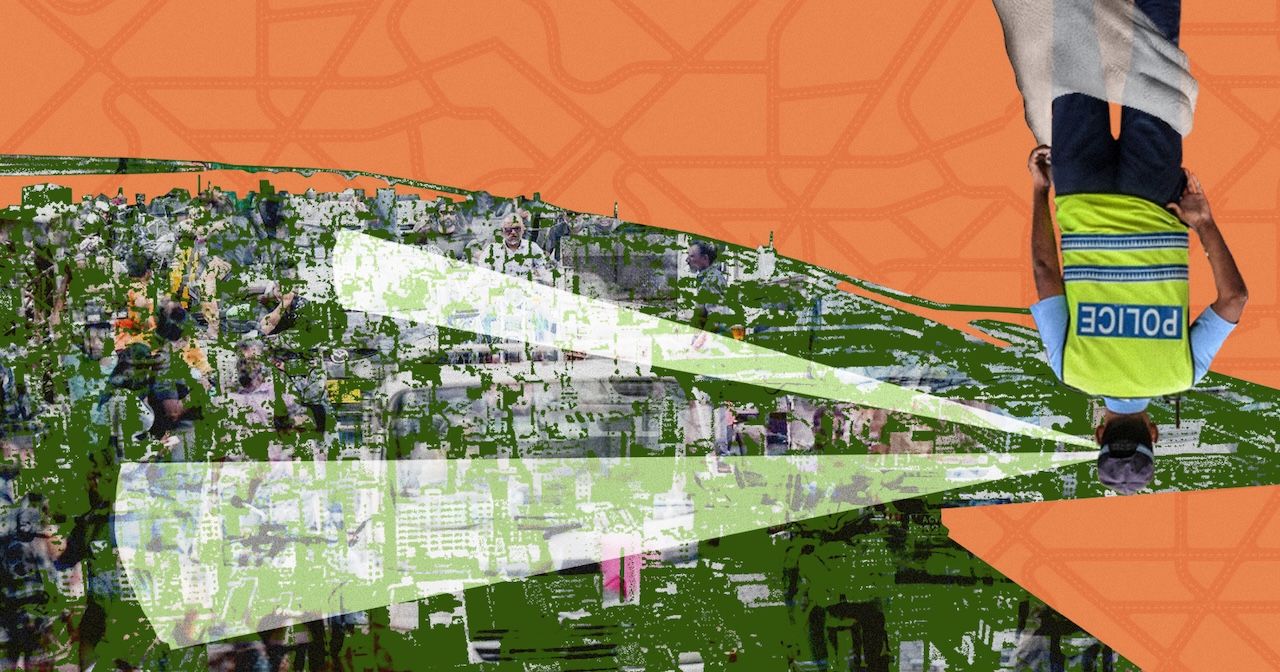
Artwork: Dosain
06 Oct, 17:31
Greater Malé's 254,557 residents share 8.3 square kilometres of road with 130,806 active vehicles – nearly nine in 10 of them motorcycles – according to a government strategy drawn up in July. Vehicles occupy 82 per cent of that road space.
President Dr Mohamed Muizzu set up the Greater Malé Transport and Mobility Office by directive on 12 July. The Land Transport Act, which took effect last Thursday (1 October), handed the new body functions previously overseen by the Malé City Council with a three-year lifespan. The office has six months to determine how many vehicles the region can carry. It was established to deliver a 2026–2033 reform plan spanning 11 areas, from paid roadside parking to moving garages and workshops out to Thilafushi and Gulhifalhu.
Yoosuf Maaniu was appointed to lead the office on 15 September. He was commissioner general of customs under Muizzu until July 2024. He was previously president of the National Integrity Commission until former President Abdulla Yameen dismissed him in 2017.
He spoke to the Maldives Independent about cameras, parking, pavements and his promise to deliver results within two years. The interview was conducted in Dhivehi and English, and has been translated, condensed and edited for clarity.
What is your mandate?
Managing traffic, along with pedestrian walkways, pavements and crossings. Beyond that, we look at the traffic management and control systems used in developed countries, adapt them so they work here, and establish them.
Our work is tied to a great many stakeholders – the police, the Maldives Transport and Contracting Company (MTCC), the Housing Development Corporation (HDC), the Malé City Council and the water and sewerage company. To do this completely, we would have to substantially change the infrastructure of Greater Malé. It was not designed for the capacity it now serves. Many former commercial and open areas have become very high-density apartment buildings, and we have to accommodate that.
We want to improve the roads through research and expert advice – making some roads one-way, for example – and give enforcement agencies a system through which the law can actually be enforced. Cameras will go up in parking areas and on main roads, with radar to capture speed. In the background, AI will identify licence plates. Once we know which vehicle it is, the owner is responsible and can be fined.
Right now, even if someone speeds, the rules aren't firmly enforced. When an officer stops someone, they often have to let them go because there's no proof. Not every officer has a body camera yet, but the police have said many will.
I think there should be no parking on the road at all. We should have parking buildings in strategic areas, so that from any direction you can reach a motorcycle space within a five- to ten-minute walk, and a car park within about 15 minutes.
The problem is very bad in Hulhumalé. Many high-rise social housing blocks there use the ground and first floors for commercial space, with very little parking, so people are forced to park on the road. Even the police can't do much, because there is no robust public transport system yet. MTCC has done very well and is rolling out buses and taxis fast. But even they struggle to plan when they don't know what population will gather in an area – how many are schoolchildren, how many go to work.
Take schools. Residents of an area are supposed to attend that area's school, but it isn't enforced, so every day children travel between Malé and Hulhumalé. Most offices are still in Malé, but a very large population now lives in Hulhumalé. Unless offices are strategically moved to places with more space, we're not future-proofing anything.
It's like the roots of a big tree – everything is connected. You can't fix one problem without the others, and you only get a total solution by involving every stakeholder. So I'm focused on a permanent solution, not a temporary fix.
Are you drawing on any studies or data?
Yes. The infrastructure ministry and HDC have urban planners who have done studies. The transport ministry makes the rules on traffic control, regulations and permits, so those studies have been shared with it too. I'll be working alongside all of them.
The police also need to study things frequently. An apartment block or a commercial space suddenly opens and they're not in the loop. Nobody has really thought about the security issues a new building brings, or the changes for traffic and pedestrians. Near some shops and homes, motorcycles have to ride over the pavement to get inside, which isn't safe, including for the children who live there. Some Maldivians drive very irresponsibly and don't think about anyone else.
I don't want to make any decision without all these people. I've asked the police for four people with traffic expertise to work with me in the office, and I want the same from the housing ministry, HDC and the environment ministry.
We're also looking at taxi stops. Taxis use the bus stop near West Park, which shouldn't happen and isn't safe. We did a small survey there the other day. Where three roads meet the space is a bit wider, so we're running a pilot: moving the pavement in a little so taxis can pull in close to it without blocking traffic. At the moment, when you call a taxi, it stops in the middle of the road wherever it is.
Places like Singapore and Hong Kong have designated taxi stops. Unless we show drivers a specific place, we can't penalise them. Ask a driver why he stopped and he'll say the passenger got in before he could pull over. With designated places, there's no room for excuses.
Declaring Malé's carrying capacity was the city council's job, but successive mayors haven't done it. The council commissioned the Maldives National University to study it, and that study is now complete. Are you aware of it?
I haven't seen it, but they must have done it. Under the old decentralisation law, each council had to declare its island's carrying capacity, and studies were carried out then. Now, under the new law, that mandate falls to our office for the Greater Malé region.
Those studies gave some figures and percentages. Whether that's the best figure, we can't yet say from our own work. The study was referred to a great deal when the office was being set up. We have to look at the number of vehicles and the road space using a formula, and we'll determine the figure after doing our own studies.
Will you declare a vehicle carrying capacity for Malé?
Under the law, it's up to me. That's why I want to do it alongside the traffic management system, so the system can tell us the maximum number. We've started work on a Traffic Management Centre with Korea's assistance. They have already done a feasibility study, and now the work has to begin. The law requires both the centre and the carrying capacity within six months.
I haven't studied their proposed system in depth yet, but it should be very good. They manage roads very efficiently in a very high-density city. We'll get a lot of help from Japan, Hong Kong and Korea, and I'm looking at how they solved these problems. But our situation is different. We can't just take something and use it as it is.
My personal view is that we need at least 30 per cent, ideally 50 per cent, more parking than there is now. That doesn't mean more vehicles – just more parking. Wherever you go, there's no parking. Even building enough for the existing vehicles won't solve it; it has to be a bit more.
Roadworthiness testing hasn't been done responsibly at all. All that gets checked is the lights and whether the brakes work. That might have been fine before there was a bridge or a highway. But the highway is now at a dangerous level, with the wind as well, so we need much stricter safety measures. Tyres wear out and nobody says anything.
For now, we're thinking of taking over roadworthiness testing ourselves – setting up a facility and running it for at least a year. The way I work, I want to experience first-hand how these things run. Otherwise you make rules that don't help the end user or the person doing the work. After a year we'd have the expertise to privatise it, and to regulate it.
In the parking buildings, cars should go at the bottom and motorcycles above. A car needs a big driveway to go up; a motorcycle doesn't, so putting motorcycles at the bottom wastes space.
They will be multi-use buildings: 30 to 40 per cent parking, then recreation centres for young people and commercial space. On the roof, I'd want at least 60 per cent green space – a park open to people in the area – with the rest commercial, such as restaurants. We're losing a lot of land, so with the environment ministry we'll use renewable energy as much as possible and bring in trees.
Greater Malé is very congested. Where will you find space for parking buildings?
We've already received a lot of spaces. The housing ministry is talking to people about handing over land, and some plots are fairly large. Some spaces already allocated for parking only use the ground level, which isn't viable in future, so we plan to build upward. Some cemeteries have also been cleared, and they could take buildings of maybe 15 storeys. Some are big – 40,000 square feet. We want those to be multi-use too.
Some matters I can't decide on my own, but I'd suggest public-private partnerships for everything. The government shouldn't bear all the cost, and local entrepreneurs should get a chance to grow. When a parking building goes up, an investor could build part of it and get a shop in return. Someone could invest in a recreation centre, regulated by the sports ministry, or a food court.
Persons with disabilities I've met often say how hard it is to walk in Malé. A visually impaired person can't even rely on the pavement because of rubbish, and tools like smart canes only help if a city is built for them. Do you have plans to improve accessibility?
Yes. When we build pedestrian walkways, we'll make them usable by wheelchairs, and we're thinking of fitting crossing lights in some places. HDC is bringing an innovative idea: raising crossings a little, roughly level with the pavement – a hybrid of a speed bump and a crossing. Wheelchair users wouldn't have to go down off the pavement, though I'm not sure of the details yet. It also forces traffic to slow down. HDC told me it's used around the world, and they're starting a pilot.
We'll make walkways as child-friendly as possible. Some crossings have become very dangerous, like at the MNDF and POLCO flats, where vehicles come off the highway from Malé at high speed. Speed has to stay at a certain level – slow everything right down and the roads will block. But this only works when people are responsible.
The bridge is another example. There are a lot of accidents going from Malé to Hulhumalé because motorcycles and cars are separated into lanes, which isn't done anywhere in the world without enough space. The universal rule is that you overtake on the right. But on the bridge, motorcycles keep left and cars keep right. Sometimes a pickup is doing 15 or 20 kilometres an hour in a 50 zone, and people are forced to overtake illegally. In effect, we criminalise people for doing things out of necessity.
It has become the norm across Malé and Hulhumalé: cars occupy the right lane and everyone has learned to overtake on the left. We want to study this thoroughly with expert advice. Very big changes have to come to the traffic rules, and we want to make them with the public's support.
Then there are pavements. Many shops use them to store goods, and the police can only enforce so much. Unless we make these things offences and get the power to fine, I don't think it can be solved. Rubbish is the same – there have to be designated places to keep it. We're studying this with urban planners.
MTCC will also help teach traffic etiquette to taxi, truck and bus drivers – everyone. We're starting with law enforcement and government bodies, so they set an example. Right now, many people in uniform drive very fast and dangerously on the highway. They should be penalised, and their institutions should penalise them too.
We hope to set out our plans in more detail next month. I don't want temporary solutions. I want plans that last 10 to 20 years.
Loading and unloading goods disrupts traffic a lot in Malé. Someone told me nowhere else in the world allows it 24 hours a day. What do you think?
I have a plan, but it's only my plan for now – the board will decide. In the big parking structures on sites of 30,000 to 40,000 square feet, like the cemeteries, we'd dedicate one floor to heavy vehicles. We'd build storage units there, each holding about a big pickup's load, and rent them to nearby shops and businesses. The big pickups would unload inside, and you'd no longer see them on the road.
I'm also thinking of talking to MTCC about a fleet of small battery-powered pickups to take goods from those units to the shops. Cutting into the pavement a little for loading wouldn't cause much trouble for pedestrians or traffic, and a small load is quicker to unload. Battery vehicles also mean less pollution, even if trips are more frequent. None of this is in the plan yet; it'll be decided after a lot of research.
We're also thinking about specific times – restricting loading during the busiest hours, when people go to and from work and school, and allowing it in between, or at night after shops close. The trouble is that big pickup operators don't work at night. If MTCC had a fleet that could run 24 hours, that would help a lot.
What will your team look like? How big is it, and what expertise are you hiring?
A very small team – about 24 staff. There will be urban planners, people with expertise in traffic management systems, someone who can develop AI for this work, and transport experts. On top of that, I want police officers attached to the office, working as part of the team, so their knowledge and experience are shared and our decisions are sound. I'd also bring in an urban planner from the housing ministry and people from the environment ministry. The 24 doesn't include them. For the first two years they could mentor my staff, so that by the end we have that knowledge base ourselves.
Successive governments and mayors haven't managed this. Given how severe congestion is, how doable is it in the three years you've been given?
People might think this is a joke, but it's not. I'll finish this within two years. If all the stakeholders go forward saying the same thing, it will happen. It would be more difficult if an entity not connected with the government were working on this.
This office is set up to work fairly independently. But I want expertise from the housing ministry, the police, the environment ministry and the rest – and the schools too. If we set up school buses, the walkways have to be safe for children walking from home. It's a very big job, but we've been looking at it from every perspective.
So I'm making an all-inclusive plan. It will make the other agencies' work easier too, and I get their expertise. It's a very doable plan, as long as everybody follows the rules we make.
Buildings where the ground floor, or the first two floors, weren't made into parking will have to change. They'll have to be converted into parking, or the owners will have to help us financially to build a parking building. Otherwise this would be impossible.
Some of these measures will make people unhappy. When something that's been lenient is restricted, people resent it. Is there the political will, given the changes are likely to be unpopular?
It won't be unpopular, because I have already put a stop to criminalising people for parking. I've said it's something we shouldn't do. We're allowing vehicles to be imported and registered, so it's our responsibility to provide parking. We're allowing buildings to go up without enough parking for the people living in them. That's our problem.
No authority or government has fully upheld its responsibility, and the President wants these things done responsibly. Where there's no other solution, we'll build parking buildings. His dream is that pedestrians can walk easily, traffic doesn't congest and Greater Malé becomes a peaceful place. Inshallah, it won't stay a dream.
It can be done within two years if everyone cooperates. I've met the police, HDC and some MTCC officials, and they're all in line with this, because it concerns everyone. We only want to penalise those who drive dangerously and break the rules, not people who do things out of necessity – and parking illegally is done out of necessity. So we first have to provide a solution, and then penalise those who don't follow the rules.
Things like leaving rubbish on the road come down to individual responsibility. How will you convince individuals, when everyone has to play their part?
Mainly through awareness programmes, and then fines. With cameras in parking areas, we'll know who's doing it. At first I want law enforcement to give warnings, for at least six months or so, to make people aware. After that, we'll announce that fines will be imposed. When people are fined a substantial amount, they'll stop. When it comes out of their pocket – I think that's the only solution, because discipline is almost non-existent here.
I've lived and driven in many places abroad. There aren't so many accidents because everyone is disciplined. Here, most people can't keep that discipline – even walking. When I jog around Central Park, people don't move aside. Even women, who I'd expect to move aside – three of them walk together with their arms out and take the whole lane.
There's a mentality that giving someone a little space is a loss. We have to convince people that's not how it's done. Everyone says "I'm a lion, I'm a tiger", but they behave like cattle. You have to take a leadership role. Giving way to others makes you a better person.
So perceptions need to change a lot, and there will be big awareness programmes. The population is young, and many grew up with smartphones, so reaching them through social media will be easier. It will start with the police, the MNDF, MTCC, all uniformed bodies and government employees. When people see someone in uniform behaving badly, they notice. That's where we have to start.
This is a very big task, something that hasn't been done before. For our readers, what is your background, and what makes you a good fit?
I've worked at many offices, because I wanted to experience how all the critical areas of the state work.
I started at Maldives Ports Limited. Then I was an air traffic controller at the airports authority, and I failed miserably. There was no radar – you had to move little bits of plastic around by hand for each flight while talking. I quit, but I learned how an airport runs. Then I spent four years in Malaysia as a financial consultant at a subsidiary of JP Morgan Chase, one of the world's largest financial institutions.
Then I was at the employment ministry. We set up a job centre. Until then, you couldn't get a job unless you were politically connected or knew someone – that was during President Maumoon's time. President Yameen wanted everyone to have the same opportunities, so we promoted equal employment. That was a very significant change.
I wanted to join MIFCO but didn't get the chance, so the next best thing was Horizon Fisheries, where I spent three years learning how the fisheries industry works. Then I wanted to see the defence sector, but not as a soldier. I became CEO of SIFCO, the military's corporate arm, and worked to make procurement and welfare cost the state less, and to use the military's assets commercially.
Then I spent about three years at the Audit Office as corporate head. That's where I learned the most – public finance laws and regulations, and compliance audits, which show you what's lacking and inefficient in a government office. Every organisation should be audited at least quarterly.
Then the Customs Integrity Commission was established. I applied, and I think I received the highest number of votes in Maldives' history, from every party in the Majlis. I became its president. Later I suggested to some MPs that we merge the police and customs integrity commissions, and the National Integrity Commission was established. I went there as vice president and then became president.
We looked at a lot of cases. Immigration was taking foreigners' fingerprints with no system to store or identify them, so it was just for show – people would come back in on another passport. Human trafficking is a very big problem. I exposed police corruption very publicly, and I was fired – unlawfully fired.
Then I was at Customs. I started a sea-to-air cargo initiative: goods made in places like Bangladesh could be shipped here and flown on to Europe more cheaply. Done properly, it could earn hundreds of millions of dollars. We also introduced an AI-based system that shows photos when people search for products, so they pick the right item and get the form right the first time.
But Customs is a very old institution, and some people weren't ready for change. When it started modernising, there was blowback, and I was moved to Homeland. I don't think I was given a reason.
Unless work is very challenging, I have no desire to be involved – it's a waste, in my view. This is the most challenging thing, and the most pressing problem. I want to give it 100 per cent.
Finally, what do you hope to achieve by the end of your term?
My vision is simply what the President wishes: that this place becomes peaceful and modern, that everything runs smoothly, and that we avoid criminalising people as much as possible by changing their mindsets. I want to do it in a way that greatly benefits all the other stakeholders too.
It's not only traffic that will be managed. Big changes will come to people's lives – road safety, pedestrian walkways, roads where people in wheelchairs can get around on their own. Making walkways safe for children is also very important.
I think this will have a very big positive impact for the President. Take the bridge. Our president was involved in it, but the name most associated with it is someone else's. Whoever is in power gets that honour.
What I want is to deliver this for the President: a Greater Malé that is very modern, comfortable and peaceful, where traffic flows well and safely. That is my aim, and it will be accomplished. Within two years, everyone will see a very significant change, because the other stakeholders remain firmly committed. I'm 100 per cent sure we can do this.
Discussion
No comments yet. Be the first to share your thoughts!
No comments yet. Be the first to join the conversation!
Join the Conversation
Sign in to share your thoughts under an alias and take part in the discussion. Independent journalism thrives on open, respectful debate — your voice matters.
Support Independent Journalism
Help us keep the news free and fearless
Give once
$
or
Become a memberfrom $5/month

