Italian research centre denies "parachute science" but admits local collaboration gaps
The Milano-Bicocca University outpost disputes why no Maldivians graduated.
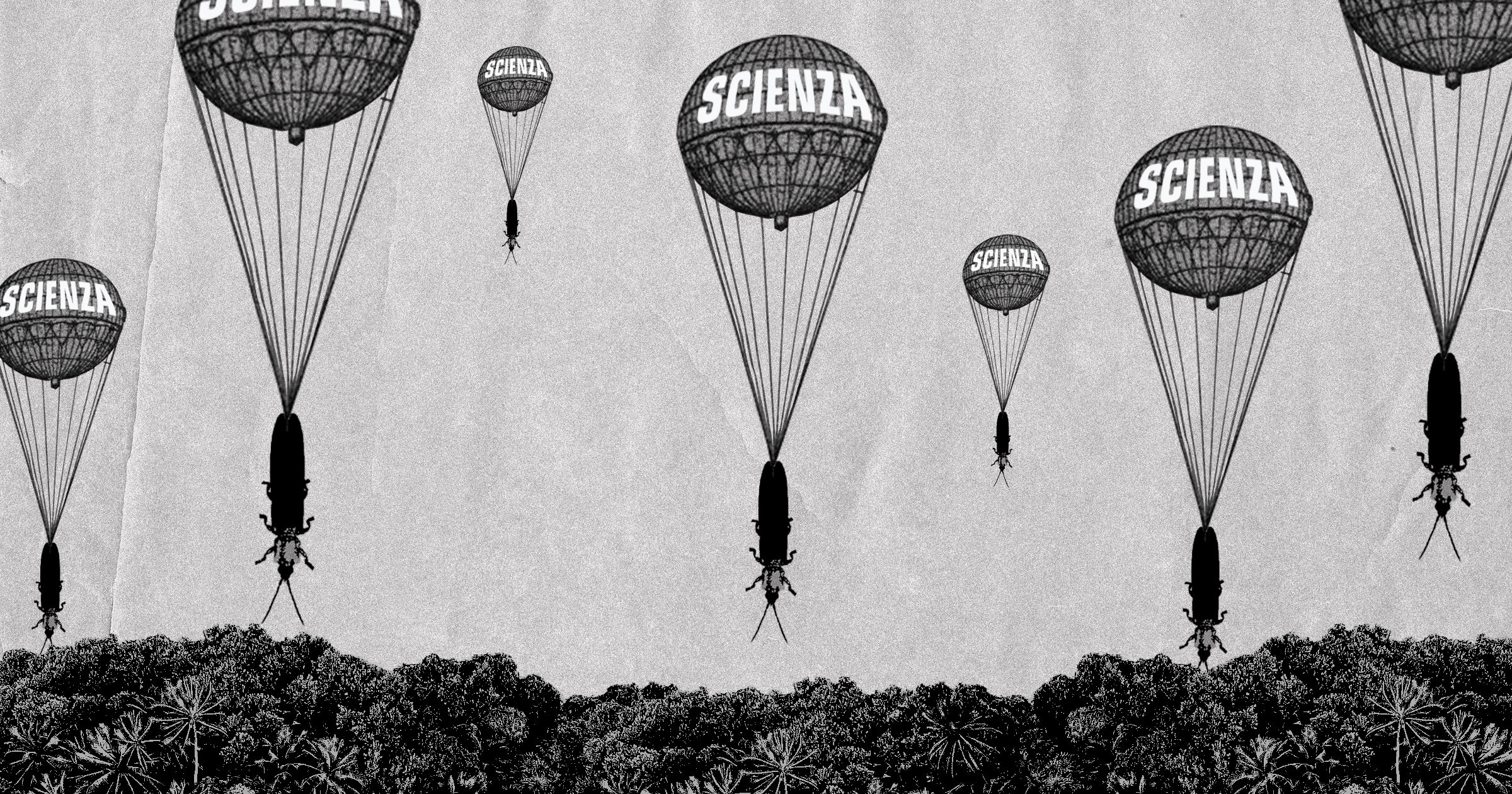
Artwork: Dosain
02 Jun, 13:53
Researchers at an Italian university outpost in the Maldives have rejected accusations of "parachute science" as unfair. But the Marine Research and Higher Education Centre, an outpost of the University of Milano-Bicocca based in Faafu Magoodhoo, acknowledged it did not focus enough on local collaboration.
MaRHE faced criticism after the Maldives Independent reported in March that a joint masters programme failed to produce any Maldivian graduates over several years. Former students described a mandatory Italian language requirement as one of the main barriers to completing their degrees and marine scientists accused the centre of conducting research with little local involvement or benefit.
In a written response to the Maldives Independent, MaRHE director Paolo Galli stressed that the centre and the masters programme run by Milano-Bicocca University's department of earth and environmental sciences were "two distinct entities, although they are connected."
Established 16 years ago, the MaRHE centre has "longstanding cooperation with the Magoodhoo community and strong ties with national institutions and NGOs, including the Maldivian National University," Galli said.
"It stands out as a rare example of a foreign research facility operating on an inhabited island (not a resort) for an extended period. Its primary aim isn't to confer academic degrees like Bachelor's or Master's; instead, it focuses on knowledge exchange, supporting research, and serving as a base for international scientific work in the Maldives."
The joint masters programme between Milano-Bicocca University and the Maldives National University was a separate academic programme. It was established in 2016 as an international collaboration but is no longer delivered, Galli said.
"Students enrolled in the Master's Degree may have the opportunity to participate in workshops and summer schools organised at the MaRHE Centre. However, attending activities at MaRHE is not a requirement, and most students complete their studies without ever visiting the Centre," he said.
Italian language requirement
According to Galli, the Italian language requirement was part of a university-wide policy requiring all masters students to obtain four ECTS credits in additional language skills. International students were required to study Italian, while Italian students were required to study another foreign language such as English, French, Spanish or German.
"This requirement reflects a broader institutional policy aimed at promoting multilingual competencies among graduates, rather than a specific condition imposed by the Marine Sciences programme," Galli said.
The university later lowered the required Italian proficiency level from B2 to B1 following feedback from international students. "For clarity, the withdrawal from studies may have been influenced by a combination of factors rather than being attributable solely to the language requirement," the statement said.
In an online interview with the Maldives Independent alongside researchers Luca Fellati and Davide Seveso, MaRHE officials argued that the Italian requirement alone could not explain why no Maldivian students graduated for 15 years.
"In your article, the problem was presented as the Italian language, but it's not really the Italian language. The reason is that people were not able to do the course, they never finished the programme," said Galli.
"It was not something that we decided, it was decided by the governors of the university. Then, after some years, we decided to lower it, so we asked marine science to lower the level to B1, in a way to help all the people. But this was something that happened, as I say, after some years. Because we also need the feedback from the students," said Fellati, a postdoctoral researcher with the university.
Students had access to free Italian language learning tools and online courses through the university, Fellati added.
"I also would like to stress, for marine science we have more or less 60 new enrolled students," said Seveso.
"Almost 30 percent come from other countries, not Italy, more than 30 percent. And all of them or most of them are able to complete this master degree. For us it is also very sad and also strange that not even one of the six were able to finish when at the same time students from other countries are able."
At the same time, the researchers acknowledged shortcomings within the programme itself.
"I think it was a mix of things. For sure, it was not completely 100 percent the fault of the students. We recognise that we have some, we as marine science, as I said it was the first year, somethings needed to be set up, and so we are aware that it's not students' fault," Fellati said.
He added that differences between Italian and Anglo-Saxon teaching styles may also have contributed to difficulties faced by students: "So I think it's a combination of factors."
"Unfair"
The researchers also responded to criticism that MaRHE had failed to adequately involve local researchers and institutions in scientific work conducted in the Maldives.
The criticism included concerns over the low number of Maldivian co-authors in published research papers, the limited number of Maldivians in leadership positions within the centre, and accusations of "parachute science" – a term used to describe foreign researchers conducting studies in developing countries with limited local participation or benefit.
Fellati rejected the criticism. "No, I think it's not fair," he said. "Especially because we are trying. We are adapting to a country that is changing a lot through time."
However, Seveso acknowledged that the centre had previously not focused enough on local collaboration. "Maybe previously, in the past, maybe we didn't pay too much attention to this," he said. "But this is something that is changing."
The researchers said they were now trying to include Maldivian collaborators and co-authors in more publications and projects. "In fact if you see our more recent publications, you can see there is at least one Maldivian," Seveso said.
But he also argued that it was sometimes difficult to find local collaborators interested in academic publishing.
"We ask every time," Galli added.
Seveso said a major issue was the limited number of Maldivian researchers publishing work in international peer-reviewed journals.
"There are many scientists in the Maldives, but nobody publish," he said. "Very few people in the Maldives that work in marine biology publish."
The researchers pointed to criticism over a 2023 MaRHE paper describing the first scientific record of bull sharks in the Maldives despite previous records by Maldivian institutions including the Maldives Marine Research Institute and the Maldives shark management plan.
Seveso argued the distinction was that MaRHE had published the finding in a peer-reviewed international journal.
"We are not the first to observe and report something, but we are the first that officially report and publish this result in a scientific journal," he said. "It's different, people do science in Maldives, of course. Maldives Marine Research Institute – but if they don't publish in international certified journal the results, they are not known. I don't know, they are not official."
"Local reports are not the same level of research paper published in a scientific journal."
The researchers also acknowledged concerns about the low level of Maldivian representation within MaRHE itself. The centre's website currently lists only one Maldivian member across its 16 member team and 13 member scientific committee.
"We want to increase," Galli said.
"The board is not representative anymore," Fellati added, saying the website was outdated and changes were being planned.
"We try"
In its written response, MaRHE highlighted a long list of workshops, training programmes and collaborations conducted with Maldivian institutions over the years. These included environmental workshops with MNU students, training for resort marine biologists, coral reef restoration initiatives, collaborations with ministries and local councils, and support for laboratory facilities at MNU.
Dedicated slots in workshops were regularly reserved for Maldivians, often free of charge or at heavily discounted rates, the centre said.
MaRHE also pointed to projects ranging from renewable energy education programmes and coral conservation initiatives to sports and environmental awareness activities with children in Magoodhoo and surrounding islands.
"We have collaborated with several governments," Galli said. "If we are there since 2008 it means we are able to provide something."
Despite defending the centre record, the researchers said they wanted stronger engagement with Maldivian researchers and institutions in the future.
"I think one of the main things that we can do is get in touch directly with the community doing environmental research in the Maldives," Fellati said.
"It's the only way we can grow and stay there."
Discussion
No comments yet. Be the first to share your thoughts!
No comments yet. Be the first to join the conversation!
Join the Conversation
Sign in to share your thoughts under an alias and take part in the discussion. Independent journalism thrives on open, respectful debate — your voice matters.
Support Independent Journalism
Help us keep the news free and fearless
Give once
$
or
Become a memberfrom $5/month