
Debt, trade and the bridge: India's envoy on the exceptions New Delhi makes for the Maldives
'We did it only for Maldives as a special case.'
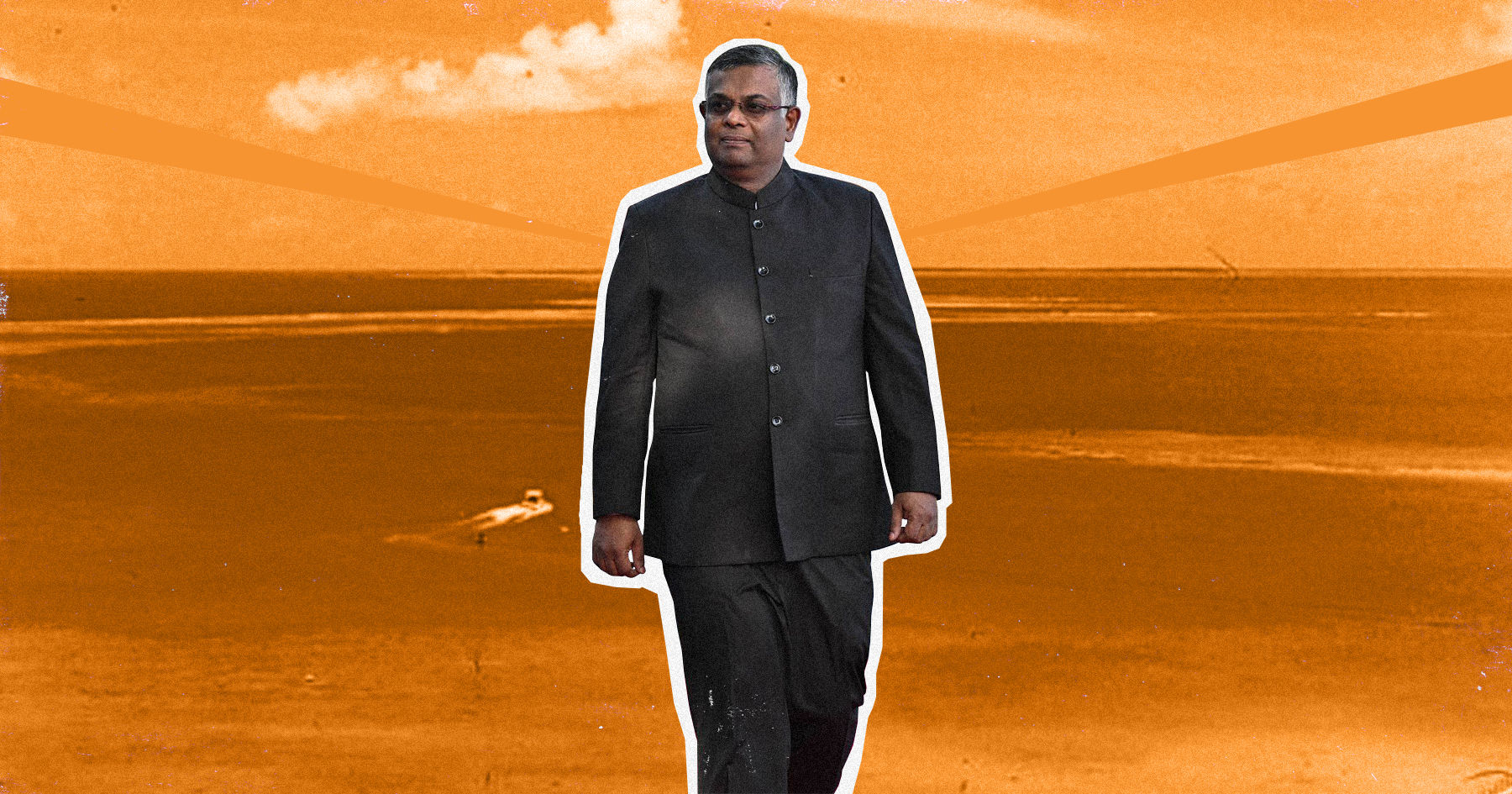
Artwork: Dosain
13 Aug, 18:17
Indian High Commissioner G Balasubramanian presented his credentials in January 2025, three months after President Dr Mohamed Muizzu's state visit to New Delhi reset strained relations. On the eve of India's Independence Day on 15 August, he spoke to the Maldives Independent about what has changed since: a rupee-denominated credit line, a free trade agreement both governments now say could be concluded by December, and the debt relief announced last year as a 40 per cent cut in annual repayments.
Three weeks ago the Maldives marked its independence. On Saturday India marks its own. Last year Prime Minister Narendra Modi was in Malé as guest of honour at the Maldives' 60th and he stood on the same road where "India Out" marches had passed. What did that moment mean from where you were standing?
First of all, good morning. Through your publication, I would like to extend my very best wishes and a happy – albeit slightly belated – Independence Day to your readers, as well as a happy Independence Day to India which is on 15th August. Yes, last year our prime minister was the guest of honour on the invitation of His Excellency Dr Mohamed Muizzu, President of Maldives. This was a very important visit.
The visit of H.E. President Muizzu to India in October 2024 was a major milestone. That was followed, within seven to eight months, by the visit of our prime minister to Malé. This demonstrates the enduring strength of our ties.
See, we understand democracy, and how elections are conducted, but that has got no bearing on the good relationship that both the countries desire and maintain.
You presented your credentials in January 2025, when the relationship was still widely described as a rupture. What was your brief then and how has it changed?
Again, I would like to say that the choice of words are not necessarily reflecting the reality on the ground. The visit of HEP Dr Muizzu to India in October 2024 was a very, very significant one, in which both the leaders have actually brought out a ‘Vision Document,’ a road map of how both the countries will have to progress and proceed. And both the countries have been working on that particular document assiduously.
If you look at the number of visits that have taken place last year, in 2025, for example, more than eight, nine ministers from Maldives have visited. Our prime minister had come as as the guest of honour in July 2025. Our civil aviation minister visited Maldives in November 2025. We had more than four business delegations that came in the fields of fisheries, agriculture, aviation, tourism, renewable energy, etc.
When I presented my credentials, the 'Vision Document' served as my guiding framework. I can reassure your readers that our relationship is solid, guided by the leadership of President Muizzu and Prime Minister Modi, and anchored firmly in that shared roadmap. So there is absolutely a great relationship that is going on.
India is often described as the Maldives' "first responder." Over the past two years that has mostly meant emergency finance rather than disaster relief. Is that a role India expects to keep playing?
Absolutely. I think your readers might have missed it, but recently, during the measles outbreak also, the government of Maldives had reached out to India, and India had, within seven days of the assistance being sought, had provided three tonnes of medicines and 20,000 vaccines of measles. So India takes its role as the first responder very seriously and it is also important for us.
This commitment extends globally and regionally. During the Covid-19 pandemic, India supplied 258 million vaccine doses worldwide. For the Maldives specifically, India's role as a first responder spans decades: from assisting during the 1988 coup attempt and the 2004 tsunami to resolving the 2014 water crisis, providing Covid-19 relief in 2020, and responding to the measles outbreak just a month and a half ago. As a country which has got the capabilities to extend its assistance, we are always ready.
The ₹4,850 crore line of credit extended last year was the first denominated in rupees rather than dollars. What was the thinking behind that? Which projects have been identified and how much has actually been drawn?
This represents an innovative approach to our development partnership. Line of Credit (LOC) facilities denominated in US dollars require India to purchase foreign currency from the market. Given that most transactions occur bilaterally, establishing a rupee-denominated line of credit is far more efficient.
A rupee-denominated LOC offers significant financial advantages to the borrowing country. The Indian rupee depreciates at an average rate of roughly three per cent per annum. Over a typical 20-year LOC repayment period, the real cost of debt servicing is reduced significantly – for instance, paying back the equivalent of say, 60 rupees for every 100 rupees borrowed today. Since many required capital goods and services are sourced directly from India, transacting in rupees eliminates unnecessary currency conversion costs for both sides.
As far as the projects are concerned, more than 16 projects have been identified based on the priorities set by the Maldivian government. I must share that India does not impose projects; we align strictly with our partner's development agenda and priorities. Final negotiations are underway, and we expect it to fructify soon.
India’s foreign secretary said in July last year that an amendatory agreement would cut the Maldives' annual repayments on the existing dollar line of credit from around US$51 million to around US$29 million. How was that achieved? Extended tenor, grace period, revised rate? And what does that add to the total the Maldives repays over the life of the facility?
See, it was a very simple thing. Normally, it is not done. However, we did it only for Maldives as a special case. As for as India is concerned, ‘Neighbourhood First’ policy is the fulcrum of our diplomatic outreach. Prime Minister Mr Narendra Modi has very clearly time and again mentioned that in the ‘Neighbourhood First’ policy, Maldives occupies a very special place.
India had previously extended an US$800 million LOC. Due to various technical and engineering preparations required prior to execution, roughly US$450 million to US$460 million had been formally committed into active projects. Standard LOC terms include a five-year moratorium followed by a 20-year repayment window at low interest rates; under standard terms, repayment commitments would apply to the full facility framework. To relieve the Maldives of unnecessary financial overhead, India agreed to amend the facility, capping the total LOC amount at the utilised sum of approximately US$495 million. This single adjustment reduced the Maldives' annual debt servicing requirement after the moratorium from US$51 million down to US$29 million So that is a huge saving as far as Maldives is concerned, and this is perhaps the first time India has amended its LOC, and that's exclusively for Maldives.
The first round of talks on a free trade agreement concluded last month. Economic Minister Mohamed Saeed said on Monday night that he expects the FTA to come into force this year. Is a conclusion this year still realistic, which chapters are hardest, and what happens to the essential commodities quota under an FTA?
To answer your question in one word: absolutely. It is possible for us to finish it by the end of this year. His Excellency Mr Saeed, the minister of MEDTT [Economic Development, Transport and Trade], has also very clearly mentioned it. He visited India very recently, a month before, and in his meeting with the Commerce and Industries Minister, Mr Piyush Goyal, both the ministers have agreed that we should conclude this FTA.
The proposed FTA acts as a 'SAFTA-Plus' arrangement, building upon the existing South Asian Free Trade Area platform. Almost all the items that are there will obviously form part of this FTA, and it will be SAFTA Plus. So additional lines would be added, and I understand that almost everything would be open except for few lines. So this would be actually a major milestone in the economic and trade relationship between our two countries when we have free trade agreement. Even today, even before the free trade agreement for that matter, your tuna is imported into India on zero per cent customs duty. So we already have extended, and we are extending further. So this would be very useful, and and we are very confident that, since it is SAFTA plus, it would be very easy for us to conclude the negotiations on mutually beneficial basis.
As far as the essential commodities is concerned, that is again an exclusive thing that we are doing for Maldives. The memorandum of understanding on essential commodities, which has about 13–14 items, including from onion to egg to construction material like stone aggregate etc – based on requirements specified by the Maldives. These are ensured by government of India continuously from 1981, as a quota. Even when domestic shortages prompt India to restrict exports globally, supply quotas for the Maldives under this MoU remain fully exempted and protected. So that is the beauty of this agreement and the importance that we accord to our neighbour Maldives. I don't think we are extending this to any other country. I may be wrong, but as far as I know, it is only to Maldives.
So FTA is different. It is a commercial trade deal. Essential commodities is a political instrument which we have extended to Maldives to support Maldives. It will have no bearing on FTA.
The Thilamalé bridge has slipped to 2027. It is India's largest project here, financed by an Indian loan and grant and built by an Indian contractor. Is India satisfied with the pace, and who absorbs the cost of the delay?
If you ask me whether we are satisfied with the pace: no. If you ask me whether the project is coming up, well, yes. More than 76 per cent of the project has been completed. The major portions have already been done. The important engineering segments have already been done. We remain committed to ensuring the bridge is built to high engineering standards.
With a total allocation of US$500 million, the landmark Greater Malé Connectivity Project is one of India's largest overseas infrastructure endeavours. Both governments are working closely with the contractor to maintain quality, complete execution as swiftly as possible, with little cost overrun as possible.
What is your priority as High Commissioner of India to the Maldives for the bilateral relationship?
Our primary focus is strengthening collaboration across political, economic, digital, energy, defence, and deepen people-to-people connect.
India and Maldives are close neighbours; we share the same ocean, and we have deeply connected histories. Last year, when Prime Minister Mr Modi was in Maldives, as a gesture to mark the 60th anniversary of diplomatic relations, both countries issued a joint commemorative stamp depicting traditional maritime vessels (dhonis). Historical evidence shows that maritime trade between Lothal in Gujarat and the northern atolls of Lhaviyani and Noonu dates back to the Indus Valley civilisation. Our relationship is built on this enduring history, mutual respect, complementarity and shared maritime interests.
The priorities during my tenure over here, and that of Government of India, are to implement the Vision Document signed during the visit of President H.E. Dr Muizzu, to India in October 2024, 'India-Maldives Vision for Comprehensive Economic and Maritime Security Partnership.' Key aspects across domains include: political exchanges, development cooperation, and cooperation in the areas of trade and economy, digital and financial, renewable energy, health, defence and security and people-to-people linkages.
With regard to the political exchanges, as I mentioned, we have been having a lot many political exchanges at the levels of ministers. Several ministers have already visited India and there are more visits in the pipeline. Most recently, Foreign Minister Ms Iruthisham Adam paid her first official visit to India in May 2026; and MEDT Minister Saeed visited India last month.
The development cooperation partnership is also going strong. We have more than 78 projects ongoing including LoC projects, apart from the major GMCP project. We have grant aid and HICDP [High Impact Community Development] projects too.
On trade and economic cooperation, we recently launched the UPI, also one of the strongest platforms that India has in terms of fintech. The agreement on UPI was signed in July 2025 during PM Modi visit. We are also progressing on MoUs on digital public infrastructure and Indian pharmacopeia. On renewable energy part, India presently has more than 45 per cent of its energy basket out of renewable energy, and we are very happy to share that experience and set up things over here. Similarly, on defence and security cooperation, strengthening joint exercises with the Maldives National Defence Force (MNDF) are a regular feature. India currently trains over 1,600 Maldivian personnel annually across civil and military sectors. Further, we have to increase the maritime and air connectivity. We have already started the Shipping Corporation of India regular cargo service to Maldives. Air connectivity we are trying to improve with Hanimaadhoo airport now operational.
On people-to-people linkages, we are very positive towards setting up of consulate of Maldives in Bengaluru in due course of time. Similarly, both the leaders had agreed to set up a consulate of India in Addu.
So I would say that the cooperation between our two countries has been defined by this ‘Vision Document,’ and the priorities of government of India is to ensure that each and every aspect of the vision document that has been brought out, agreed to by both the sides, are implemented. That is our priority.
Discussion
No comments yet. Be the first to share your thoughts!
No comments yet. Be the first to join the conversation!
Join the Conversation
Sign in to share your thoughts under an alias and take part in the discussion. Independent journalism thrives on open, respectful debate — your voice matters.
Support Independent Journalism
Help us keep the news free and fearless
Give once
$
or
Become a memberfrom $5/month