
Opinion

MDP is not the opposition – it's the gatekeeper

They occupy the left so a real left never emerges.
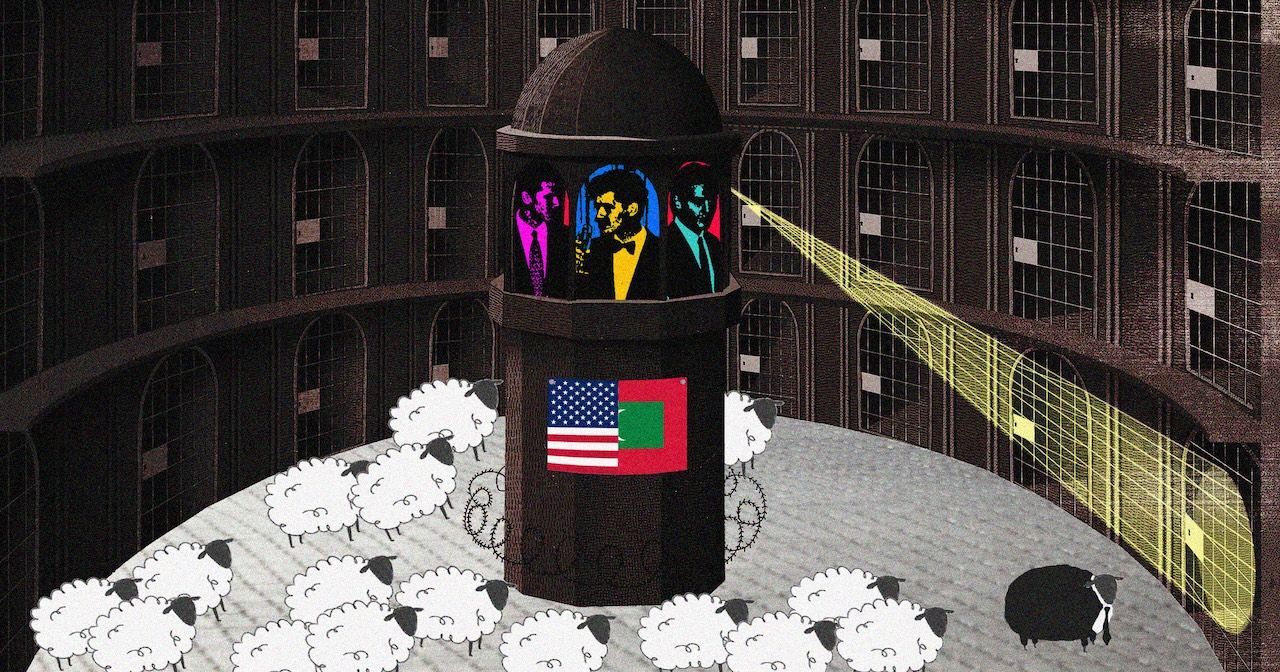
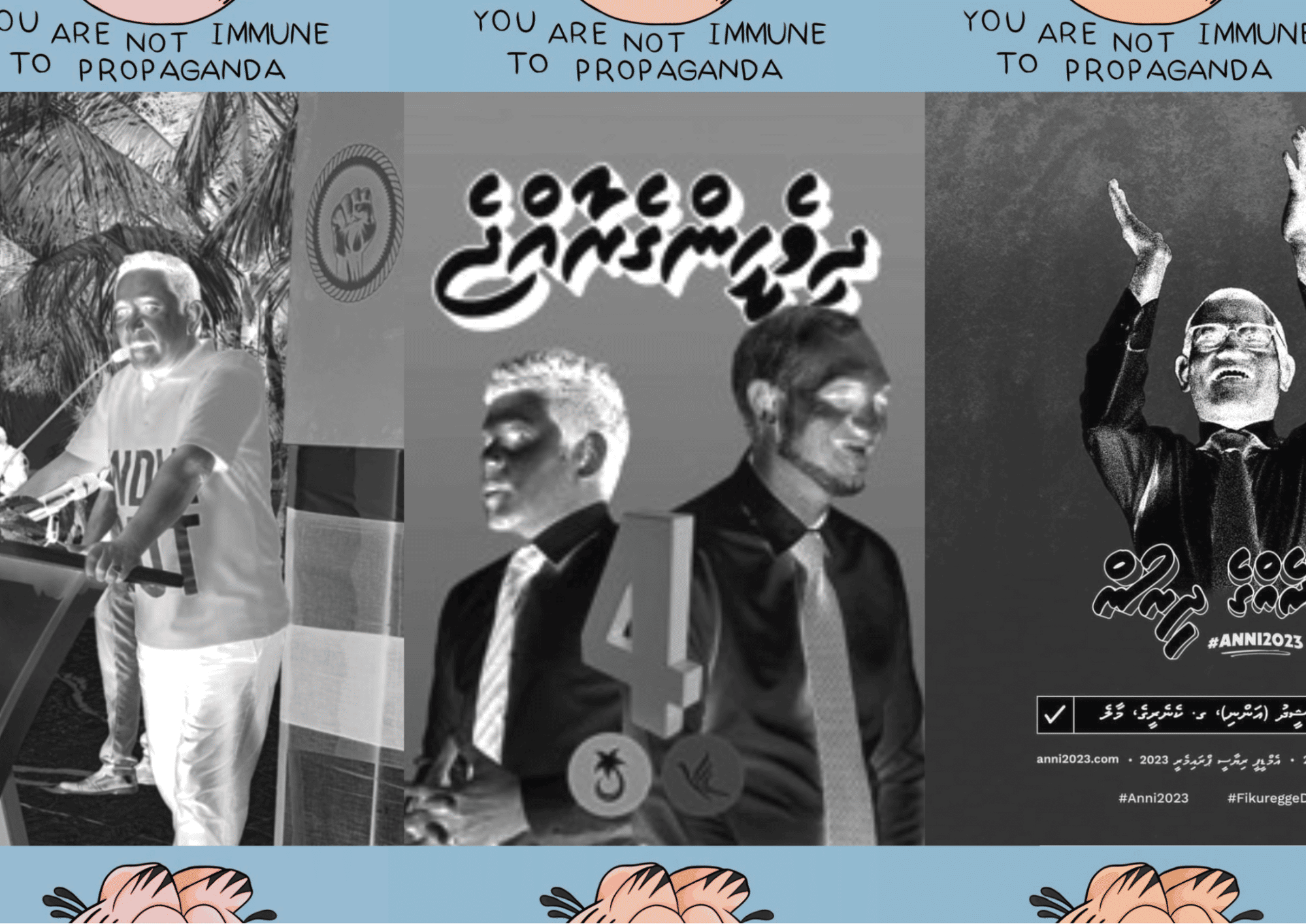
Artwork: Dosain

Artwork: Dosain

The post-2008 political order isn’t freedom; it’s the evolution of our national elites into a more horrifying political dystopia.
The current socio-economic decay isn’t only due to the Maldivian Democratic Party (MDP), Progressive Party of Maldives (PPM), the pre-2008 dictatorship regime, or our current government alone: it is the result of all these administrations, their industrial allies, and their actions combined that led us to this point, all equally complicit from the very beginning.
They are simultaneously the comprador bourgeoisie and national bourgeoisie. In simpler words: the national elites who mutually assist foreign colonial-capitalist elites in exploiting and robbing the working class.

MDP: the capitalist sheepdog that inhibits the Maldivian working class
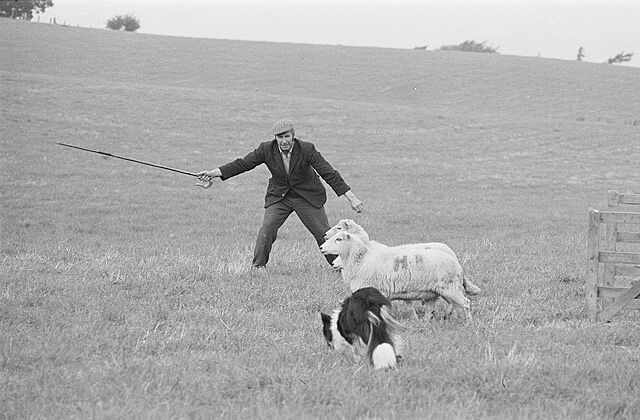
Llansannan sheep dog trials by Geoff Charles.
In my last article, I talked about how MDP is fundamentally a right-wing capitalist faction by self-admission. I’m not saying nothing’s changed since the era of former President Maumoon Abdul Gayoom. I’m highlighting the evolution of our elite into a new bureaucracy, and the way post-digital capitalism now makes us exercise our own oppression under the masquerade of democratic freedom.
We need to address our own political sheepdogs that exist to deceive us back into the capitalist fold before we could meaningfully discuss the “kuree sarukaaru mi sarukaaru” dilemma.
Remember: MDP didn’t win a majority in the first round in 2008. Their vote share was low, and they only barely won, even with the coalition in round two.
This means the political atmosphere at the time was divided (clearly, since it culminated in 2012 riots), and they needed to amplify the “bread” part in the bread and circuses (and they certainly had the capital to do so at the time) to pacify the highly polarised masses and leave a lasting legacy to solidify their political legitimacy without sacrificing the bourgeois powers they’re loyal to. Of course, as always, neoliberal capitalism eventually loses to outright fascism, its partner-in-crime – and so follows former President Mohamed Nasheed’s coup-ousting by the own elites he pandered to.
Here’s a direct quote from Nasheed: “I am a conservative…I feel a natural kinship with the school of thought that brought us Thatcherism and Reaganomics." Further, consider this excerpt: “Mr Nasheed… relied heavily on the Conservative party for its expertise in campaigning and policy development." A self-described neoliberal Thatcherite and Reaganomist, whose policies were in great part planned by Thatcher-worshipping British conservatives.
If this isn’t a damning enough self-indictment, I don’t know what is.
To suggest that their policies were intentionally left-wing, no matter how aligned or beneficial, is to suggest that the Tories and self-described neoliberal conservative were consciously enacting left-wing policies. Don’t you think it’s more possible that they were co-opting the policies and language of the left, much like other neoliberals around the world, to manipulate their voters?
They are not your friends. Their highest-ranking leadership elites are just very good at insidiously roleplaying as “common people."
I criticise MDP/Democrats so much because they deceptively occupy the space of a working class movement, preventing an actual one that represents the working class from ever developing. Not because I think MDP/Democrats ever resembled anything left-wing, even at the start. They’re impostors.
Even if they co-opt our language and ideals today (they already are doing this), I’d no longer believe or accept them.
And hey, it’s not like they’re even the worst. PPM, People's National Congress (PNC), the Gayooms, Dr Mohamed Waheed – they’re all far more brutal fascists – but they’re only the other side of the political coin.
Because you see, when neoliberals like MDP are pressed, when their elites are threatened and class interests are at stake, they would sooner work with the fascists against the working class (even if said fascists hate them and have actively tried harming them before!) rather than dismantle the capitalist system that produces fascists. That is why they are an “opposition that can’t oppose” – not because they’re "burdened by their own elite." They were never a "people’s" party.
You can’t fix them from within!
The MDP-loyalist faux left-wing impostors are the first things we need to clean up in our own house before we talk about dismantling the rest of the bourgeois system.
That doesn’t mean violence or harm, that just means sidelining them, convincing their good-faith members to revoke membership, remembering MDP for the populist class traitors they are, dismantling their manipulation, and making them utterly irrelevant.
But why do you call the post-2008 order “worse”?
Because, firstly, consider how the violence of the pre-2008 regime still exists as it did then: 

You will end up stabbed to death or just straight up vanish if you dig too deep into the bureaucrat capitalists and the national-comprador bourgeoisie

Much of our news outlets are owned, sponsored, and funded by elite factions

Consent for violence is manufactured via dehumanising misinformation and incitement against targets. This includes the elite-loyalist anonymous accounts that spread disinformation, lies, and at times, even revenge porn

Even bureaucrat capitalists like Abdulla Yameen and Mohamed Nasheed were targets of organised violence

Sometimes, entire media outlets get violently attacked – the yellow party and pink party factions are both guilty

The threat of state retaliation (asset seizure, imprisonment, fines, torture, death sentences, et cetera) against resistance and criticism

Can you really say “but we don’t have Maumoon-style imprisonment and torture anymore” to the victims of indefinite detention today? Can we say that to Ahmed Siraj, Hassan Niyaz, and Mohamed Aslam? Can we say that to everyone else who was brutalised or killed in custody?

Not only have the inequalities gotten worse, but so has the gap between the ultra-rich and the working class, with over a billion dollars lost every year to fund their hedonism.
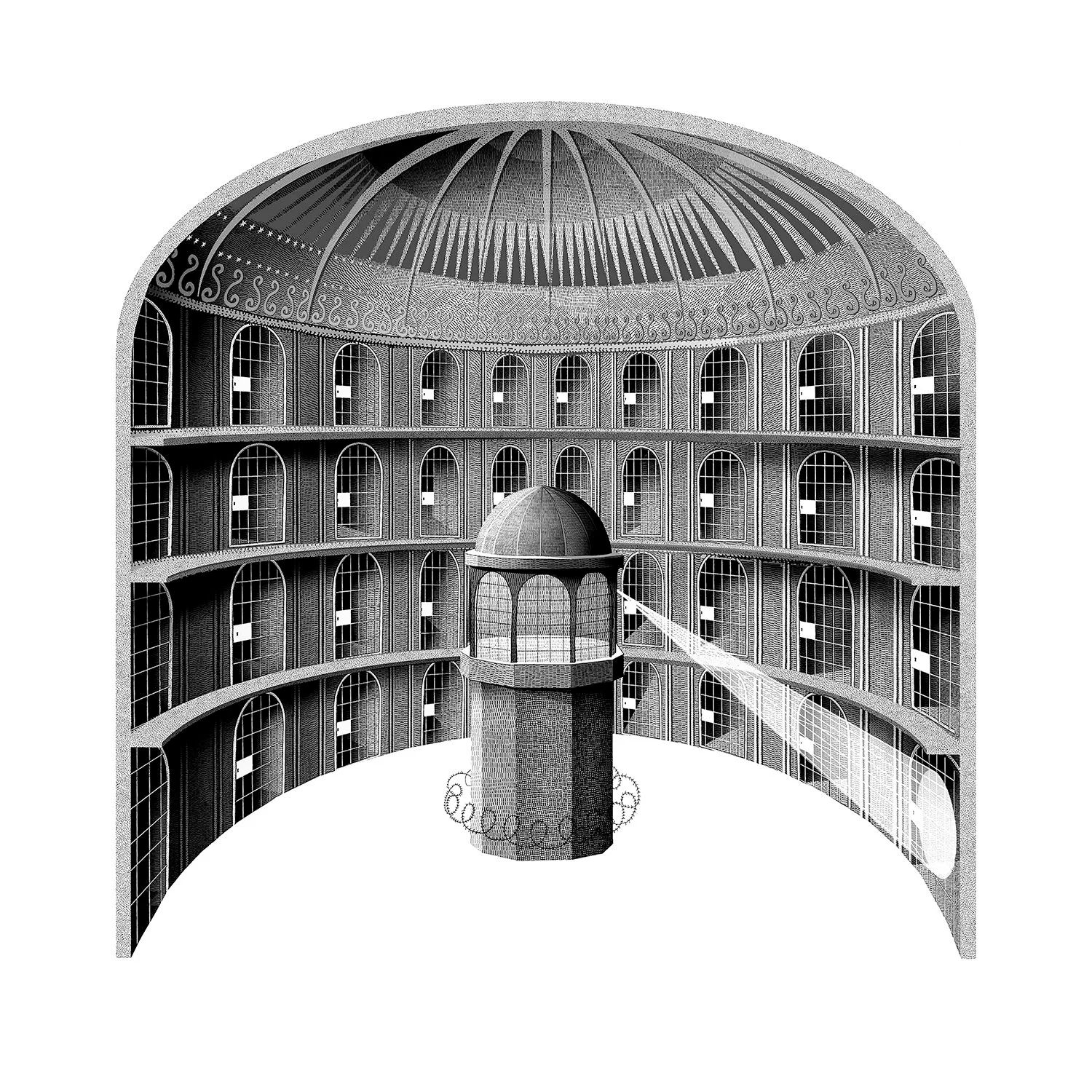
Adam Simpson’s rendition of the Panopticon.
Before the post-2008 social order, there were black-and-white oppressors to distinguish, fear, and be aware of. However, the existence of these violences alone is not why I call it worse.
Today, the same fears and subjugations exist (as I’ve explored earlier), but their objects have evolved, disseminated into the many arms of neoliberal democracy – digital mass media, organised violence, corporate exploitation, bureaucratic oppression – the objects of fear and subjugation are no longer a dictator, his family, and his dictator-bureaucracy, but rather abstract elements of society that can’t be pinpointed and overthrown in one fell swoop.
Our ruling elites evolved into a new bureaucracy where political democracy exists without economic democracy: we are free to participate via spectating and popularity-polling, but when it comes to wealth distribution or access to decision-making, ordinary citizens have no power, none whatsoever.
It’s the illusion of freedom and choice.
With the advent of social media, dissent and coverage thereof themselves (including this article!) became depoliticised as circulating noise in a greater stream of noise, to be consumed, digested, and excreted before eating up the next trending thing. This is by design, it’s not your fault.
Fun little dystopia, right?
As Mark Fisher theorises, we are no longer even able to imagine an alternative to capitalism either. This is what feels natural and normal now.
Hence the “worse” part: unlike then, not only must we submit to these great forces of wealth, violence, and power, but we must also psychotically convince each other that our choices are made freely under no systematic coercion or influence, and that the violence we face today is less brutal than yesterday. It’s cognitive dissonance.
The Marxist political theorist Slavoj Žižek clarifies this with a one-minute analogy.
Žižek elaborates further in The Sublime Object of Ideology: “the situation of the forced choice consists in the fact that the subject must freely choose…what is already given to him. The point is that he is never actually in a position to choose: he is always treated as if he had already chosen. Moreover… we must stress that there is nothing ‘totalitarian’ about it."
What brought me to the core of this realisation is the striking irony in a conversation with a friend: he suggested that it’s inaccurate to say things are worse than the Maumoon era since we can even write about these things now, and the very next day, he suggests I write less about politics too directly because he fears I’d get stabbed to death and am painting a target on my back.
It was then that our social paradox clicked for me: we’re “free” and not free at the same time.

Yameen is not an economic genius, he was a lucky demagogue
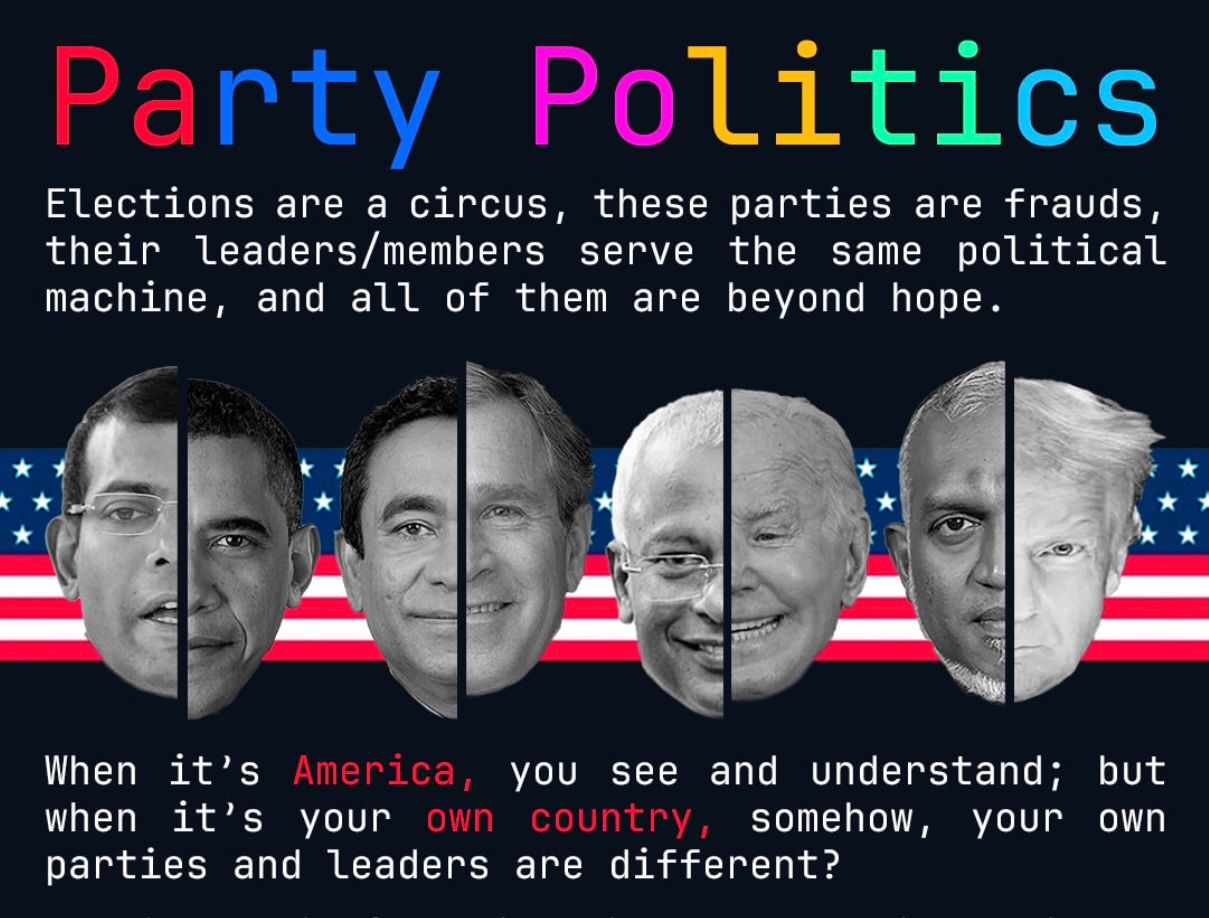
You may say that the problem isn’t laissez-faire capitalism, but rather how it’s managed. You may point to the PPM economy and say, “See? He was a criminal, but at least he knew how to run the economy." This is, for the lack of a better word, stupid.
Context matters here.
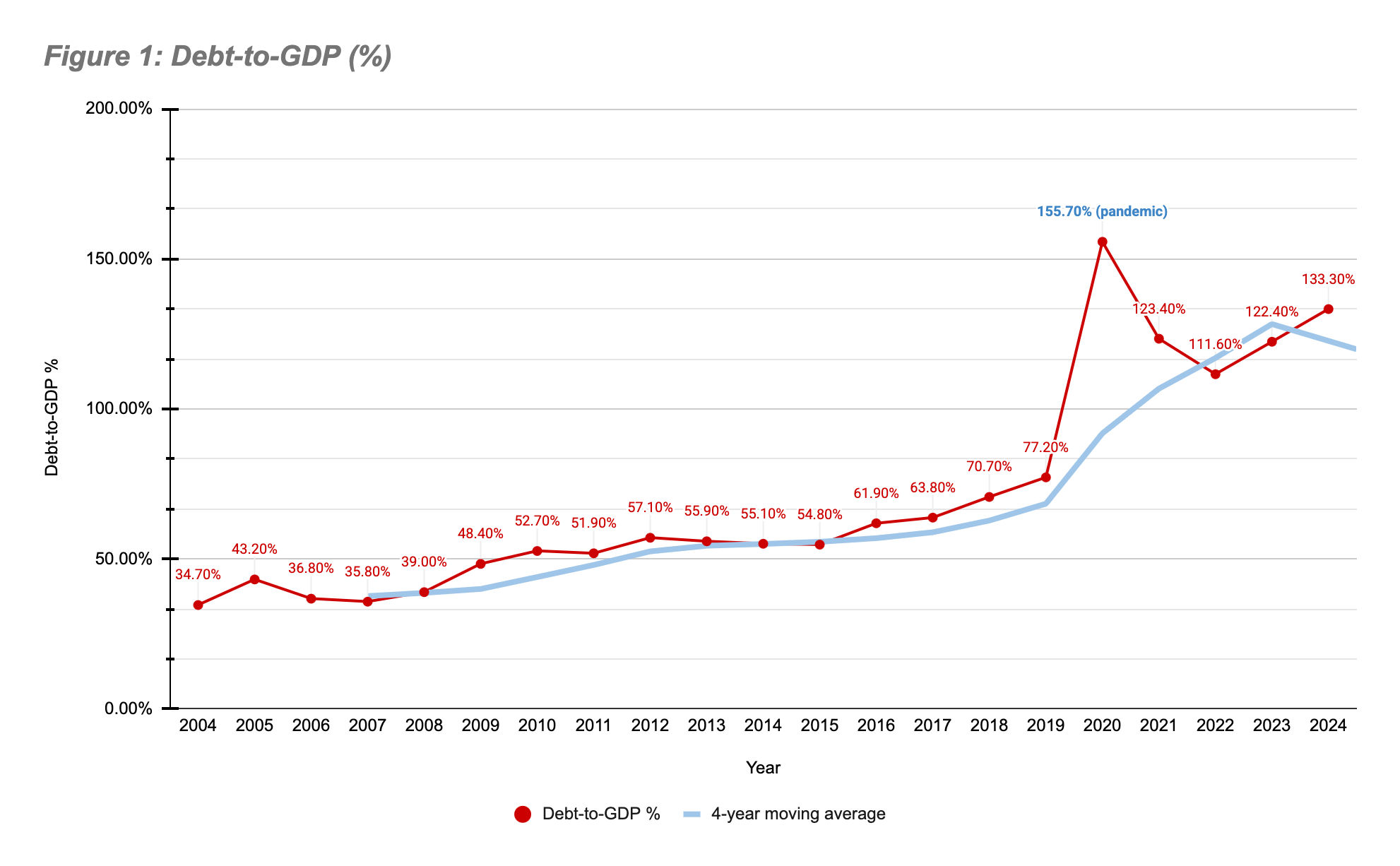
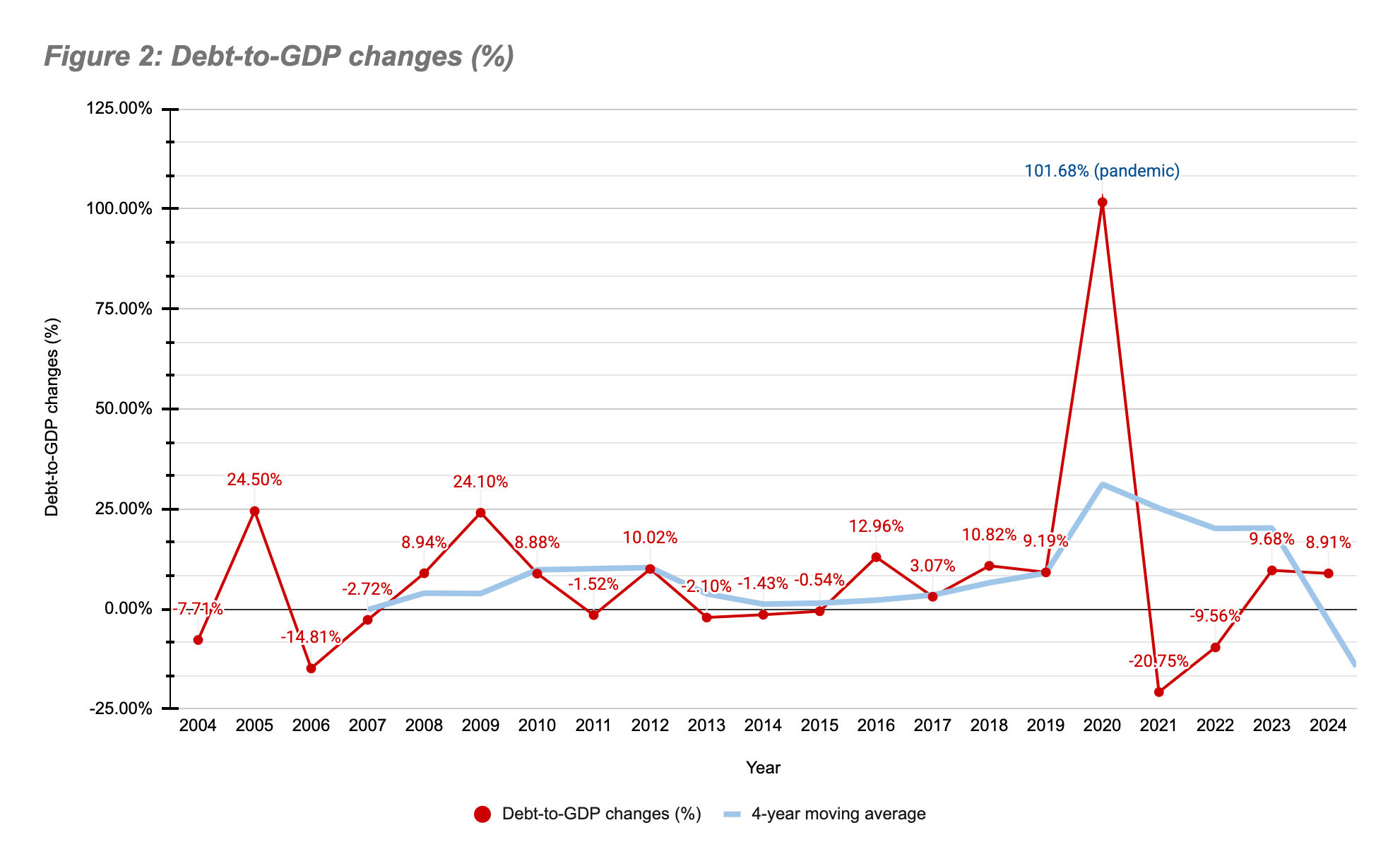
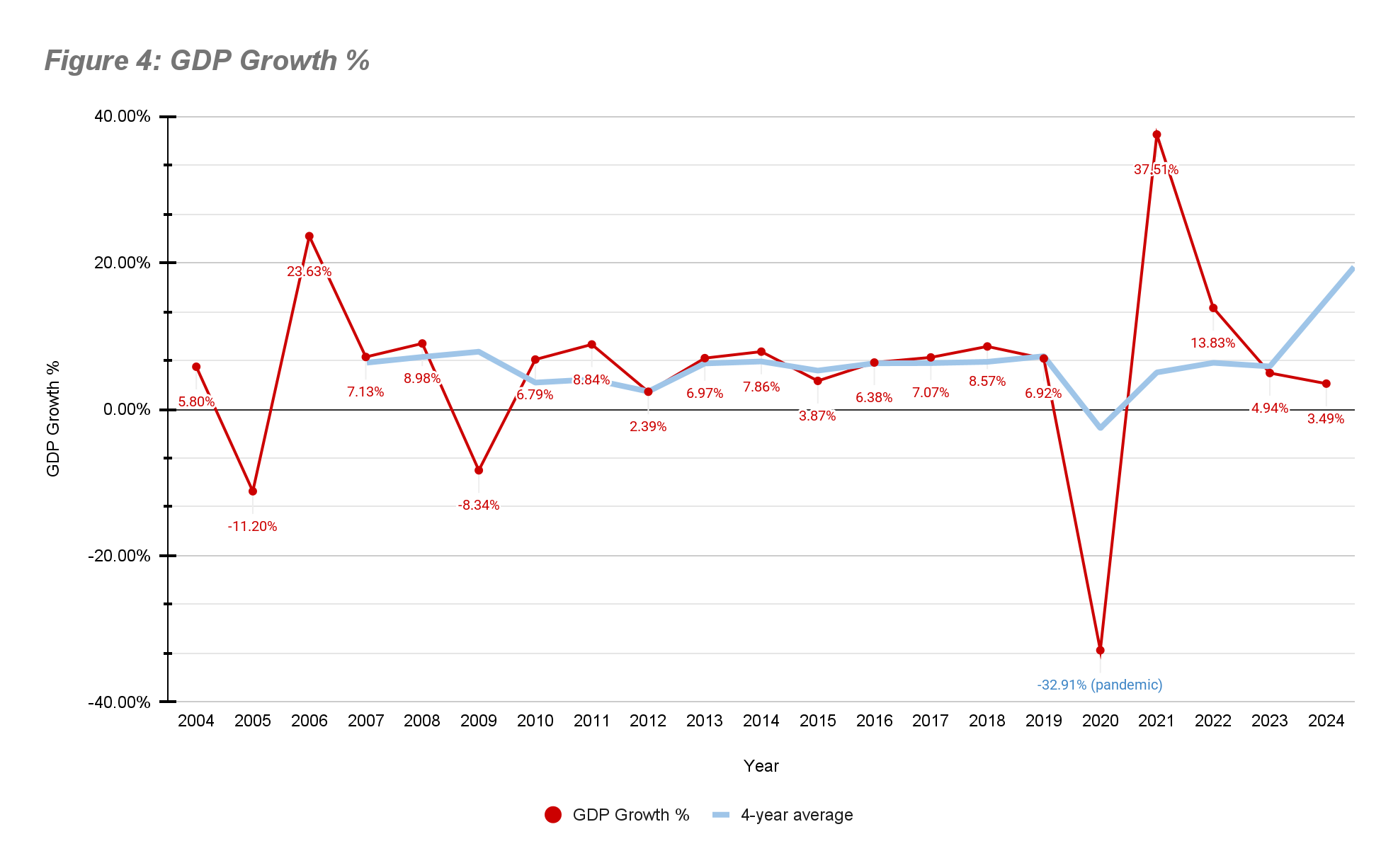
The Anni administration would’ve performed just the same if it began in 2013 rather than 2008, at the edge of the global financial crisis. You need to look at the averages in the larger picture to understand this, so take a look at these graphs first.
If we look at our debt-to-GDP ratio (and growth rate thereof) from 2008 to 2024 with a four-year moving average (accounting for election years), not a single party administration diverged from the average. I discussed these implications further in my data journalism piece, including a discussion of deficits, debts, and the nature thereof.
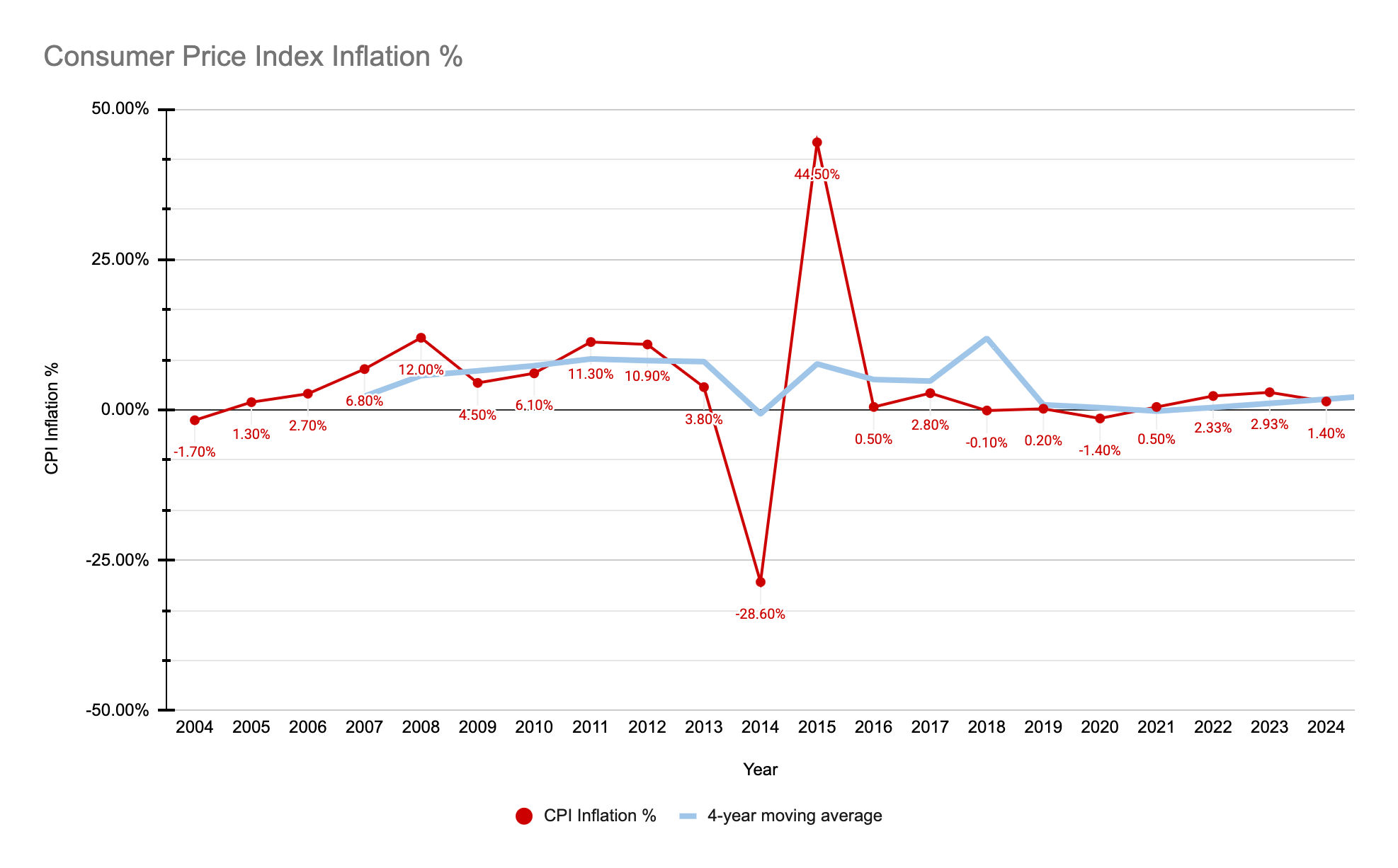
Basically, this is the rate of inflation. Again, notice a pattern: only two divergences from the four-year moving average. Even inflation rates remained the same throughout different administrations (except for a suspicious sudden drop and return to baseline between 2014 and 2015).
Even with GDP growth rate, the pattern remains – no divergences from the average except for the pandemic. Again, even GDP growth rate fell right back to the moving average baseline.
GDP, CPI, inflation, and debt, i.e., post-Keynesian capitalist macroeconomics’ most basic bare minimum yardsticks for a nation’s economic health and performance. None of these administrations made an actual difference.
The points I’m trying to make are the following:

Abdulla Yameen was an alleged thief among other thieves – just like the other administrations – that happened to be lucky enough not to exist in a period of crisis, but rather a period of abundance and surplus, particularly for luxury industries like tourism.

Our debt crisis is the natural result of the actions of all our past and current administrations combined, not just a unique one-off incident.

Not a single administration ever sought to tackle our billionaire elites, unfairly asymmetrical pay to politicians, increasing foreign ownership of our economic lifeline industry (tourism), or the grand corruption that permits these.

Again, as I demonstrated to you in my data compilation some time back, many of our basic problems (including our debt crisis) are problems we could end almost overnight or in a year – at maximum, a single presidential term. 
Of course, neoliberal conservatives like Nasheed, a key architect of our new order, would frame it as a helpless situation that can only be rectified by foreign intervention, because radical redistribution means they and their allies (all part of our one percent elite) would have to forfeit their offshore lands, hoarded domestic islands, and excess tourism-industry wealth too.
There’s no reason we couldn’t do these things systematically, at a policy-level.
There’s no point talking about a “kuree sarukaaru” or “mi sarukaaru,” they’re all the same.

The resistance’s evolution: we’re all aware of “kuree sarukaaru, mi sarukaaru” games now
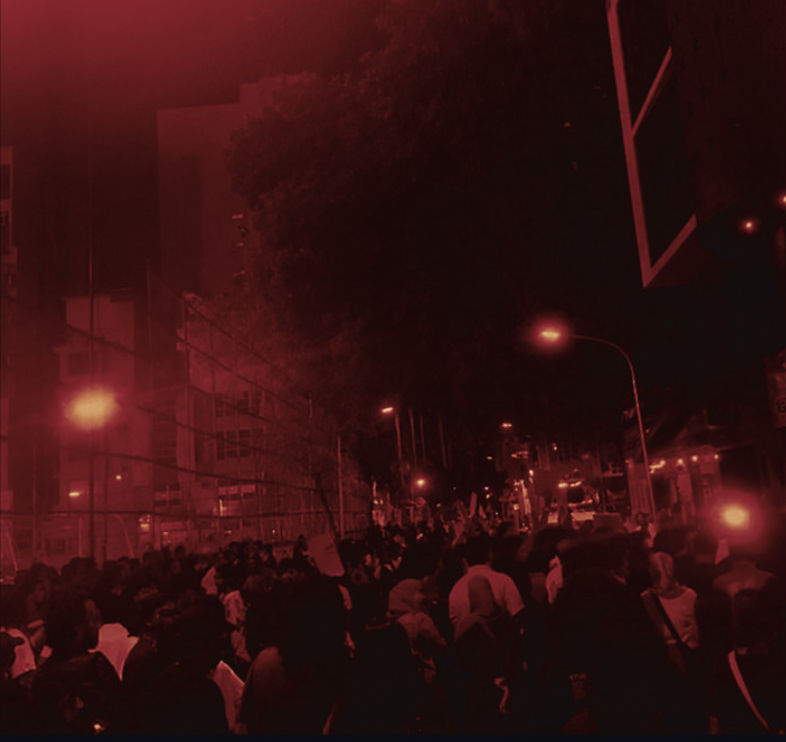
But while the post-2008 new order is a behemoth that evolved to become worse than its predecessors, the resistance has evolved, too.
We are reading, learning, practicing, connecting, and growing.
We don’t need to use violence, slander, deception, and hatred like you do.
You may think we can’t think beyond your electoral popularity contest games. Just because we think it’s futile to vote in your broken, gamed up systems doesn’t mean we’re standing by idly. 
To take an excerpt from Che Guevara: “'when the oppressive forces maintain themselves in power against the laws they themselves established, peace must be considered already broken. Under these conditions popular discontent expresses itself in more and more active forms and resistance finally crystallises, at a given moment, in an outbreak of the struggle.”
Do you hear that? Beyond the circus music of your electoral clownery and Mamdani copycatting, the chorus of revolution grows stronger and fiercer.
We will no longer let you commodify our rage and shepherd it into your stupid systems. We won’t let you gaslight us into hollow participation with “farudhee zinmaa” anymore.
We are the new popular front. Not you, not your other beyfulhu enemies, and not your unwitting aides playing your games either. They are few, we are many.
While the elites have infiltrated bureaucracy and transformed it into a new monster with the aid of foreign colonial-capitalists, the resistance has also organised outside of this with unions, societies, and mutual aid networks along with our own anti-imperial, anti-colonial, citizen-level allies worldwide.
Our brothers and sisters, friends and allies worldwide are witnesses to whatever you’ll do to us. 
They’re all observing and documenting everything.
When the fascist, murderous US-Israeli empire crumbles under its own weight and balance is restored to the world – when the international court of justice finally reclaims the enforcing power it should have – justice will come for you, too.
Even if you kill me, even if you kill all of us, justice will come for you as sure as rain tomorrow.
As the Palestinian writer Mohammed El-Kurd says: “The world is changing because it must. If seeds can germinate in the inferno, so can revolution. On the phone, my mother tells me: rain is coming and God is almighty.”
The first few days of the protests for Yumn – the energy, the momentum, the numbers, the outrage at injustice and corruption, the sidelining of opposition vultures who tried to hijack it for their party’s “redemption arc” – that was us.
The people that will answer a genuine call to revolution beyond your party politics are here.
Any action against any one of us will become an indictment of all of you, because we’re critical of all of you elites and your parties and idols. 
We no longer rely on heroes, idols, and cults of personality like those before us.
Even if you erase or assassinate those of us at the front, there are hundreds more that’ll take our place, without instruction, without planning, leaderlessly. It is simply the human spirit. You, with your guns, lies, and wads of cash, are incapable of killing it.
You can’t stop the birth of this new world by silencing or killing a few of us. You can’t distract us by hurting one of us and framing your opponents’ parties while pretending to be on our side, either.
Even if you paint us as villains or erase us, people are perfectly capable of discarding us and moving forward. That applies even to me. 
I’m expendable, disposable, and replaceable – in a good way. I could be murdered and my character could be thrown into the gutters, and that will not change a single thing, because in the grand scheme of things, I’m irrelevant.
I’m not special or important to any of this, and God, does that feel so, so damn good.
You will have to kill us all, you cartoon villains.
But above all, I want to believe that love and compassion will prevail.
“Beneath this mask, there is an idea, Mr Creedy, and ideas are bulletproof.”
  
Mahal Ibrahim Abdulla is a writer, artist, musician, and aspiring social scientist. He works as the managing editor for Moosumimagazine. He is an honours graduate in Politics and Social Policy from the University of Leeds. His goal is to become a researcher – to eventually settle down and live a quiet life. His current research interests are political communication, social psychology, and the de-growth paradigm.  
Editor's note: The views, political positions, and calls to action expressed are the author's own and do not represent the editorial position of the Maldives Independent. The publication of this piece does not constitute an endorsement of any political programme or movement.
All comment pieces are the sole view of the author and do not reflect the editorial policy of the Maldives Independent. If you would like to write an opinion piece, please send proposals to editorial@maldivesindependent.com.

Discussion

No comments yet. Be the first to share your thoughts!

No comments yet. Be the first to join the conversation!

Join the Conversation

Sign in to share your thoughts under an alias and take part in the discussion. Independent journalism thrives on open, respectful debate — your voice matters.

Support independent journalism

Explore more