
Opinion

Rebellion or revolution? Why Maldives' anti-party movement faces co-option

Opinion: The playbook for hijacking your discontent.
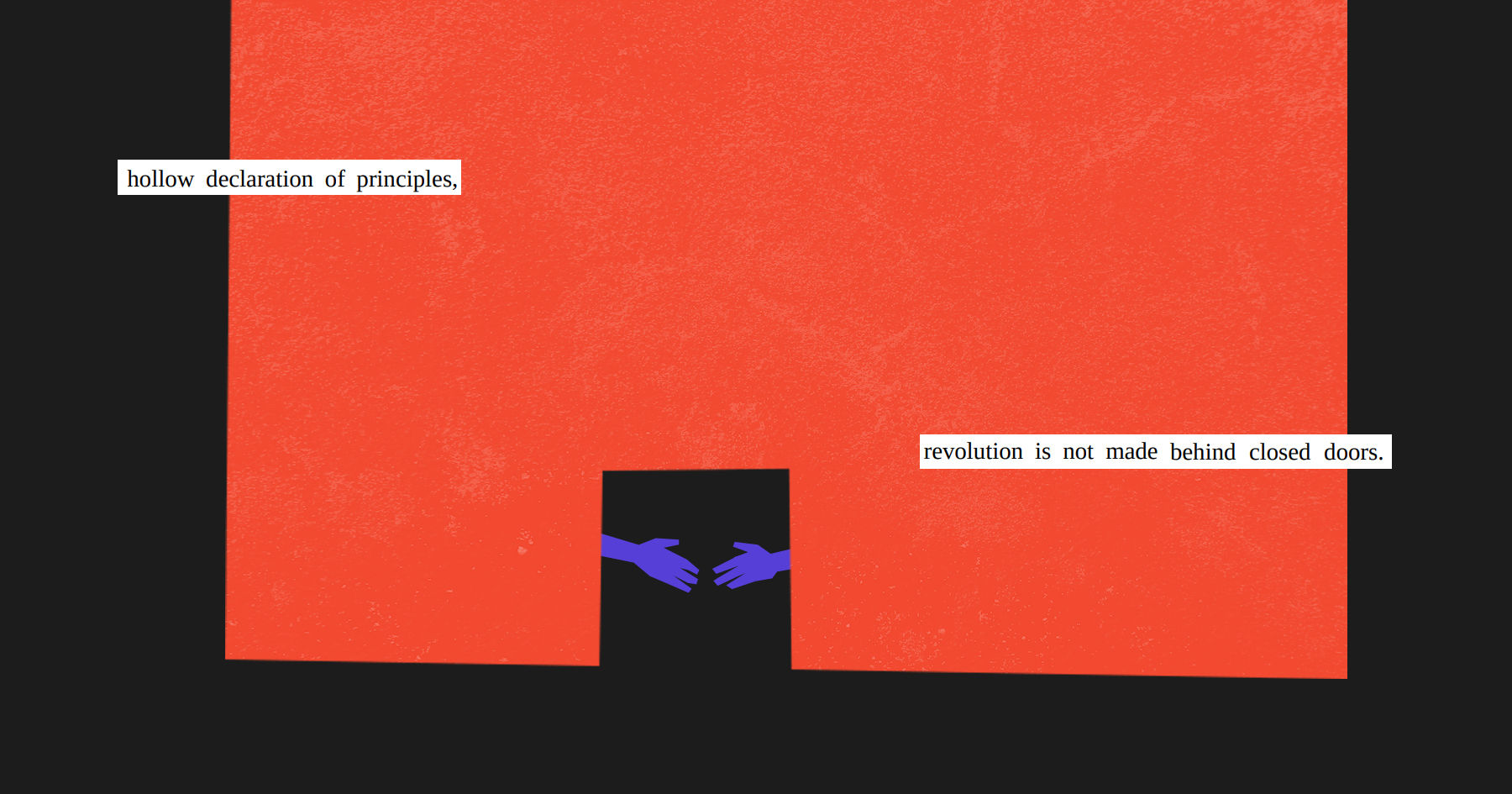
Artwork: Dosain

Artwork: Dosain

20 Oct, 5:17 PM
A new political consciousness is growing in the Maldivian political theatre: the absolute rejection of political parties and politicians who played their roles in corruption – from the party pundits and those who now label themselves “independents” to the dictator Maumoon Abdul Gayyoom’s lineage. 
Of course there were a few people like myself who always rejected them and never signed up to a party at all before. But that number began rising rapidly this year. Public discourse around anti-partisan rhetoric has also increased, with some international media outlets noticing that “early efforts to co-opt the movement (for Yumn) were rebuffed” this May.
The tides are turning. It would be mindless to assume that the leaders, elites, and strategists of the party-politics establishment haven’t noticed.
My forecast for political parties’ campaign strategy is this:

They will manufacture conflict within their own ranks

Party loyalists will be tasked with generating external movements that distance themselves from party politics

The leaders of the old guard (like former presidents Abdulla Yameen and Mohamed Nasheed) may distance themselves from these parties and even align with these movements once their subordinates have successfully infiltrated the resistance

They will monopolise discourse about party politics, effectively using that platform to paint their leaders in a favourable light

They will co-opt revolutionary language and policies, promising these things once in power

Towards the tail-end of the 2028 election cycle, these supposedly revolutionary movements will realign themselves with the old guard, citing a need for numbers, cooperation, formality, and “unity”.

This is the most logical strategy given the current political atmosphere. Nasheed rejoining the Maldivian Democratic Party is a clear sign of this strategy in motion: the party leaderships are beginning to realise that people are no longer swayed by the allure of parties.
An economic collapse and power vacuum are inevitable. It is the compounding result of all the looting and greed from Maumoon’s to Nasheed, Yameen, and former president Ibrahim Mohamed Solih's political administrations. President Dr Mohamed Muizzu’s administration, too, is currently participating in this looting. The Maldives Monetary Authority’s statistics database makes it clearer: with our astronomical external debt, deteriorating currency rate, diminishing foreign currency reserves, increasing imports expenditure, and dwindling trade balance – paired with our recent increasingly ominous financial ratings – an economic collapse is inevitable now: it’s a matter of when, not if.
Anyone with a basic understanding of economics couldn’t deny this reality. That means career politicians and bureaucrats past and present are well aware of this outcome as well, and are gearing up for it. They mean to seize that opportunity to consolidate power once and for all in the chaos and confusion.

Revolution or rebellion?

All of this perhaps begs these questions: isn’t it better if people resisted under some banner rather than not at all? Isn’t it better to choose a lesser evil?
This mindset is misguided. “Choosing lesser evils” was the same ideal people united under in 2018 and 2023. This is a logical fallacy called a politician’s syllogism, which is as follows:
1-

We must do something

2-

This is something

3-

Therefore, we must do this

If we were to use 2023 as an example, it goes: we need “Ibu noon gotheh”, Muizzu and the People's National Congress are “Ibu noon gotheh”, therefore we must elect them. Where has that logic of electing lesser evils gotten us? While absolute moral purity can’t be obtained with revolutionary movements, it is crucial to interrogate the values and principles upon which a movement is founded, because corrupt foundations will lead to the same old results.
As Albert Camus wrote in his essay The Rebel, what sets a true revolution apart from a mindless rebellion is the total rejection of long-entrenched contemporary and historical political values and institutions. That is what made the French Revolution a revolution: the paradigm shift from the monarchy’s divine rights of the kings. 
In our case, that means the dismantling of our current party-politics system, to rewrite our constitution to make legislative and executive processes more accessible to the general public, to restructure our political institutions in a way that eases external accountability and dissolution measures, and to rewire our economic machine to redistribute the inflow and circulation of wealth back to public infrastructure or services like guaranteed housing and food security as well as economic equity and the ensured basic wellbeing of all citizens without exception.
If we allow party votaries and faction loyalists to hijack our growing current of rebellion, then a rebellion and another coup d'état is all it will remain. For it to be a revolution, we must burn the political relics of the past and chart new horizons.
  
Mahal Ibrahim Abdulla is a writer, artist, musician, and aspiring social scientist. He works as the managing editor for Moosumi magazine. He is an honours graduate in Politics and Social Policy from the University of Leeds. His goal is to become a researcher – to eventually settle down and live a quiet life. His current research interests are political communication, social psychology, and the degrowth paradigm.
All comment pieces are the sole view of the author and do not reflect the editorial policy of the Maldives Independent. If you would like to write an opinion piece, please send proposals to editorial@maldivesindependent.com.

Discussion

No comments yet. Be the first to share your thoughts!

No comments yet. Be the first to join the conversation!

Join the Conversation

Sign in to share your thoughts under an alias and take part in the discussion. Independent journalism thrives on open, respectful debate — your voice matters.

Support independent journalism

Explore more