

Comment: indefinite detention under gang and terror laws must cease
Four hundred Maldivians are being subjected to 'Vaanuvaa', under ill-defined terrorism (and now gang) laws.
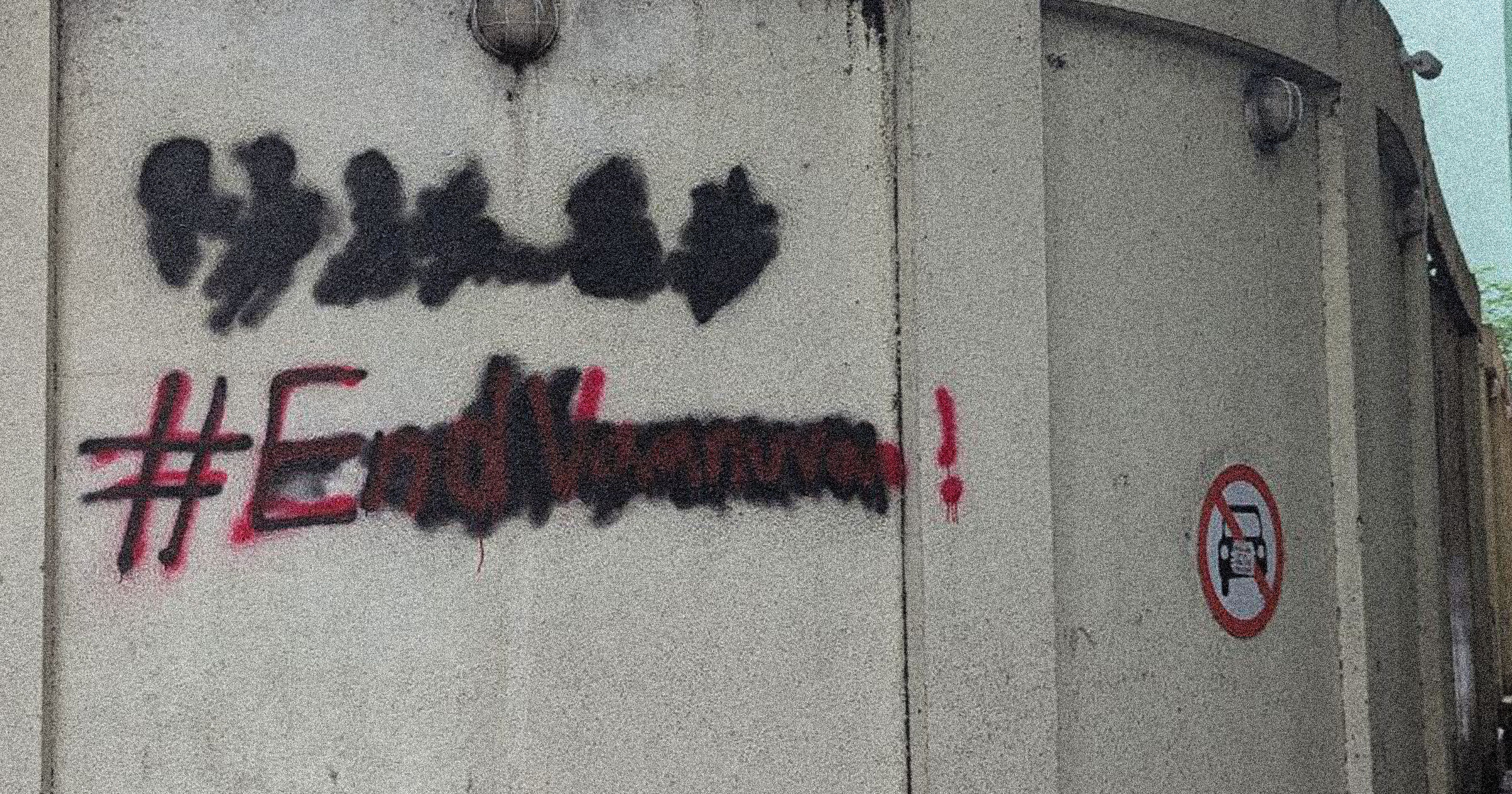
Artwork/photo: Dosain
30 Nov 2025, 15:34
Vaanuvaa Bandhu [indefinite detention] remains one of the least discussed state abuses in the Maldives. Despite its scale and cruelty, it receives little scrutiny within mainstream media. The political framework that enables it, the so-called “terrorism” model, is one of the most destructive mechanisms imported from the capitalist–imperial West.
This op-ed outlines why Vaanuvaa Bandhu is a dehumanising injustice, how the concept of “terrorism” is used as a political weapon by the state, and why the working class must be the ones to defend the hundreds imprisoned under this system. Before that, a brief explanation is necessary: terrorism is a fundamentally hollow concept, and understanding that helps explain why Vaanuvaa Bandhu exists at all.
Why we must reject the concept of “Terrorism Studies”
“Terrorism” is a vague, undefined term with no real ontological or epistemological foundation. As Gilbert Ramsay argues in his 2014 paper, Why terrorism can, but should not be defined, there is still no accepted definition and no observable criteria for what constitutes this so-called phenomenon. In the West, the term is routinely used to override due process, discipline minority populations, suppress dissent, and maintain control.
Critiques of terrorism as a concept — culminating in the discipline known as Critical Terrorism Studies (which is itself flawed) — have existed for decades. Much of this work shows how the framing of “terrorism” helped manufacture public consent for the Iraq invasion after 9/11 and how it later justified intervention across the Middle East and other Muslim societies targeted for Western economic interests.
Ramsay central point is simple: academic papers follow a predictable cycle in arguing that terrorism has not been defined, should be defined, and can be defined — yet almost no two scholars agree with each other on what it means or constitutes, and we still do not have any scholarly consensus today as to what terrorism, extremism, or radicalisation are supposed to mean. Despite this, these terms are widely used in policymaking.
Now you might be wondering, “if ‘terrorism’ is such a meaningless concept, why do politicians — including ours — even bother with it?”
Its meaninglessness is the point.
Because its definition is elastic, terrorism (like extremism and radicalisation) can be stretched to fit whatever purpose the state requires. It sits comfortably within the securitisation framework, which allows authorities to declare individuals as “security threats” and then bypass the usual limits of the judicial system. Once a person is labelled a “terrorist” or “extremist”, the law effectively no longer applies to them. It becomes a convenient human rights loophole.
The working class’s moral obligation to end Vaanuvaa Bandhu
The reason I opened this article by challenging the concept of terrorism is so you understand what the state is actually doing. By using terrorism as an excuse, the state has been polishing a system where they can justify imprisoning people as security threats that the protections of law do not apply to: no due process, fair trial, right to attorney — nothing. By dehumanising these victims, the state is able to manufacture public consent for unjustified imprisonment, indefinite detention, and blatant mistreatment in captivity.
For a political environment built on corruption and intimidation, these are valuable tools. If all this sounds familiar to you, it’s because it is: these powers are exactly what is granted in the gang bill too — arrests without a warrant, indefinite detention, seizure of belongings without justification, unlawful spying, and many more. Everything listed in this bill are exactly what the approximately 417 victims of Vaanuvaa Bandhu in the Maldives are currently subjected to. If you swap ‘terrorist’ with ‘gangster’, this proposed system looks exactly the same. It simply broadens the list of people you can justify subjecting to this cruelty for political and personal reasons.
And herein lies why President Muizzu failed to deliver on his campaign promises to release the prisoners: if he actually abolished Vaanuvaa Bandhu, not only does it mean giving up the power to capture and imprison people on a whim and dissolve their human rights; it also means the whole gang bill is invalidated for legitimising exactly the same processes and injustices.
The fact that he and his party actively campaigned on the promises to abolish this means they are absolutely aware of how horrible Vaanuvaa Bandhu is and why it must be abolished, but choose not to, because it would hinder their corruption and political power consolidation. Instead, they chose to continue the legacy of the parties and administrations before them, rather than surrender that power.
Once we understand the motives and logic behind Vaanuvaa Bandhu and how it functions as a tool of control by the state, the way we approach the solution also changes: no longer can you trust any of these political parties or legacy politicians to uphold justice for the imprisoned victims of Vaanuvaa Bandhu. Their loyalties are to their parties — and by extension, the state apparatus from which they stand to profit — which means they, too, will not honour their promises when it comes to this because they would also want to retain these measures of control and power.
The surest way to ensure justice is via citizen-led external resistance and action. In that regard, this must also be absorbed into the currents of a working class revolution. If the working class of the Maldives does not speak up for their imprisoned brothers and sisters and fight for their rights and freedom, beware: you might be the next one subjected to the cruelty of Vaanuvaa Bandhu.
Mahal Ibrahim Abdulla is a writer, artist, musician, and aspiring social scientist. He works as the managing editor for Moosumi magazine. He is an honours graduate in Politics and Social Policy from the University of Leeds. His goal is to become a researcher – to eventually settle down and live a quiet life. His current research interests are political communication, social psychology, and the degrowth paradigm.
All comment pieces are the sole view of the author and do not reflect the editorial policy of the Maldives Independent. If you would like to write an opinion piece, please send proposals to editorial@maldivesindependent.com.
Discussion
No comments yet. Be the first to share your thoughts!
No comments yet. Be the first to join the conversation!
Join the Conversation
Sign in to share your thoughts under an alias and take part in the discussion. Independent journalism thrives on open, respectful debate — your voice matters.
Support Independent Journalism
Help us keep the news free and fearless
Give once
$
or
Become a memberfrom $5/month