

Who broke the Rufiyaa? Two records and a blame game
BML has never sold more dollars, the street has never charged more.
Artwork: Dosain
14 Jul, 20:02
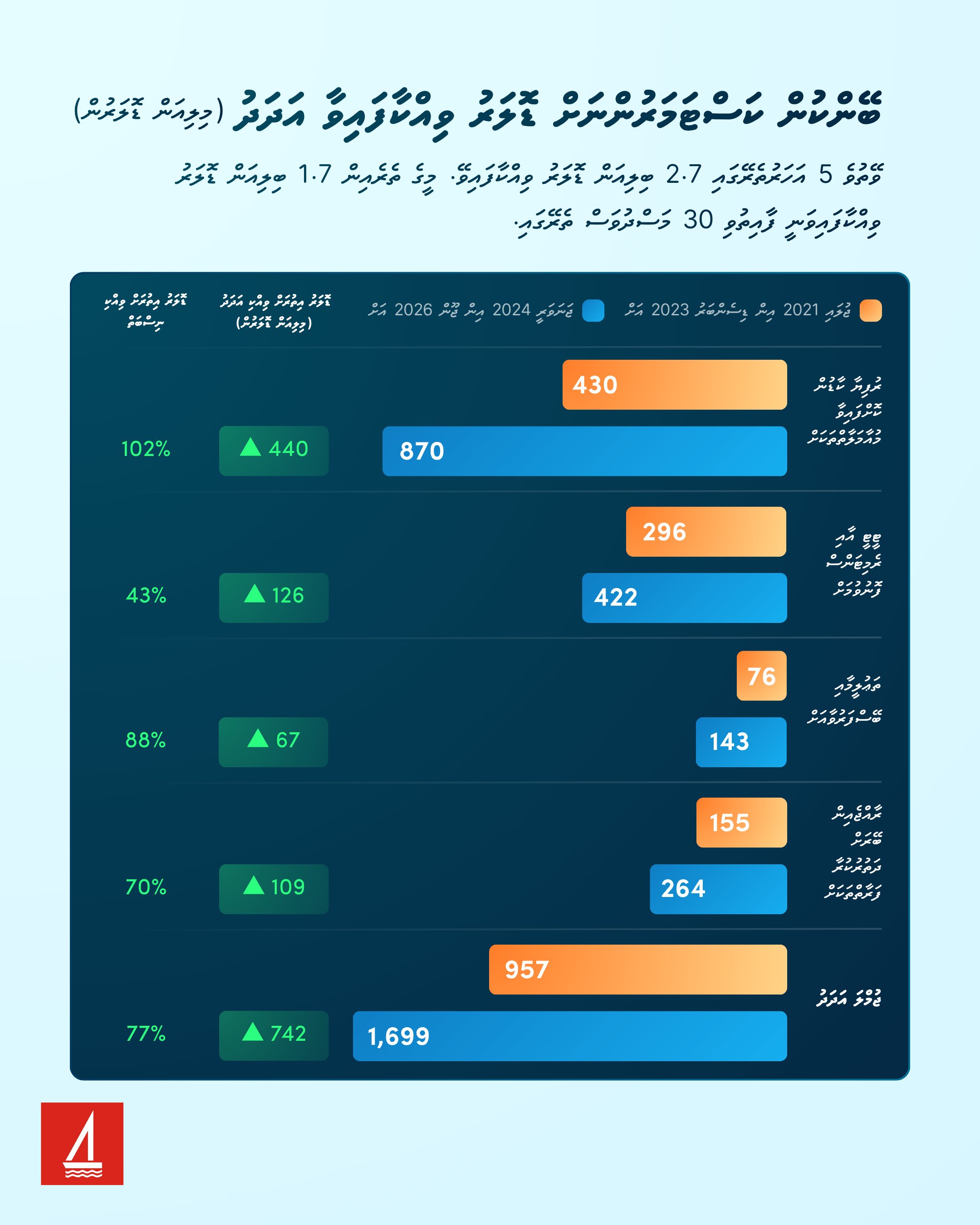
The Bank of Maldives published a set of infographics on Sunday showing it has never provided more foreign currency to its customers: US$ 1.7 billion over the past 30 months, up 77 percent on the 30 months before. The same week, the black market price of a dollar climbed past MVR 21 for the first time, a premium of about 36 percent over the MVR 15.42 peg.
The opposition Maldivian Democratic Party seized on the sliding Rufiyaa with a panel discussion on Sunday night. Former finance minister Ibrahim Ameer declared the country "on the cusp of a cost of living crisis" and blamed "the incompetent policies of President [Dr Mohamed] Muizzu's government": failure to secure foreign financing (US$ 1.8 billion envisioned in the budget over three years), wasteful spending on drones, land reclamation and a ballooning wage bill (recurrent expenditure up from MVR 32 billion in 2023 to MVR 39 billion this year), and a state that "took all the dollars in the domestic market, including deposits of individuals at banks."
Ameer concluded: “What we had before was really a market failure, but what we’re seeing now is the black market worsening due to the government’s policies."
The criticism reignited a blame game that has run for the past five years. Economic Development Minister Mohamed Saeed returned fire at a press briefing on Tuesday, branding Ameer the "architect of indebting the Maldives" and reiterating his contention that the roots of the shortage lie in the money printed under the previous government during the Covid-19 crisis.
Saeed said the country was "plunged into this state" through Ameer's irresponsibility, quoting what he said were fellow panellist Ilyas Labeeb's words from when the former MP was among the loudest internal critics of the MDP government's expansionary policies: "Ameer, don't do this – when you print so much money, the Rufiyaa is becoming weaker in the face of the dollar; we won't ever be saved from such damage." For them to lecture on the shortage now, Saeed said, was "a bit odd."
In contrast, the minister said his administration has repaid US$ 1.2 billion of debt in two years, enacted a foreign exchange law "no other government dared" making dollar conversion mandatory, and price-controlled supply of 23 essential food items. More dollars are reaching the public and businesses than ever before: "It's there to be seen from the figures."
Ameer's riposte came swiftly on X: nearly three years into the Muizzu administration, a dollar costs MVR 21, no one will lend to a government that has lost investors' trust, and "the government has crushed the Bank of Maldives and used up even the people's money".
Each side insists the numbers convict the other. Here is what they show.
What do BML's charts say?
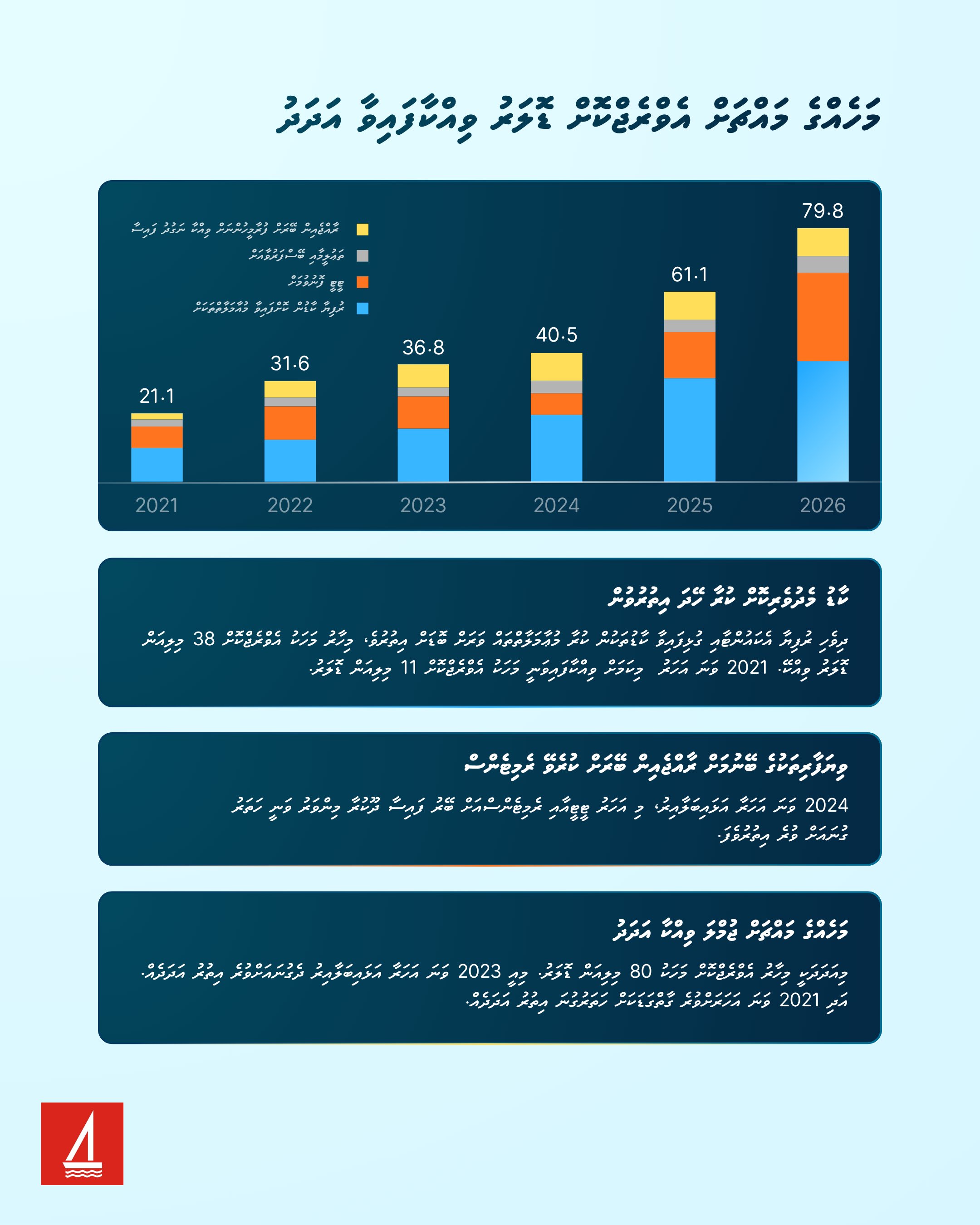
The average amount of dollars the bank provided each month: US$ 21.1 million in 2021, rising to US$ 61.1 million in 2025 and US$ 79.8 million in the first half of 2026.
The bank also compared two 30-month windows under the current and previous administrations (July 2021 to December 2023 and January 2024 to June 2026): foreign transactions from cards linked to Rufiyaa accounts more than doubled, up 102 percent from US$ 430 million to US$ 870 million; education and medical spending rose 88 percent to US$ 143 million; cash for travellers rose 70 percent to US$ 264 million; and telegraphic transfers went up 43 percent to US$ 422 million.
Where are the dollars going?
The charts describe growing demand, not abundance. The growth engine is Rufiyaa debit and credit cards: foreign transactions on cards linked to Rufiyaa accounts took more than half of everything the bank provided in the latest window, up from 45 percent in the previous one, swelling from US$ 11 million a month in 2021 to US$ 38 million at present. Last month, CEO Mohamed Shareef characterised the cross-border e-commerce as a marker of digital adoption and rising "prosperity."
Telegraphic transfers – the channel importers depend on – grew least of any category, and their share of the bank's provision shrank from 31 percent to 25 percent. But according to BML, the amount of dollars provided for TT remittances has grown fourfold from 2024. The bank is selling more dollars than ever, but proportionally fewer of them are reaching the businesses that stock the shelves.
If supply is at a record, why is the street price too?
Under the Foreign Exchange Act's conversion regime, tourism businesses must exchange a share of their foreign currency earnings at Maldivian banks. The banks must surrender 90 percent of those proceeds to the central bank at the pegged rate, which releases a portion back for essential needs.
According to its 2025 annual report, the Maldives Monetary Authority redistributed the proceeds to banks, "prioritising the financing of essential imports and thereby mitigating the impact of exchange rate pressures on consumer prices."
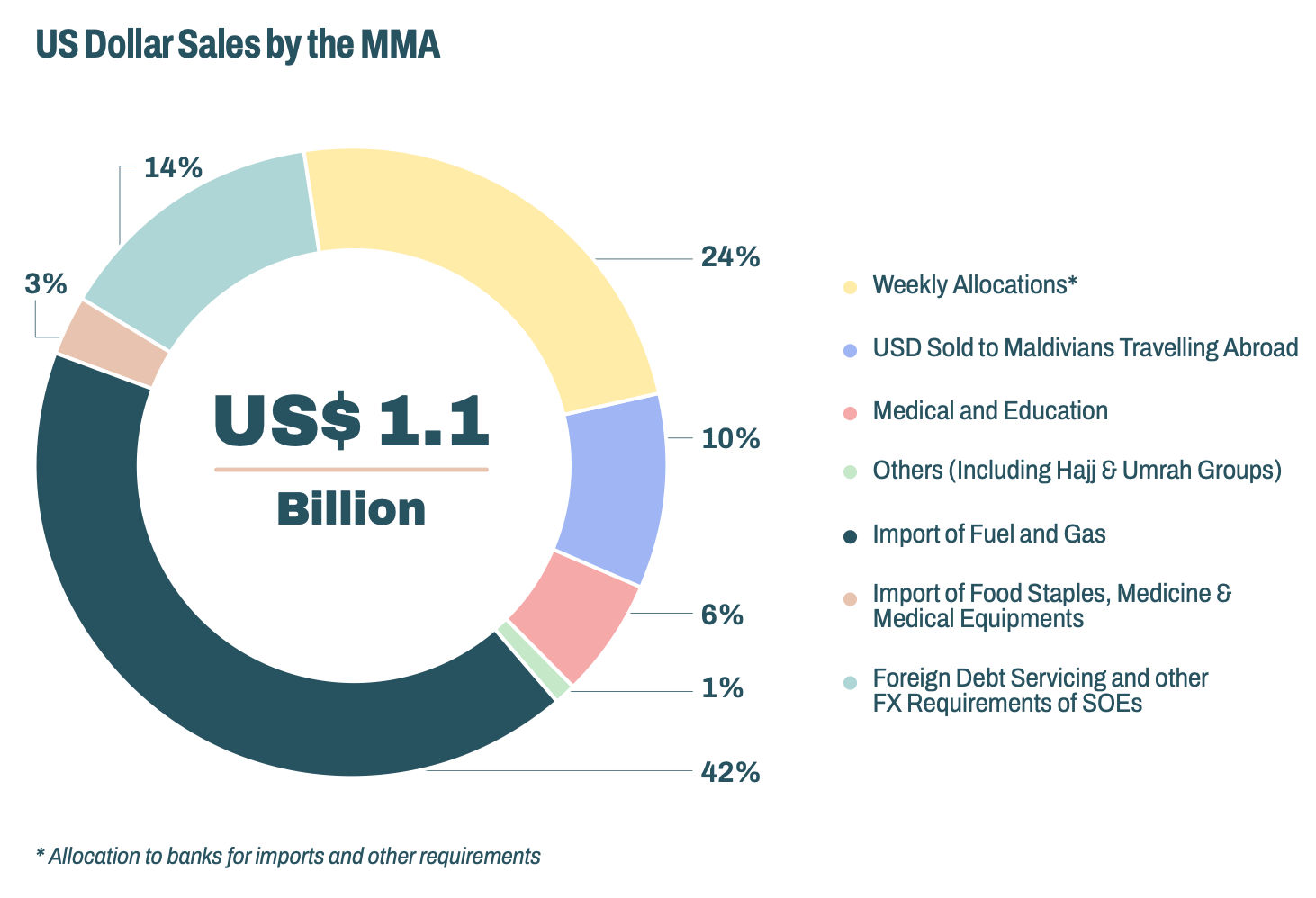
BML's charts show provision of dollars leapt 51 percent in 2025, the year mandatory conversion took effect, followed by 31 percent this year.
In response to a Right to Information request from Adhadhu, the MMA disclosed that US$ 959 million was exchanged at banks between January 2025 and May 2026. The monthly average of US$ 56 million was significantly higher than the US$ 40 million originally projected. With June's exchanges, the total crossed US$ 1 billion. The central bank did not answer whether businesses are complying with the deposit requirement. No enforcement action has been taken against violators to date.
The MDP's argument on Sunday was that the government's celebrated repayment of the US$ 500 million sukuk in April left the Sovereign Development Fund nearly empty, while official reserves fell to US$ 718 million, about 1.4 months of import cover. Foreign currency gathered from the domestic market over 17 months went out "in one swoop" where a prudent government would have refinanced or restructured part of the maturity.
Ameer cited the MMA as saying that 52 percent of travel receipts entered the domestic banking sector in 2023, down from 75 percent in 2019. He said dollar deposits have seen nothing like the promised increase since, blaming the MMA's "policy implementation failure".
Who printed the Rufiyaa?
The political fight has centred on the paternity of the money chasing those dollars. The government's case rests on the pandemic: central bank financing of the government more than doubled across the MDP's term.
Ameer's counter at the panel was that the printing never stopped. He pointed to MMA placements at commercial banks reaching MVR 3.8 billion, which the banks invest in government securities that enables government spending. "For the MMA to provide money this way is just an effort of money creation, money printing, through quantitative easing," he said, accusing the MMA of acting in contravention of its stated aim of "mopping up" excess liquidity of MVR 2.1 billion in circulation.
Ilyas Labeeb cited MMA statistics showing the Rufiyaa supply at MVR 78.4 billion at the start of July, nearly double the MVR 41.4 billion at the end of 2020. "This MVR 78 billion is chasing all the available dollars in the Maldives," he said. Broad money was up 32.5 percent over the past 17 months, Ameer said.
In a 12-page statement last August, the MMA traced the Rufiyaa's deterioration to the Covid-era printing – excess liquidity was up 178 percent from 2020 – while acknowledging that new money kept entering circulation as successive administrations plugged budget deficits with domestic borrowing.
Ali Hashim, the central bank governor who presided over the pandemic-era expansion – and who, according to Saeed at Tuesday's press briefing, "stayed silent" when MPs from both the opposition and MDP's breakaway faction demanded the rationale at the time – rejected the premise of a single monetary original sin when he spoke to the Maldives Independent this month.
"It's a fiscal disciplinary issue that's the cause of all of this, whatever administration. None of the administrations had any fiscal discipline," he said. Hashim defended the expansion, saying it ensured "a V-shaped recovery," but conceded the cost: "In the long-run it's not good. But in the short-run, you have solved a problem."
But he criticised Ameer for what he characterised as spending more than necessary to stabilise the economy and avert a potential collapse: "What I told them is, ‘look, don’t take the entire chunk, if you take the entire chunk, that is pumping a lot of money into the system, that’s going to give us the problem in the long-run that we’re facing now.'"
Who still can't get dollars at 15.42?
At the peg, almost nobody who needs them at scale. Former deputy speaker Eva Abdulla said at the MDP panel that the bank covers only about a quarter of a business's telegraphic transfer, forcing the rest to be bought on the black market: on a US$ 100,000 transfer, about MVR 400,000 extra, or about MVR 5 million a year. "What business can take such a hit?" she asked. Either the business stops or it raises prices. Even processed transfers are taking up to two weeks to reach suppliers, she added.
At MVR 21, every dollar of imports carries a premium of MVR 5.58 over the official rate.
The essential commodities price index released last week put inflation at eight percent, outrunning the World Bank's projection of six percent inflation this year, which was expected to stay above four percent through 2028 "due to intensified foreign exchange (FX) constraints and demand pressures for food and essential goods." Nearly half the population lives close enough to the poverty line that a 10 percent rise in food prices alone would push the poverty rate up by 1.6 percentage points, by the same report's estimate.
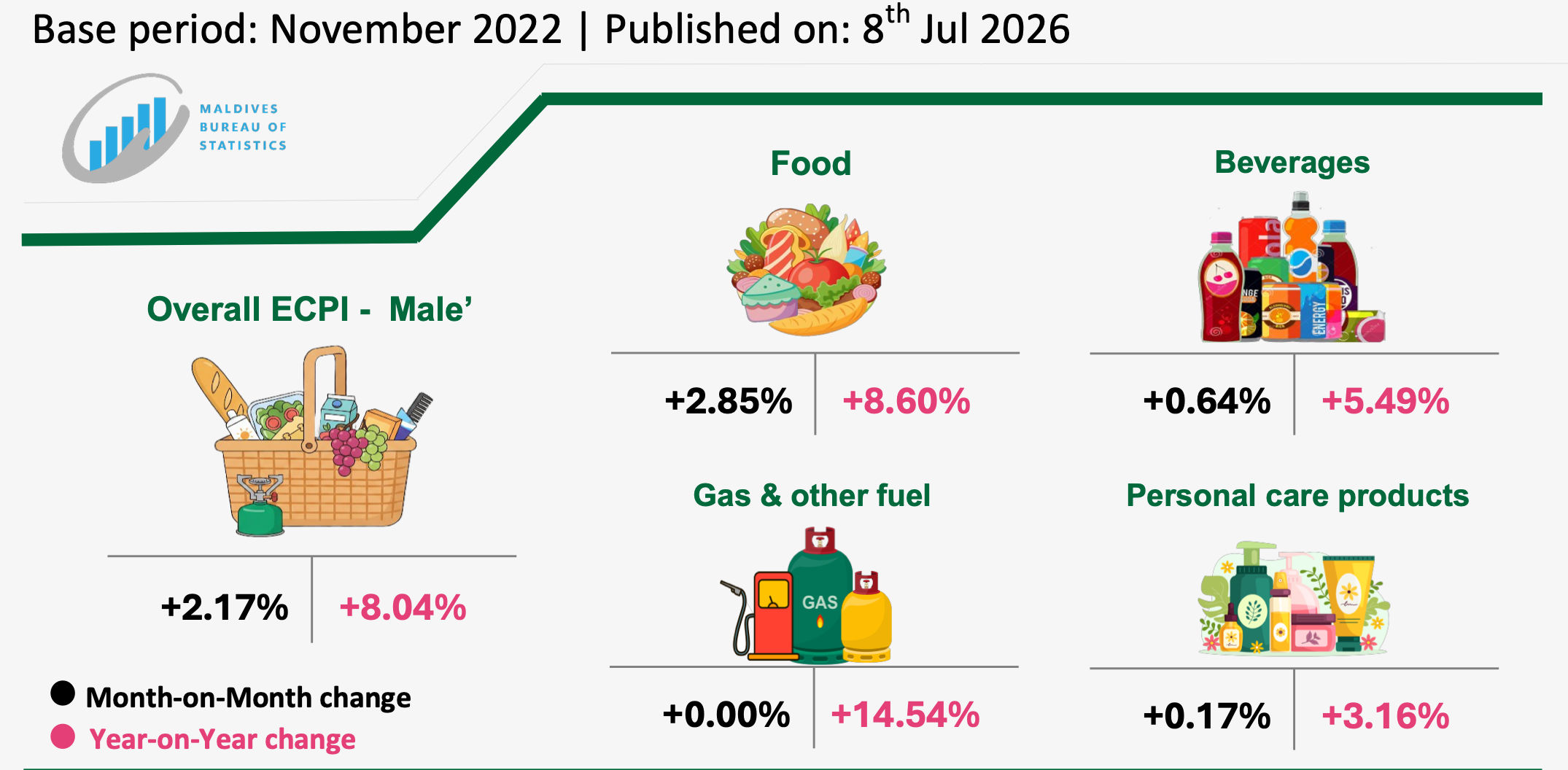
The MDP panellists pointed to empty or sparser shelves – STO milk among the items running out – which Ilyas Labeeb attributed to shipment and customs delays as much as the dollar crunch.
Ameer alleged the bank's balance sheet is in a "bubble," with investments in government securities reaching MVR 21.6 billion by the first quarter of 2026, up from MVR 9.6 billion at the end of the last government and that the State Trading Organisation took a US$ 100 million fuel payment facility from Oman and on-lent it to the government, despite denials that external loans repaid the sukuk. A further MVR 1.5 billion was obtained through the sale of dollar-denominated treasury bills and bonds, he said, and the government has paused providing subsidies to STO. Despite the sukuk clearance, public debt will reach MVR 160 billion by the end of the year, he predicted.
In May, the Bank of Maldives capped overseas e-commerce transactions and imposed an unannounced per-website "daily budget" that customers discovered only through declined cards. BML says inflows from its new investment scheme have let it expand that budget, whose size and reset times it has still never published.
Late last month, former President Abdulla Yameen predicted the dollar could pass MVR 21 before the end of 2026, challenging government assurances that prices would hold. It took until the middle of July.
Discussion
No comments yet. Be the first to share your thoughts!
No comments yet. Be the first to join the conversation!
Join the Conversation
Sign in to share your thoughts under an alias and take part in the discussion. Independent journalism thrives on open, respectful debate — your voice matters.
Support Independent Journalism
Help us keep the news free and fearless
Give once
$
or
Become a memberfrom $5/month

