
Abandoned seafarers warned of hunger and anchor failure before Sinamalé bridge crash
The agencies involved say the failed mooring was not their responsibility.

Artwork: Dosain
22 Sep, 15:51
The only anchor holding two powerless tankers off Dhoonidhoo "may fail at any moment".
The International Transport Workers' Federation (ITF) logged this warning on a database for abandoned seafarers on 6 July. On 10 September, during rough weather, the two vessels broke loose and collided with the Sinamalé Bridge.
The nine crew still aboard were rescued by the Coast Guard as the vessels drifted away. Both tankers continued taking on water and sank later that night about 30 nautical miles east of Malé Atoll.
The accident followed warnings from both the ITF and the 20 Indian crew, who posted repeated appeals to the database throughout July. They reported running out of food and drinking water and alleged the detention of crew members taken ashore for medical treatment. Customs disputes their account, saying it facilitated food deliveries through a local agent. But the crew say that agent was never appointed.
The two tankers are among 15 abandoned vessels reported in Maldivian waters since 2022, according to the International Maritime Organisation (IMO) and International Labour Organisation's (ILO) joint database for abandoned seafarers. Ten of those were reported in 2024 and 2025.
Infrastructure Minister Dr Abdulla Muththalib called the collision with the bridge a "near miss" after Chinese engineers found no structural damage. But the incident raised questions about who bears responsibility for meeting the country's obligations under the Maritime Labour Convention to manage a known hazard and support an abandoned crew.
Customs said it was not responsible for the anchorage. The Maldives National Defence Force said the mooring was outside its mandate. The Maldives Ports Limited declined to comment. The Maldives Independent also sent detailed questions to the Ministry of Homeland Security, Labour and Technology, Maldives Immigration and the Human Rights Commission as well as the Indian High Commission, International Transport Worker Federation India and the National Seafarers Union of India.
Illegal entry
The two vessels entered Maldivian waters on 26 April after switching off their Automatic Identification Systems (AIS). The crew later said they acted under orders from the vessels' owners, who threatened to withhold wages if they refused. It took Maldivian authorities a week to notice the vessels were inside the country's exclusive economic zone.
Customs launched an investigation, found no illicit cargo, and fined each vessel MVR 310,000 (US$20,100). As legal proceedings dragged on for four months, the two vessels remained anchored near Malé with their Indian crew members still aboard.
AL 1, an oil tanker flagged to Haiti with no recorded IMO number, had been listed as abandoned by the ITF since 1 December 2025. Its 11 Indian crew had gone unpaid for months. The captain had not been paid since October 2025 and the rest since December 2025, totalling US$42,293 in unpaid wages.
KG 1, formerly named Sunshine 7, was previously flagged to Zanzibar/Tanzania and carried IMO number 8921327. It was reported as abandoned since 1 March. Its nine Indian crew were owed US$37,250. Built in 1990, it had a deadweight capacity of 1,106 MT and a length of 67 metres.
Vessel tracking data showed both ships had been travelling from Shinas, Oman, to Kandla, India. In a video posted by the National Union of Seafarers of India (NUSI) on 4 July, one captain described being ordered to switch off AIS and divert to the Maldives.
"They speak to us.. turn off AIS and go to Maldives.. When we questioned them.. It's not legal, it's illegal..for anyone, for every country we are entering we should be starting our AIS. After they said, ‘Captain, if you are like this, if you don't listen (to) us, we will not pay a single dollar of all crew salaries’," the captain explained.
The ITF corroborated this in a database entry two days later. Both vessels had entered without pre-arrival notification, in violation of customs regulations, but "the crew acted strictly under the instructions of the vessel's management and had no authority over the operational decisions of the company," ITF noted.
"It has also been reported that the vessels' AIS tracking systems were switched off before arrival. Although the Maldives Customs authorities conducted an investigation and reportedly found no prohibited or illegal cargo on board, both vessels continue to remain at anchorage."
In the video, the captain also said that a "new owner" of the vessels had arrived in Maldives and was seeking the appointment of a local shipping agent to process the administrative matter and provide essential supplies for the crew.
"Unfortunately, this situation has now gone far beyond a regulatory or administrative matter. It has become a grave humanitarian emergency demanding immediate international attention," ITF warned.
Vessels spoofing AIS and entering the Maldives is not new, according to Captain Abdulla Saeed, the former managing director of Maldives State Shipping.
"Of course it’s not in the media often unless the Coast Guard and MNDF gets involved for illegal fishing...It’s not random, vessels come without permits, especially yachts. But the common practice is that such vessels are subjected to regulation. They are made to follow procedure and get fined," he observed.
The two vessels had been kept anchored until the fines were paid, Customs Spokesman Ahmed Niyaz told the Maldives Independent.
"Any vessel that enters Maldives is under Customs control, which means that embarking or disembarking from the vessel or loading or unloading any cargo must be overseen by Customs, and must be with Customs permission," he said.
"These two vessels did not take the clearance so we investigated and fined the vessels. So that means when they pay the fines, based on how our investigation goes, the vessels would be released."
Abandoned
KG 1 lost its anchor in early July. The two ships were tied together with AL 1's anchor, which was itself in poor condition.
From 6 July onward, the IMO and ILO's joint database for abandoned seafarers carried repeated warnings to Maldivian authorities, both about the crew's humanitarian situation and the risk of a maritime accident from the poor mooring.
The crew of the two vessels first reported running out of food, water and essential supplies on 4 July in the video posted by NUSI.
"We are stuck here for two months and we have already contacted the ITF...ministry...We need to be urgently released from here, we don't have food for three days...We are drinking this water..this water we collect from rainwater. We put this water in tanks, and our tanks condition is not good. We are suffering here. I don’t know if anybody died here who will," the captain can be heard pleading in the video, holding up a glass of water that appeared to be tainted with rust.
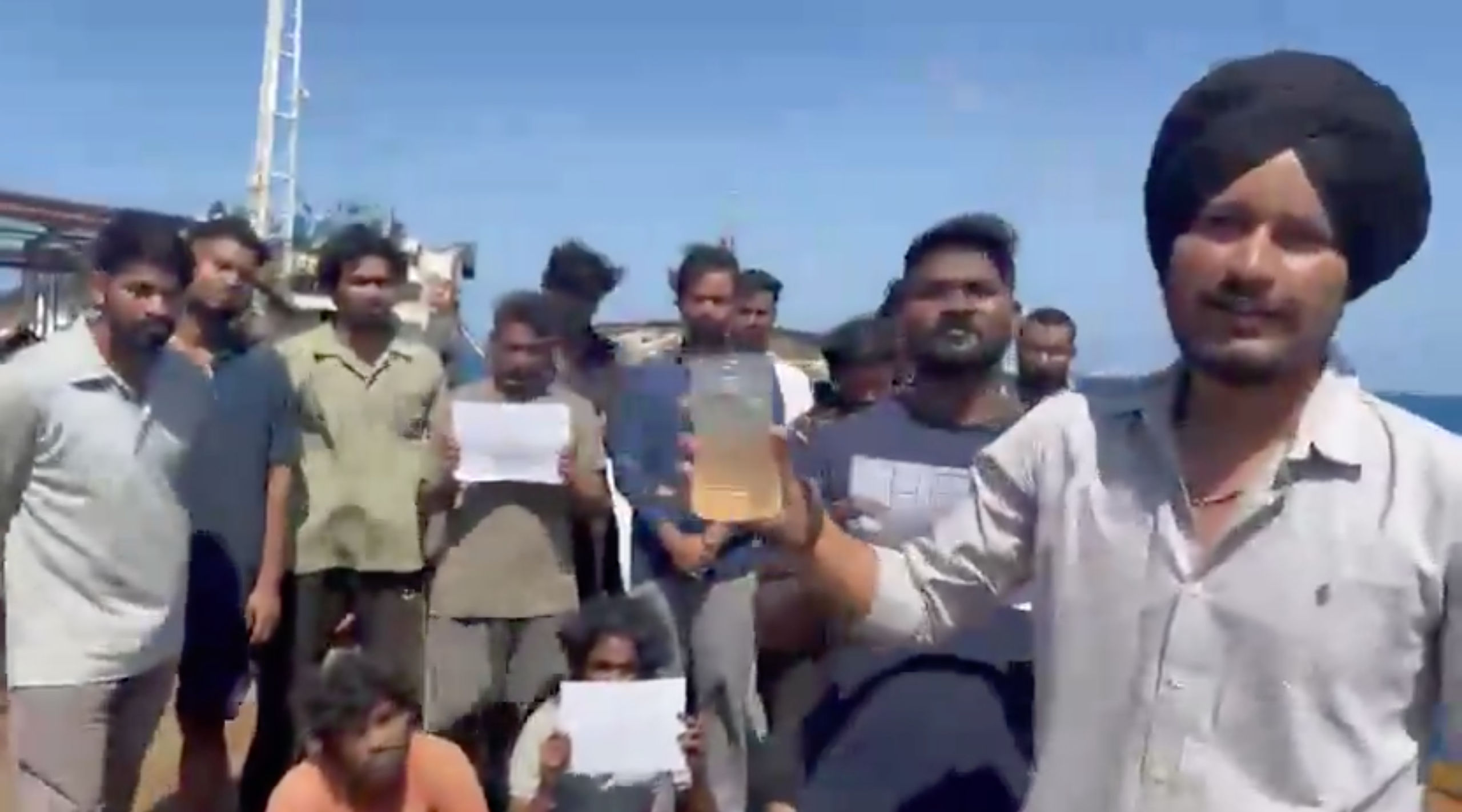
None of the crew members had any food for three days, he said.
"Please, I request you, help us. We need urgently food, fuel.. We need urgently provision, everything we need. But nobody here. I complained to ITF also the Indian embassy also and their customs. Customs didn’t listen us."
Two days later, the ITF posted its first record on the abandoned seafarer database for vessels AL 1 and KG 1, calling for "urgent humanitarian intervention regarding the extremely critical and life-threatening situation of 20 Indian seafarers" on board the two tankers.
The 20 crew members were deprived of basic necessities for human survival with "no food, no safe drinking water, no fuel, no electricity (as both vessels are in complete blackout condition) and no essential supplies for their health, safety and survival".
Both vessels had been reported abandoned, it noted, saying that the 20 crew members were "facing complete abandonment in violation of the Maritime Labour Convention, 2006".
"Out of sheer desperation, they are being forced to consume dirty and contaminated water that is unfit for human consumption. No seafarer, regardless of nationality or circumstance, should ever be subjected to such inhumane and degrading conditions," the log stated.
Citing information provided by the crew, ITF said the vessel's owner had arrived in Maldives and was prepared to pay any penalties or fines.
"The owner has also expressed willingness to arrange the immediate repatriation of all crew members together with payment of their outstanding wages. However, this process cannot proceed because a local shipping agent has not yet been permitted to act on behalf of the vessels."
ITF acknowledged that the vessels had entered the Maldives after turning off its AIS in violation of regulations. But it said the crew were ordered to do so by their employers.
"The seafarers are innocent victims of circumstances entirely beyond their control. They did not make navigational, commercial or regulatory decisions; they only performed their professional duties in good faith. It is therefore both unjust and inhumane for them to continue paying the price for matters for which they bear no responsibility," ITF said.
The following day, KG 1's master sent an urgent appeal via the IMO, asking Customs to either grant clearance and permit an agent or to directly facilitate delivery of fuel, water and provisions.
"Without an officially appointed agent and the necessary permissions, the Owner and Master are legally unable to arrange supply boats or essential services. We cannot lawfully bring supply boats alongside the vessel without the required authorization, even if we are fully prepared to purchase and pay for all provisions, fresh water, and bunker fuel," the appeal stated.
Four days later, on 18 July, a third appeal for provision of supplies was posted by the master and crew of KG 1. Food and water on board had "completely finished on board", it said.
"There is not even a single drop of drinking water available for the crew," it added. "Crew had last meal on the night before yesterday. Yesterday the crew did not eat anything and did not drink enough water."
The message accused Customs of failing to make arrangements for the provision of supplies despite payment by the owner. After initially agreeing to send a boat to collect and deliver the supplies, Customs later refused and asked the owner to deliver the supplies to customs, it said.
"Customs is already aware that the owner is currently in Colombo. Furthermore, no official agency appointment letter or inward clearance has been provided, so no local shipping agent has been officially appointed. In these circumstances, how can the owner practically arrange and deliver the provisions locally?" it added.
Due to the emergency, the owner paid MVR1,350 to the captain to purchase supplies.
"We requested that basic essential provisions such as rice, dhal, flour and drinking water be purchased with this money, and we informed Customs that if these supplies were brought to them, they could kindly deliver them onboard. However, once again, we have received no response," the captain said.
One agent, three answers
Customs has given three answers on whether a local shipping agent had been appointed. The harbour management section said on the database that an agent had been officially assigned. The vessel's representatives told ITF otherwise. Customs Spokesman Niyaz first said the agency had not been granted permission for an agent, then said the vessel had used one.
In response to 18 July appeal, the harbour management section of Maldives Customs posted a response stating that a shipping agent had indeed been officially assigned and authorised to act on behalf of the vessel.
"We wish to clarify that we have no objection whatsoever to the assigned agent providing all necessary services and assistance required by the Master, and crew," it said.
An ITF inspector responded by asking for clarity on the appointment of the shipping agent that had been assigned. Despite the Customs email to the contrary, the vessel and company representatives informed ITF that no agency had been officially assigned, even on a temporary basis, it said.
"If an agency has been officially appointed, we would be grateful if you could share the relevant confirmation or order. This will enable us to ensure that the company immediately fulfils its obligations, including the supply of essential provisions, payment of the crew's outstanding wages, and their repatriation," ITF said.
ITF repeated the call for urgent humanitarian intervention, noting the urgency of the situation for the crew.
"Since yesterday evening, the crew has been without food or drinking water. They are hungry, exhausted, and facing an extremely distressing situation. No seafarer should be left to suffer in this manner. Your timely support can prevent this humanitarian situation from becoming even more critical.
“We trust in your compassion and look forward to your urgent intervention”
When questioned about the repeated requests for humanitarian assistance and supply of food, drinking water and essential supplies, Customs Spokesman Niyaz maintained that Customs had "facilitated the supply of food and supplies for the vessels".
"It’s not the Customs responsibility to provide them food. It is the responsibility of the ship’s captain, master and owner to provide food for the crew. Customs' role is to make sure what is loaded and unloaded is with our permission," he said.
Asked whether and when a shipping agent was assigned, Niyaz was less privy to offer details.
"The processes in the rules apply to those that follow the legal channels, when they violate the laws, there is a different proceeding, which is investigating and taking action. Shipping agents are assigned to vessels that enter legally. In this case, because they entered illegally, we did not grant permission to appoint an agent. But we had been facilitating the loading of essential food supplies for the vessel," he said.
But when pressed further, Niyaz said the vessel did have an agent.
"They did use an agent, we have records of food that were loaded to the vessel by an agent, we have been facilitating it. How could they have stayed without food since 4th July? They had food. We have been facilitating food. They did appoint an agent," he insisted.
Asked about the exchange on 18 July and request to facilitate the supply of flour, rice, dhal and water, Niyaz said he was unsure about the specifics.
"I do not know all those details. I have to check from the investigations department… I can say that generally Customs were facilitating the supply of food and provisions, I cannot say whether a packet of dal was loaded on a particular day, I have to check," he said.
Detained
On 13 July, ITF posted a second record on the ILO/IMO database for KG 1, saying it had been informed that members of the crew were taken ashore for medical treatment by the Maldivian authorities but were instead transferred to a detention facility.
"In this case, it is reported that the seafarers have instead been detained and are now facing fines for unknown offences. The crew of the vessel are already facing abandonment and are now facing refusal of medical care, unfair treatment and criminalisation," it said.
ITF noted that MLC regulation 4.1 requires both the flag state and port states to have measures in place to ensure seafarers receive medical care when required. It urged the Maldives to consider guidance based on the Guidelines on Fair Treatment of Seafarers Detained in Connection with Alleged Crimes "before any further action is taken which may further criminalise the crew."
The master's 14 July appeal also noted that members of the crew had been detained and were being "treated as criminals".
"These are ordinary seafarers who have fully cooperated with all authorities. They are victims of the circumstances and have committed no offence," the message stated.
"The Owner and the Master have continuously cooperated with Customs, Immigration, the Police, the Public Prosecutor, and all other competent authorities throughout the investigation," it said.
The next entry on the database came on 19 August, when International Maritime Organisation noted the detention of the crew members and issued another reminder about the Maldives' obligations under the Maritime Labour Convention of 2006.
The Maldives ratified the convention in 2014.
Niyaz said he was unaware about any crew members being detained. But some crew members had been repatriated after falling sick, he noted. Customs do not have a detention facility and anyone held ahead of repatriation would be held by Immigration, he said.
"Some crew got very sick and some were sent back to their country. So before being repatriated, the people handed to Immigration would be held in one of their facilities. So is that a detention? I don’t know.
"They would be held in a facility and they would only be repatriated once the arrangements are made. That’s the same for someone they [immigration] picks up someone from the streets too.
"They would count as people who came here illegally. The boat did not come here legally, so the crew would not also have entered with Immigration control...crew also have to enter a country with a stamp on the passport. If that process did not happen, the crew would also count as illegal," Niyaz said.
Abdulla Wisham, a spokesman for Immigration, described the treatment of detainees.
"When people are brought to the detention facility, they are taken to hospital for medical treatment if it is needed, and any medication that is provided will be provided by the staff at the detention facility. They would be given food and water and anything they require at the facility," he said.
On 12 September, two days after the accident, the Human Rights Commission said it "coordinated with the Maldives Police Service, Maldives Customs Service, and the designated local agent to provide assistance" to the crew during July.
HRCM said that the matter was brought to its attention after members of the crew filed a complaint about drinking water, food, and essential supplies running out on board.
Who was responsible for the mooring
The ITF report on 6 July raised concern about the dangerous anchorage, warning that both vessels were moored by a single anchor and that this could lead to an accident.
"The situation is becoming increasingly dangerous due to adverse weather conditions. We have been informed that KG 1 has already lost its anchor, forcing both vessels to remain secured alongside each other merely to prevent drifting. Furthermore, the anchor of AL 1 is reportedly in a very poor condition and may fail at any moment. If this occurs, both powerless vessels could drift uncontrollably, collide with other ships, run aground, or cause a serious marine pollution incident. Most importantly, the lives of all 20 seafarers are at immediate risk," the record logged on 6 July stated.
Niyaz said that although the vessels were "under Customs control" the maintenance of the vessel or the condition of its mooring was not its responsibility, nor was the location of its anchorage.
"Maintaining the vessels are up to the captain and crew.. It’s not us who tell them to anchor at a certain area. Anchoring vessels are done by MPL and places like that. In the Male area, the vessels that do port calls to Male are designated an area, that’s the area in front of Male where vessels are anchored. It’s not like we go and tell them that the vessels should be in a certain area," he said.
Adhadhu reported last week that discussions took place between agencies to move the vessels to Thilafushi for secure mooring to prevent an accident. The relocation was to be carried out by MPL and Customs with assistance from MNDF, according to Adhadhu. The Housing Development Corporation reportedly granted approval for Thilafushi to be used for mooring in July.
However, the vessels remained anchored near Dhoonidhoo – a police detention island near Malé – until the accident on 10 September.
Captain Abdulla, the former head of the state shipping company, called leaving the vessels in such condition an "oversight" and "irresponsible".
"The impounding authority, whoever that is – in this case it’s Customs – Customs have to secure it, if the vessel is not under command. Or they must take it away from normal traffic and keep it secure and monitor it," he said.
The broader issue highlighted by the incident and the refusal by any institution to take responsibility is that the Maldives lacks a clearly defined maritime port authority, he said.
“Who monitors AIS? There is no clearly defined maritime port authority. We don’t know who does what and who must be responsible. We have the equipment, the Coast Guard will have all the equipment, I think even MPL has a lot of the equipment," he said.
"The common international practice is that each state must have a maritime port authority. We don’t have one. In such a port authority, the highest person is the harbour master. There is a person with that title in the Maldives.
"Our harbour master is an employee of MPL. In other words, there is no law that defines the powers of a harbour master. It is under the CEO of a company, it’s a commercial thing at that point, not a regulatory thing."
According to media reports, 11 crew members of AL 1 had been repatriated back to India two days prior to the accident on 10 September.
Wisham, the Immigration spokesman, said the nine crew members who were brought in after being rescued had since been repatriated. The remaining 11 crew members had been repatriated earlier, he confirmed, though he could not say when exactly.
The ILO/IMO database shows an increase in the case of abandoned vessels being left in Maldives since 2022. There was only one report in 2022 and two in 2023. But six vessels that were abandoned were reported to be held in 2024 followed by four in 2025. Most of the cases concern unpaid wages for crew members and abandonment by the vessel’s owner themselves. At least two previous cases included logs of crew facing difficulty in accessing essential provisions.
“Once impounded, it’s under Customs responsibility, there should not be a humanitarian issue," said Captain Abdulla Saeed.
"They should be provided food. Customs could foot the bill, and even seize the ship and sell it to recover the costs. But what the crew needs in terms of human rights has to be delivered by someone."
Discussion
No comments yet. Be the first to share your thoughts!
No comments yet. Be the first to join the conversation!
Join the Conversation
Sign in to share your thoughts under an alias and take part in the discussion. Independent journalism thrives on open, respectful debate — your voice matters.
Support Independent Journalism
Help us keep the news free and fearless
Give once
$
or
Become a memberfrom $5/month