
Two Adhadhu journalists detained as Aisha case mobilises the state against the press
First contempt detentions of journalists in the post-2008 democratic era.

Artwork: Dosain
12 May, 18:58
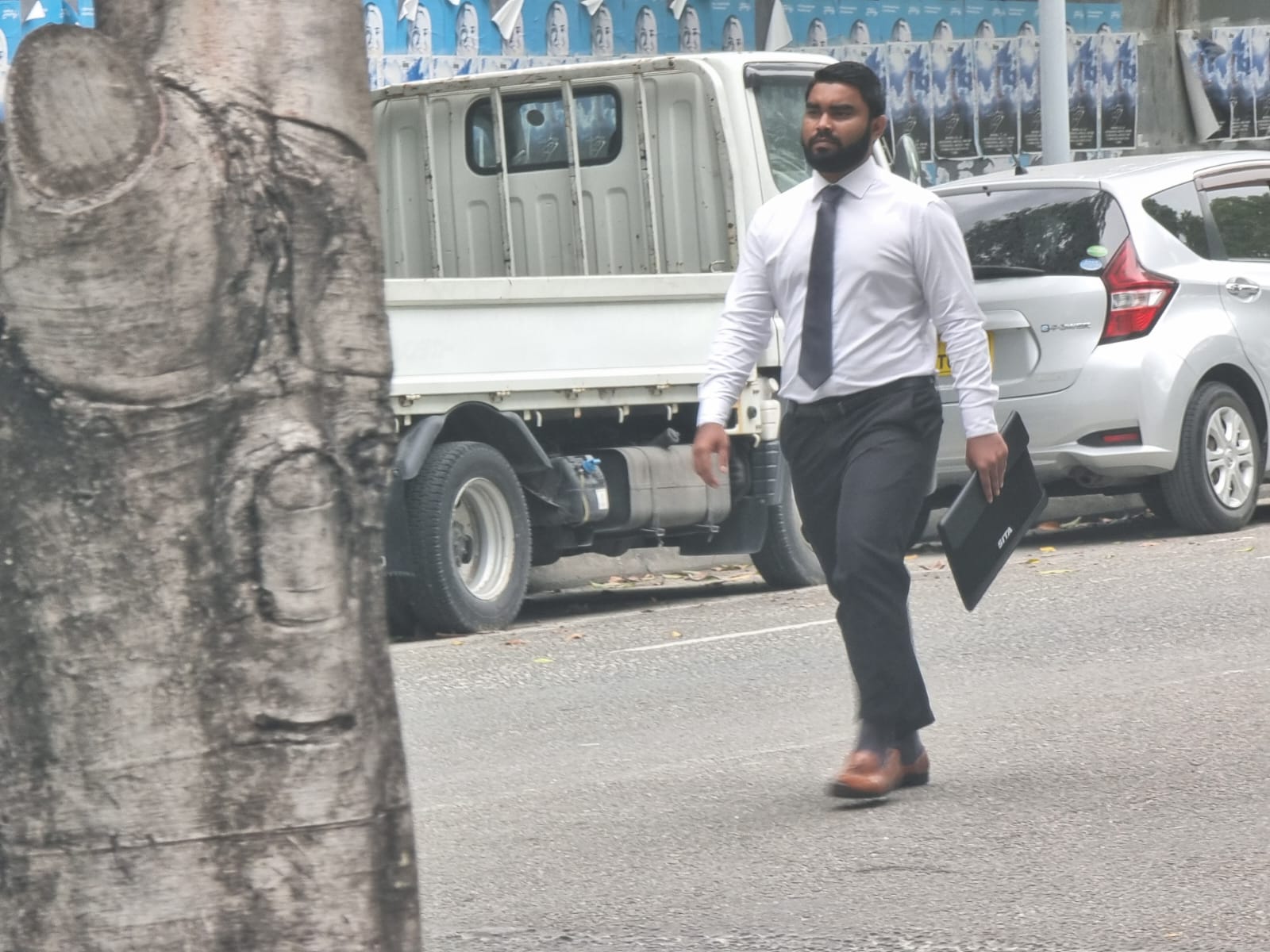
Two Adhadhu journalists were detained on Tuesday in the first contempt rulings issued under a Criminal Court gag order that has mobilised the Maldivian state against the press. Leevan Ali Naseer was put in prison for 10 days for reporting the release of the order on Sunday; Mohamed Shahzan for 15 days for asking the president a question.
It marks the first time the Criminal Court has sentenced journalists to prison since the adoption of the 2008 constitution. The court also handed down fines to both journalists. Shahzan was fined MVR 25,000 (US$ 1,620). Leevan's full sentence, according to the court's published judgment, was four months and 24 days under the contempt of court regulations and section 533 of the penal code (obstructing administration of law or other government function), of which four months and 14 days were converted to a fine of MVR 26,800. The three-judge panel ordered Leevan to make the payment within 20 days.
Both journalists appeared in court without legal representation. Both asked the court repeatedly for time, but the judges gave them two hours to appoint counsel. Shahzan told the Maldives Independent that "lawyers are hesitant to take this case" in the current political climate. Leevan said a judge asked him: "Aren't there lots of lawyers in the Maldives?" Both said the judges appeared to be in a rush to conclude proceedings.
The rulings come two days after the sweeping gag order in the qazf case against Adhadhu's CEO Hussain Fiyaz Moosa and Editor Hassan Mohamed over a documentary in which a former aide alleged a sexual relationship with President Dr Mohamed Muizzu. Since then, the Prosecutor General's Office has routed the order to the Elections Commission, which has fined the opposition People's National Front MVR 100,000 (US$6,500) for protests at which the underlying allegations were aired. The Media and Broadcasting Commission has ordered every news outlet in the country to comply, and separately instructed Channel 13 to halt its live coverage of opposition gatherings.
On Monday, security personnel escorted Shahzan from the press hall on Muizzu's orders for asking about alleged calls to the former President's Office staffer. Military officers attempted to seize the phone of a journalist who filmed Shahzan's expulsion.
"You are making a blatant lie and a false accusation against me," Muizzu told Shahzan. "No one will be allowed to violate a court order within this hall. The rule of law will be upheld within the President's Office."
The President's Office subsequently banned Adhadhu indefinitely from its press conferences.
"The question I asked was because I have call logs from the president to a President’s Office employee, I asked what the purpose of those calls were? I don’t believe that violated the court order," Shahzan told the Maldives Independent before Tuesday's contempt hearing.
All of this has unfolded in response to what former President Abdulla Yameen has called "a personal matter." The state's prosecutor general cannot bring such a complaint to court on behalf of the state, Yameen told supporters at a PNF gathering on Sunday. "That is Muizzu's personal complaint," he said. "So the state's institutions are being deployed in a very unfortunate way." The president is not a defendant in any of these proceedings.
Tuesday in court
Tuesday's contempt hearings were held behind closed doors. Court staff told the Maldives Independent the proceedings were "secret" and refused entry to journalists. However, the constitution requires public trials under article 42(b), with narrowly drawn exceptions.
Leevan's hearing began at 11am before three judges. He had received the court summons at 8pm the previous evening. He told the Maldives Independent he repeatedly asked the bench for time to appoint a lawyer. One judge told him: "We need to finish this quickly." The court granted a two-hour adjournment. Leevan returned at the end of the window without counsel.
"This is what we warned of with the control bill," Leevan said. "We're seeing it happen now."
Shahzan's 1pm hearing followed similar contours. He told the Maldives Independent the court order summoning him had been delivered at around 9pm on Monday. "I was told to appear at court today, so I didn't get adequate time to consult a lawyer or appoint a lawyer," Shahzan said.
Shahzan also disputed that his question to the president had violated any court order. The Criminal Court had issued four orders in connection with the Aisha case, he said, each with named recipients: Fiyaz, Hassan, the main opposition Maldivian Democratic Party, and the PNC. "There's no court order against me," Shahzan said. "The other thing is that it ordered not to talk of any persons involved in the Criminal Court case. The persons are Fiyaz, Hassan and the PG. I didn't say anything about any of these three."
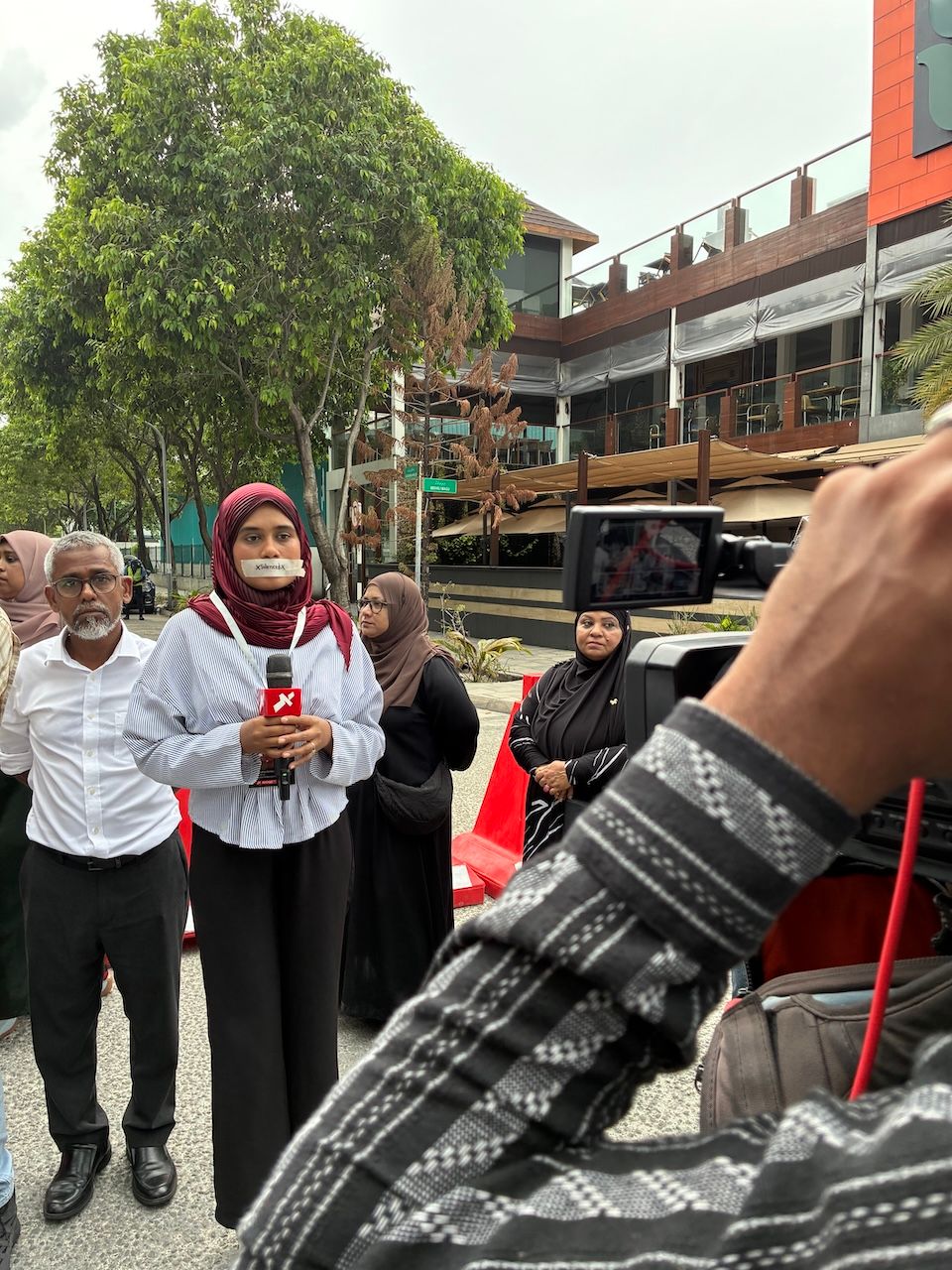
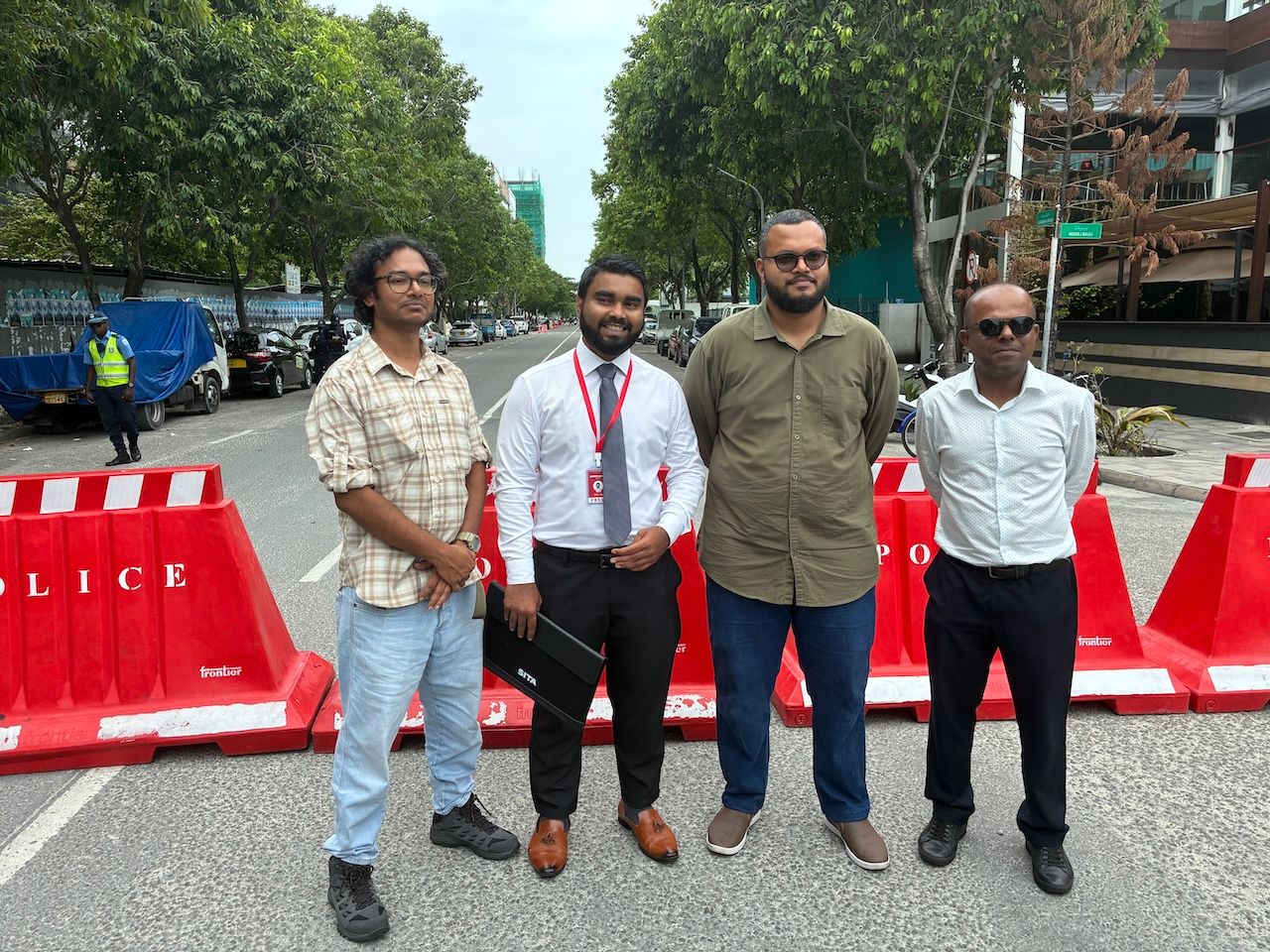
Outside the courthouse, a heavy police presence had been deployed. Roads on three sides of the court were barricaded. A small group of MDP supporters gathered to protest. Their amplified soundtrack openly defied the gag order. Journalists and members of the Maldives Journalists Association also assembled in solidarity with the two reporters.
Shahzan and Leevan each hugged their mothers, who were in tears, before they walked alone to the courthouse. The gathered journalists and activists clapped and cheered.
The documentary and the response
Adhadhu published the Aisha documentary on its X and Facebook accounts on March 28, six days before the local council elections and constitutional referendum of April 4. The documentary featured an interview with a former President's Office political appointee, her identity concealed, who said she had had a sexual relationship with Muizzu. Adhadhu reported reviewing chat logs of messages between the woman – a single mother in her early 20s and President Muizzu, who is 47 and married with three children. The President's Office spokeswoman denied the allegations, calling them "baseless lies."
The state response began the same day Muizzu was asked about the allegations at a press conference on April 27. Asked by Shahzan, he denied any wrongdoing and directed the "relevant authorities" to take action. That night, officers raided Adhadhu's newsroom under a Criminal Court warrant, seizing 20 laptops, hard drives and computers. The court imposed travel bans on Fiyaz and Hassan, freezing their passports until July 26. The journalists as well as the former staffer were summoned for questioning.
Fourteen days into the investigation, the Prosecutor General's Office filed qazf charges against Fiyaz and Hassan and asked the Criminal Court to issue a gag order pending trial.
The order
The Criminal Court gag order (528/Cr-C/2026) was signed by Judge Muzammil Nasir on Sunday (May 10), the same day the charges were filed.
The order prohibits any party from circulating the documentary, discussing its contents directly or indirectly, or associating the documentary with any party to the case or the alleged victim. It orders the trial to be held behind closed doors under article 42(b)(1) of the constitution, which permits closed proceedings to preserve "public morality." It deems any violation of either provision to be contempt of court.
The order's reasoning described qazf – false accusation of adultery or fornication – as one of "the major sins" under Islamic sharia, carrying a hadd punishment. It was grounded in a duty to protect "honour," citing the constitutional protection of name and reputation (article 33) and the presumption of innocence (article 51(e)). The reasoning treats Muizzu as the party whose reputation requires protection through speech restriction, even though he is not a party to the case.
The legal authority cited by the PG's submission, and accepted by the court, consists of two earlier Supreme Court orders: 2021/SC-A/79 (PG v Mohamed Ameen) and 2022/SC-A/39 (PG v Ahmed Moosa).
"Bad law"
The Criminal Court's order is the first general gag order on a Maldivian criminal case to bind the entire public. In a statement on Monday, the Maldives Journalists Association called it unprecedented. Past gag orders had been limited to preventing parties from debating legal details outside the courtroom or to prohibiting statements that explicitly declared an unproven suspect guilty. "Never before has the general public been entirely banned from discussing a case in its entirety," the association said. The MJA observed that blanket gag orders are a practice usually reserved for jurisdictions with jury trials, where the concern is preserving jury impartiality. The Maldives has no jury system and judges decide cases.
In an analysis of gag orders in Unsuru, the PG's Office's own journal, following the Criminal Court's May 2024 gag order in the Bassam Adheel Jaleel case – the most recent prior order in this chain of precedents – Aminath Shaama Naseer, a public prosecutor at the Prosecutor General's Office, traced the doctrine to the 1966 US Supreme Court case Sheppard v. Maxwell, in which a husband's murder conviction was overturned because the saturation of pre-trial media coverage had made an impartial jury impossible to seat. The gag-order doctrine was developed to protect defendants against prejudicial publicity that could taint jury impartiality. The Maldives has neither lay juries nor, in her view, a doctrinal basis for importing the rule. "Under the Maldivian system," Shaama wrote, "no matter how the defendant is talked about in society, the right to a fair trial is not affected."
Shaama's article was written to question gag orders even where they protect defendants. The Prosecutor General's Office is now the party requesting the broadest such order yet issued, against journalists who are themselves the defendants in the case.
Of the four gag orders in the Maldivian precedent chain – the Supreme Court's 2021 order in PG v Mohamed Ameen, the Supreme Court's 2022 order in PG v Ahmed Moosa, the Criminal Court's May 2024 order in PG v Bassam Adheel Jaleel, and the Criminal Court's 10 May order against Fiyaz and Hassan – the first three were all requested by the defendants, seeking to protect their right to be presumed innocent until convicted. The May 10 order is the first such order in the Maldives requested by the state against a defendant's interest.
The apparent consensus among lawyers, former judges and constitutional scholars commenting publicly is that the May 10 order is unlawful.
"Courts do not have the power to issue this kind of order, in the name of protecting court dignity, against political parties or the general public," former vice president Dr Mohamed Jameel Ahmed wrote on Facebook. "Nor is this how the judicial system works. The Criminal Court does not have the legal authority to issue such an order in this way."
Jameel also raised a procedural objection. Before reaching a blanket public order of this kind, a judge should at minimum have allowed argument in court, he said. Issuing such an order before even formally deciding whether the trial should be closed, on the same day the charges were filed, suggests a court acting in advance of its own deliberation. He called for the order to be tested through the appellate system.
Lawyer Hamza Latheef laid out the genealogy of the gag-order power on X. The Maldives has no general sub judice rule and the Contempt of Court Regulations of 2014 – under which the present order's enforcement provisions operate – were enacted by the judiciary itself, without an enabling Act of Parliament. Before 2008, contempt rules existed in regulation and gave judges broad powers to deem out-of-court comment as contempt. After the 2008 constitution introduced the requirement that any restriction on fundamental freedoms be set by statute, the judiciary in 2014 chose to re-frame the same rules as enacted under its "inherent rule-making power to protect its process," retaining the broad categories.
"In essence what Justices Suood, Adnan, Shujune, Ibrahim, Ali Zahir and Dr Ibrahim have espoused is the same thing," Hamza wrote of the 2021 and 2022 rulings that originated the doctrine. "That the courts possess an inherent power to limit free speech on pain of being found in contempt of court without sanction by a statute." Hamza's view is that authority does not exist. The portions of the 2014 regulations restricting free speech are inconsistent with article 16 of the constitution, which requires limits on fundamental freedoms to be set by statute. "Such powers should be derived from an enabling statute."
"This is bad law," he concluded.
If the premise of the precedent chain is wrong, every order resting on it is unsound, Hamza argued. A challenge to the May 10 order would test whether the appellate courts are "free to rule in line with their conscience or remain gagged themselves."
Former Chief Justice Ahmed Abdulla Didi, writing on X, argued that under article 42(b) of the constitution, the principle of public trials is the foundational rule of criminal procedure, and exceptions to that principle must be construed narrowly, only to the extent necessary to serve the specific public interests enumerated in article 42(b), and only consistent with the "democratic principles" required by article 68. A gag order that absolutely restricts freedom of expression and press freedom, in his view, "would plainly contravene article 68 of the constitution."
Didi also rejected the legal basis for the qazf charges themselves. Qazf under Islamic Sharia requires explicit accusation of zina – sexual intercourse outside marriage – against a chaste person, supported by the required witnesses. The documentary made no such accusation. It alleged "sexual relations" but not every sexual offence is legally categorised as adultery. The decision to investigate the documentary as a qazf case, in his view, "suggests a departure from the principles of independence and professionalism that investigative agencies are required to uphold."
Because the documentary described conduct allegedly committed outside the scope of presidential duties, and because the constitution under article 100(a) makes the president accountable to the people for such matters, "the documentary published by Adhadhu must, in principle, be viewed as media content that adheres to journalistic codes of ethics unless proven otherwise." If existing institutions lack the capacity to investigate the allegations impartially – Didi noted that the Homeland Security Minister had publicly characterised the allegations as "false accusations" before the investigation concluded, conduct he described as undue influence – then a special investigator should be appointed, on the model of the 1998 American precedent.
A Raajje TV legal analysis of the May 10 order, examining the two Supreme Court precedents the PG cited, reached similar conclusions about the new order's overreach. The earlier orders did not prohibit all reporting on the cases concerned, they restricted only speech that would presume guilt before adjudication. The May 10 order bans all coverage of the case in any form by any outlet, party or individual, with the effect that "the mouths of the entire Maldivian public have been taped shut."
The cascade
The Prosecutor General's Office circulated the order to other arms of government and instructed them to ensure compliance within their constituencies. The Elections Commission sent it to every political party with a directive to monitor compliance. The Media and Broadcasting Commission – the regulator established under the contested 2025 media law that dissolved the Media Council and Broadcasting Commission and consolidated regulatory power in a single state body – ordered every news outlet to comply, acting "in its capacity as the regulator of the media." The same regulator separately ordered Channel 13, the broadcaster aligned with former President Abdulla Yameen's People's National Front, to halt live coverage of nightly PNF gatherings at which the Aisha allegations have been discussed.
The EC fined the PNF MVR 100,000 (US$6,500) over the same gatherings, citing repeated violations of the Political Parties Act and breaches of the parties' code of conduct. The fine was signed by EC deputy chair Abdul Rahman Salah Rasheed in a letter addressed to Yameen. The PNF rejected the fine as "a lowly act" carried out "under government influence and outside the standards expected of an independent institution," and said its only gatherings were town halls at the party office.
The President's Office's ban on Adhadhu and all its journalists from attending its press conferences, communicated by WhatsApp to the official media group, will remain in place until both the criminal case and the parallel MMBC investigation conclude. The office invoked articles 40 and 44 of the new media law – provisions on codes of conduct and the duty to disclose accurate information – and article 13 of an internal President's Office policy on press conference attendance issued on March 31, three days after the Aisha documentary was published.
The Maldives National Defence Force, responsible for security at the President's Office, expelled Shahzan from a Monday press briefing on Muizzu's direct order, and subsequently attempted to seize the phone of Raajje TV journalist Shaihan Zareer on suspicion that he had filmed Shahzan's removal. MNDF officers also asked other journalists to hand over their phones.
The Criminal Court, having issued the underlying order, has now issued contempt findings against the same journalists who covered the order's existence and its effects. Shahzan was detained for the question he put to Muizzu at Monday's briefing. Leevan was detained over an Adhadhu news article whose headline read: "Court issues gag order prohibiting discussion on 'Aisha' documentary."
"A personal complaint"
In his critique, drawing a distinction between Muizzu's official and personal capacities, former President Yameen said: "Things done in the capacity of president are done by President Mohamed Muizzu. But his own personal matters are the things Dhimyaathu Mohamed Muizzu does. The allegations under discussion concern such a matter."
A qazf prosecution against journalists for allegedly false sexual accusations against a private citizen would, in ordinary circumstances, require that citizen to bring the complaint. The state has instead treated the president's personal interest as a state interest, mobilising the prosecution service, the criminal court, the media regulator, the elections regulator, the security forces and the executive press office in its support.
Yameen also rejected the legal grounds of the qazf charge itself. The police investigation had not established that qazf had been committed, only that allegations had been made. "The police did not want to investigate. The police did not investigate," he said.
He was equally scathing about the gag order: "Judges need to have a bit of substance in what they do. When rulings come out without substance like this, they become subjects of public review." Judges had been given too much power, and the resulting orders were "all sorts of strange orders, going beyond their bounds."
His closing observation captured the absurdity of the order's reach: "Then there are chairs used in homes; if it is a chair, then a chair; if it is a bed, then a bed; the sofa can't even be named. There is no way to live in this country. Even the detergent used to clean the sofa can't be discussed. This is astonishing."
On X, former President Mohamed Nasheed announced his readiness to defy the court order, calling widespread public defiance of the injunction "a form of protest to defend the right to freedom of the press." In a separate post, Nasheed said: "Filing criminal charges against journalists, forcing the disclosure of sources, raiding news offices, seizing property and equipment, and removing journalists from press conferences for asking unfavourable questions is unacceptable."
On Monday, the Committee to Protect Journalists called on the Prosecutor General's Office to drop all charges against CEO Fiyaz and Editor Hassan, saying that "criminalizing journalism poses a serious threat to press freedom and democratic accountability." CPJ also condemned Shahzan's removal from the press briefing, saying journalists "must be able to ask questions and carry out their work without intimidation or exclusion."
The qazf trial of Fiyaz and Hassan – closed to the public and the media – is due to commence on Wednesday with a preliminary hearing.
"I want to assure the Maldivian people that our work will not be deterred. Shahzan will be out in 15 days, Leevan will come in 10 days. God willing, our team will be march forwards in strength," Fiyaz told reporters after the sentences on Tuesday evening.
Fiyaz expected to be convicted on the qazf charge: “Muizzu won’t be satisfied without stopping Adhadhu,” he said.
"We don't accept this judgment. We challenge this judgment," said Hassan. "We won't do journalism the way the court dictates, we won't do journalism the way the government dictates. We will expose President Muizzu."
Updated Wednesday (May 13): This article has been updated to include the Criminal Court's ruling against Leevan Ali Naseer (550/Cr-C/2026), published on the court's website after this piece was first reported.
Discussion
No comments yet. Be the first to share your thoughts!
No comments yet. Be the first to join the conversation!
Join the Conversation
Sign in to share your thoughts under an alias and take part in the discussion. Independent journalism thrives on open, respectful debate — your voice matters.
Support Independent Journalism
Help us keep the news free and fearless
Give once
$
or
Become a memberfrom $5/month