
Maggots, blunt razors and nightly raids: a journalist's 15 days in Maafushi
Jailed for a question, an Adhadhu reporter on what he found inside.
17 Jun, 21:03
Mohamed Shahzan, an Adhadhu reporter and vice president of the Maldives Journalists Association, was sentenced to 15 days in prison on May 11 for contempt of court, after he questioned President Dr Mohamed Muizzu at a press briefing about allegations raised in the outlet's "Aisha" documentary. His colleague Leevan Ali Nasir was handed a 10-day sentence for reporting on the existence of a gag order in the same case. The convictions were the first time the Criminal Court has jailed journalists since the adoption of the 2008 constitution. Both appeared without legal representation, having been given two hours to find counsel.
Released on Eid, Shahzan spoke to the Maldives Independent about the sentencing, the conditions he observed inside Maafushi prison, and the toll the episode took on his family. His account of repeated late-night cell raids was publicly disputed by Home Minister Ali Ihusan, who said on May 28 that the searches followed the discovery of a mobile phone hidden in the journalists' cell and were standard procedure, not targeted at them.
Tell us about your prison experience.
Let's start with the court. The trial was to begin at 4:15pm and we were let in at 4:25pm. After letting us in, because the judge had not arrived, the administrative staff asked to wait downstairs, so I went downstairs. When I went downstairs the trial had not begun, but security came to receive me. So I questioned who they were and they said they were security, to take [me] to the cell. So then I realised the sentence had been written long ahead. When I was being brought out from the waiting area, the administrative staff said to the security [I] had not been sentenced yet.
Then, in any case, I was sentenced. When I was being sentenced I told the court I want to respond properly but would like to do so with legal representation so I asked for more time. They sentenced without providing more time.
Initially, I was summoned to court over contempt of court charges. However, I was sentenced for violating a court order for four months and 24 days.
After sentencing, I was taken to the cell in the criminal court. Initially Leevan and I were in separate cells next to each other and we were able to speak. Then they brought the statement. They had included some things I had not said in court. It said that I had refused to respond to the charge in court and that I admitted that the question I had asked at the President's Office was with regard to the woman in the documentary. Then I told the administrative staff that this is a blatant lie, [that] this has something I did not say in court and asked them to remove it and that I can only sign it then. They gave me a pen and asked me to cut out those parts. After I cut those parts out only some of it was amended, like the part about wanting to respond to charges. I still have that statement.
When we were in the Criminal Court's cells, the security staff treated us really well. They provided us with evening tea and dinner as well. They did not treat us like criminals. They took us to be handed over to the correctional services around 9pm.
When we were sentenced because I was in office attire, I asked the judge to provide me the opportunity to change as it would be very difficult if I go to jail tucked in and with my tie on. The judge said that opportunity will be provided and that he will ask the court's administrative staff. The administrative staff even provided us with the phone call but there is no regulation there to bring things inside. Then the court said to ask family to hand it over to the correctional services officers when they come, and that they will give us the phone call. So when they gave us the call we called and told them. However, the correctional services officers did not give us that opportunity. Maybe because it was us.
They took us to Hulhumalé jail. When we were being transported, we asked where we were being taken and they said Hulhumalé jail. Then we asked if we are going to be kept there and they said they do not yet know where we will be held. That is against normal procedure. Because under normal procedure escort officers know if they are transporting an inmate, where they will be held. Then they said nothing specific has been decided.
At the Hulhumalé jail we were initially kept at a holding cell. A very small cell. Very unhygienic, full of cobwebs and thick layers of dust. There was a lot of cigarette butts on the floor. There were two benches in a corner where both of us can sit. Two people can't lie down there with legs stretched. If one of us lies down the other has to sit up. We were there for about 45 minutes.
The officers there also treated us well. They gave us water and they fulfilled our requests. They did not know where we were to be taken. Then, when the Maafushi escort came, they said we were being taken there. We were handcuffed and taken to Hulhumalé wooden jetty. A police escort also followed. They left the vehicle and arranged themselves into two rows and we were between the two rows when we were taken to the launch. The Maafushi officers were also quite good to us. They said because we are journalists, we will not be taken amongst criminals. They were informed that we would be taken to the area dedicated for political prisoners, so as not to mix with criminals. So I think it was arranged that way. But after going to Maafushi jail, at the gate, which is what they call the prison's processing area for registration, visitor scanning and all, the officers there looked very worried.
They said we were being taken to Unit 12, then we said "you're saying this with such worry, is that a very bad area?". Then they said yes because there will be murderers and dangerous criminals kept there. They gave us a lot of advice like telling us not to respond even if other inmates say anything, not to talk to them too much. They said "what can we do, we have to act as we are told". After processing us ,they gave us a bar of soap, a shaver, a toothbrush and a tube of toothpaste, a pillow, a mat and a bedsheet. Then when we told them we did not have clothes, they gave us a mundu [sarong]. They did not give us a towel to dry ourselves.
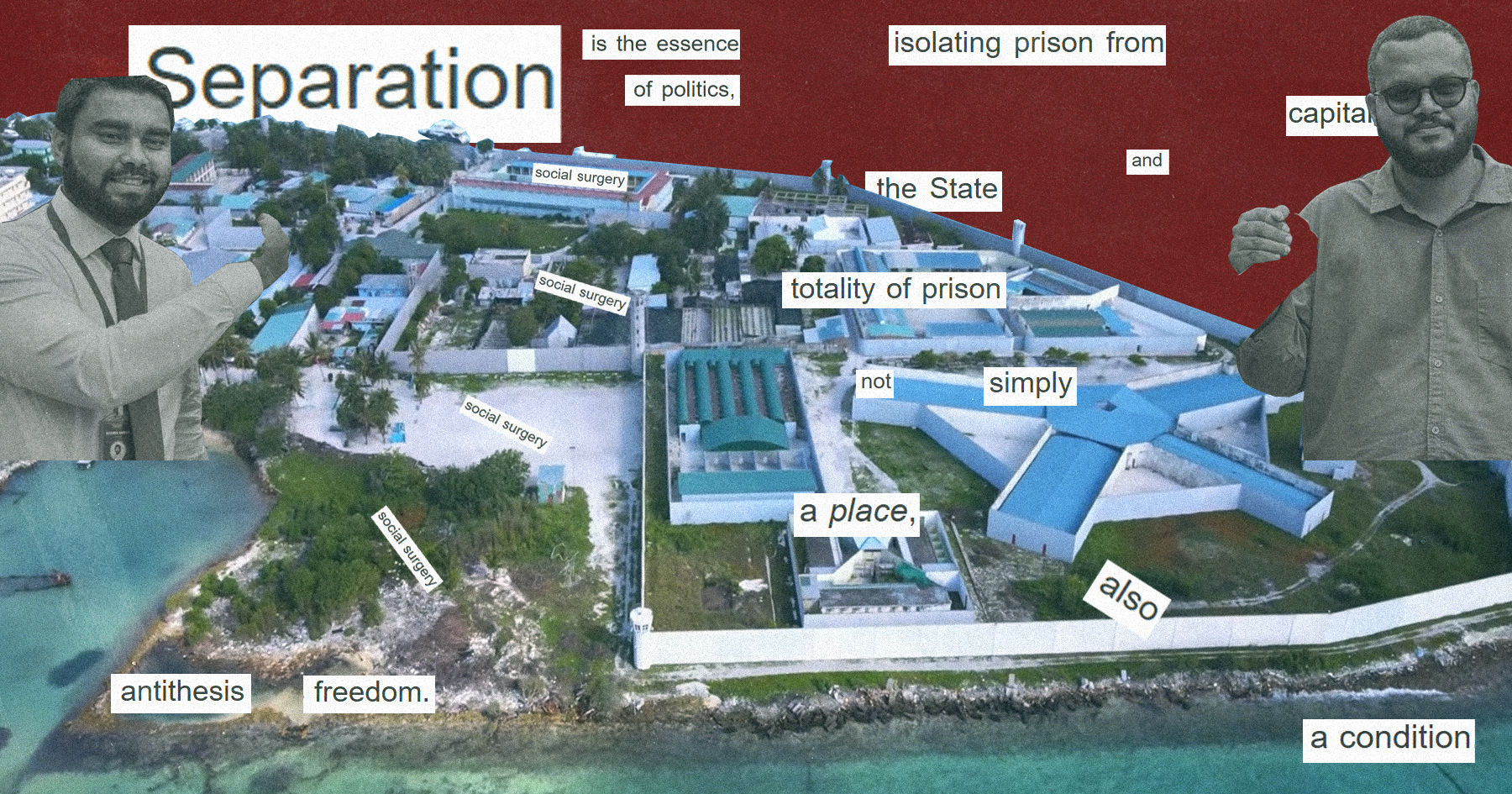
When we were taken to the cell, it would have been about 11:30pm. Those are actually cells for isolation, when you are inside those cells you cannot see other people or other cells. But when you talk from one cell, other cells can hear you. There are two wings. In one wing there are eight cells; the other wing has ten cells. With two corridors, there is a 15-foot-high wall between the two wings. When we were taken into the cell, which was the eighth cell in the second wing of unit 12, inmates started asking who we were. Then some inmates called out that we are journalists and then they said a lot of foul things that night. That journalists are like this and that, they treat us like this and that, this is how our state is, but we do not see that. That was the night of May 12.
But when we went into the cell, it had not been cleaned. Very unhygienic. There was a lot of dust in the cell and it had not been swept.
We faces the bars and the door – there are about 37 bars with the door. When you go inside, there is a space about 3.5 feet wide and the length is about 5-6 feet. There are two concrete benches on either side and its height is about the height of a chair, 5 feet long and 3.5 feet wide – the size of an ordinary single bed. There are no cupboards and there are three floating concrete shelves and a concrete table similar to a dressing table. The height of the toilet is about five feet. In the unit, toilets do have doors but in our cell the door had been removed. In the toilet, there were a lot of ants. The toilet bowl was in a disgusting state. I could not even bring myself to go to the toilet that night because of how unhygienic it was. So I just slept that night. That is generally the state of the cell.
The next day, after waking up, we both washed the entire cell. By then, inmates had calmed down as they knew what case we were brought there for because some cells have things like radios. There are three inmates employed there. One brings meals, the other works in the laundry and the third one cleans. The three of them are released from their cell from 6am till 9pm daily. So they can come near the cells. All other cells are locked. So among them, the one that provides meals, when he brought breakfast, said they knew who we were, why we were brought there and said not to mind what happened last night, that it's just frustration. He asked that we expose what is happening there. He said they [inmates] would provide us with books and stuff. So he brought a book and we had pens that officers had given us. So we were noting the situation there.
Let's start with the food. The quality of meals is actually very low. They bring different kinds of food for different meal times, so yes, variety is there. For example, they might serve vegetable curry for breakfast, dhal for lunch, short eats for evening tea and perhaps some fish curry with roshi [flatbread] for dinner. However, all of them have the same taste. If it's dhal, perhaps the taste is slightly different. But even the dhal does not have any substance or nutrients … It's very watery. When I crush the fish in the fish curry, my hands sometimes itch, so it's fish that has been kept frozen for a long time. Something I personally experienced was a piece of potato that had gone bad was used to cook the potato curry, the whole piece was black in colour. There are many issues like that. Even in the mashuni they bring, it does not have any nice taste, but mashuni is something Maldivians find very tasty, but there is some sour taste with a lot of coconut, little fish without onions and all. When we talked to the inmates, they said they do not even eat the mashuni because they found a maggot about 2-3 months earlier. So they don't even eat the mashuni.
Rice and roshi are fine and good quality, but the side [dishes] are of terrible quality ... the curry and all are in a bucket from which they distribute it to inmates. There are three buckets: one for curry, the other for rice or roshi and a smaller bucket for things like chilli and lime. We couldn't see how it was being brought, it's the same buckets and we don't know if it's being washed or how it's stored. It's transported on a wheelbarrow. There are a lot of mosquitos too, and flies swarm the buckets that do not have a lid, so the flies go into the food as well. Food is provided cell by cell, and each inmate has a plastic plate and a plastic cup to put the food in. There is an extraordinary amount of mosquitoes and flies. There are flies similar to those on islands where tuna is smoked, even inside the cell. Rats, geckos and cockroaches are common in the unit and the cells. I usually stayed with one slipper in my hand, so when a rat comes nearby I hit my slipper and it doesn't come inside the cell. When I say rats, I don't mean normal small rats. But when I wake up in the morning, there's rat faeces inside the cell. which means they have come inside. So we wash the cell again.
When we consider public hygiene standards, the bar of soap that they provide is very ordinary. I would say I cannot properly clean myself with that. Body odour or the smell of sweat is still present even when I shower 2-3 times. For someone who maintains their hygiene, it will be very difficult when your body smells bad.
The toothbrush that they provide is also very ordinary – you can break it with two fingers. I ran the twin-blade razor along my arm to test it out, the hair cuts off in different lengths. It was very blunt.
There is a business policy for sentenced inmates when you open an account and the family deposits funds. On Sundays, a slip will come to the cell. You can fill out the slip, noting the things you need. There is a business list. That list includes shampoo, shower gel, deodorant, Coke, Fanta, Sprite and a variety of biscuits. The list is about seven pages long and with that there is also a list of things that are out of stock, which is about 3-4 pages. Among the materials out of stock is deodorant and shampoo. Basic necessities are out of stock. I asked other inmates and they said those things like shower gel and shampoo have been unavailable for 6-7 months. We have also experienced this now. The only thing that you can regularly buy is tobacco – if Amber Leaf, then you can buy one pouch per week; if you want cigarettes, I think you can get 2 packs. I did not buy cigarettes. Rashu bidi [pre hand-rolled tobacco] you can buy in bunches or bouquets for the rate of MVR 3 per bidi. They receive those things regularly. For example, you can get either one of those options once a week. If cigarettes are not available, Amber Leaf is and, if Amber Leaf is not available, they can get rashu bidi without interruption. Everything else has been out of stock for ages. As someone who went there for 15 days, I know, when I think about it, that there is no lack of stock of shower gel or deodorant. It is purposefully not being taken. Maafushi is not that far away.
The same company that provides meals does the business. I think there was some issue over things not being available and the quality of the meals dropping. Because inmates said the food quality was very good before ... I mean to home-cooked level, and it tastes good too. Even on the days they bring Maldivian food, they get sweet potatoes, yams and even rihaakuru [fish paste].
The next is healthcare. Healthcare is not provided, I would say. Because the inmate I mentioned who brought us breakfast that morning, when he came to us that day, his leg was swollen. We can see it, but we would obviously become friendly later, after about two days of meals we became friends. I asked him what happened and he said he twisted his leg. He was taken to the doctor a day before we were released, on the 14th day of our 15-day imprisonment. However, he said it has been swollen for three months. But we heard him talking about it every day: "Take me to a doctor, the leg hurts a lot". He was not able to come out to distribute meals on three days because of the pain while I was there. But he was not taken [to a doctor].
Additionally, in the same wing as me, cell 10 holds [Hussain] Humaam, who was sentenced for the murder of Dr. Afrasheem. Humaam has lost himself with mental health illness. He doesn't even recognise people. He was my neighbour, and because we had hung out together as kids, he will know me well. So I said: "I'm Shahzan", and he did recognise me at first, but after 2-3 days he might forget who I was. He talks about a lot of things that don't make sense. He even believes there are people with him, but he is on his own in the cell. He has these bottles, with water in them, and he believes they are his wife and children. He even argues with them after having disagreements. He even yells and argues with other inmates in his cell block, thinking they are talking badly about him, and he even gives them death threats. The situation is dire.
The inmates there are not aware of these things, so they believe he is just bad and doing this on purpose. But in the time that we spent there, we realised he is battling mental illness. They do bring him medication, but he does not take it. They do not ensure he takes the medication. The reason I say he has lost himself is the first day I was taken to the yard, I went near his cell. He came to the door and asked for a cigarette. So I gave him the remaining half of the one I was smoking. Then I looked around his cell. Like I said before, there are two benches in the cell and there is no one else except him in the cell. One bench is for him to sleep on, there was no pillow there, nor a bedsheet or a mat. So he sleeps on the concrete. He was dressed in a piece of a dustbin bag. The second bench had food that had gone rotten with maggots on it – literally, maggots on it.
It was very difficult to see that. He's a human being too, I thought. I left and asked other inmates, you can hear when someone speaks from the cell. Then, they sent a note, I still have that note. [They said] in his cell there is no shower; the shower had been broken. There is no bucket and no jug. There is no light or fan. What's happening is, with the state of his mental health, when he gets upset he breaks the fan and shatters the bulb. And when people go in, he hurts them. So no one wants to go into his cell; there is no way to bring out the food in there so it catches maggots. And when he gets upset, he throws some of the food outside. He is not provided any kind of treatment. Considering his condition, he is not someone who should be kept isolated in a cell; his health is much too bad for that. He is a diabetic patient but he eats normal food. There are different menus but, like I said, inmates do not believe he has mental health issues and that he is doing these things because he is evil. And what happens is, it's easier for the inmates too if he is calm. He is calm when he gets normal food, so they provide normal food because he does not eat the food from the diabetic menu.
In the wing, almost all cells are provided with mental health medication every morning. I only noticed this after 2-3 days. One morning, after breakfast, I lay down. When I woke up, there were pills on the ledge of my cell entrance. Then I thought we had missed them when we cleaned the cell. But even the next day, I was reading a book after breakfast and he came and gave me the medication. I asked him what kind of medication it was and why he was bringing it here. He said it was being brought to my cell but I said I do not have any mental health condition. I also did not request medication from the doctor. Then he said sorry and left with it. This is how common strong mental health medication is there. They brought it to my cell for seven days. I asked the inmates in cell number seven, next to mine, how much medicine they are given. They said they have received three day's worth of medication. It fills two thirds of the box of a Colgate toothpaste tube when three days of medication are in it. Each tablet is cut with scissors. So two-thirds will be filled because there is a lot of medication. That's medication he takes over the course of three days.
Some of the inmates have lost sense in their mouths, or their mouth is drooping from taking mental health medication continuously. They abuse the medication, like they take ten pills at the same time. They will also call out that they have a specific medication, they will say so: "I can give ten pills, send two rashu bidi". So when they get some tobacco, they will send the pills. They exchange it and take the medication and sleep for about a day and a half. Because they have been isolated for so long, they take medication to sleep.
Humaam does this too. He will not take the dose he gets and takes all of them together. Then he will get hyper beyond control: he will hit the walls, the floor and the entrance. He even injures his limbs; that's how hard he hits. They cannot attend to him and the duty officers are hesitant to go in front of his cell. He is calmed down by the inmates. They send him a rashu bidi with every meal. They tell him that, if he shouts, they will not give it to him. Then he calms down. This dangerous person, this man who shouts in anger, if they say they will not give him the bidi, even his tone changes. He will go and hide in the toilet on his own and say: "I am in the toilet, I am being good. Bring it". His family sends him enough to buy one bundle of bidi and, because he is not well, he finishes it within about two days.
Treatment is not provided. The inmate in cell number nine next to mine, Asif Ali – a young man from Gaaf Alif Dhaandhoo – I think he is 32-years-old, he is also someone who has lost sense in his mouth from taking the medication. His limbs are very thin. He is an inmate that the family does not care for; he has about eight years remaining. Last year, he had neck surgery. That area is swelling and he has been asking to be taken to see a doctor for the past four months. Now it will be five months. I can hear him say all the time: "When will i be taken to a doctor?". But he was not been taken to a doctor, even by the time we were released.
As I said, we did not get a chance to change our clothes. After three days, I got a t-shirt and a pair of shorts. Leevan got it after four days. When we were first taken to the jail, at the gate, a doctor consulted to check if there is any skin conditions or long-term medications being taken. I said I don't have any issues like that. Leevan said he has a skin condition, which is psoriasis, and that if he does not use medication, it gets very bad and that he will need medication. They said they will send medication. But he was not provided medication even after 2-3 days. As I said before, there are a lot of insects. The way the cell is, even rats can go in and out, geckos too, and there's so many ants they are running across our bodies. If you have a skin condition when they bite, it will flare up. So there were bumps on his face and his back was reddening and they brought a medication; not the one he was using, some lotion from Cetaphil. Then, after that, Leevan was separated on the third day and, for the next 12 days, I was on my own in the cell.
There are special officers called ESG [Emergency Support Group], similar to police specialist operations [SO] officers. They are the ones that come to check and sweep the cells. They came almost every night to my cell. One night, they came early and, on another night, they came while I was sleeping. They come with a metal rod, a fuhkashi [chisel] and a hammer. So like I said before, the employed inmates are also locked in after 9pm. They close the wing gate at that time as well and no one can come out. Then they will open that gate at 11pm. When the duty shift changes, the officer will come and do a headcount. We can hear it very loudly when the gate is being unlocked and the ESG officers run through when the gate opens. So it won't be apparent they are coming in. Otherwise, if inmates know they're coming, they will shout "Haavaa haavaa". Then everyone in the unit will know they are coming. Immediately they came to my cell and the duty [officer] would open the door when they asked. That night I was sleeping and they came and said: "get up". I was very upset that day and I even argued with them. They hit the walls with the tools like the hammer and shatter parts of the cement wall and bench, and there will be dust. Maybe because inmates hide things. I said: "what can I do or hide as someone who is only here for 15 days?", that you are coming here and bothering me and that they are bothering me on purpose. There is a CCTV camera that captures audio as well, in front of every cell. As I said, it is a high security unit.
When I was being handled there, I was also treated as a high-risk inmate. Whenever I was brought out of the cell, I was handcuffed, even when I went to my lawyer meeting. But when some of the actual dangerous criminals are brought out, they are not handcuffed. I am inside a big jail and being escorted by 2-3 officers, so what can I do even if I am not handcuffed?
Another thing is, the inmates there are not categorised. I am someone who went to jail for 15 days, but in my unit there were death row inmates, people who have been sentenced for life in prison in murder cases and people who are reaching the end of the sentence. There were four murderers there. Then there were those in cases of committing a crime using a sharp object, child abusers, drug dealers and drug users and thieves – but there were very few drug users, mostly big criminals, like those who sell. A murderer might be placed in the same cell as a drug user or someone who was sentenced to rehab who had tested positive for drugs. That person is also committing a much smaller crime, but he is being held with more major criminals so he becomes an even bigger criminal. He learns things like how to steal and scam. I saw the reality of the criminal environment, what is really happening.
The person who is imprisoned for drug use has no opportunity for rehabilitation – programmes are not being run. They said programmes were run under the previous administration to some extent, but after it stopped the current administration has not run them. So the institution does not provide an atmosphere for them to leave the criminal environment. For example, what are things they can do once they are out? In earlier administrations, they had certificate 3 and certificate 4 level courses and skills were taught. They had certificates with them as well, for example, things like refrigeration. Their complaint is that, even after doing the courses, there is no way for them to utilise it. For example, for those who have completed the refrigeration courses, they can be employed and assigned to service and look after the AC units at least in Maafushi jail. There are many things they can do inside the jail. For example, cooking for inmates: if some of the inmates who have received pardons are brought out to work, they will work there. That also decreases expenses of the jail and inmates also get some work they can do.
There are many people who have not received clemency and parole, despite meeting the conditions, who have been approved by the clemency board and received the letter.
Then, I noted all this in the book, tore off the pages I had used and left the book as they needed books more. I was released on Eid. The officer who was in charge of the jail that day was called Adam Shareef, I think. When I was taken to the gate for release, he took away my notes, said it was for checking and began to read them. I said they cannot read those, that there are letters I had written for my wife and children and they are personal information. He said he can read it and I cannot take them. The only thing I can take is the official documents provided, he said. And I said: "which law or regulation says so?" and that it cannot be held like that. I am a journalist, and a lot of information has been written on that. I said if they hold them they cannot take me out of there, and I said to call the head officer. He said he was the head right now. I said he is a boy, the head is called Ameen. When I started getting loud, many officers came and he went out and called Ameen who said to let me take the notes.
I was handcuffed and taken to the launch. That is also not something they can do; when a person is detained at Maafushi jail to begin their sentence and is leaving the jail after sentence completion then that person is free. And taking the inmate to the ferry is something they do for them. But I was placed in a correctional services launch and taken to Malé and then placed in another vehicle from Malé jail to Hulhumalé jail with a police escort vehicle. And then again at Hulhumalé jail they kept going through my notes. I said they cannot read them and had the same argument again. The head of the Hulhumalé jail that day was an officer called Shifau ... Documents that were released by the head of a higher security prison do not need to be read by them. They do not have that right. The security [person] in charge came and tried to talk to me. I said I will not leave without [the notes] and they said they will not let me go until they have been able to take the notes. I told them they are mistaken, that I am here for 15 days and releasing me within that timeframe is their responsibility. And when I challenged them that much, then they released the notes.
Why do you think two jails tried to withhold the notes?
Because there were stories about the jail. When I was saying things to the officers who were raiding, I said: "even if I am imprisoned, no matter how much i am made to feel intimidated, once I have been released I will write about it, I will talk about it". I will question the president and the person in charge of the institution. The officers will report that I had said this.
When I started arguing, they said any document or drawing that endangers the security and safety of the jail cannot be taken out of the jail. I said I am someone who was in an isolated cell, locked for 15 days and asked how I can draw the blueprint of the jail. Also that if there is any sort of drawing that they can see it. But they read everything before it was released.
What was it like being on the other side of the story?
I actually felt very sad, even about myself. As a journalist, I felt I was not working to the level I should when I went there. There are countless inmates there that have been robbed of basic rights and their human rights. The jail is overcrowded, beyond its maximum capacity. When things are like this, I feel we are not doing the required amount of work to find out. We are reporting what the corrections and police say. We do not speak to the inmates and we [only] cover a report they release every now and then. We are not able to do any work on that on our own to learn about them or report on them. So I felt sad as a journalist that I had not been able to do that, and how I view the prison changed a lot. The inmates are also human beings like us, not that I believed otherwise before, but it is something that does not always cross our minds.
We always think about holding people in the free environment accountable. For example, we try a lot to hold the head of police accountable, but we do not ask any questions to the person in charge of prisons. We are not concerned that they do not hold press conferences or release information. When we hear an inmate has passed from declining health, we do not check why these things are happening. For example, the cell I was staying in was occupied by an inmate who had passed away while in jail in a murder case. The inmates said one of his kidneys had already failed when he was locked up ,but he took ten pills, his condition started to deteriorate and he died after he was taken to IGMH. Yes, he died cause he took those pills, but how did he get those pills? That is negligence from the prison and not someone whose health simply declined while he was detained.
How did the experience affect you mentally?
Mentally, it did not affect me when I was in jail; I did not have any guilt. Even when I asked the question [to the president], I was prepared. I told my wife and parents the previous night that I would be jailed when I ask this, but this question needs to be asked for press freedom. If I don't, this will become permanent. I saw it as something good I did.
But something that bothered me was thinking about what my children would think when I have to remain without speaking to them. For example, if I'm travelling for however long, I can still talk to them. We are very close, so they will look for me. For example, if I'm away for election coverage, after three days they will start crying, or I will have to read a story to them on the phone or something or they will not sleep. But later I thought they also need to learn that this is how the world works. And then I was taking notes and kept myself busy.
But after I left jail, it really affected me mentally. Because it's not a problem for me that the president imprisoned me for asking him a question. I had prepared before I asked that question. But when I got out, I saw the effect on my family. When they protested, my sibling was arrested and detained for four hours. What my mum went through when my sibling was arrested is visible on live television. There was a large injury on my mum's leg from the police shield; we only removed the large scab just three days ago. My wife and my dad were being pushed from the shields. When I saw those things, I could not accept that this is a level they should get. That bothered me significantly; even now it bothers me. I wonder what I can do because they did that. Just because I am a journalist, my family does not need to be punished. So that really bothered me. For about two nights or so, I could not sleep because this was bothering me.
For example, how much it affected my children. My youngest, who is three, can't really know why I am away. But she didn't want to let me go when I came home and would not leave my side for about 10-12 hours. A child of that age will only behave like that when it has really affected them. It really affected me. My five-year-old said his favorite number has changed, that it is now 15 because Dad was in Maafushi for 15 days. He waited for 15 days. What bothered me most was seeing what my family had to go through.
How did this affect how you work, are you self-censoring, has this changed how you work?
It has not.
Does it bother you or do you fear writing something that it might affect your family?
Yeah, it does cross my mind. There is assurance that, no matter what, action will be taken. But even then I think, no matter what they do, this [work] has to be done. There is no end to it otherwise, and the people who assume power next need to see an example that journalists cannot be silenced.
But there is a difference now. Before, [my] family was also very supportive, like "any punishment is fine, do it". But now my wife also asks me to think about it more. They are afraid and are hesitant when it affects children and all, like: why should they suffer? Why should you make that sacrifice on your own? Who sees that? Who sees journalists in the Maldives? Why should you do that? Why should you sacrifice? This is not something that even pays that well. What is achieved?
So I face questions like that now.
What kind of support did you get internationally?
Not much really. CPJ [Committee to Protect Journalists] called and asked how I was doing and took a lot of information after I was released.
Discussion
No comments yet. Be the first to share your thoughts!
No comments yet. Be the first to join the conversation!
Join the Conversation
Sign in to share your thoughts under an alias and take part in the discussion. Independent journalism thrives on open, respectful debate — your voice matters.
Support Independent Journalism
Help us keep the news free and fearless
Give once
$
or
Become a memberfrom $5/month