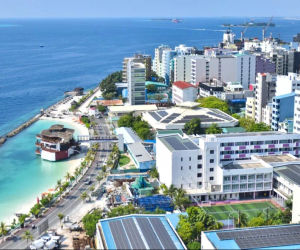

Hulhudhoo and Meedhoo celebrate "independence" in legal limbo
The city council still runs 80 percent of operations.
Artwork: Dosain
29 Oct 2025, 18:47
Vehicle rallies filled the streets and fireworks lit up the skies as Hulhudhoo and Meedhoo celebrated their "independence" from Addu City. But four days after Saturday's referendum when both islands voted decisively to break away, it remains unclear when that independence actually begins – or what happens to the 80 percent of operations still run by the city council they chose to leave.
Nobody knows, says Imad Solih, the secretary general of the Addu City Council. The legal framework has no precedent, no timeline for implementation, and interim councils would be needed.
But Minister of Cities, Local Government and Public Works Adam Shareef Umar says the answer is simple: both islands will remain wards until the local council elections in March 2026, after which separate councils will be set up with their own budgets.
Ahead of the polls, residents of Hulhudhoo and Meedhoo – which lie geographically separate from the interconnected islands of Hithadhoo, Maradhoo, Maradhoo-Feydhoo and Feydhoo – cited bureaucratic delays, lack of financial autonomy, and insufficient representation on the 13-member city council as justifying the split. Hithadhoo, as the most populous island and historical capital of the southernmost atoll, holds a voting majority.
"The referendum question presented to the public was whether they want to form individual island councils. It didn't specify when this would take effect," Imad, who is also a lawyer, explained to the Maldives Independent. The decentralisation law has no provisions that prescribe the course of action when voters choose to secede from a city.
"The closest scenario that can be considered is when Thinadhoo got elevated to a city and the island council structure got transferred to a city council structure without an election," he suggested. But since Hulhudhoo and Meedhoo each has one councillor, Imad argued that it is crucial for the government to make interim arrangements.
Administrative limbo
Both islands would also "have to start from scratch" because they missed out on 15 years of experience in decentralised administration that other islands have gained, Imad observed.
The secretary general contended that the Addu City Council could no longer legally fund the municipal administration of Hulhudhoo and Meedhoo.
At present, 80 percent of operations, including procurement, legal, finance and human resources, are carried out by the Addu City Council. A proper organisational structure and more staff would be required for both islands to begin functioning independently, he added.
"Those who advocated for this secession promised that a lot would be done for the islands within an island council structure [...] so any interruption of the services currently being provided to these islands by the city council would be a grave injustice," he said.
An interim arrangement must clearly define the operations and assets that need to be transferred to the islands from the city council, as well as how the island council accounts would be operated, Imad stressed.
"My argument is this does not need to wait til the next election cycle, especially since those who would come into the island council roles would not have the experience of working in island council models," he said.
The city council has received no instructions or directives from the local government ministry or the Local Government Authority on the next steps, Imad said.
No interim council needed: minister
Speaking to the Maldives Independent, Local Government Minister Adam Shareef said he respects the decision made by the people of Hulhudhoo and Meedhoo, echoeing the common refrain from city council members and lawmakers in the wake of the referendum results.
The minister dismissed any legal uncertainty created by the outcome. Both islands will continue to operate as wards of Addu City, he said.
"By the end of the term, [I] will make the necessary arrangements for Hulhudhoo and Meedhoo councils to function independently. Hopefully the situation will not change to a point where an interim island council is needed," he said.
Addu is home to many "capable" and "experienced" people, who would be able to manage without an interim council, he suggested.
However, "both councils would receive separate budgets" during the first quarter of 2026, he assured, since the local council elections are scheduled to take place at the end of March.
A deeper structural problem
Imad's concerns extend beyond the referendum to the possibility of Addu having to adopt an atoll council structure.
In August, President Dr Mohamed Muizzu announced the government's plans to amend the constitution to abolish atoll councils, calling it a "useless" layer of bureaucracy. Atoll councils currently coordinate the work of island council and city councils in each administrative atoll.
The absence of an atoll council raises questions about coordination by an overarching body that represents collective interests, Imad argued.
"Would it be LGA? Or would cities ministry branches be established in the atolls? Or would the president appoint a representative – these are all questions we have," he explained, characterising the replacement of atoll councils by an appointed representative of the president as a "step backwards" in decentralised governance.
The outcome of the October 25 referendum does not represent merely an administrative separation, he warned. The breakaway is fraught with legal, economic and social complications, he suggested, especially pertaining to the disputed borders of Hulhudhoo and Meedhoo, which is geographically one island.
"Violence between the two islands was so bad that houses on the border [shared by the islands] were destroyed by sunrise. There were only a few times when school holiday competitions didn't end in fights," he recounted.
"There was a time when there was no guarantee that people who travelled between the two islands after sundown would be able to travel safely back home," Imad recalled the tense situation from 30 years ago.
However, the relationship between the communities has since mended, which Imad attributed to the single administration within the atoll established in 2011 as well as the atholhu madharusa that brought together students from Hulhudhoo and Meedhoo in the same classrooms.
While he remains "hopeful" that history will not repeat itself, Imad advised the government to resolve the long-simmering border dispute, especially now that each island would receive a separate block grant based on land size, among other factors.
As Addu adjusts to its new fractured reality, Imad believes the city council must do more to ensure that other islands – who either rejected the separation in the referendum like Feydhoo, or did not want to separate like Hithadhoo, Maradhoo and Maradhoo-Feydhoo – don't end up with a change of heart along the way.
Imad acknowledged the organisational and administrative circumstances that led to the inefficiencies from which the grievances of Hulhudhoo and Meedhoo stemmed. As the rest of Addu City moves forward, services and facilities must be improved and provided equally among the remaining islands, the secretary general said.
Discussion
No comments yet. Be the first to share your thoughts!
No comments yet. Be the first to join the conversation!
Join the Conversation
Sign in to share your thoughts under an alias and take part in the discussion. Independent journalism thrives on open, respectful debate — your voice matters.
Support Independent Journalism
Help us keep the news free and fearless
Give once
$
or
Become a memberfrom $5/month