
Addu splits: Feydhoo votes to stay as Hulhudhoo and Meedhoo break away
Fewer than half of eligible voters turned out in Saturday's referendum.

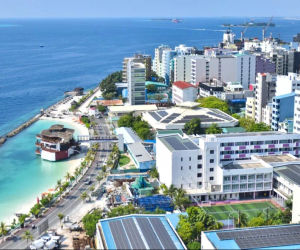
Photo: Leevan Ali Naseer.
25 Oct 2025, 20:15
The Addu City Council will partially split as Hulhudhoo and Meedhoo voted overwhelmingly in favour of forming separate island councils while Feydhoo chose to remain within the unified structure, provisional results from Saturday's referendum in the southernmost atoll show.
Meedhoo voted decisively to break away with 85.47 percent in favour (847 votes) to 14.53 percent against (144 votes). Hulhudhoo supported the proposed independent council with 68.73 percent (723 votes) to 31.27 percent (329 votes). Feydhoo rejected the proposal by a large margin as well with 74.33 percent voting to remain (1,784 votes) to 25.67 percent in favour of splitting (616 votes).
Voting began at 9am but polling stations remained largely empty without any lines as only 1,661 people voted by noon. Aside from the three islands, a polling station was also set up at the Kalaafaanu school in Malé for voters residing in the capital. By 3pm, turnout stood at 35.6 percent of 9,576 eligible voters. More people joined the queues before polls closed at 4pm, prolonging voting until they could all cast their ballots. Vote counting was underway by 5pm.
The final turnout reached 47.13 percent. It was highest for Feydhoo at 55.94 percent followed by Meedhoo (42.95 percent) and Hulhudhoo (37.20 percent).


Residents of Hulhudhoo and Meedhoo – both geographically separate from Hithadhoo, Maradhoo and Feydhoo, which are linked by causeways – who supported breaking away cited bureaucratic delays, lack of financial autonomy, and insufficient representation on the 13-member city council, where Hithadhoo as the most populous island holds a voting majority. Mayor Ali Nizar warned that the overhead costs of independent councils could consume any financial gains.
Saturday's poll was the first to be called under the new law on conducting referendums. President Dr Mohamed Muizzu announced plans to hold the referendum in mid-September, citing a campaign pledge made to voters in Hulhudhoo and Meedhoo. After the cabinet approved administrative matters on October 5, Muizzu assured that the government will remain impartial and "fully respect and implement the decision of the people."
However, despite Feydhoo ultimately rejecting the proposal, Feydhoo MP Ibrahim Didi from the ruling People's National Congress and his son, Home Minister Ali Ihusan, campaigned in favour of separation. Speaking in Laamu Gan last Monday, President Muizzu also criticised alleged attempts to mislead voters. If voters decided to create separate councils, Feydhoo, Hulhudhoo and Meedhoo would be allocated an annual budget of MVR 25 million (US$ 1.6 million), MVR 14 million and MVR 18 million, respectively, he said.
The opposition Maldivian Democratic Party seized on the president's remarks during the campaign as evidence of the government's intention to "divide and control" the MDP stronghold.
Ahead of the vote, Hithadhoo Central MP Ahmed Azaan from the PNC concurred with Mayor Nizar from the MDP that separation would result in "fragmented, weak political views and diminished influence."
Hulhudhoo and Meedhoo's decision to break away from the city comes just over 15 years after a referendum on October 9, 2010 approved designating Addu atoll as a city with 54 percent in favour. Amid a low turnout of 21 percent, voters in Hithadhoo, Maradhoo, Maradhoo-Feydhoo and Hulhudhoo endorsed the proposal, while Feydhoo and Meedhoo rejected it.
Despite Hulhudhoo and Meedhoo breaking away, the Addu City Council is expected to remain in place as the population of Hithadhoo alone exceeds the 10,000 threshold for city status.
All photos by Ameera Osmanagic from the polling station in Feydhoo.
Discussion
No comments yet. Be the first to share your thoughts!
No comments yet. Be the first to join the conversation!
Join the Conversation
Sign in to share your thoughts under an alias and take part in the discussion. Independent journalism thrives on open, respectful debate — your voice matters.
Support Independent Journalism
Help us keep the news free and fearless
Give once
$
or
Become a memberfrom $5/month