

Why Maldives wants to ban social media for under-16s
And what the rest of the world has learned trying.
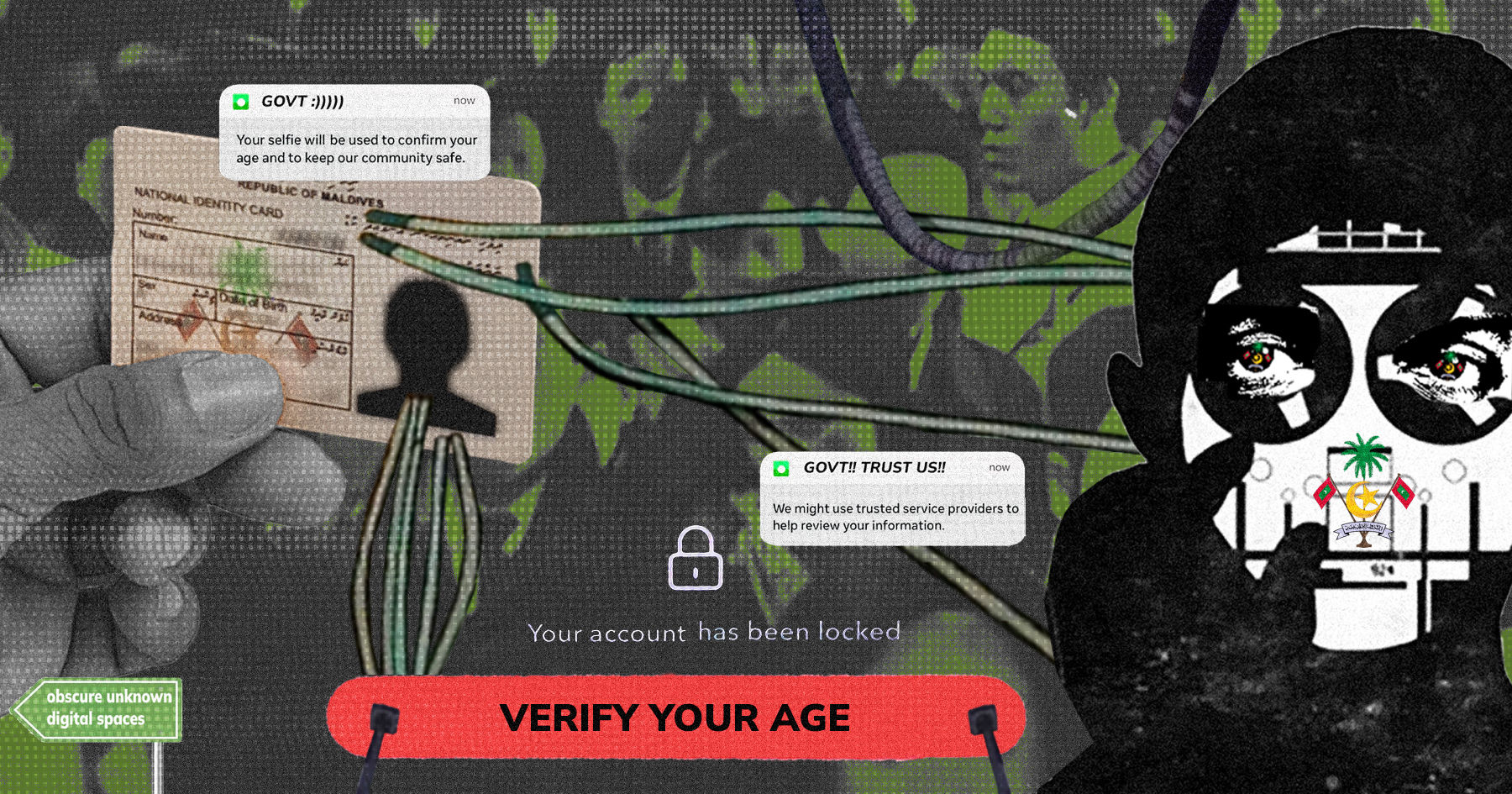
Artwork: Dosain
04 Jun, 15:18
The announcement
At his weekly press conference on Monday, President Mohamed Muizzu said the government intends to bar children under 16 from certain social media platforms. Australia, which introduced the world's first such ban in December, will be the standard the Maldives would follow, he said. The government would consult civil society, the public and relevant authorities before legislating or alternatively deal directly with the platforms themselves. The president set a horizon of up to about a year. But the measure could come sooner if the work is finished this year, he said.
Muizzu called cyberbullying "a very, very dangerous" and worldwide problem, warning that children were being exposed to online grooming and harmful content. "Since we are an Islamic country and such a closely-knitted small community, undertaking efforts to save our young children from these things is the responsibility of the government," he said.
The government plans to target "specific determined apps" rather than the internet as a whole. The measures would come "whether it is changes that need to be made to laws, or whether it is the correspondence needed with the companies that operate these social media apps," he said, expressing hope the work would take "about a year at the most."
Muizzu also moved to separate the ban from his wider technology agenda. It did not entail retreating from digitalisation, he said: Maldives 2.0 – his administration's plan to build "an AI-driven digital society" – remained central with internet access, online education and digital skills the country's way forward. An age limit on social media would not impede any of that, he stressed.
The Maldives joins a fast-growing list of countries moving to keep children off the major platforms.
Where the idea comes from: the "great rewiring"
The intellectual case for these bans is most closely associated with the American social psychologist Jonathan Haidt, whose 2024 book The Anxious Generation became an international bestseller. Haidt argues that childhood was "rewired" between roughly 2010 and 2015: a play-based childhood gave way to a phone-based one, as smartphones and social media became near-universal among teenagers. He links that shift to a sharp rise in anxiety, depression and self-harm among young people across the West from around 2012. He prescribed four norms in response: no smartphones before secondary school, no social media before 16, phone-free schools, and far more unsupervised play and independence.
Haidt builds on the work of the psychologist Jean Twenge, who documented the same timing. The argument's intuitive pull is obvious to anyone who has watched a teenager – or themselves – struggle to put a phone down, and it has given governments a clear, actionable target.
Where it is contested
The most prominent challenge came from Candice Odgers, a psychologist at the University of California, who argued in a 2024 review in the journal Nature that the evidence does not support the claim that social media is rewiring children's brains or driving a mental-illness epidemic. She warned that blaming social media risks distracting from the real causes of youth distress. The Oxford researcher Andrew Przybylski, who has tried to reproduce some of the underlying findings, has likewise reported associations that are small and mixed rather than large.
The core of the dispute is the oldest one in social science: correlation versus causation. Critics accept that teenage distress rose as smartphones spread, but say most of the data is correlational and that the causation could run the other way, with already-distressed young people using the platforms more. Some go further, placing Haidt's argument in a long line of moral panics about new technology, from the printing press onward.
Haidt rejects this. He has pointed to experimental studies he says demonstrate harm, arguing his case rests on multiple compounding factors rather than social media alone. Notably, even his critics tend to agree that many of his practical recommendations – later phone use, phone-free schools, stronger platform design rules – are sensible regardless of how the causation question is resolved.
The rise in youth distress is real and large. Whether social media caused it or is one strand among several remains disputed. A ban is one answer to a question the science has not closed.
The model: what Australia has actually done
Australia's ban took effect on December 10, making it the first country to impose a hard age limit. Ten platforms fall under it – Facebook, Instagram, TikTok, YouTube, X, Snapchat, Reddit, Threads, Twitch and Kick – while messaging apps such as WhatsApp, online games, and services usable without an account are excluded. YouTube's inclusion came after an earlier plan to exempt it, an early sign of how contested the line-drawing is.
Crucially, the law puts the burden on the platforms, not on children or parents, neither of whom face penalties. Companies that fail to take reasonable steps to keep under-16s out risk fines of up to A$ 49.5 million (US$ 32 million). Regulators have said platforms cannot simply ask users to state their age. Australian law does not permit them to demand government-issued ID, leaving companies to combine age-estimation methods whose reliability is itself in question.
Australia's online safety regulator reported in mid-January that platforms had removed access to about 4.7 million under-16 accounts. The regulator called the preliminary results encouraging.
But the picture is mixed. The regulator has acknowledged that some under-16s remain on the platforms, characterising success not as zero access but as reducing harm and resetting norms over time. Reporting in the months since has found teenagers circumventing the rules with VPNs, borrowed or fake IDs, and other workarounds. Some surveys suggest platforms retained a large share of their under-16 users and that many pre-existing accounts were never removed. Researchers have urged other governments to wait for proper data before copying the policy, noting that the real test comes at the six-month mark and beyond.
The wave the Maldives is joining
The Maldives would be following a broad and accelerating trend, though the details vary widely from country to country.
In Europe, France's lower house passed a bill in January to ban under-15s; Denmark has secured cross-party backing for an under-15 ban that could become law by mid-2026, paired with a state age-verification app; Spain has announced an under-16 ban with mandatory age checks; Norway is consulting on a minimum age of 15, with platforms responsible for verification; Germany's governing conservatives have floated an under-16 limit; Poland is drafting an under-15 ban; and Portugal has gone a different route, requiring parental consent for 13- to 16-year-olds, with fines of up to two percent of global revenue. The Netherlands is pushing for an EU-wide minimum age rather than acting alone.
Beyond Europe, Malaysia has moved to bar under-16s from opening accounts and hopes platforms will comply this year; Brazil's new child digital statute, in force since March, mandates parental controls and age verification without setting a hard age limit; China enforces a device-level "minor mode" that caps screen time by age; and Canada and Ecuador are weighing their own restrictions. Britain, by contrast, has set no age limit, relying instead on its Online Safety Act to police harmful content.
The common thread is that almost every country places the onus on platforms to verify age. Almost none has yet shown that verification can be done reliably without either intrusive identity checks or easy circumvention.
The privacy cost
That verification problem has driven much of the early reaction on X in the Maldives. To keep children off a platform, everyone using it has to prove they are old enough. The burden falls on adults as much as on children and the proof has to go somewhere.
The fear is that "age assurance" becomes a pretext for data collection. To confirm a user's age, a platform or a verification service may demand an identity document or a facial scan, handing the same companies the policy is intended to discipline still more personal and potentially biometric data. Maldivian users have also warned that face-based checks would exclude women who wear the niqab, for whom showing their face to a device simply to use social media is not an option.
Under one possible model – sketched by the security researcher who posts as @WhoIsFishie – the check would run through eFaas, the national digital identity system. A platform would redirect the user to eFaas, the user would authorise eFaas to confirm only that they meet the age threshold – a single yes-or-no, not their date of birth or anything else – and eFaas would return only that confirmation, without learning which account it related to and without passing the platform any further information. This would not involve any third-party verifier, biometric scan, or anything else the platform could mine.
The catch is trust. Fishie cautions that he has little confidence the government would build such a system cleanly. The country still has no comprehensive data protection law in force. A privacy-protective verification system is technically possible. But whether it is the one actually built is an open question.
What it would mean for the Maldives
President Muizzu referred to "certain apps" without naming them. A defined list would be more enforceable than a blanket ban, but also easier to sidestep.
The president also left open whether the route is new legislation or direct deals with the platforms. Australia's leverage rests on the threat of multimillion-dollar fines and a market of 27 million users no company will abandon. Whether global platforms will engage with a market of a few hundred thousand is untested.
Verification and enforcement present a different problem. Every country attempting this has run into the same wall: how to check a user's age reliably and how to stop determined teenagers using VPNs and workarounds that have already undercut the Australian ban.
The Maldives does face a documented rise in youth mental-health pressure. Whether a ban modelled on a contested theory, and on a country whose own results are not yet in, is the measure best fitted to that crisis is the question the coming year of consultation will determine.
If you or someone you know is struggling, the National Mental Health hotline can be reached on 1677.
Discussion
No comments yet. Be the first to share your thoughts!
No comments yet. Be the first to join the conversation!
Join the Conversation
Sign in to share your thoughts under an alias and take part in the discussion. Independent journalism thrives on open, respectful debate — your voice matters.
Support Independent Journalism
Help us keep the news free and fearless
Give once
$
or
Become a memberfrom $5/month