Disappearing Dhivehi: what the research actually says
A language can be everywhere and still be vanishing. Here's how.
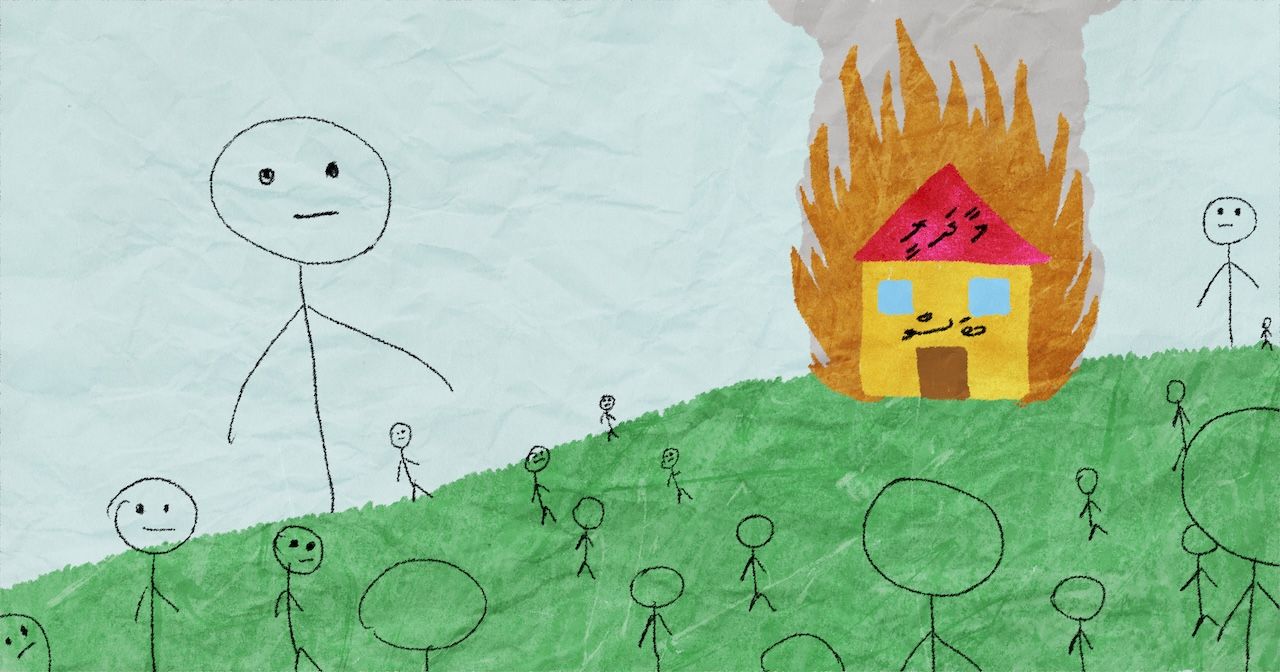
Artwork: Dosain
24 Jun, 16:00
Part two of our series on the decline of Dhivehi among young Maldivians. Our feature last week followed the children who can't speak to their grandparents. This is the framework behind it: why a language almost everyone still speaks can nonetheless be in trouble, what "domain loss" means, and why researchers say this is a problem of environment, not affection.
If almost every Maldivian still speaks Dhivehi, what exactly is the problem?
The newer thinking in language-vitality research is that a language can be widely spoken and still be losing ground.
"Languages do not disappear only when speakers disappear," explained Dr Aminath Riyaz, assistant professor at the Maldives National University's Department of Social Sciences. "Languages may remain widely spoken while losing depth, losing domains, weakening among children, narrowing emotionally, or becoming symbolically present but functionally reduced."
For Dhivehi, "the central issue may not be extinction in the traditional sense" but this quieter hollowing. A language still everywhere, yet doing less.
What does "losing domains" mean in practice?
A domain is a sphere of life a language is used in: home, school, work, religion, entertainment, government, social media, signage. A healthy language occupies many. A language in trouble retreats into a few.
The concept explains how a language shrinks without anyone deciding to abandon it. As English takes over schooling, technology, entertainment and aspiration, Dhivehi can be pushed back into the home and casual conversation. It remains present, but it is no longer the language in which the important parts of life are conducted.
Dr Naashia Mohamed, a senior lecturer at the University of Auckland in New Zealand, describes the result as subtractive bilingualism: English expanding at the expense of Dhivehi rather than alongside it. "Increasingly, we are seeing situations where children may understand Dhivehi fluently but struggle to express complex emotions, humour, intellectual ideas, or specialised vocabulary in it. That points not simply to bilingualism, but to domain loss and weakening linguistic depth," she said.
Isn't this just bilingualism? Plenty of countries raise children in two languages.
That is the distinction researchers are careful about. While bilingualism adds, subtractive bilingualism replaces.
Earlier in her research, Dr Naashia found "translanguaging practices where children moved fluidly between Dhivehi, English and sometimes Arabic depending on context and purpose." At that stage, "multilingualism often appeared dynamic and flexible rather than indicative of outright replacement."
What changed is the direction of travel. "More recent observations suggest something more significant may now be occurring in certain contexts, especially urban and middle-class settings: English increasingly becoming the default language of peer interaction rather than simply an additional resource."
Why is this happening now? Did Maldivians stop valuing Dhivehi?
No.
"The shift is not happening because Maldivians dislike Dhivehi," said Dr Riyaz. "In fact, emotional attachment to the language remains very strong. The shift is happening because the linguistic environment increasingly rewards English while reducing the functional depth of Dhivehi. In other words, this is less a crisis of identity and more a crisis of ecology."
Parents are "not necessarily choosing English over Dhivehi out of rejection of culture" but "responding rationally to educational systems, labour markets, media ecosystems, digital technologies, and prestige structures that disproportionately privilege English."
The uncomfortable implication is that love is not enough. "People may love a language deeply and still stop transmitting it if the surrounding structures make another language more economically and socially advantageous."
Languages have been passed down for thousands of years without curricula or phonetics charts. What broke that?
Dr Naashia locates the change not in any single policy but in the whole ecology of childhood.
"Traditionally, Dhivehi surrounded children almost completely – at home, in neighbourhoods, in storytelling, religious spaces, playgrounds, informal peer interaction, and local entertainment," she said. "The language was not taught as a subject alone; it was lived socially."
That immersion has thinned. "English entered the child's world not as an additional language but increasingly as the language of cartoons, YouTube, schooling prestige, educational aspiration, digital interaction, and sometimes even parental performance of status." In some urban settings, she said, children "now consume more English-language media before school age than Dhivehi-language interaction outside the home."
At the same time, urbanisation, smaller households, migration and screen-based entertainment have eroded the informal spaces where children once picked the language up from each other. "Intergenerational transmission depends on whether a language remains socially alive in ordinary childhood experience" – and that is what has weakened.
This is different from how today's parents grew up. Why?
Earlier generations took English in but used Dhivehi with each other. The shift now is that English has moved into the relational spaces themselves.
"In earlier generations, Dhivehi remained unquestionably dominant in family and community interaction even if English held educational prestige," Naashia said. "What I increasingly observe now is a shift in intimate and everyday linguistic practices themselves. Children speak English with siblings and friends, and adults often accommodate this by responding in English."
Much of that interaction has also moved online, she noted, "including the use of the English alphabet to transliterate Dhivehi utterances" – Dhivehi words typed in Latin script in family and friend group chats.
Is there hard evidence or is this impression?
Both. Riyaz's research documented what she calls a stratification across generations: language behaviour is "no longer uniform." Older Maldivians "still operate largely within a Dhivehi-dominant framework, while younger cohorts are developing very different linguistic instincts and preferences."
Naashia's 2020 study of secondary students found pupils scoring higher in English – their second language – than in Dhivehi, their first. The smallest tasks were revealing: "If you ask many young children today to tell the time, count, or describe colours and shapes, I would be very surprised if they consistently do so in Dhivehi without prompting," she said. In preschool work in Malé, she found children who could perform these tasks in English "but did not know how to do them in Dhivehi at all."
What did young Maldivians themselves say about the language?
In Naashia's work on adolescent identity, students expressed deep attachment to Dhivehi as central to "family, humour, intimacy, and cultural belonging" – while also feeling "more articulate, confident, or academically capable in English."
Several "openly acknowledged that they lacked the Dhivehi vocabulary needed to discuss complex academic, emotional, or global topics." Many were already aware of a hierarchy, associating English with "sophistication, intelligence, education, and higher social status," and Dhivehi with emotional importance but less social and economic power.
The striking part was that "many young people simultaneously loved Dhivehi and feared losing it, while also reproducing behaviours and ideologies that contributed to its marginalisation."
People complain that young Maldivians can't use "proper" or formal Dhivehi. Is that the kids' fault?
The registers are slipping. But Naashia asks where children were supposed to learn them.
"If children rarely hear sophisticated Dhivehi used consistently, rarely encounter it in books or media, and have limited opportunities to practise and engage with it meaningfully themselves, how are they expected to develop those competencies?" she asked. "Rather than place the blame on the younger generation, maybe we need to start reflecting on what actions have led to this point and any role we may have played in that process."
Proficiency "develops through exposure, participation, modelling, and meaningful use" – not from being told to preserve a language.
Is "language mixing" – switching between Dhivehi and English mid-sentence – a sign of decline?
Not necessarily. Naashia warns against treating it as one. This is the most counter-intuitive part of her argument and an important caution for a debate that can tip into purism.
Mixing languages, or translanguaging, is "a normal and legitimate communicative practice for multilingual speakers," she said. The danger she flags is the opposite reflex: insisting on one "correct" form: "If we continue framing all forms of language mixing as inherently 'bad' and insist on rigid forms of linguistic purism, we risk alienating young people or discouraging their use of Dhivehi altogether."
"When children and adolescents feel constantly corrected, policed, or judged for how they speak, they may begin distancing themselves from the language rather than developing confidence and connection with it."
That is not an argument against teaching rich or formal Dhivehi. The point is that a language survives "through use, adaptation, creativity, and emotional connection," not by being kept in an idealised form young people cannot relate to.
Beyond communication, what is actually lost if Dhivehi shrinks?
Knowledge that the language carries and another does not. Naashia's recent work links the erosion of Dhivehi to the erosion of ecological and cultural knowledge.
"A great deal of environmental and intergenerational knowledge is carried through language," she said. "In the Maldives, this includes ways of understanding the sea, weather, landscapes, navigation, food systems, relationships with nature, and communal life."
The concern is not only "whether Dhivehi survives as a means of communication" but "what happens to the knowledge systems, relational understandings, and worldviews embedded within the language" if those ways of knowing fall out of use.
Is there anything encouraging?
Yes. The clearest bright spot is at the youngest end: a marked growth in recent years of Dhivehi picturebooks for small children. Naashia recently completed an analysis of more than 100 of them.
These matter because early storybooks are where a child first builds "emotional connection, imagination, vocabulary, and familiarity with language in meaningful and enjoyable ways." When children see their own language "represented beautifully in stories, illustrations, humour, and everyday experiences," it positions Dhivehi as alive and creative rather than merely functional.
The shortfall comes later. There remains "a significant shortage of engaging reading and digital material in Dhivehi for older children and adolescents" – precisely the age at which English begins to dominate through schooling, media and peer culture.
Is it too late?
No. But the window might be closing. Riyaz is explicit that language shift is "not purely linguistic; it is environmental and ideological," and therefore reversible in principle.
"Children acquire the language that is socially rewarded, emotionally normalised, and consistently available around them," she said. "If Dhivehi is meaningfully present in education, media, peer interaction, literacy culture, and aspirational spaces, transmission can still be strengthened."
The caveat is the one that should worry Maldivians most. There are already families who do not speak Dhivehi with their children, and whose children do not understand it. "If we do not act today, in one to two generations, there will likely be no Maldivians to transmit the Dhivehi language to further generations."
"Recovery becomes increasingly difficult," she said, "once a generation no longer sees the language as naturally belonging to its future."
What a serious response would require – the medium-of-instruction debate, enforcement of the language laws, the technology gap and the people building against it, and the lessons of other small-language nations – is the subject of the pieces that follow.
Help us report this series. We're looking into how Dhivehi and English work in the lives of Maldivian children today. The experiences of families are central to that. If you're raising children in the Maldives, we'd like to hear from you. Our short, anonymous survey takes about five minutes. What you tell us will help shape the reporting to come. Share your household's experience here.
Discussion
No comments yet. Be the first to share your thoughts!
No comments yet. Be the first to join the conversation!
Join the Conversation
Sign in to share your thoughts under an alias and take part in the discussion. Independent journalism thrives on open, respectful debate — your voice matters.
Support Independent Journalism
Help us keep the news free and fearless
Give once
$
or
Become a memberfrom $5/month