
Disappearing Dhivehi: why a generation of children can't speak to their grandparents
How English became the language children choose with each other.
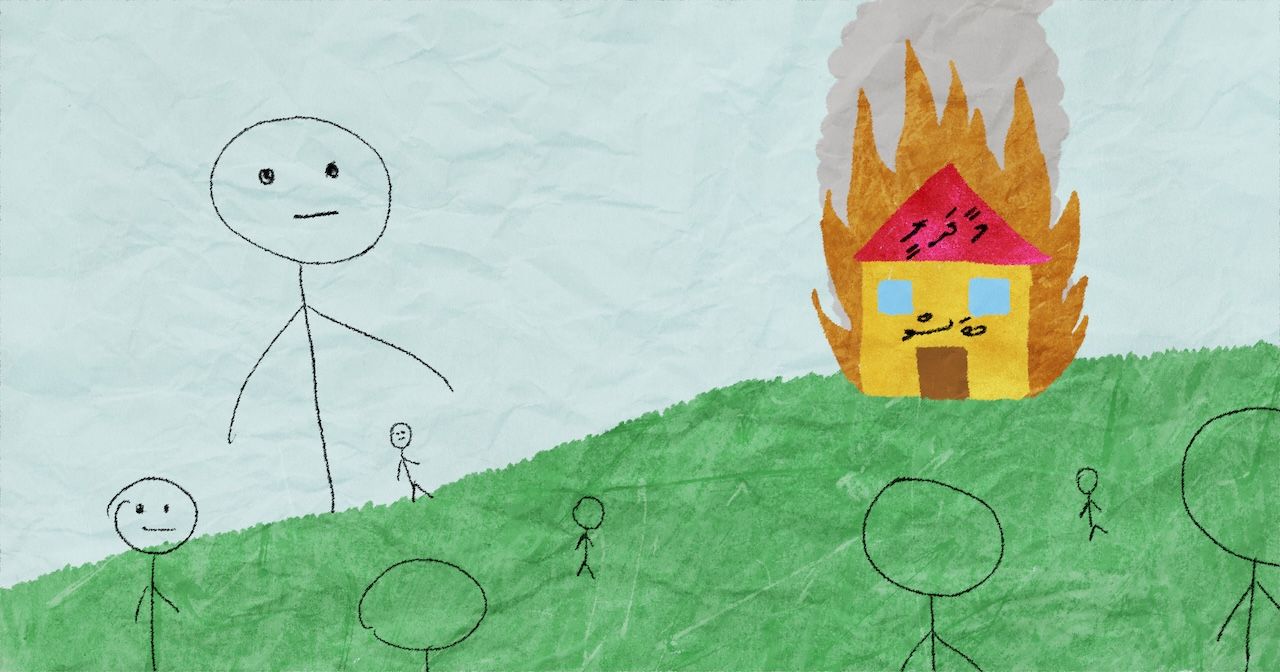
Artwork: Dosain
18 Jun, 17:55
Aminath is teaching her two-year-old son to answer a question. "What is your name?" she asks him in English. But he answers in Dhivehi, the way a child raised in a household with grandparents would. That has become the problem. In a few months, he starts pre-school in Greater Malé and his parents worry he will hit a language barrier.
"Most of his peers speak English," Aminath said. "We need to teach him to converse in English for him to be able to communicate with them."
The other children are Maldivian too.
A generation ago, children arrived at pre-school speaking Dhivehi. School was understood to supply the English. That order has now flipped. In parks, on buses, in cafés, the language you hear between Maldivian children is English. Many can barely hold a sentence in Dhivehi.
Many Maldivian adults grew up with English too – Monday night movies on TVM, the American sitcom Friends, Hardy Boys and Nancy Drew. The obvious question is why it did not do to them what it appears to be doing to their children.
Earlier generations absorbed English but spoke Dhivehi to each other. English was the language coming in. Dhivehi was the language going out. What has changed is that English has moved into those intimate, relational spaces themselves. "In earlier generations, Dhivehi remained unquestionably dominant in family and community interaction even if English held educational prestige," said Dr Naashia Mohamed, a senior lecturer at University of Auckland in New Zealand.
Now children speak English with siblings and friends. And adults answer in kind.
Crisis of ecology, not affection
A language does not have to lose its speakers to be in trouble. It can remain widely spoken while quietly losing its domains, retreating into the home and casual talk as another language takes over schooling, technology, entertainment and ambition. A language could stay present but shrink in function, understood yet no longer the language in which children do their thinking, joking or learning.
The reassurance that "everyone still speaks Dhivehi" misses what is actually changing.
Traditionally, Maldivian children started off learning three alphabets at home: Dhivehi, English and Arabic. By school age, they would know a smattering of English and Arabic words, while being fluent in Dhivehi. Along the way, they would also pick up some Hindi from the Indian movies their parents watched. That pattern has now broken.
This is the heart of what researchers now stress: the shift is not driven by any dislike of Dhivehi. "The shift is happening because the linguistic environment increasingly rewards English while reducing the functional depth of Dhivehi," explained Dr Aminath Riyaz, assistant professor at the Maldives National University's Department of Social Sciences. "In other words, this is less a crisis of identity and more a crisis of ecology." Parents are not rejecting their culture but responding rationally to schools, job markets and digital media that all favour English. A language can be loved deeply and still go untransmitted if the structures around it make another language the more advantageous choice.
Her research found that language behaviour is no longer uniform across generations. Older Maldivians still operate largely in Dhivehi, while younger cohorts are developing "very different linguistic instincts and preferences." Among some children, their bond with Dhivehi is weaker than a stable language environment would produce.
English was made the medium of instruction in the capital's schools in 1960. By 2000, it had become the language of instruction in every school across the country. The 2020 education law cemented it.
Dhivehi was relegated to a subject when the government switched to the British system for schools in Malé. Islam was the only other subject taught in the local language. The shift also created a two-tiered system with other islands having to contend with a localised system with Dhivehi as the medium of instruction. A unified curriculum was eventually introduced in the 1970s to the outer atolls, but some subjects continued to be taught in Dhivehi until the 2000s.
This educational divide became evident with children in the capital developing a markedly better command of English compared to their counterparts from the rest of the country. The perception of English as the language of affluence, opportunity and educational qualification can be traced to these differences. A person who spoke better English was more likely to land government scholarships, better jobs and even societal respect.
"The result of the education system being completely dependent on the English language was the status of English becoming elevated in all Maldivian schools," observed Dr Aminath Zahir, a senior lecturer at the Maldives National University's Faculty of Arts and the first scholar to complete a PhD in Dhivehi.
Both the 2012 pre-school law and the 2015 national curriculum mandated kindergarten to be taught in Dhivehi. But parents' attitudes left teachers struggling to comply, she noted, citing research that showed how parents believed their children would do best in proportion to how well they mastered English. Even before 2020, pre-schoolers were taught in English, or a mix of Dhivehi and English, as the 2012 law went unenforced, she added, until the 2020 law required only the Dhivehi subject itself to be taught in Dhivehi.
"The result of the language of instruction for Maldivian children's learning, starting from their youngest age, being a language other than Dhivehi was that they became more at home in the language they hear all the time, and the standing accorded to that language was elevated," she said.
No common language
Shahuma Ali, director of Dhivehi Language Academy, expressed dismay over children's inability to communicate in Dhivehi even when the occasion calls for it.
"The lack of language fluency is not only putting into peril the existence of Dhivehi, it is also creating distances in families sadly," she said, referring to children who cannot speak with their grandparents. "They don't have a common language anymore".
Dr Naashia has documented the same rupture. The shift is no longer confined to how children speak to each other. There is now a growing expectation that adults should speak to children in English, she said. Parents are adopting it at home because it is seen to serve the child's future. In many cases she knows of, that has cut children off from grandparents who are not comfortable with English.
Shahuma acknowledged the common complaint of parents about the lack of materials in Dhivehi designed for children. But she stressed the importance of home environment. "The basics have to start at home. There are Dhivehi names for everything in our surrounding areas, we can at least start teaching the children this first," she said.
The solution is not discarding English, she suggested: "Experts say a kid can be taught multiple languages from two to six years, so we are not saying not to teach English, but build the basics in Dhivehi."
Earlier research conducted by Dr Naashia identified "translanguaging practices where children moved fluidly between Dhivehi, English and sometimes Arabic depending on context and purpose." This multilingualism appeared dynamic and flexible instead of outright replacement.
"However, more recent observations suggest something more significant may now be occurring in certain contexts, especially urban and middle-class settings: English increasingly becoming the default language of peer interaction rather than simply an additional resource," she explained.
What is emerging is subtractive bilingualism: English expanding at the expense of Dhivehi rather than alongside it. "Increasingly, we are seeing situations where children may understand Dhivehi fluently but struggle to express complex emotions, humour, intellectual ideas, or specialised vocabulary in it," she said.
"That points not simply to bilingualism, but to domain loss and weakening linguistic depth."
Fluent in neither
"The paradox at the moment is that despite children speaking English, the exam results show that they don't have a mastery over that language either," said Shahuma.
The latest results for Dhivehi and English written exams are both bad. "Speaking English fluently and writing it is a different matter, written language has a different structure," Shahuma noted.
A principal at a private school concurred. "Exam results are not good in either, so we are now in the process of thinking maybe we should concentrate more on English. So at least to make them proficient in one language." It is very hard to get teenagers interested in Dhivehi as they deem it to be useless, he added.
The principal's impression is borne out by the numbers. In its 2024 round, the education ministry's National Assessment of Learning Outcomes found a falling trend in Dhivehi attainment at both grades tested even as English edged up: average Grade 3 Dhivehi scores dropped from 62 percent in 2016 to 53 in 2021 to just 40 in 2024, a fall the report itself calls significant, with even the top quarter of pupils reaching only half the expected standard.
Academic research points the same way: in a 2020 study of more than 1,500 secondary students, Dr Naashia found pupils scoring higher in their second language, English, than in Dhivehi, a first language slipping behind the one met at school.
The tension has surfaced in public debate. In January, slipping grades – blamed on children's difficulty in comprehending instruction in Dhivehi – prompted consideration of switching the Islam subject to English, a change the national university's former vice chancellor, Hassan Hameed, warned could hasten the language's demise.
Still evolving
The Dhivehi Language Academy's director disagrees that Dhivehi is becoming functionally obsolete, a widely held view among younger Maldivians.
"It's true we might lack some words in Dhivehi for new technology and such, but the language is very much evolving," she said, noting that new words are periodically incorporated into the Dhivehi radheef (dictionary). "We even change the meaning of words to keep up with the times," she added. The usage of the word salhi (nice or cool) is one such example, she suggested.
For students who study abroad, for instance to become a doctor, "they would still need to be able to communicate in Dhivehi with their patients." This is especially relevant as nuances and cultural connotations can be lost in translation, she noted.
Dr Naashia's research shows that Maldivian youth overwhelmingly associate English with intelligence, educational success, upward mobility and modernity. Though at the same time they express a lot of pride in Dhivehi. The link with Dhivehi is emotionally important for most adolescents, though considered less powerful socially and economically.
What is slipping is not only words but registers. Dhivehi carries distinct levels: an everyday form, a more formal one for people one does not know well, and a high register for status and formal settings. Students told researchers they had never been taught the higher forms they will need once they leave school for work. They described feeling "incompetent" and "anxious" about it. In the same study, some could not name more than five animals in Dhivehi, or reach for the Dhivehi words for shapes and colours.
The gaps show up in the smallest tasks. Ask many young children to tell the time, count, or name colours and shapes, Dr Naashia said, and they will not reach for Dhivehi without prompting. In pre-school work she carried out in Malé, some children could perform these tasks easily in English but could not do them in Dhivehi at all.
The blame cannot entirely be laid out at the feet of the youth. English is obviously the dominant language all around them. "Even the national Bank's name is only written in English," noted Shahuma. "Even the emails we receive here are in English, the only thing we can do is tell the other government entities that as per law they should be writing in Dhivehi."
Dhivehi literature is scarce and limited in availability. Even when people have taken up upon themselves to write books in Dhivehi and publish, they find it hard to find sellers. "We are at the mercy of private bookshops to see if they can stock our books," said one such writer. More children's books in Dhivehi have been published in recent years. One researcher has analysed more than a hundred, which matter because early storybooks are where children build an emotional bond with a language.
But options for older children or teenagers are practically non-existent. "Even if we do want to encourage Dhivehi speaking or reading, we cannot find any books," the mother of a 15-year-old lamented.
Unlike the pre-internet era, where the school system shaped language practices, children in the present day grow up in a transnational digital world, where "English dominates, in media entertainment, social interactions, gaming cultures, influences and information consumption," Dr Naashia noted.
The rise of K-pop and its popularity among Maldivian youth has been a more recent phenomenon. Many young people are familiar with Korean as well as Japanese through the avid consumption of manga and anime. Though English remains the language of choice for communicating with family on WhatsApp or Viber groups.
"Language shift is not sustained through policies alone, but by daily interactions also. Once a language loses ground in intimate spaces, friendship, childhood, humour, affection and family life, the effects can be generational," Dr Naashia said.
Ultimately this is where the biggest loss might lie.
"If this young generation grows up without being able to speak Dhivehi properly, we might end up losing the language," warned Shahuma, questioning whether they would be able to pass on the language to their own children. "We do need to have a reckoning at the national level about this acceleration of the disappearance of Dhivehi."
Losing the language would mean losing more than words. "Environmental and intergenerational knowledge is carried through language. Our way of understanding the sea, weather, landscapes, navigation, communal life, all of this is linked with language," Dr Naashia noted.
It would also mean losing something singular. The southernmost language of the Indo-European family, Dhivehi's roots stretch back more than 2,000 years. It has a written record of eight centuries. It is written in its own unique script, Thaana, and spoken almost entirely in this one nation, by fewer than half a million people.
Dr Aminath Riyaz does not think the situation is unsalvageable. Language shift is environmental and ideological, not fixed. Children acquire the language that is rewarded and consistently around them. Transmission can still be strengthened if Dhivehi has a real place in education, media and the spaces young people aspire to. "But recovery becomes increasingly difficult once a generation no longer sees the language as naturally belonging to its future," she said.
She put the stakes in plain terms, illustrated by the growing number of Maldivian families who do not speak Dhivehi with their children, who do not understand it.
"If we do not act today, in one to two generations, there will likely be no Maldivians to transmit the Dhivehi language to further generations," she warned.
"If so, Dhivehi will die."
Discussion
No comments yet. Be the first to share your thoughts!
No comments yet. Be the first to join the conversation!
Join the Conversation
Sign in to share your thoughts under an alias and take part in the discussion. Independent journalism thrives on open, respectful debate — your voice matters.
Support Independent Journalism
Help us keep the news free and fearless
Give once
$
or
Become a memberfrom $5/month