

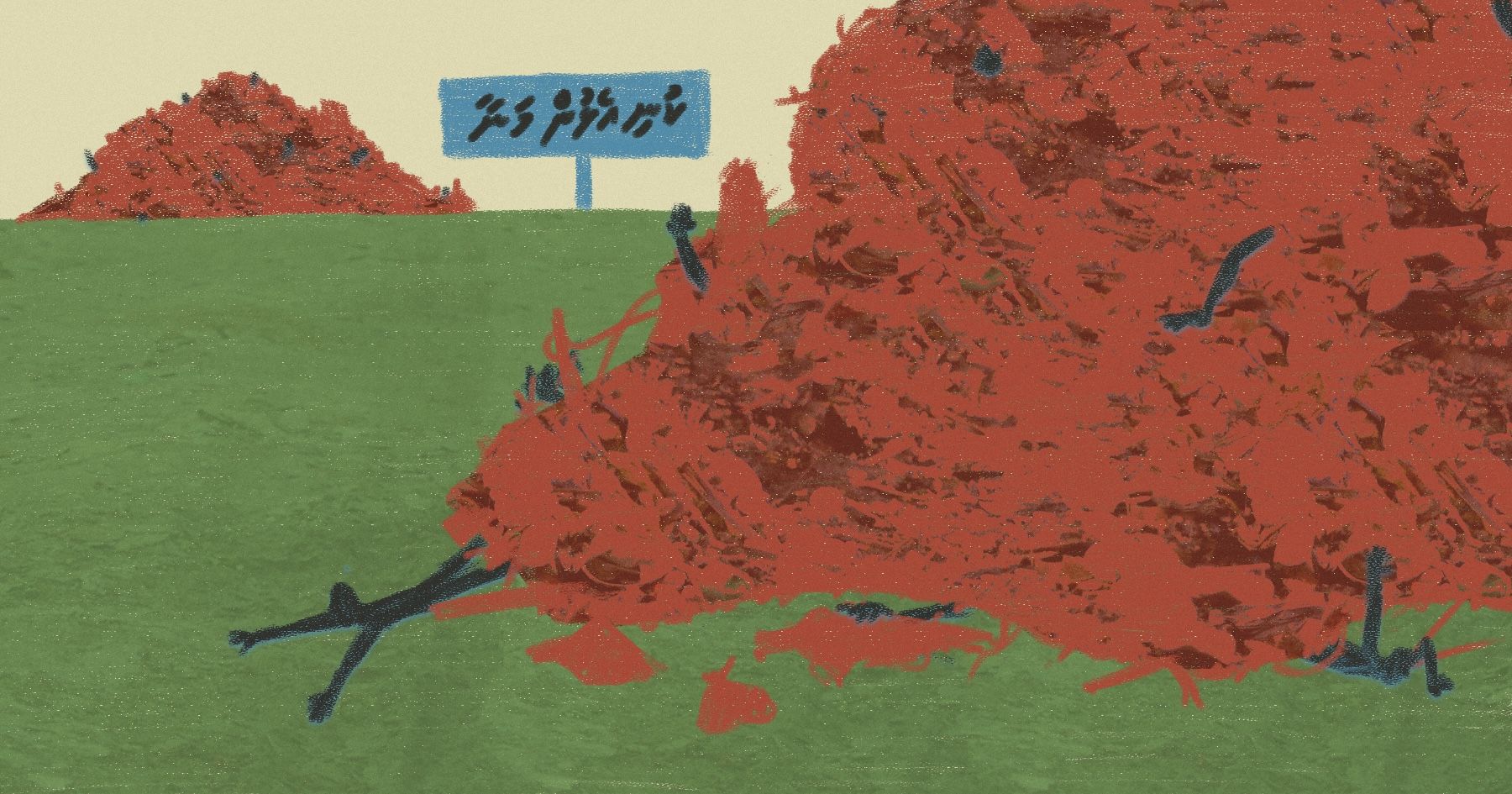
Thilafushi's trash mountain could give way. There's nowhere else to put it.
Ministry says the slope could slide. July's fire disrupted collection citywide.
Artwork: Dosain
05 Aug, 17:48
The mountain of trash in Thilafushi has grown so steep it could give way at any time, according to the environment ministry’s top waste management official. On the night of 19 July, it caught fire.
The fire at the Waste Management Corporation’s site took nearly 12 hours to control and disrupted operations at the Thilafushi base, leading to a buildup of bulk waste on the streets as MPs argued about where to send the ash.
Three days after the fire, WAMCO said it was forced to limit the amount of waste accepted at waste transfer stations in Malé, Villimalé and Hulhumalé, scaling back the collection of bulk and construction waste. Malé City Council members met with WAMCO officials to share complaints from residents about the accumulation of waste in public spaces, raising concern over a potential public health crisis.
Mujthaba Jaleel, WAMCO’s managing director, blamed the fire on unsegregated waste. On Sunday, WAMCO announced that all waste must be separated into three categories: bulk waste, construction and demolition (including sand, concrete, aggregate, bricks, hollow blocks and ceramics); and other C&D waste (such as PVC, wood, metal, plastic, electronics and cardboard). Landing crafts transporting waste must keep these categories separate. Vessels that are turned away from Thilafushi for failing to comply will be reported to the relevant authorities, WAMCO warned.
Normal operations at the three transfer stations resumed on Saturday, WAMCO said, along with its Call and Pickup Service and the collection of construction and demolition waste. The Housing Development Corporation had allocated WAMCO a plot of land to manage waste in Hulhumalé temporarily, Jaleel said.
50 tonnes
In the wake of the 19 July fire, WAMCO barely managed to collect organic household waste in the Greater Malé Region, according to Jaleel. He said over 50 tonnes of waste that had burned in the fire would be transferred to the northern waste transfer station in Kunburudhoo, an uninhabited island in Haa Dhaalu atoll.
The plan drew an immediate and furious pushback from MPs and council members from northern islands. Kulhudhuffushi Mayor Mohamed Athif called it “unacceptable” to use an island in the middle of the northern atoll as a dump site for the country’s waste after billions were spent reclaiming land near Malé. Haa Dhaalu Kurinbee council president Ali Wisam said his island – which lies 2.7km from Kunburudhoo – could not accept the smell, mosquito and flies from dumping waste in Kunburudhoo.
On Wednesday (29 June), opposition Maldivian Democratic Party MP Hussain Ziyad, who represents the Haa Dhaalu Vaikaradhoo constituency, submitted a motion without notice calling attention to WAMCO’s decision to transfer the burnt toxic waste to Kunburudhoo. Waste management facilities in Kunburudhoo have not been completed, he said, expressing concern over the potential irreversible harm to the public health, environment and natural ecosystems of the surrounding region that the toxic waste from Thilafushi could pose. The waste would have to be dumped on the ground since there was no concrete base, which would damage the soil, groundwater layer, greenery and marine environment of the island, the motion warned. Kunburudhoo is also home to a population of protected black turtles, it noted.
The ruling party’s supermajority defeated the motion with 27 opposing votes. MP Ziyad sharply criticised the decision later in the day, reprimanding ruling party lawmakers for refusing to accept the motion – which would have opened the floor to a debate – and asking why the waste was not being taken to a completed waste management facility in Raa Vandhoo.
"We’re taking a bunch of burnt, toxic waste in Thilafushi to the middle of Haa Dhaalu Atoll. Kunburudhoo is right in the middle of Haa Dhaalu – the second most populated atoll. Right next to Kunburudhoo is Kulhudhuffushi City, where the residents of Haa Alif, Haa Dhaalu, Shaviyani go to get healthcare. We are talking about planting a mountain of toxic waste right in front of that regional hospital," he said. "The next island is Kurinbee, even if the population is small, they are Maldivian people, too. Even now during the northeast monsoon they cannot barely stand the flies from the waste there. During the strong winds of southwest monsoon if you take the waste there, the people of Kulhudhuffushi, Nolhivaran, Nolhivaranfaru, Hanimaadhoo and Hirimaradhoo...to consider the people in these islands is what we asked.”
Ziyad was expelled from the parliament floor after he stood up and started protesting in front of the speaker’s well.
The controversy quickly drew national political figures into the fray.
“Now they are trying to dump the trash of this place [Malé area] in the islands of Maldives. They said they would take the trash to Thiladhunmathi. The islands of Maldives are not a landfill for our waste. These are places people live. It’s not a landfill. There’s no landfill in Thiladhunmathi. Each island must dispose of its own waste,” former President Mohamed Nasheed, the MDP’s chairperson, said at a gathering in Malé.
It is not clear whether the burnt waste was transferred to Kunburudhoo.
'Number one problem'
Briefing the press last month, Ahmed Murthala, the director general of waste management and pollution at the environment ministry, described waste management as the “number one environmental problem” facing the country.
“A number of years ago, the biggest issue facing our islands was beach erosion. It’s still an ongoing issue but the problem of waste has now overtaken that as the most urgent and biggest challenge,” he said.
The Maldives currently generates about 517,000 tonnes of waste annually, with waste production growing by nine per cent every year. A major factor in this volume is the tourism sector. Tourists generate about 3.5 kilos of waste per person daily, about three times the amount produced by locals. A Maldivian living in urban areas creates 1.2–1.4 kilos of waste per day, while a Maldivian living on other islands creates about 800 grams of waste per day.
To tackle these issues, the government is advancing a “holistic circular, green economy” strategy centred around formulating policy, enacting new legislation and laws as well as designating and developing regional areas for waste management. Three regional management facilities in Raa Vandhoo, Kaafu Thilafushi and Seenu Hithadhoo and four waste transfer stations in Haa Dhaalu Kunburudhoo, Dhaalu Hulhudheli, Gaaf Dhaalu Vaadhoo and an undisclosed island in Thaa Atoll. The completion of these facilities will bring a circular solution to the waste problem, Murthala said.
The waste management facility in Raa Vandhoo has now been completed and handed over to the service provider. Murthala said the facility includes dedicated infrastructure for managing hazardous waste. Further upgrades and additional works are currently underway.
In addition, the development of island-level waste management centres is currently underway across 129 islands through contracts awarded to state-owned enterprises and private companies. Progress thus far includes completed centres on 28 islands, equipment supplied to 82 islands, waste trucks delivered to 92 islands and mechanical composting machines successfully operating on six islands.
Murthala said the ongoing projects were contracted to be completed within a period of six months. But delays have occurred for various reasons, including supply chain issues, mid-project location changes requested by councils and the need to comply with strict protocols under the Public Finance Act and foreign funding frameworks, such as World Bank and ADB safeguard categories for environmental projects.
“We have to accept that reality. There are difficulties in getting materials because of what's happening in the world, so even if the agreement is for six months, it’s hard to say we can finish in the next month or so. But our aim is to finish the projects by July next year,” he said.
“The instruction from the president is that by July 2027 the construction of these places must be complete and the equipment needed for these facilities must also be provided.. We are talking about equipment that we have to import from abroad, but we have to finish this in 129 islands within one year.”
Significant milestones have been achieved in specific regional projects and regulatory tools, according to Murthala. The Single-Use Plastic (SUP) phase out plan has already helped reduce plastic bag imports by 25 per cent within a year, and a new regulation set to come into force in September will improve progress, he said.
“You will notice that banned plastic bags are still in the market. That is because when the plan came into force, there was no regulation to implement it, but when the regulation comes into force it will be solved as well,” he said.
“Not all plastic bags would be banned. Some bags would be allowed with a different thickness. We cannot ban everything. So we will make slight design changes because thinner bags are not recyclable. So we would change the thickness so that it would pave the way for recycling by those involved in recycling.”
He noted that single-use plastics involved in airline operations and in packaging of medical equipment would be exempt. The phase-out plan, initiated during the former administration, has been relatively successful despite initial pushback.
“You would recall that plastic supari [betel nuts] wrappers were very common back when we started this. Now you would not find plastic supari wrappers on the streets of Malé. Back then during the rainy season when the street drains got clogged we would see plastic supari wrappers floating on the water, but we don’t see that now,” he observed.
A new amendment to the Waste Management Act has since been submitted to parliament. The bill is currently at committee stage. Murthala said the changes will prevent double-charging of plastic bag fees by exempting the fee from bundles of 50 bags sold by wholesalers to retailers and allow transfer of waste between islands.
Responding to a question by a reporter, he acknowledged past mistakes in allowing waste facilities to fall into disrepair because of negligence and failing to use the facilities due to a lack of local capacity to operate state-of-the-art facilities.
The waste-to-energy gamble
Among the ongoing projects, the largest is a US$40 million project to build a Greater Malé Waste-to-Energy project in Thilafushi, with funding sourced from Asian Development Bank, Asian Infrastructure Investment Bank, Japan Fund for Joint Crediting Mechanism and the Maldives government.
The problem of Thilafushi – a man-made island west of Malé dubbed by international media as “trash island” – has been a long-term challenge. Murthala noted that the smoke emitted from the garbage mountain has been stopped following a targeted effort after years of complaints.
“Those complaints have stopped now, but now the complaint now is that...the trash mountain keeps growing. There’s no other space to dump the trash. So we are still putting trash there, compressing it and managing it with huge difficulty. The slope is very steep and it’s likely that it could slide off at any time,” he warned.
“Even now, trash is getting dropped into the lagoon from the vessels that try to dock near there. But the operator tries to manage it in real time. Sometimes even though they are not able to respond immediately because of problems with the vehicles there, they respond within 24 or 48 hours and return it to normal operation.”
Forty per cent of civil construction of the state-of-the-art facility has been completed and an incinerator has been taken to the site, he said. Once complete, the facility will be able to process 500 tonnes of waste per day and produce 13 megawatts of electricity, with 10 megawatts released back into the power grid.
Murthala said the government estimates the project would save 1–2 million litres of petrol annually and reduce annual carbon dioxide emissions by 40,000 metric tonnes.
Emissions from the incinerator will comply with international standards, he said. The fly ash will not include harmful chemicals released into the atmosphere, he assured. The bottom ash is to be treated and sold for construction.
A similar waste-to-energy centre in Hithadhoo of Addu City is estimated to process 50 tonnes of waste daily, producing 1.5 megawatts of electricity with one megawatt released back into the power grid. Even though this facility has now been completed and tested, an engineering landfill to store the bottom ash still needed to be built and is now being tendered, Murthala said.
'Burning the future'
The commitment of the government and foreign agencies to continue funding and investing in mega waste-to-energy projects has faced criticism from civil society groups.
A report released by Zero Waste Maldives in April called into question the waste-to-energy projects in Thilafushi, Vandhoo and Hithadhoo.
The facilities require large amounts of "high calorific value waste" such as plastics for them to be effective and efficient, which is fundamentally at odds with national policies such as the Single-Use-Plastic phase-out plan and Net Zero by 2030, the report argued.
The Thilafushi facility, for example, would require 500 tonnes of waste to be burnt daily for it to be effective. Thilafushi receives 800 tonnes of waste per day from Greater Malé and surrounding islands, but a majority of this is organic waste. Meanwhile, the existing waste in the Thilafushi is unsegregated. The report said it was difficult to ascertain how much was combustible.
“It’s like baking a cake. If you don't have the right ingredients it's not going to come out right. If you plan to cook with firewood, you’d need firewood. You can’t just throw in whatever,” Afrah Ismail, co-founder of Zero Waste, explained.
Authored in partnership with Global Alliance for Incinerator Alternatives, the report suggested that the incinerator's economics and the plastics phase-out pull against each other. Citing UN figures, it put plastic at about 43,134 tonnes a year, or around 12 per cent of the country's waste. About five per cent of that stream is single-use bottles and packaging: feedstock the phase-out is designed to remove.
It also warned that incineration would undercut household segregation as people are unlikely to sort waste they believe will be burned regardless.
The fly ash produced from the incineration is considered hazardous, according to the report, which noted the absence of air quality policies or standards in the Maldives.
The two claims address different stages. Murthala's assurance concerns what leaves the stack. The report's concern is the ash captured before it does and where it goes afterwards.
The report estimated incineration of 500 tonnes of waste to emit between 127,750–310,250 tonnes of carbon dioxide into the atmosphere every year. The US Environment Protection Agency has found emission rates from incinerators to be higher than the burning of coal.
While the report counts carbon dioxide leaving the stack, the government's estimate of a 40,000-tonne annual reduction appears to be a net one, offsetting emissions avoided elsewhere against those the plant produces.
"The on-the ground reality points to the impracticality and infeasability of WtE [waste-to-energy] incineration," the report concluded.
Discussion
No comments yet. Be the first to share your thoughts!
No comments yet. Be the first to join the conversation!
Join the Conversation
Sign in to share your thoughts under an alias and take part in the discussion. Independent journalism thrives on open, respectful debate — your voice matters.
Support Independent Journalism
Help us keep the news free and fearless
Give once
$
or
Become a memberfrom $5/month

