

Bleached reefs, scarce bait, broken seasons: Maldivian fishers on a changing ocean
As catches slump, a review finds fisheries rules yet to adapt.
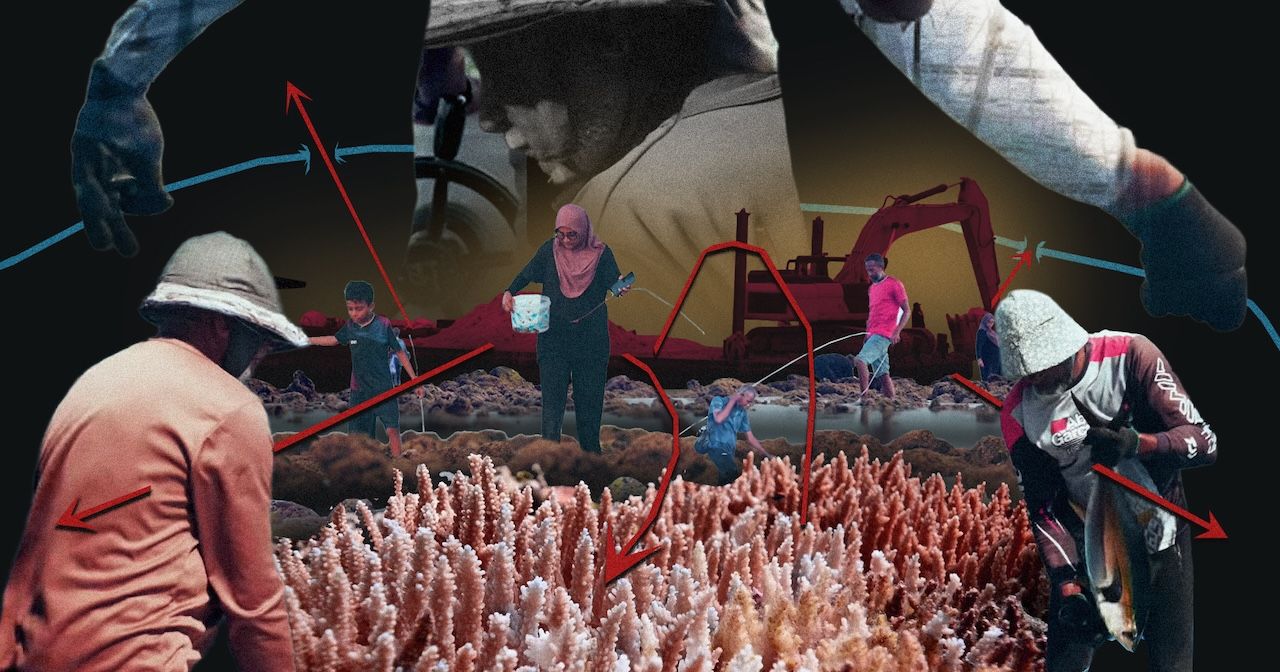
Artwork: Dosain
1 hour ago
Bait fish around a single rock could fill a whole dhoni, Abdul Hakeem Amir recalls in Roadhi, a documentary released this month by Maldives Resilient Reefs. "Now you could stop at 10 rocks and not have enough," he says.
The environmental NGO spoke to fishers and islanders from across the country about the changes they have witnessed: fishers forced to travel further for bait; flocks of seabirds that once led boats to tuna now all but gone; reefs teeming with marine life and resembling cultivated gardens with blue-tipped coral that are now discoloured, bleached and covered with algae.
"Who knows where they went," says Aishath Hassan, an elderly woman from Kulhudhuffushi, recalling the abundant grouper, eels, octopus and sea cucumbers in the lagoon. “My children saw something of the sea as it was. But my grandchildren and great grandchildren, not one of them would have seen it.”
The short film, directed by Nashath Mohamed, was screened in Malé on 1 October.
"With Roadhi we wanted to bring the voices, experiences and emotions of our fishing communities to the forefront. What struck us was how closely their lived experiences reflect what science has been warning us about for years," Shaha Hashim, executive director of MRR, told the Maldives Independent.
"These changes are no longer distant predictions. They are happening now, affecting the lives and livelihoods of our fishing communities."
The film comes amid an unexplained slump in fish catch. Fish exports in the first half of 2026 fell to 16,991 tonnes, the lowest since 2010. Purchases of skipjack tuna from fishing vessels was down 65 per cent compared with the same period last year. Possible explanations range from warmer seas and scarce bait to rising fuel costs and crew leaving for government jobs.
Nonetheless, fishing remains a key source of livelihood and Maldivians eat more tuna than almost anyone else in the world.
Bait
Roadhi was part of a Commonwealth Foundation-funded project by MRR and the UK-based Blue Marine Foundation, which have also published a review of the research on climate change and Maldivian fisheries and a legal review of fisheries law. Officials and experts consulted for the latter linked a collapse of fish catch in 2024 to El Niño and Indian Ocean Dipole conditions.
Warming and falling oxygen levels are expected to shift where tuna are found, both across the ocean and at depth, the literature review noted. Fishers would need more time, fuel and money to locate schools. Repeated coral bleaching is also reducing the complex reef habitat of reef fish and some baitfish.
The Maldivian pole-and-line tuna fishery is dependent on live bait sourced from shallow reefs and lagoons. Fishers in the film spoke of how boats from Huvadhoo and Addu now have to travel as far north as Baa and Lhaviyani atolls for bait, incurring an enormous cost. One recounted how bait fishing that once took half an hour at dawn now takes several hours, leaving little time for catch tuna.
The literature review noted reports from fishers of falling bait catches despite the use of lights, scuba gear and large nets, citing research including Shaha Hashim's. For some baitfish populations, fishing pressure and new technology, such as submerged night lights, may currently pose a greater threat than climate change.
Powerful lights used to attract bait – some now submerged – threaten the pole-and-line fishery, Samrath Hassan, the captain of a fishing boat, told the Maldives Independent in August.
But one fisher in the film pushed back. "Some people say bait is scarce because of the lights used to catch bait. But this lagoon has never been a place where we take bait with lights. We take it by freediving in daylight," said the fisher from Haa Dhaal Makunudhoo. Even in the inner atolls, where lights are used, "now they sink Euro lights deep and still struggle to get bait".
Fishers also blamed dredging and land reclamation for smothering bait grounds. One called it "destruction caused by our own hands".
"If the bait fishery goes, there will be no fishery at all," warned Ahmed Ali from Makunudhoo.
In Makunudhoo, the westernmost inhabited island of the Maldives, silver sprat have not come into the lagoon for a decade, said Suvaidha Adam. In 2018, there were 18 yellowfin tuna fishing boats in Makunudhoo, she said. With the decline of bait fishery, there are now only two left.
Changing seas
"Before, two of us would go out and let down two lines. And we caught more than we catch now," said Abdul Hakeem Amir from Kulhudhuffushi. "Now we wind line onto 100 bottles and set them out in one string. A hundred hooks. And still we catch less."
Emperors, snappers and cowries are rarer and sea cucumbers are hardly seen, others said. Fishers also spoke of how the water is now warm to a depth of 10 metres. In the recent past, only the top foot or two warmed and the lagoon cooled by sunset.
Maldivians are increasingly eating reef fish rather than tuna, the literature review found. Fishers have come to rely more on reef fish partly because bleaching reduced baitfish habitats. But heavier fishing of reef fish can accelerate reef decline, creating a "food security trap", it warned.
Winds meanwhile blow from the wrong direction for the season. "Before, each nakaiy began exactly on time," said Hamza Hassan from Kulhudhuffushi, referring to the traditional calendar of 27 periods, each named after a star or constellation, that fishers have long used to read the weather. "Right now we're in the rainiest days of the southwest monsoon. And yet here we sit in bright hot sun." The northeast current, which brings bait, no longer sets in when it should.
One yellowfin fisher said the northern fishery has been gone for eight years, leaving only the south. The film's closing narration cited research projecting that the maximum catch potential of Maldivian waters could fall by as much as 75 per cent. World Bank projections cited in the legal review suggest pelagic catches could fall by more than 90 per cent by 2081–2100 under a high-emissions scenario.
The law
The legal review, prepared by Dr Shaistha Mohamed, found that the Fisheries Act makes climate change adaptation and mitigation a responsibility of the fisheries ministry, but most regulations and plans do not translate that mandate into specific requirements. Climate change "is still treated more as context than as a formal driver of fisheries decisions”, it concluded.
Management plans are not required to consider climate projections or indicators such as sea surface temperature or bleaching alerts. They are reviewed on fixed cycles, usually three to five years, with no climate-linked trigger for an earlier review. Seagrass is not recognised as fish nursery habitat in fisheries law, and there is no framework for protecting "climate refugia", areas likely to fare better as the ocean warms.
The live bait fishery has no specific management plan, the review noted. There are no climate-triggered safety nets or insurance for fishers who lose their catch and plans to cut emissions from fishing and processing are not reflected in fisheries law or licensing.
Officials and experts consulted for the review in November and December 2025 – from the fisheries ministry, the environment ministry's protected areas department, the climate envoy's office and a fisheries researcher – conceded uneven implementation. Advisory committees required under the management plans are not active, enforcement is limited, and fisheries and vessel-tracking data are under-analysed. Fisheries and environment authorities have overlapping mandates over protected areas, bait fishing grounds and coastal development. Shortages of staff and money were "repeatedly cited".
Rather than new institutions, the review recommended working through existing ones. Management plans should assess climate risk and be reviewed early when catch rates, fish sizes or habitat condition pass agreed thresholds and advisory committees should be given an explicit climate remit. It also recommended recognising reefs, seagrass and mangroves as "climate-critical" fisheries habitats and linking the fishermen's registry to social protection that can be triggered by severe catch failures.
"We have a relatively well-developed legal and policy framework, yet we continue to fall short when it comes to investing in resilience and taking meaningful action on the ground," said Shaha Hashim, MRR’s executive director.
"We cannot afford to keep destroying the very ecosystems that sustain us while talking about adapting to climate change."
Discussion
No comments yet. Be the first to share your thoughts!
No comments yet. Be the first to join the conversation!
Join the Conversation
Sign in to share your thoughts under an alias and take part in the discussion. Independent journalism thrives on open, respectful debate — your voice matters.
Support Independent Journalism
Help us keep the news free and fearless
Give once
$
or
Become a memberfrom $5/month