
Dredgers and debt: the airport company’s Rasmalé bill
Audited accounts reveal reclamation spending, mounting debt and dwindling cash.
Artwork: Dosain
13 minutes ago
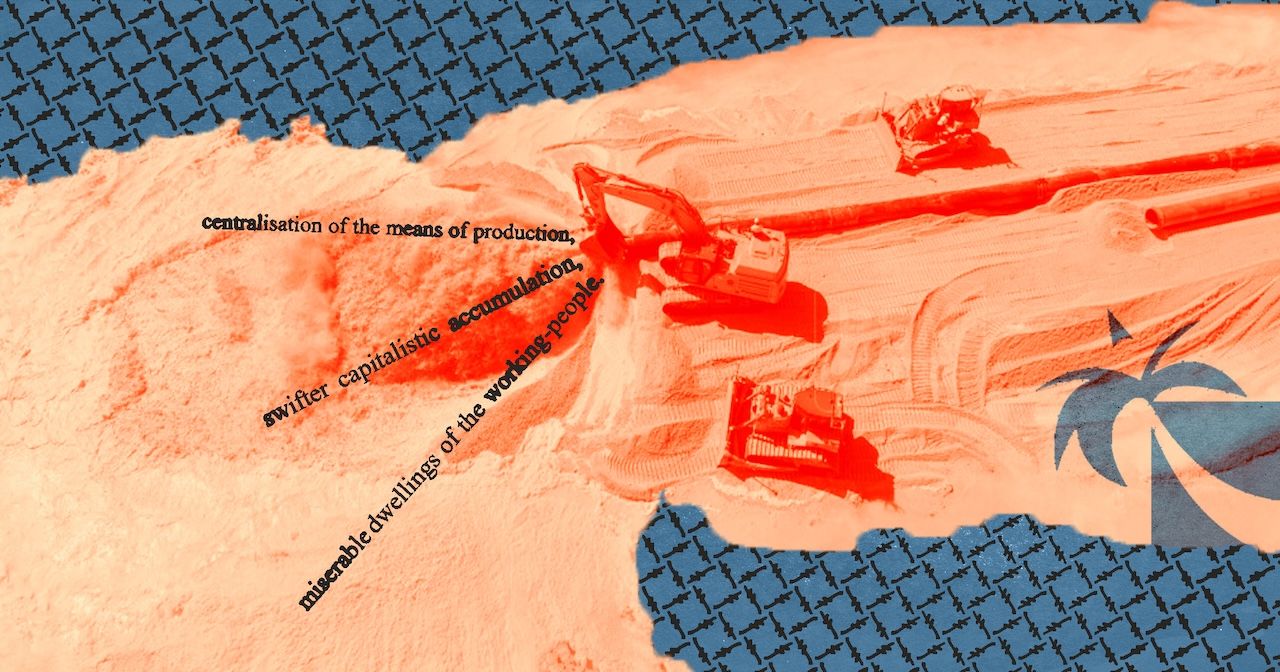
In November last year, one of the world’s largest dredgers arrived in the Maldives to reclaim land for Rasmalé. The Cristóbal Colón operated by Belgium’s Jan De Nul would “triple up the speed of creation of land for the 100% net zero carbon, smart eco-city”, President Dr Mohamed Muizzu announced.
The trailing suction hopper dredger was chartered by an unlikely client: the state-owned operator of Velana International Airport and one of the most profitable state-owned enterprises.
How much the Maldives Airports Company Ltd (MACL) has paid for reclamation has been an open question since then. The company’s audited accounts for 2025, released by the Auditor General’s Office last week, gave the first answer: MVR435.3 million (US$28.2 million) in 2025.
The money, including advance payments, was spent through Peninsula Infrastructure, a subsidiary set up in October for “government-directed reclamation and infrastructure projects”. The figure only covers the first months after the airport operator took over the project. Spending in 2026 will appear in next year’s accounts. The 2025 accounts show how much reclamation the government placed on MACL outside the state budget and the impact on the company’s finances.
Rasmalé, the Muizzu administration’s flagship project, was launched in December 2023 shortly after the change of government. In January 2024, Infrastructure Minister Dr Abdulla Muththalib said three contractors would spend US$700 million to reclaim 1,153 hectares in the Fushidhiggaru lagoon south of Malé in exchange for 70 hectares of land. President Muizzu said the reclamation would be done in eight months without any expenditure from the state budget.
But the state-owned Housing Development Corporation, which enlisted the three contractors, terminated its agreement with Sri Lanka’s Capital Marine and Civil Construction in May 2024. In July 2025, with less than 30 per cent of the lagoon reclaimed, the President’s Office instructed the finance ministry to pay the contractors from the state’s foreign currency reserves, Adhadhu reported. The letter also outlined plans to obtain US$600 million worth of loans through three state-owned enterprises.
How much Rasmalé cost to reclaim has become central to the row over the deal with Abu Dhabi’s Eagle Hills to develop 500 hectares of the artificial island. Muththalib says it was less than US$500 million. Opposition figures have put the price tag at US$800 million.
The accounts
MACL's business operations generated MVR2.05 billion in cash last year, but it spent MVR5.5 billion on projects, including the airport’s expansion and reclamation. It plugged most of the gap with MVR3.5 billion in new loans. Even if all its operating cash went to repaying debt, clearing its borrowings would take about eight years, Adhadhu calculated in its analysis of the accounts.
Cash fell by almost half to MVR493 million, enough to cover about 27 days of running costs as Adhadhu estimated. Its dollar cash fell to US$13.5 million from US$29.1 million. The company’s dollar debt exceeds US$1 billion. For every MVR100 it owed within a year, it held MVR45 in cash and other short-term assets. By the end of the year, its current liabilities exceeded its current assets by MVR4.86 billion, up from MVR 1.33 billion. That includes MVR1.43 billion MACL’s second new subsidiary, Marine and Integrated Infrastructure Development (MIID), owes for CMC’s work.
MACL paid MVR252 million in interest during the year. A further MVR387 million was added to the interest it had yet to pay, which more than doubled to MVR693 million. What it owed the State Trading Organisation tripled to MVR418 million. STO supplies both the jet fuel MACL sells to airlines and fuel for the dredgers.
The strain has carried into this year. In February, MACL borrowed US$40 million from Sri Lankan banks to repay debt taken on for the new terminal.
In 2025, MACL spent MVR1.05 billion on reclamation and related works through Peninsula Infrastructure, including MVR262.4 million at Haa Alifu Dhidhdhoo andMVR 248.2 million at Thaa Vilufushi, both for airport projects. It also paid for environmental assessments and bund walls at five more sites.
Under 2023 deals with HDC and the Maldives Fund Management Corporation, contractor Capital Marine and Civil Construction (CMC) was to be paid in land for reclaiming Hulhumalé Phase 3, Thilafushi and Giraavaru Falhu. Through deeds of novation, the first of which was signed on 7 October 2025, MIID took CMC’s place and its claim to the land. It kept CMC on as a subcontractor, paid in cash.
MIID agreed to pay CMC MVR1.76 billion (US$114 million) for the work it had already done. In 2025, MIID paid CMC MVR 447.4 million, the same amount MACL had put into the company. It owes a further MVR1.43 billion this year. The Giraavaru lagoon west of Malé, for which the treasury lent MACL MVR650.7 million this year, is one of the three projects.
The land MIID is to receive in return has not been identified. Its accounts say the location, extent and characteristics of the land “have not yet been finalized”. According to its financial statement, the MACL subsidiary did not have any cash at the end of 2025 nor did it expect any from its operations for at least a year. It relies on MACL for funding.
It is unclear how MACL will recover the money. The spending is recorded as work in progress, an asset expected to bring future returns. But half of Rasmalé is designated for Eagle Hills, with 10 per cent of revenue from property sales going to the state, and the government says the rest is for Maldivian families.
MACL also wrote off its entire MVR11.4 million investment in Peninsula Investment because it had no source of revenue. It also owns 12 per cent of the Maldives Industrial Development Free Zone, which it bought for MVR185 million in 2024. That appears to be the joint venture the President’s Office letter named as the company paying Rasmalé’s contractors. The accounts describe its mandate as setting up free trade zones.
Management concluded that MACL remained a going concern, citing its cash flows and the government’s role as its owner and main lender. But it said the conclusion required “significant judgement”, including on “the continued availability of financial support” from its shareholder, the government. The auditor general gave the accounts a clean opinion.
The main opposition Maldivian Democratic Party says reclamation is draining scarce foreign currency. In July, MDP parliamentary group leader Ibrahim Nazil alleged that the government was paying US$200,000 a day for each dredger at Rasmalé. "They are taking money from the state treasury, turning it into sand and dumping it into the sea until it is all gone," he said.
MACL and the finance ministry did not respond to questions sent on Sunday.
Discussion
No comments yet. Be the first to share your thoughts!
No comments yet. Be the first to join the conversation!
Join the Conversation
Sign in to share your thoughts under an alias and take part in the discussion. Independent journalism thrives on open, respectful debate — your voice matters.
Support Independent Journalism
Help us keep the news free and fearless
Give once
$
or
Become a memberfrom $5/month