

Back to the drawing board: why is the government re-zoning protected sites?
Conservationists concerned over spate of boundary changes.
30 Jun, 18:00
The government amended the boundaries of six environmentally protected areas in just three weeks, representing six percent of all such sites in the Maldives, just before the introduction of regulatory safeguards to prevent further unilateral changes.
These alterations – gazetted in April and May – included a site in Dhaalu Atoll, listed in the UNEP’s World Database for Protected Areas (WDPA), that has been moved aside to make way for an integrated tourist resort.
The redrawing of the maps continues a trend observed last year when Rasfari, one of the few untouched lagoons in Malé Atoll and considered its most ecologically valuable, had its boundary trimmed as dredgers started reclaiming the adjacent lagoon for resort development.
The Environmental Regulatory Authority (ERA) says some of the changes were initiated by the former government, and stressed that the new rules would make it harder for any administration to redraw boundaries.
But conservationists argue short-term political incentives and a lack of will among policymakers is getting in the way of meaningful protection, expressing concern that the new regulations could become a “box-ticking exercise” that legitimises more changes.
The Maldives has over 93 areas designated as environmentally protected, though all but six are considered ‘paper parks’, meaning they are protected in name but not actively managed.
Redrawn maps
The environment ministry gazetted changes to six areas between April 27 and May 18: Dhaalu Fushi Kandu, Vaavu Vattaru, Vaavu Miyaru Kandu, Laamu Maabaidhoo Koaru, Kaafu Huraa Kandoofaa and Addu Nature Park.
Several of these areas did not previously have precise official boundaries as their protected designations, first given in 1995 or 1999, included only a single coordinate to mark the area. However, specific boundaries were listed in the protected areas handbook in 2024 and submitted to the WDPA.
The most concerning among the recent changes were those made to the Addu Nature Park and Dhaalu Fushi Kandu, due to their close association with political and economic interests.
The redrawing of the Addu Nature Park – a UNESCO biosphere reserve and one of only six managed protected areas in the Maldives – received criticism from conservation groups. It is widely believed the borders were redrawn to fast-track a road project to garner support for a ruling party candidate in the parliamentary by-election.
Dhaalu Fushi Kandu's boundary changes appear equally blatant. The previous boundary included the Fushi Kandu channel and a lagoon to the south-west. However, the new boundary has been redrawn to remove this lagoon completely.
According to the new developments on the tourism ministry website, four plots within the lagoon, totalling 120.1 hectares, have been leased to a company called Yash Exotic Island Private Limited to develop an integrated tourist resort.
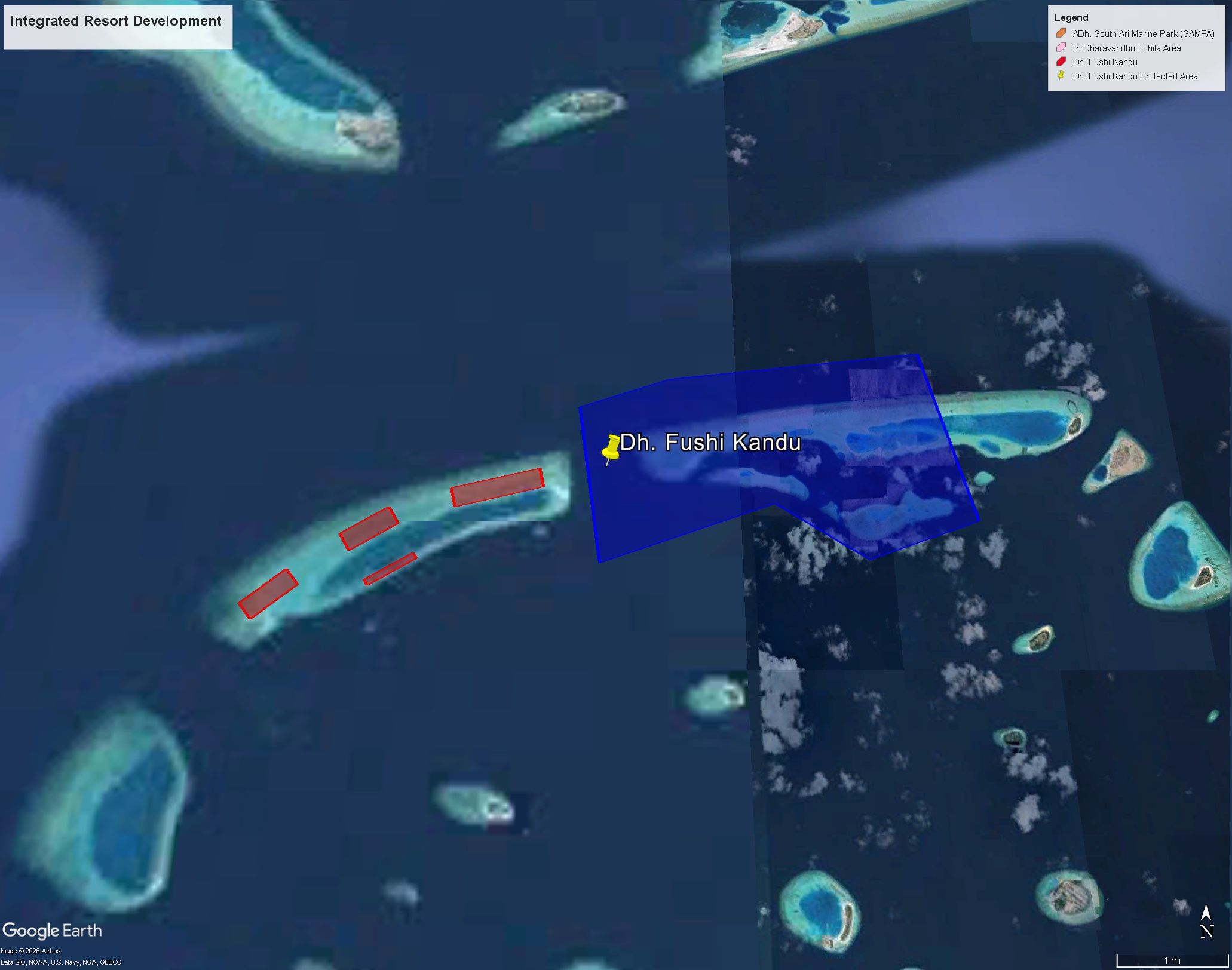

 Interactive Image - Slide to compare
Among the changes, those affecting the Vaavu Vattaru and Vaavu Miyaru Kandu areas appear minimal – a formalisation of the boundaries previously only included in the PA handbook.
Hassaan Mohamed, chief executive of the ERA, said changes made to the two wetland areas – Laamu Maabaidhoo Koaru and Huraa Kandoofaa – were initiated during the former administration despite being gazetted last month. Maabaidhoo Koaru was amended because the island council wanted to build a city hotel, while the Huraa Mangrove area was redrawn to make way for a boatyard, he said.
New rules
Following the changes, the environment ministry gazetted a second amendment to the Protected Area Regulation, introducing stricter requirements for the alteration of existing boundaries.
Under the amended regulations, announced on June 14, the environment ministry or the ERA will have the power to change the boundary of a protected area, reclassify their protection category or make changes to permitted activities.
The regulation requires the ministry or ERA to conduct an ecological survey of the area and undertake consultations before any change can be made. Alterations to a protected area must not reduce the total size by more than 50 percent, say the rules. If any area's size is reduced, an area of equal size, or 75 percent of the area being reduced, must be designated.
Conservationists welcomed these tougher rules, attributing them to the work of technical staff within the ministry. But Maeed Zahir, advocacy director of EcoCare Maldives, said re-zoning was being driven by the short- or medium-term goals of policymakers.
“Even if the new regulations introduce safeguards, what we see even during an EIA process is that the ecological and economic values of an ecosystem are not counted and stakeholder voices are not adequately considered,” said Maeed.
Shaha Hashim, the executive director of the charity Maldives Resilient Reefs, echoed these remarks. “If protection can be adjusted to fulfil short-term political agendas, its purpose and power to safeguard our most important ecosystems is severely weakened,” she said.
“The lack of transparent, publicly available justification for these boundary changes undermines public confidence in the very idea of protection,” Shaha added, expressing concern that theoretical requirements for consultation and assessments could be used to facilitate future changes.
“In practice, we are worried that it formalises an easier legal pathway to shrink or alter protected areas, especially if the process is treated as a box-ticking exercise rather than a genuine safeguard.”
She argued that one area cannot be swapped for another of equal significance as easily as specified in the regulation. “This is not how reefs and ecosystems work. It often takes many years of scientific work and advocacy to secure legal protection for a site, but only days or weeks of development to permanently destroy it.”
The new rules introduce several additional changes, including detailed provisions which regulate entry, videography and research activities. They also specify the minimum requirements for management plans, including carrying capacity and limits of acceptable change needed to preserve ecological characteristics.
Discussion
No comments yet. Be the first to share your thoughts!
No comments yet. Be the first to join the conversation!
Join the Conversation
Sign in to share your thoughts under an alias and take part in the discussion. Independent journalism thrives on open, respectful debate — your voice matters.
Support Independent Journalism
Help us keep the news free and fearless
Give once
$
or
Become a memberfrom $5/month