
After the sukuk: the 2027 budget in numbers

Foreign repayments ease, but more borrowing now comes from home.

Artwork: Dosain

Artwork: Dosain

1 hour ago
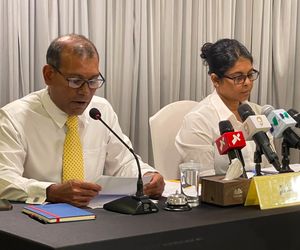
Finance Minister Hassan Zareer told parliament on Thursday that keeping spending within the approved budget was among the government’s “most notable achievements” this year. 
The 2027 budget documents show the trade-off that was required. The government expects to spend MVR2.7 billion (US$175 million) more on fuel subsidies and MVR1.8 billion less on infrastructure projects in 2026. Subsidies reached MVR4.3 billion by 22 October, 149 per cent of the amount allocated for the full year. Spending on public sector investment projects stood at MVR5.1 billion, 23 per cent lower than the same period last year. 
According to the World Bank's biannual development update, similar cuts to capital spending in 2025 had been made "on a cash basis and a decline in commitments has not been reported, which may have led to an increase in expenditure arrears."
With the dreaded US$500 million sukuk out of the way, Zareer presented a budget of MVR59.7 billion for 2027, MVR4.5 billion smaller than this year. But proposed spending is 6.6 per cent higher at MVR52.6 billion. Capital expenditure is up 45 per cent from this year’s reduced level. The deficit is wider at MVR9.4 billion or 7.3 per cent of GDP, well above the 5.5 per cent forecast a year ago. 
“This year, 2026, is a historic year in the Maldives' financial history, in which a record sum was spent from the state budget to free the people from the heavy burden of debt they had to carry,” Zareer said.
Including the sukuk, principal repayments on debt would reach MVR11.7 billion by the end of 2026. The figure is expected to fall to MVR4.5 billion next year. But interest payments will be up 11 per cent to MVR5 billion. 
Recurrent expenditure is expected to remain largely unchanged at MVR42.7 billion (up 0.4 per cent). Capital expenditure would rise to MVR9.9 billion, of which MVR8.2 billion is under the Public Sector Investment Programme. The government’s aim is to complete 70 per cent of ongoing projects by the end of next year, Zareer told parliament. 
Here are the key numbers from the 2027 budget.

Budget at a glance

New projects and initiatives

Tax and revenue

No tax rises; revenue to come from better compliance and closing loopholes

An expanded Maldives Guest Information System and a new e-invoicing system

The customs service's fiscal role to be transferred to the finance ministry

The GST registration threshold to rise from MVR1 million to MVR1.5 million in annual turnover from 1 January

Tourism

2027 named Visit Maldives Year with a target of 2.5 million arrivals

A picnic island in every atoll

Infrastructure and transport

The commercial harbour relocated to Thilafushi, due to open before 11 November 2027, with capacity rising from 80,000 to 390,000 containers a year

The Thilamalé Bridge to be finished and in use by the end of 2027

Road and infrastructure projects in Addu City

The Greater Malé Transport and Mobility Plan and an AI-based traffic enforcement system

Maldives Waterfront and Marina, described as a step towards developed country status by 2040

Fisheries, farming and business

11,400 tonnes of new cold storage and 550 tonnes a day of extra ice production

Mariculture expansion and a yellowfin tuna packing facility in Hulhumalé

Import controls on produce that grows locally, to protect farmers' prices

The Addu SME Trade Facilitation Zone and a start-up fund for young entrepreneurs

Housing

MVR3 billion for housing projects

MVR750 million in equity for a home-loan scheme for first-time buyers and people building homes

Water and sewerage on vacant island land

Energy and environment

A 250-megawatt solar and storage project, built as a public-private partnership, to cut oil imports by more than 100 million litres a year

The president's pledge of 33 per cent renewable energy by 2028

The Climate Adaptation Model Island Project and an expanded five-million-trees programme

Health and education

MVR10.2 billion for health, including a new Maldives Tertiary Hospitals Group

Central procurement of medical supplies and more regional services from MRI and CT scans to maternity care

MVR136.3 million for free degrees and more than MVR651 million for higher education loans

New classrooms, halls and laboratories, and more inclusive schooling

Social and other

Accessibility works and jobs for people with disabilities

Gender budget tagging from 2027

Drug rehabilitation centres in three more regions

Fitness centres in every region and outdoor gyms on every island

An expanded National Service programme

A grand mosque in Hulhumalé for 10,000 worshippers

Digital ID cards, a national sovereign cloud data centre and the Maldives 2.0 digital government programme

The Ihthiraam (respect) national project

More police staff in regional centres

Where the money goes

Just over MVR1 billion was earmarked in the 2026 budget for fuel subsidies. After the US and Israel war on Iran drove up oil prices, that figure is now estimated at MVR3.75 billion. The allocation for next year’s budget is MVR3.2 billion.
The Middle East conflict was "the third major shock to hit the Maldives' finances in the past decade or so," Zareer said. "Daily life for Maldivians has not been disrupted and businesses carry on because the government has softened the impact of rising oil prices," he said.
"In particular, fuel subsidies have protected workers in the fishery sector, which has the highest share of poor workers in the country," the World Bank observed.
Salaries and pension contributions amount to MVR17 billion. By function, the largest allocation is for healthcare with MVR10.2 billion, followed by economic affairs at MVR8.6 billion, education at MVR6.1 billion and housing and community amenities at MVR2.4 billion.

Where the money comes from

Of MVR43.2 billion projected as revenue and grants, MVR33.6 billion is expected from taxes.  

How the gap is filled

The total financing needed to plug the deficit and repay debt is MVR18.9 billion, down from MVR24.7 billion this year. The government plans to raise about MVR7 billion from foreign sources, including MVR2.4 billion in project loans, MVR1.9 billion in budget support and MVR2.7 billion (US$175 million) from an international bond or sukuk. It will rely on domestic sources for the remaining MVR12 billion, which includes MVR8.7 billion worth of government securities to be issued at home.   
"The main aim of all this work is to bring the overall deficit down to 5 per cent of GDP by the end of 2028," Zareer said.
According to Moody’s, US$428 million will be needed to service debt in 2027, down significantly from US$1.9 billion this year. But “large domestic refinancing requirements will sustain elevated liquidity risk,” the ratings agency said. 
"A larger or more persistent fiscal deficit than we currently expect would also increase already substantial borrowing needs, while high government debt and large domestic refinancing requirements will continue to expose the sovereign to liquidity risks," it warned.
"Despite a fiscal consolidation in 2025, due to liquidity challenges, and recent announcements to cut costs, the baseline projections do not assume a major expenditure reduction over 2026–28," the World Bank observed. "As a result, the fiscal deficit is projected at 10.9 percent of GDP in 2026, driven by weaker tourism revenues and higher subsidies, and to remain elevated at around 9.6 percent of GDP in 2027–28."

The debt path

Public debt, including government guarantees on debt incurred by state-owned enterprises, is projected to reach MVR161.3 billion by the end of 2027, representing 124.5 per cent of GDP. That is down from 128.8 per cent of GDP this year. The budget forecasts guaranteed debt to fall from MVR17.6 billion to MVR9.8 billion. 
"Direct government debt is projected at 117 per cent of GDP in 2027. While it is expected to fall to 116.3 per cent in 2028, the budget also sets a target of bringing debt down to 107.9 per cent by 2029," Zareer said.
But the World Bank projects public debt to reach 140.5 per cent of GDP over the medium term, "reaching 140.5 percent in 2027 and 143.2 percent in 2028 in the absence of major fiscal consolidation."
"Overall, banks, other financial corporations, and MMA remain heavily exposed to the sovereign with exposures accounting for 40, 66, and 42 percent of their total assets, respectively, as at end-2025. This warrants close monitoring due to the high risk of public debt distress in Maldives, further exacerbated by the conflict in the Middle East."
Moody’s expects debt to “remain above 100% of GDP over the next few years”.  
Moody's, which upgraded the Maldives’ credit rating to Caa1 from Caa2 with a stable outlook earlier this month, said it reflected "a material reduction in the government's near-term default risk following the repayment and refinancing of significant external obligations, supported by stronger foreign exchange buffers, Sovereign Development Fund savings and continued bilateral financing."
The agency said it would consider downgrading the rating "if default risk increases because of weaker financing access, declining foreign-currency buffers, or reduced effectiveness of foreign-exchange reforms."

Discussion

No comments yet. Be the first to share your thoughts!

No comments yet. Be the first to join the conversation!

Join the Conversation

Sign in to share your thoughts under an alias and take part in the discussion. Independent journalism thrives on open, respectful debate — your voice matters.

Support Independent Journalism

Help us keep the news free and fearless

Give once
or
Become a memberfrom $5/month

Explore more