Too late to lament: Solih's botched police reform
Farhad Fikury is back because Solih's government let him stay.
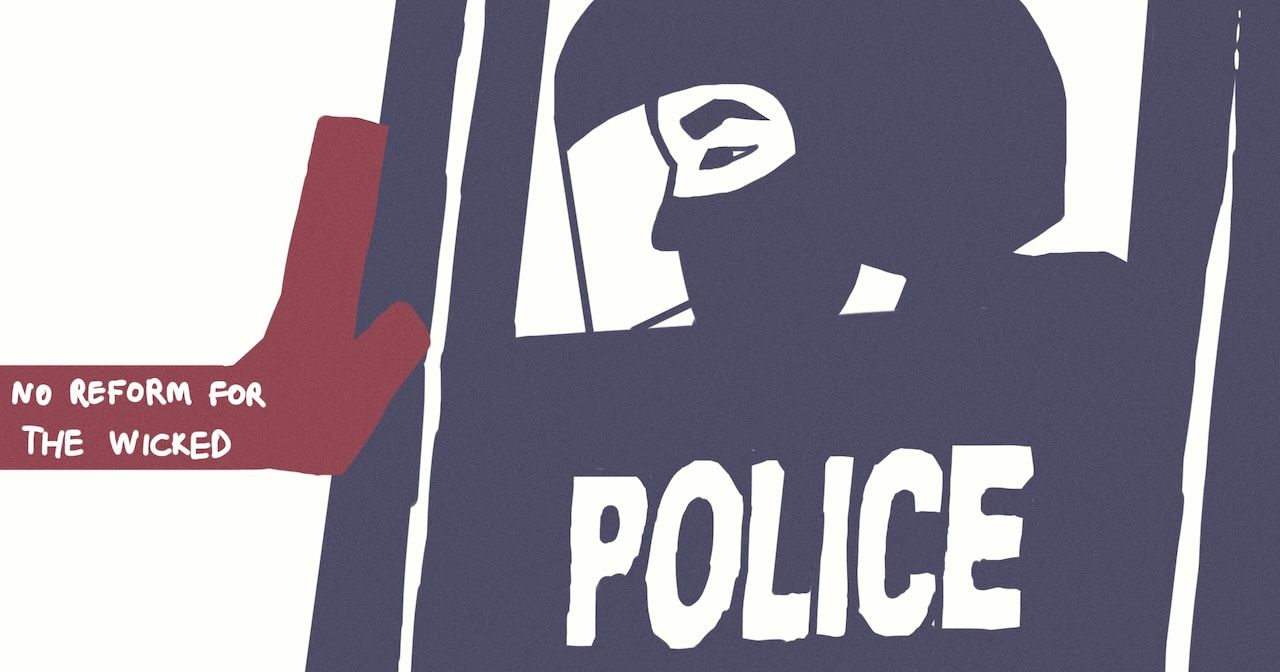
Artwork: Dosain
16 Mar, 13:58
Former Police Commissioner Mohamed Hameed says the Maldives Police Service is in crisis. He's right. But the crisis didn't begin with this administration. It was cemented under the one that appointed him.
Hameed has led the chorus of disappointment. I share the sentiment. Yet there is a certain irony in hearing such lamentations from President Ibrahim Mohamed Solih's police commissioner, who also happens to be Solih's brother-in-law (husband of his wife's sister). Solih, Hameed, and their administration effectively squandered the very opportunity to reform the police they had pledged during the 2018 presidential election.
Police reform has once again come into sharp focus following the retirement of Police Commissioner Ismail Naveen after 32 years of service.
He has now been replaced by Farhad Fikury, the same officer whose appointment as Acting Police Commissioner in April 2025 had been rescinded within an hour following public backlash.
At the time, Commissioner Ali Shujau had been forced to resign after four consecutive nights of Gen Z-led protests over alleged police negligence and a cover-up surrounding the unexplained fall of a young woman. Farhad Fikury was initially named as his temporary replacement, but the appointment was quickly withdrawn amid accusations that he had destroyed evidence in a 2014 rape case.
Later in October 2025, Farhad Fikury was accused of interfering in a police investigation after his son was arrested in a state of intoxication for allegedly assaulting a police officer.
Now, despite that earlier public rejection, the post has once again been handed to him.
The police institution increasingly resembles a revolving door of the same individuals, cycling through allegations, failed investigations, aborted removals, and eventual reappointments. Officers facing serious accusations seem to persist within the system while meaningful police reform remains perpetually out of reach.
To understand how things got this bad, it is necessary to revisit the long and troubled story of failed police reform.
New Police Act
Since the events of February 7, 2012, when a police mutiny brought an end to the presidency of Mohamed Nasheed, reform of the police institution has been a central pledge of the Maldivian Democratic Party.
To address this, a new police law was conceived and eventually passed in December 2020 as the Police Service Act. It came into force in March 2021.
Under the new law, a Police Board was created to advise the administration. However, whether or not to accept the board's advice remained entirely within the discretion of the home minister.
In a closed meeting of the Majlis 241 Committee in September 2022, Home Minister Sheikh Imran Abdulla himself described the Police Board as ineffective. Ironically, three of its seven members had been directly appointed on the minister's own advice.
In the same meeting, Imran said he personally wished to chair the board's meetings. He also revealed that many of the board's recommendations had not been accepted by the ministry and the Attorney General's Office and therefore had not been implemented.
The extent to which the very government that created the Police Board refused to empower it became clear in other ways as well. Even two to three years after its establishment, the board still did not have a website or even an email address. Although the public was supposedly able to bring complaints about the police to the board, there was no actual procedure or mechanism for doing so.
As things stand, complaints against the police still have to be submitted to the Professional Standards Command within the police itself.
The promises MDP made about police reform, the legal changes introduced, President Solih's public commitments, and the attitude of his own home minister were all fundamentally at odds with each other.
Officers recommended for dismissal
Placing the blame for failed police reform solely on Solih's administration would be unfair. The courts also played their part.
The Police Act required that once the law came into force, all senior police officers facing allegations of unlawful use of force, inhumane conduct, or corruption be reviewed by the Police Board.
Following that review, on August 9, 2021, the board recommended the dismissal of seven officers: Superintendent Mohamed Dawood, Assistant Commissioner Farhad Fikury, Chief Superintendent Ahmed Shuhad, Assistant Commissioner Mohamed Jamsheed, Assistant Commissioner Ahmed Mohamed, Superintendent Ismail Shameem, and Chief Superintendent Abdulla Shareef.
Shuhaad and Dawood had also been suspended in connection with the MMPRC corruption scandal.
In the end, Commissioner Mohamed Hameed moved only to dismiss Assistant Commissioner Mohamed Jamsheed and Assistant Commissioner Ahmed Mohamed, also known as 'TwoFour.'
Those two officers, along with Ismail Shameem Adam, Abdulla Shareef, and Mohamed Davood, challenged the decision in the Civil Court, arguing that they had been removed without being given an opportunity to respond.
On December 21, 2022, the Civil Court ruled that Mohamed Jamsheed, Ahmed Mohamed, Abdulla Shareef, Ismail Shameem, and Mohamed Davood could not be dismissed. The court held that the board could assess competence but did not have the authority to remove officers.
The police appealed the decision at the High Court and sought an injunction suspending the Civil Court ruling, which the High Court granted.
However, in a sudden turn of events triggered by the current administration's decision to award promotions to Abdulla Shareef and Mohamed Dawood, the High Court later dismissed the state's appeal against the Civil Court ruling, citing discrimination.
In effect, this was the current administration's way of ensuring that the appeals process came to an end and that senior police officers who now owe their positions to President Dr Mohamed Muizzu remained in place.
The result is that any attempt to review or discipline senior officers accused of wrongdoing has effectively come to a standstill.
However, while admitting that the legal framework created under Solih's administration "allowed significant influence over the Board's composition," former police chief Mohamed Hameed criticised the current administration for leaning toward abolishing the board.
He pointed to the Canadian model, where Police Services Boards composed of civilian members appointed by municipal and provincial authorities oversee policing. These boards hire police chiefs through open merit-based competitions, set strategic priorities, and evaluate performance. The police chief reports to the board rather than directly to a minister.
None of this was implemented during Solih's administration or during Hameed's tenure as commissioner.
Instead of reform, things got worse
While Solih's administration failed to remove problematic elements within the police, it simultaneously granted the institution greater powers without establishing meaningful mechanisms of accountability.
The 2020 law expanded police authority under provisions dealing with special investigative techniques. Officers were given wider powers to conduct surveillance, inspect messages and emails, and create fake accounts to interact with individuals during investigations.
Combined with the Prevention of Terrorism Act passed in 2019 and amendments introduced in 2021, the police institution today possesses some of the broadest powers in Maldivian history while remaining among the least accountable.
Instead of using the opportunity to reform the police service, Solih's government effectively expanded its power and discretion.
In early 2023 public concern grew over the investigation into the death of Abdulla Rasheed, who died on the deck of a launch in Gaaf Dhaal Hoadedhdhoo lagoon after failing to receive medical treatment while in police custody. The family complained that the post-mortem report had not been shared with them. The home minister later insisted there had been no negligence by police.
Around the same period, on February 26, 2023, tasers were issued to the police.
The depth of negligence
The Death Commission report established that police resources had been used to surveil journalist Ahmed Rilwan before his enforced disappearance in August 2014.
In the case involving the attack on foreign tourists in Hulhumalé on 4 February 2020 by individuals holding extremist views, the Prosecutor General later said the eight suspects were released during court proceedings because police investigators had failed to gather sufficient evidence.
In June 2022, a yoga event at Galolhu Stadium was disrupted when roughly twenty individuals broke through police lines, entered the grounds, intimidated participants, and forced the event to stop.
In September 2022, Mohamed Azuhan, who had been reported missing, was found dead among trees in Hulhumalé two weeks after police had been informed of his disappearance. His body was discovered less than 200 metres from the location where he had last been seen.
Cases such as these could fill a much longer list.
From failures in maintaining chain of evidence to broader administrative and investigative lapses, so many offenders have escaped accountability because of police negligence that one would quickly run out of fingers trying to count them.
Let me stop there.
When questioned by the press two weeks ago, Homeland Security Minister Ali Ihusan said the allegations against Farhad Fikury had been investigated by "relevant authorities" and found to be unsubstantiated.
I guess then it is all fine.
Column By Saif Fathih
Saif Fathih is a columnist at the Maldives Independent and a serving member of the Malé City Council for Galolhu North. With his educational background in communications, international studies and public policy, he previously worked as a journalist, editor and public policy advisor, with roles including senior policy director at the ministry of national planning and editor of Ocean Weekly Magazine. Saif began his career as a radio producer and presenter at Minivan Radio, writer for Minivan Daily, and translator for the British High Commission and the European Union Mission to Sri Lanka and the Maldives. He is also the host of Ithuru Vaahaka, the Maldives Independent podcast.
Discussion
No comments yet. Be the first to share your thoughts!
No comments yet. Be the first to join the conversation!
Join the Conversation
Sign in to share your thoughts under an alias and take part in the discussion. Independent journalism thrives on open, respectful debate — your voice matters.
Support Independent Journalism
Help us keep the news free and fearless
Give once
$
or
Become a memberfrom $5/month