The revolving door of commissioners: democratic policing in Maldives at a crossroads
Three police chiefs in two years is not normal. It's a pattern.
Artwork: Dosain
28 Feb, 15:16
Commissioner Ismail Naveen, who succeeded Commissioner Ali Shuja, has stepped down, barely months after his formal appointment in June 2025.
There are already multiple narratives circulating about why he is leaving so prematurely. Some point to the Public Accounts Committee’s inquiry into the POLCO audit. Others speak of internal factional tensions or leadership performance concerns. Regardless of the “why,” what should concern us most is not the individual departure, it is the pattern.
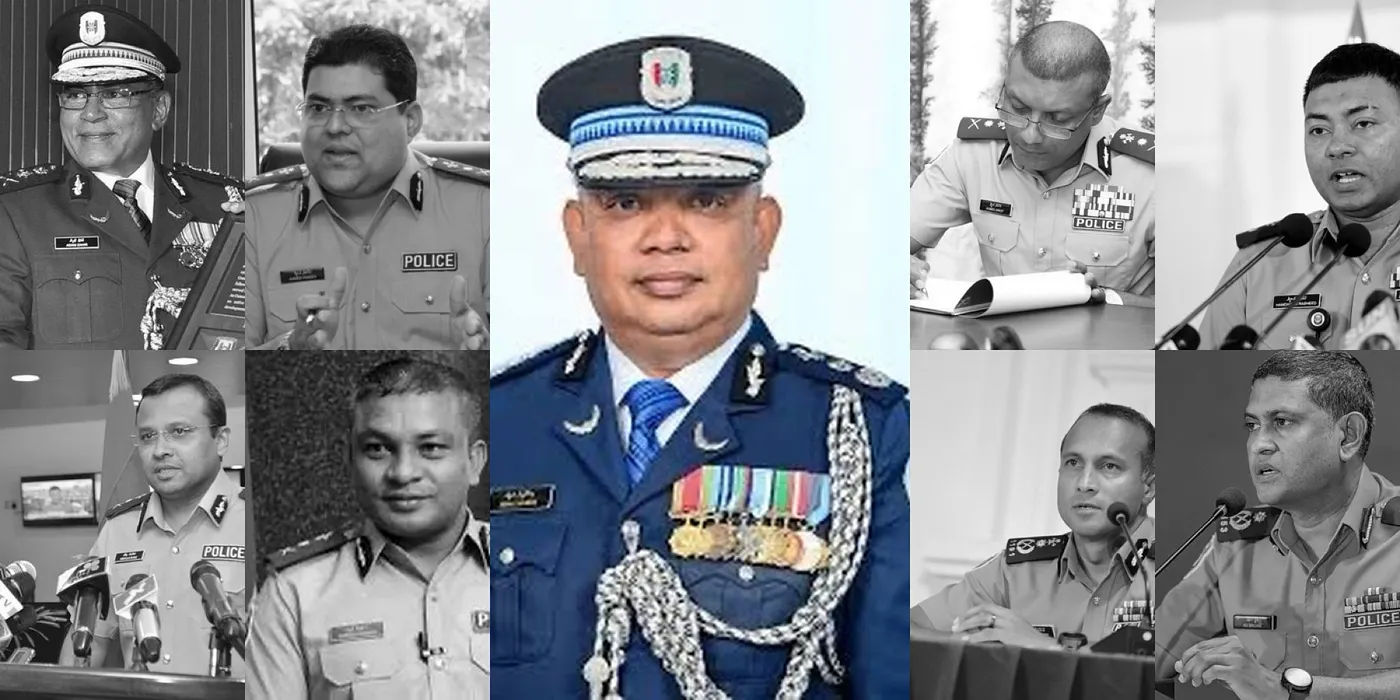
Three commissioners in just two and a half years. Next appointment would be its 10th Commissioner for the Maldives Police Service, in its short history of 22 years.
That level of turnover is not normal for any professional police service. And it should alarm anyone who cares about institutional stability.
Leadership instability is not a minor administrative issue
Frequent changes at the top disrupt strategic continuity. They affect morale across ranks. They weaken operational clarity. They create uncertainty within the command structure.
A police service relies heavily on consistency of direction. When leadership shifts repeatedly, long-term reform efforts stall. Policy priorities are reset. Officers begin to question whether professionalism is truly valued or whether political alignment determines survival.
Over time, this erodes public confidence.
Citizens begin to ask whether the institution is being steered by national interest, or political convenience.
The real question is not “why”. It is “what next?”
The deeper issue is whether the administration is prepared to act in the long-term interest of a democratic institution.
It is natural, particularly for an administration that appears increasingly comfortable departing from democratic norms, to prefer a Commissioner who is politically aligned and controllable. In moments of political stress, such a leader offers predictability for those in power.
But democratic policing demands something different.
It demands a commissioner who is professionally grounded, politically neutral, and capable of resisting partisan pressure. It requires loyalty to the Constitution and the law, not to political actors of the day.
This is the real test now before the government.
The timing matters
The current administration is approaching the halfway point of its term. The political climate is tense. Governance decisions in recent months have raised concerns about democratic backsliding.
At the same time, discussions are underway regarding amendments to the Police Act. Among the proposals reportedly being considered are:
• Disbanding or weakening the Police Board
• Centralising control over the appointment of Commissioners and Deputy Commissioners
• Removing transparent and competitive processes for senior appointments
• Reversing aspects of local policing empowerment
The Police Board was introduced as a notable improvement in oversight and accountability. Weakening it would concentrate appointment authority within the executive branch at precisely the moment when institutional insulation is most needed.
Likewise, reducing the autonomy of regional structures risks undoing progress toward community-focused policing.
These are not minor technical adjustments. They are structural shifts that reshape the balance between political power and institutional independence.
The second half of the term will be telling
The second half of any administration’s tenure is politically sensitive. The focus inevitably shifts toward securing another mandate.
In such circumstances, the temptation to appoint a Commissioner who is closely aligned with political objectives increases. Particularly if the political environment becomes more contested or polarised.
That is why the current vacancy matters so profoundly.
The appointment of the next Commissioner will signal whether the administration intends to:
• Strengthen democratic policing
• Or consolidate control over it
The choice will define the character of law enforcement in Maldives for years to come.
This is about institutional integrity, not personalities
It is disappointing to see a third Commissioner appointed within such a short span. But this moment also presents an opportunity.
The government can choose to appoint someone whose professional record demonstrates:
• Political neutrality
• Competence
• Integrity
• The ability to lead a complex institution under pressure
Such an appointment would send a powerful message, not only to officers within MPS, but to the public and the international community.
Conversely, a politically aligned appointment would deepen perceptions that the police service is becoming an extension of executive authority.
A call to professional responsibility
For officers inside MPS, including those who are politically engaged, this is a moment of reckoning. The institution must come before faction. The badge must stand above partisan loyalty.
The Maldives Police Service is one of the pillars of democratic governance. If it loses neutrality, the rule of law becomes selective. And when the rule of law becomes selective, democracy weakens.
The police service cannot fail the public.
The next appointment will tell us whether Maldives is prepared to strengthen democratic policing, or drift further from it.
And that decision, more than any narrative about why one Commissioner stepped down, will shape the future of the institution and the credibility of the administration itself.
Mohamed Hameed served as the commissioner of police from 2019 to 2023.
All comment pieces are the sole view of the author and do not reflect the editorial policy of the Maldives Independent. If you would like to write an opinion piece, please send proposals to editorial@maldivesindependent.com.
Discussion
No comments yet. Be the first to share your thoughts!
No comments yet. Be the first to join the conversation!
Join the Conversation
Sign in to share your thoughts under an alias and take part in the discussion. Independent journalism thrives on open, respectful debate — your voice matters.
Support Independent Journalism
Help us keep the news free and fearless
Give once
$
or
Become a memberfrom $5/month