
Redundancy is a legal process, not a political slogan
The law does not recognise "right-sizing."
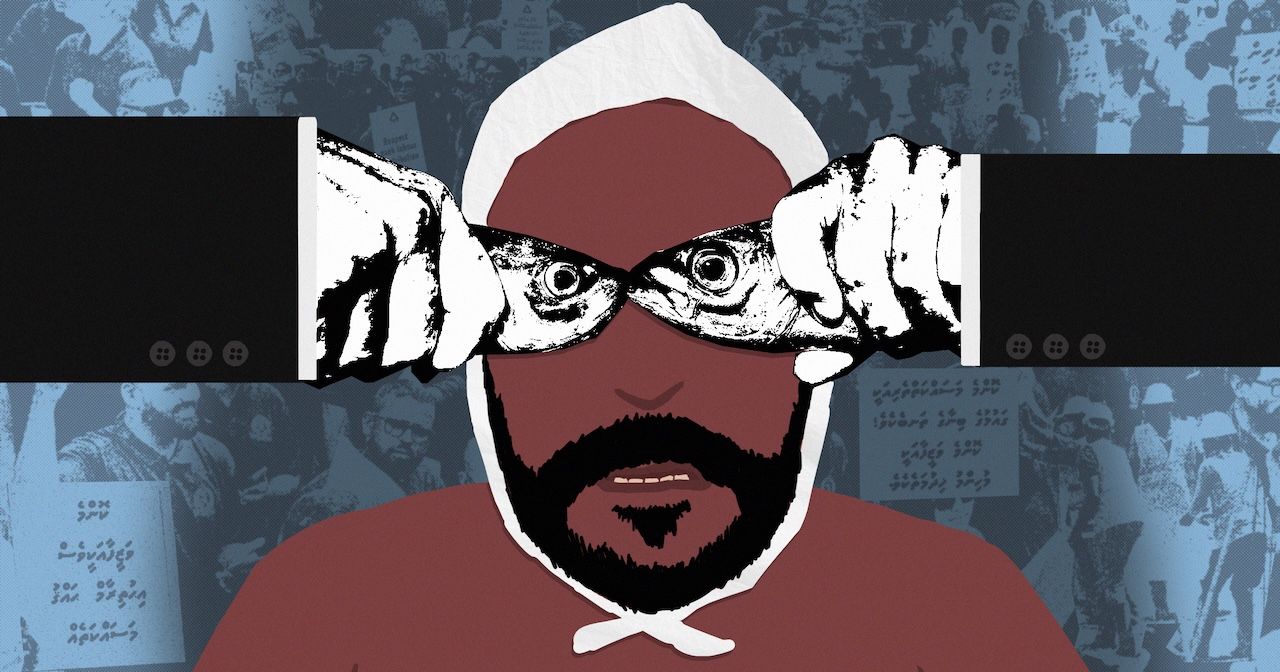
Artwork: Dosain
28 Jul, 13:33
In April, the government said state-owned enterprises employed 42,000 people. Four months earlier, the figure was under 40,000. In July, it instructed those same companies to dismiss a third of them within three months.
Mohamed Masih was among the first. An electrical engineer who had worked at STELCO since 2017, he was dismissed weeks after attending an opposition protest against politically motivated sackings at state companies. His termination notice cited a circular.
A circular is not a legal basis for dismissing anyone.
Over the past few years, the government handed out what many believed were secure jobs to thousands of people. Whether that was economic policy or naked electioneering is open to debate. What is beyond dispute is that the bill has now come due. The people being forced to pay it are not the politicians who created the problem, but the ordinary employees who trusted the state.
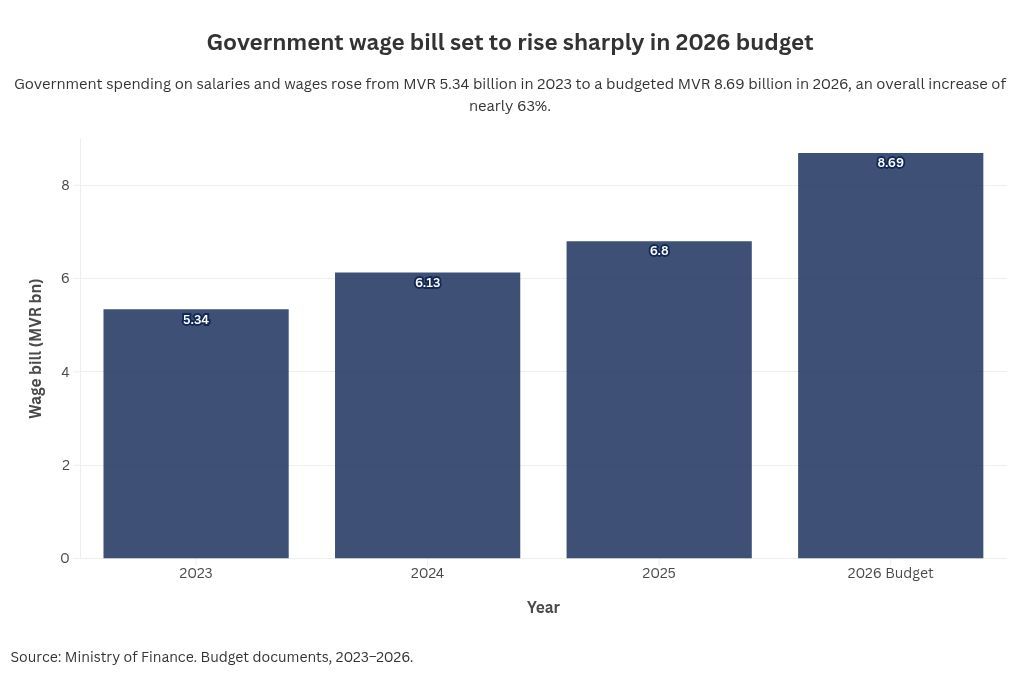
In the third quarter of 2025, publicly available figures placed the SOE workforce at around 39,643. The 42,000 figure was provided by then-finance minister Moosa Zameer on 19 April 2026. An increase of more than 2,350 employees in a few months is extraordinary by any standard. There was no comparable expansion of SOE operations, no surge in major infrastructure projects and no dramatic increase in the public services these enterprises were expected to deliver. The only thing that expanded at breakneck speed was the wage bill.
To be fair, politically motivated recruitment did not begin with this administration. SOE employment stood at 32,576 in the first quarter of 2023. By the end of the year, under President Ibrahim Mohamed Solih, the SOE workforce had grown by 2,083 employees to 34,659.
The Privatisation and Corporatisation Board's annual report for 2024 showed an increase of more than 4,300 employees for SOEs during President Dr Mohamed Muizzu's first year in office, rising to 38,969.
The latest recruitment spree "coincided" neatly with the local council elections and the national referendum of 4 April 2026. That explosive increase lays bare the extent to which SOEs had become instruments of political patronage rather than commercially managed public enterprises. Yet recognising that reality does not absolve it of responsibility today. Having manufactured the crisis through politically expedient recruitment, it now seeks to solve it through an aggressive cost-cutting exercise, forcing employees to bear the consequences of decisions they neither made nor benefited from.
Many of those now facing dismissal are fishermen, construction workers and others who abandoned traditional industries in search of what appeared to be secure employment in the state sector. The government actively encouraged that migration. It promised stability, recruited aggressively and presented these jobs as long-term opportunities. Now those same workers are being discarded as though they were little more than an accounting entry.
The consequences extend far beyond the balance sheet. They are perhaps most visible in the fisheries sector. One of the factors behind its long-term decline has been the migration of labour into government and state-owned enterprise employment, as politically motivated hiring drew workers away from productive industries. The latest available figures show that fish export volumes fell by 69.7 per cent in the first quarter of 2026 compared with the same period in 2025, underscoring the continuing deterioration of a sector that has struggled for years to retain workers. Having first lured workers away from productive industries with politically convenient jobs, the government is now dismissing many of those same employees, damaging both the productive economy and the livelihoods of the very people it encouraged to leave it behind.
Two possible explanations
The first is that the recruitment drive immediately before the local council elections was politically motivated. The second is that, having suffered an electoral setback, the government is now using fiscal consolidation as a convenient pretext for political retaliation. Neither explanation reflects well on the administration. Fiscal consolidation did not suddenly become necessary in July 2026. The Maldives' deteriorating public finances have been evident for years. The IMF, the World Bank, economists and even the government itself have repeatedly acknowledged the need to rein in expenditure. Yet despite those warnings, recruitment accelerated instead of slowing.
If SOEs genuinely required an additional 2,000 employees between the third quarter of 2025 and the first of 2026, what changed within a matter of months? If those appointments were genuinely necessary to meet operational needs only months ago, what credible evidence is there that those operational requirements disappeared almost overnight?
If these dismissals are truly driven by operational necessity, the government should have no difficulty proving that through the lawful redundancy process. If it cannot, every employee working in an SOE has every reason to ask whether the next dismissal letter could have their name on it.
International financial institutions support reform, not arbitrary dismissals
For more than a decade, both the IMF and the World Bank have consistently identified SOEs as one of the Maldives' greatest fiscal vulnerabilities. Their diagnosis has never been ambiguous. The SOE sector is too large, too inefficient, insufficiently accountable and poses a serious threat to the country's public finances.
In its 2026 Article IV Mission, the IMF warned that "state-owned enterprises remain a material source of fiscal and governance risk, warranting stronger oversight and control." Its 2024 Article IV Report reached much the same conclusion, finding that SOEs "pose significant challenges for the public finances," frequently require "large and ad-hoc budget support," and create substantial contingent liabilities through government guarantees. The Fund's recommendation was unequivocal: "reforms of SOE framework and operations are critical to support the sustainability of public finances."
The World Bank has delivered essentially the same message. In its 2024 Maldives Development Update, it warned that "fiscal risks from loans, trade payables, subsidies, and investments in state-owned enterprises (SOEs) remain elevated," and stressed that "urgent actions are needed to reduce spending," including "reforming SOEs to reduce the state's footprint in the economy." Once again, the emphasis was on governance, transparency, accountability and efficiency, not indiscriminate workforce reductions.
Crucially, neither institution has advocated bypassing Maldivian labour law or carrying out politically motivated dismissals. Even if they had, the Maldivian government would still be bound by local laws. It is not above the law. It cannot suspend statutory protections simply because compliance has become politically inconvenient. Any workforce rationalisation must be carried out strictly in accordance with the Employment Act.
Cost-cutting cannot override the law
The government's latest initiative is undoubtedly sweeping. A circular signed by Privatisation and Corporatisation Board President Mohamed Nizar on 12 July 2026 directs SOEs to reduce their workforce by 33 per cent within three months, beginning on 13 July. This means 13,860 employees will lose their jobs. No government circular, ministerial directive or policy decision can override laws. Neither does fiscal pressures. Under Maldivian law, employees cannot be dismissed merely because the government wants to reduce expenditure.
The Employment Act expressly prohibits dismissal without reasonable cause. That cause must relate to an employee's conduct, performance or inability to fulfil work responsibilities. The Act also expressly prohibits dismissals based on discriminatory grounds, including political opinion. Only cases of gross misconduct permit dismissal without notice. Where the issue is not misconduct but the abolition of a position or a genuine reduction in the workforce, the law treats the matter entirely differently. It becomes a redundancy. But redundancy is not merely a polite euphemism for mass dismissal. It is a carefully regulated legal process designed to protect employees from precisely the kind of arbitrary decision-making that often accompanies politically driven workforce reductions.
Redundancy is governed by law, not executive instruction
The PCB circular itself implicitly recognises this by referring to redundancies. But if redundancy is indeed the mechanism being relied upon, every SOE must comply fully with the General Regulation on Employment. That regulation demands far more than issuing dismissal letters or satisfying an arbitrary numerical target handed down from above. It establishes a structured legal framework specifically designed to ensure that redundancies are genuine, necessary, transparent and fair.
The first requirement is genuine operational necessity. A redundancy must arise because organisational needs have genuinely changed through restructuring, technological change, closure of part of an undertaking or a real reduction in operational requirements. It cannot lawfully be used as a convenient device to remove politically undesirable employees or simply to hit a workforce reduction quota dictated by the government. The law requires employers to prove that the job has become unnecessary, not merely that the employee has become inconvenient.
The second requirement is consultation. Before any redundancies take effect, employees must be informed of why redundancies are being proposed, what alternatives have been considered, how affected employees will be selected, and what measures are being taken to minimise job losses. Consultation is not a courtesy extended by a benevolent employer. It is a statutory obligation. That obligation exists for one simple reason: governments and employers are not permitted to present workers with a fait accompli. Employees must be given a genuine opportunity to understand, question and respond before decisions affecting their livelihoods are finalised.
Third, employers are legally required to exhaust reasonable alternatives before resorting to compulsory redundancies. The regulation expressly identifies voluntary separation, redeployment, recruitment freezes, reduced working hours and other lawful measures intended to preserve employment wherever reasonably possible. Compulsory dismissal is not supposed to be the government's opening move. It is meant to be the option of last resort.
Fourth, any selection process must be objective. Employers are expected to assess qualifications, experience, skills, performance, attendance and disciplinary history. Political loyalty, party membership, personal relationships or ideological differences have absolutely no place in a lawful redundancy exercise. Finally, every employee declared redundant remains entitled to the statutory notice period or payment in lieu. None of these safeguards are optional. They are not administrative formalities to be brushed aside in the name of efficiency. They are legal obligations enacted to ensure that redundancy does not become a convenient cover for arbitrary dismissals.
And if any employer should be held to the highest standard of compliance, it is the government. As the country's largest employer with approximately 42,000 employees in state-owned enterprises and a further 32,000 in the civil service, it has the greatest responsibility to uphold the law, not circumvent it.
The government's actions raise serious questions
That is precisely why the government's conduct is so troubling.
So far, there has been remarkably little public evidence that these legal requirements are being observed. There has been no indication that comprehensive redundancy exercises have been carried out across SOEs, that meaningful consultations have taken place, that operational assessments have been conducted and published, or that objective selection criteria have been disclosed.
The dismissal of STELCO electrician Mohamed Masih – shortly after he participated in an opposition Maldivian Democratic Party protest on 18 June 2026 against what demonstrators described as politically motivated dismissals – illustrates exactly why these statutory safeguards exist. His termination notice cited the PCB’s circular directing SOEs "to reduce company employees as part of the efforts to strengthen company management and reduce operational costs."
Masih had worked at STELCO since 2017 in the Malé Transmission and Distribution Department and holds a Bachelor of Electrical and Electronics Engineering (Honours). Apparently electrical engineers are now redundant at the national electricity company.
Should teachers now wonder whether they are redundant in our schools? Should nurses and doctors begin asking whether our hospitals have suddenly become overstaffed? Once a government starts treating statutory safeguards as optional for SOE employees, every worker in the Maldives becomes more vulnerable, including nearly 74,000 people employed across the public sector. The rule of law cannot be applied selectively without eroding the security of everyone it is meant to protect.
Instead, dismissals appear to be taking place one employee at a time, with little explanation beyond vague references to "restructuring." That is not transparency. It is opacity masquerading as reform.
If this bungled so-called "right-sizing" exercise continues to disregard the legal requirements governing redundancy, the government may ultimately discover that unlawfully dismissing employees is far more expensive than retaining them. Rather than reducing expenditure, it risks exposing the state and its SOEs to thousands of unfair dismissal claims, substantial compensation awards and years of costly litigation all because it chose political expediency over the rule of law.
Column By Saif Fathih
Saif Fathih is a columnist at the Maldives Independent and a former member of the Malé City Council for Galolhu North. With his educational background in communications, international studies and public policy, he previously worked as a journalist, editor and public policy advisor, with roles including senior policy director at the ministry of national planning and editor of Ocean Weekly Magazine. Saif began his career as a radio producer and presenter at Minivan Radio, writer for Minivan Daily, and translator for the British High Commission and the European Union Mission to Sri Lanka and the Maldives. He is also the host of Ithuru Vaahaka, the Maldives Independent podcast.
All comment pieces are the sole view of the author and do not reflect the editorial policy of the Maldives Independent. If you would like to write an opinion piece, please send proposals to editorial@maldivesindependent.com.
Discussion
No comments yet. Be the first to share your thoughts!
No comments yet. Be the first to join the conversation!
Join the Conversation
Sign in to share your thoughts under an alias and take part in the discussion. Independent journalism thrives on open, respectful debate — your voice matters.
Support Independent Journalism
Help us keep the news free and fearless
Give once
$
or
Become a memberfrom $5/month