

Referendum, record turnout, and a fractured opposition: key takeaways from the April 4 elections
69 percent said No. That was just the start.
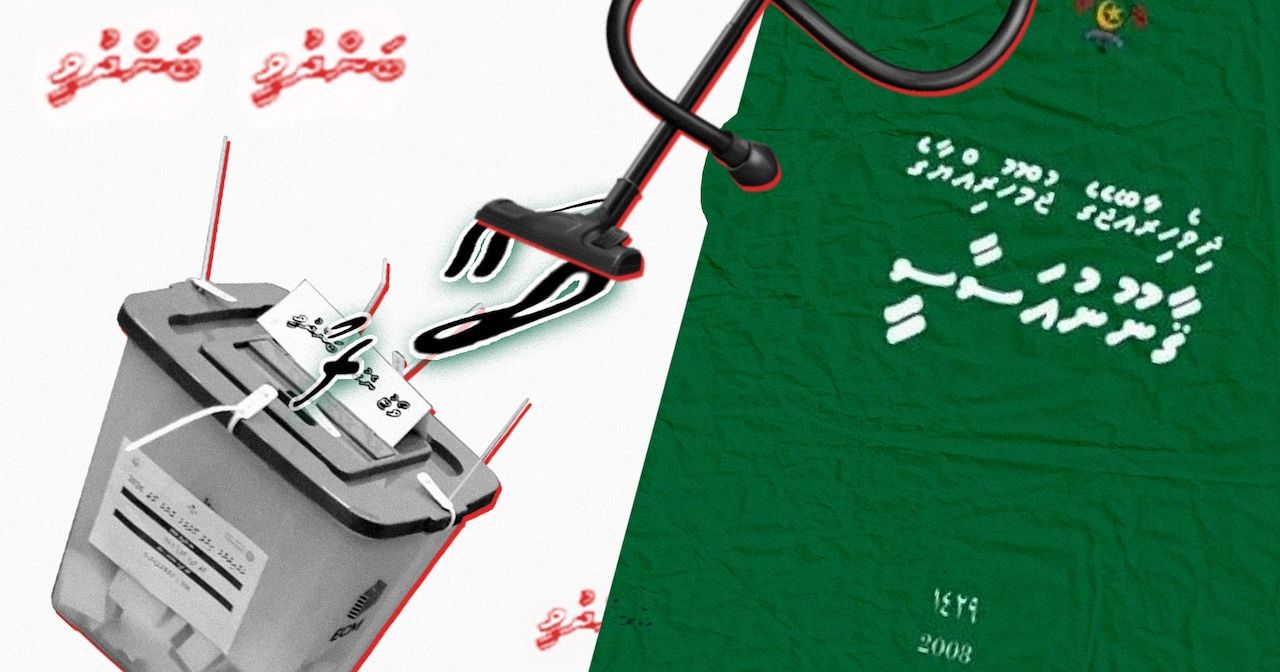
Artwork: Dosain
07 Apr, 16:54
Saturday's local council elections and constitutional referendum delivered a decisive mid-term verdict on President Mohamed Muizzu's government. The opposition Maldivian Democratic Party swept all five cities, took council majorities across most of the country, and the public rejected the government's proposal for concurrent presidential and parliamentary elections by a margin of more than two to one.
Here are the key takeaways from the provisional results.
The referendum was a landslide rejection
It was the most emphatic margin in a nationwide election to date. Voters rejected the constitutional amendment to hold presidential and parliamentary elections on the same day by 68.73 percent to 31.27 percent: 67,413 people voted in favour while 148,153 people voted against the proposal. With 583 out of 588 results sheets entered by late Tuesday afternoon, the turnout stood at 74.74 percent (220,402 out of 294,876 eligible voters).
The Yes vote was well below the 74,000-strong membership of the ruling People's National Congress. Several islands that elected PNC council majorities voted No on the referendum.
The referendum sank the PNC campaign
PNC insiders have identified the referendum as the strategic error, a costly decision that transformed a routine council election into a national verdict on the government.
The referendum appears to have driven a surge in turnout, reaching a record 75 percent for a council election after averaging between 62 and 69 percent across the previous three cycles. PNC leaders blamed bundling the referendum with the council vote for the party's defeat. The referendum mobilised voters, including a "silent majority" of non-partisan voters who opposed concurrent elections, and their frustration with the government's proposal bled into the council ballot.
"The result was that it turned into a yes-or-no vote on the government," one senior PNC figure told Mihaaru. "It was easier to publicly argue the harms of combining the two elections than the benefits. It was easier to plant in people's minds the losses they would suffer."
Many voters who came out to vote No on the referendum, also appear to have cast ballots in the council race, and their anger carried over.
"In the fury of the referendum campaign, people voted for the councils too. Most people believed that fewer elections meant politicians would disappear and development would stop," another PNC insider told Mihaaru.
The pre-election hiring spree by state-owned enterprises and the bonanza of infrastructure projects did not deliver the expected outcome for the PNC. In Haa Alif Dhidhdhoo, where the government had reclaimed land for an airport, voters gave all but one council seat to the opposition.
Other last-minute gestures did not help. The government repaid a US$ 500 million sukuk, launched an electric taxi service, and broke ground on a string of housing projects in the Greater Malé Region. But voters were unmoved. "What this election made clear is that jobs, last-minute projects, and money no longer sway Maldivians," a PNC loyalist told the newspaper.
Fisheries Minister Ahmed Shiyam acknowledged the result was "a chance to think deeply and reform," adding that the party would work in line with the public's wishes. President Muizzu himself conceded errors, pledging on X to make corrections "in line with the people's pulse."
Malé lags behind national average
With 1,362 sheets entered out of 1,367, the turnout for the capital's hotly contested mayoral race stands at 56.6 percent, 18 percentage points below the national referendum turnout of 74.74 percent.
This extends a trend previously documented by the Maldives Independent: in the 2024 parliamentary elections, Malé turnout trailed the national average by 13 points. The urban-rural enthusiasm gap appears to be widening.
A fractured MDP swept all five cities
Incumbent mayors from the MDP retained their seats in all five cities: Malé, Addu, Fuvahmulah, Kulhudhuffushi, and Thinadhoo. The urban centres account for more than half the Maldivian population. MDP also took council majorities in all five, including a clean sweep in Addu.
With the exception of Thinadhoo, where Saud Ali held off PNC challenger Mohamed Ajeeb by a 47-vote margin (50.56 percent to 49.44 percent), the MDP mayors won comfortably. In the southernmost atoll, Mayor Ali Nizar leads with 64.93 percent (8,792 votes) against PNC's Mushrif Ali at 31.45 percent (4,259 votes). Independent candidate Mohamed Assam took 3.61 percent with 489 votes. In neighbouring Fuvahmulah, Mayor Ismail Rafeeq has 63.95 percent (4,968 votes) against PNC's Ali Maseeh at 36.05 percent (2,801 votes).
Up north in Kulhudhuffushi, Mayor Mohamed Athif proved to be the most popular incumbent with 68.92 percent (3,544 votes), handily beating PNC candidate Ibrahim Hassan, who trails with 1,589 votes. In a more crowded field in Malé, Mayor Adam Azim failed to win a majority, but secured re-election with 45.11 percent (13,906 votes). PNC's Moosa Ali Jaleel, a retired general, came a distant second with 30.42 percent (9,378 votes). Other opposition candidates – Ismail Zariyand, who was backed by former President Abdulla Yameen's People's National Front, took 20.44 percent (6,302 votes) as 27-year-old independent candidate Ahmed Aiham came fourth with 2.90 percent (892 votes), followed by Abdulla Mahzoom Majid from the Maldives Development Alliance at 1.13 percent (348 votes).
Of the 52 city council seats, PNC only won six. The ruling party lost the urban centres despite the full weight of the government's campaign machinery and a special focus from the president. Throughout Ramadan and during the final weeks of the campaign, President Muizzu stayed in the capital and went door-to-door on an almost daily basis, visiting homes with the mayoral and council candidates. After opening campaign halls for PNC candidates in Malé, First Lady Sajidha Mohamed was dispatched to the other cities. In the final campaign event, a large crowd marched behind the first couple through the streets of Malé, outnumbering the MDP's similar march.
The last time a governing party lost all major cities in a mid-term election was in 2021, when the then-ruling MDP lost council majorities and former strongholds to the opposition, a result that foreshadowed President Ibrahim Mohamed Solih's defeat in the 2023 presidential election.
PNC held some ground
PNC's one consolation was the Women's Development Committee elections, where the party won a majority of seats. MDP took council seat majorities in all but four atolls. But PNC won about 246 seats nationwide against MDP's 247 seats (including seats confirmed without a contest).
Independent candidates won 81 seats whilst resort magnate Ahmed Siyam Mohamed's MDA took 10 seats, followed by The Democrats with two seats and the Adhaalath Party and Jumhooree Party with one seat each.
PNC made inroads in some traditional MDP-leaning islands, notably flipping Alif Alif Ukulhas and taking the Maafushi council presidency. But the party also lost ground in its own strongholds. In Alif Dhaal Mahibadhoo, where MP Ahmed Thoriq has won the parliamentary seat three consecutive times, PNC lost the council presidency to MDP by 813 votes to 609 and retained just two of five seats.
The PNC's other victories came in small islands with populations below 2,000. The total seat count also obscures 33 council seats and 49 WDC seats that were confirmed without a vote being cast. In these constituencies, candidates ran unopposed after withdrawals left exactly as many candidates as seats. PNC secured 28 of these council seats and 41 of the WDC seats, representing 85 percent of all uncontested council confirmations. Six council president seats were filled without competition. In Laamu Mundoo, all six elected governance positions across the council and WDC were confirmed as PNC candidates before polling day. Not a single vote was cast for any local office on the island.
Whether the absence of challengers in small island communities reflects genuine consensus or a chilling effect in which the social and professional costs of standing against the incumbent are prohibitive is difficult to determine, Transparency Maldives observed in its pre-election review.
An MDP win, but not an MDP mandate
The results were a clear defeat for the government. Whether they were an MDP victory is the subject of an ongoing debate.
As Adhadhu noted in a detailed examination of the opposition's campaign, the main opposition party entered the election divided into four factions revolving around former Presidents Ibrahim Mohamed Solih and Mohamed Nasheed, as well as former chairman Fayyaz Ismail, and former foreign minister Abdulla Shahid, who remains in the post of MDP president. A last-minute appearance of Solih and Nasheed campaigning side by side gave supporters what "a spark of life" but the four faction leaders were never seen together on the campaign trail. The party arranged joint travel for all four, but at least one reportedly declined.
The MDP lacked a clear policy platform and did not articulate a clear message. Its campaign slogan, "Ready and Prepared" (Heyvalaa Thayyaru), did not say what it was prepared for. Its only message was that Muizzu was worse than the alternative.
The party had only expected to win the five city mayors, not the broader council sweep, an MDP national council member told Adhadhu. "MDP had decided it would lose the local councils. It did not even expect to win city council seats other than the mayors," the member said. That the party won so much more is a measure of the government's unpopularity rather than the opposition's strength.
The party's referendum campaign was overshadowed by an independent effort. Lawyers, former judges, economists, and civil society activists organised their own "Nufenay" (No) campaign, holding three public debates on the constitutional amendment that drew far more engagement than MDP's formal committee, which according to Adhadhu "held a press conference on day one and was barely seen after."
A verdict on the Majlis
The 20th Majlis, where PNC holds a 75-seat supermajority in the 93-member house, has passed a series of constitutional and legislative changes at speed and with minimal public consultation.
These include anti-defection provisions inserted into the constitution in a single day, empowering parties to unseat lawmakers who cross the floor, as well as a widely-condemned media regulation law, the abolition of atoll councils, and amendments stripping powers from local councils ahead of the election.
Public consultations on some of these bills were opened for 24 to 48 hours. The referendum law itself was drafted and passed in two months. Key disparities in the law such as requiring the Majlis to publish arguments for and against a referendum question, while exempting the president from presenting opposing arguments — were never explained in parliamentary debate. "It could even be a typo," he joked.
A Sun columnist argued the president's treatment of former President Yameen's political base was a driving factor. Campaign promises to free Yameen were not honoured; rallies featured speakers mocking him. "The silent grief of two and a half years was poured onto the ballot paper on April 4," the columnists wrote. "That silent voice was delivered like a thunderclap."
In February, 71 MPs voted in favour of the constitutional amendment for concurrent elections with just one against and 12 MDP members boycotting. Eighty-five percent of the Majlis said yes, but nearly 70 percent of the public said no.
Several commentators have since suggested that the 69 percent No vote is the strongest signal yet that the Majlis supermajority does not have a popular mandate for the pace and scope of constitutional change it has pursued. As lawyer and former MP Ali Hussain put it: "This is the time for members to free themselves. No member has anything to worry about now."
Dhauru editor Moosa Latheef argued the referendum was the first time the Maldivian public had spoken directly in defence of the constitution. "The supermajority is not the people," he wrote. A senior PNC figure, speaking before the vote, had told him: "The president is trying to claim the five years God didn't give him, on top of the five years He did."
Discussion
No comments yet. Be the first to share your thoughts!
No comments yet. Be the first to join the conversation!
Join the Conversation
Sign in to share your thoughts under an alias and take part in the discussion. Independent journalism thrives on open, respectful debate — your voice matters.
Support Independent Journalism
Help us keep the news free and fearless
Give once
$
or
Become a memberfrom $5/month

