"We will sense even if we cannot see"
She co-founded an NGO after being told blind people couldn't run one.
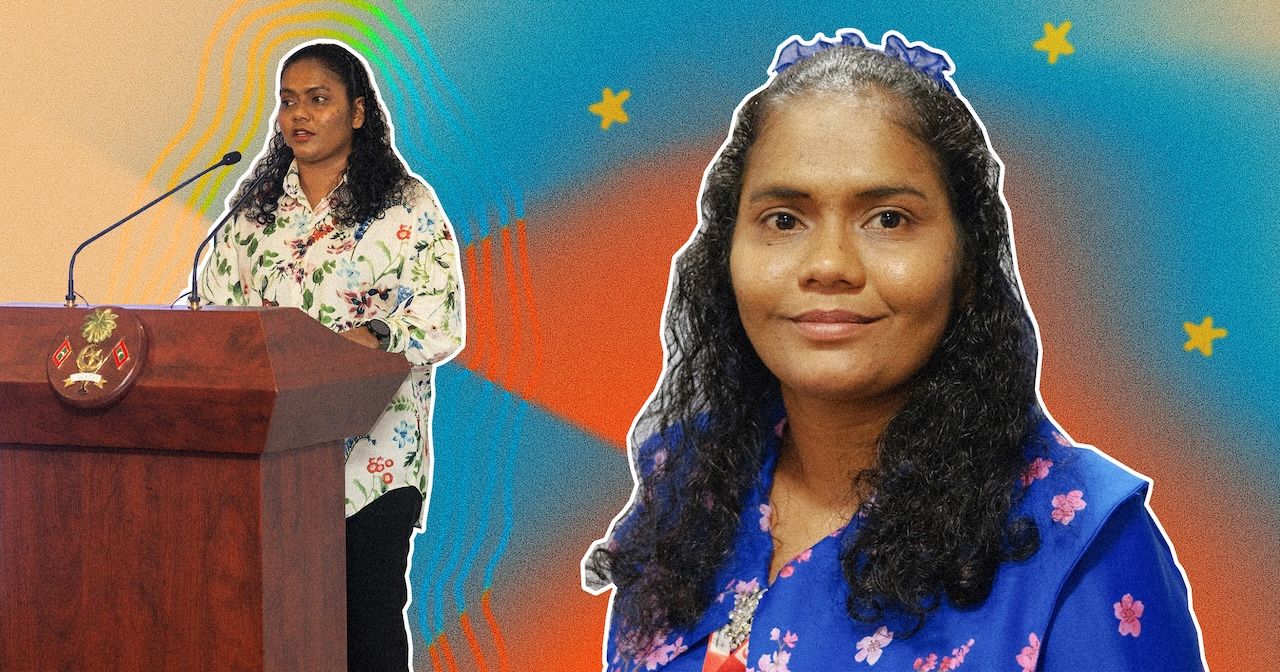
Artwork: Dosain
15 Apr, 14:45
Faathun could not see the finishing line. She could hear the music and the crowd. With 400 metres left, she told her guide runner she didn't think she could make it.
She had started too fast. It was cold when the run began early that morning in Addu. She was very excited. In the first kilometre, she set a pace far too high. As she got closer to the finish, the sun was rising and the heat was building. Her guide runner told her she could do it. She'd been running all this time.
"I was very happy when I finished. It was a different feeling. [I thought] ‘this is not something that can't be done. I was able to do this as well,'" she recalled.
It was 2018. Fathmath Ibrahim had just become the first visually impaired person to complete a 10K run in the Maldives.
A year earlier, Bank of Maldives told the Blind and Visually Impaired Society of Maldives – an NGO she had co-founded – that the organisation would receive MVR 20,000 (US$ 1,300), if five visually impaired runners completed a 5K.
"I thought that's a very small thing, that a lot of people are going to be helped with such a small thing. That's why I started running," she said.
Her confidence came after a Dhiraagu Road Race. Many have even finished after me, she thought. She joined iRunners, a local running community. Her coach told her she could do it, she just needs a little courage. She would have to use the road a lot, there would be times she would have to run through passing vehicles. Accept these things with your mind, the coach said. Then you will be able to do it.
Now, when the finishing line is close enough to hear the music, she no longer feels tired.
"Every runner will try to beat to that rhythm," she said. "When you see the finish line, you won't remember how tired you are. You just try to finish then. You sprint and just finish."
Colours
Faathun was born with retinitis pigmentosa. Ever since she can remember, she has not been able to see colours in their real form. Once the orange rays of the sun pass and night falls, she cannot see unless something shines directly on to her eyes. Her vision deteriorated as she grew older.
Her older sister is also visually impaired. Their mother recognised Faathun's condition when she was about four months old. But the household did not treat it as a limitation. Her mother set times for the children to play outside, let them participate in sports, and never stopped Faathun from doing anything. She would warn her she might get hurt though.
"We did not grow up differently because we had a visual impairment," Faathun said. "Not how someone who could not see would, without discrimination, just like other people."
She grew up largely with her paternal grandfather, spending most of her time helping him with carpentry. It involved hand saws, tools, and physical work. She rode bicycles with friends, adjusted and replaced the tires herself. Some of those friends were fellow volunteers from the Maldives Red Crescent, where she served for years.
She credits who she is today to her mother. Because her mother had faith in her and created that space for her, she said. While growing up, people said things to her mother about her. Faathun would tell her to ignore it. That's just how they think.
"I am not someone who ever listens to people's negative comments," she said.
Step counting
Moving to Malé changed everything. On her island of Hinnavaru in Lhaviyani atoll, she could walk the roads alone, relying on step counting and whatever she could see at the time. In the densely-packed capital, she always had to be with someone.
"Even if I am stressed, if I want to hear the sound of the waves, I can't go do even things like that," she said. "The freedom to walk alone is very narrow."
Faathun described her school years as the saddest days of her life. There was no inclusive education, no system or policies for teaching students with disabilities. She listened while others read things aloud. There were no other facilities available.
The two sisters often discussed school matters with each other. When she noticed the challenges her sister faced with not being able to complete Grade 10, Faathun made it her goal to sit for the GCE O-Levels.
She almost gave up in Grade 9. Her teachers had a consistently negative mindset about whether she could do GCE exams, she said. But four friends kept her going. They were two grades above her. They forced her to come study with them.
"They will finish studying and then they will read out the lessons to me," she said. Her friend told her: without education you cannot become someone. Go to school without listening to what people say.
She completed the exams in 2009. She became the first visually impaired person to sit GCE O-Levels in the Maldives, Faathun said.
There are many moments when her blindness feels like a big barrier, Faathun said. This was not because of her eyes, but because of how the world around her was built. She wished she could have received her textbooks as audio files. She wished the Maldives had been more technologically developed, or had the facilities to study in braille.
Building a life
Things changed when she got a smartphone. Read-aloud applications developed abroad gave her access to English documents for the first time. But Dhivehi remained locked behind a script her software could not process.
In 2019, Faathun and other visually impaired Maldivians joined the Miyaheli innovation camp run by UNDP. Faathun became a co-founder of Thaana Mallow, an application launched in 2020 that translates Thaana script into Latin characters, making Dhivehi documents accessible through screen-reader software. For the first time, she could read documents in her own language.
She now uses NVDA screen-reader software on her computer, Google voice search in Dhivehi – which requires "speaking in a way where the letters are emphasised" – and AI tools for finding information. She uses TikTok, Facebook, and Instagram like anyone else. A visual impairment doesn't hold her back from "worldly happiness," she said.
Faathun said what drives her is not wanting others to go through what she went through. Closest to her, she watched her sister fail to complete Grade 10. Foreign South Asian teachers at the time were physically and verbally abusive, punishing students through caning and twisting ears.
"I thought I don't want others to have the same experiences," she said.
She noted how happy it makes her to see wheelchair users no longer having to push their chairs with their hands, able to breezily drive their motorised chairs today.
"We should also be able to live in that same manner. There needs to be lines that we can use to walk with our smart canes. All of this work can only be done when some people stand up and talk about it," she said.
The phone call
It started with an unknown call. A visually impaired person called her one evening during Isha prayer. She was annoyed. She called back and told the person off. But they kept talking. They became friends.
A group of visually impaired people began holding conference calls they named "Namoona Conference." Faathun started freeing up her Fridays to share basic information such as how to write a letter, and how to use a phone as well as lighter activities like singing together.
"When we were talking on Fridays, all of us realised we need to form an NGO," she said. "Before, our work and talking about persons with disabilities came from people with five senses intact. They will not be able to share the challenges we face."
When the group first approached the state authorities to register, Faathun said they were told: how can people who cannot see run an NGO? They succeeded on the second attempt. Individuals from across the country started filling forms. The aim of the NGO was simple: we can do it, we will do it.
The Blind and Visually Impaired Society of Maldives started with computer courses, basic English, Latin classes, phone usage, building the skills its members had never been given.
It grew into something broader. BVISM now runs awareness programs across the country, where visually impaired people travel to communities and share information on their rights, the law, and how to use the opportunities available to them.
"Specially, the obstacles we face in marriage and romantic lives," Faathun said. "Because they also want to marry and have children."
Faathun, who helped develop the country's first national action plan on disability inclusion, is now a BVISM board member. She also works across six other NGOs in Malé, connecting organisations through the networks she built during her years with the Red Crescent.
What they don't know
In 2021, Faathun began running sexual and reproductive health sessions through BVISM. The need was urgent and the gaps were basic.
"People who are 34 or 35 do not know when a brother comes and touches them inappropriately or sexually. Some of them do not know that this is sexual violence," she said.
The sessions were meant to last an hour. The first one ran until 11:30pm. The women kept talking, sharing what had happened to them, asking questions no one had ever answered. Some did not know how a marital sexual relationship works. Things that sighted people learn by observation had never been made accessible to them.
Faathun also discovered something worse. Among women with hearing impairments, Down syndrome, and autism, she said she found cases of forced sterilisation: uteruses removed without the person's knowledge or consent. She said the practice has been influenced by approaches seen in other countries and has been happening across generations.
"Even the laws do not prescribe any sentences for taking an organ from someone's body without their consent," she said. "But honestly, amongst human rights, that is such a big right that is being taken away."
Say my name
Faathun went on to complete her first half-marathon in 2019, breaking the record. She represented the Maldives at the Tokyo Paralympic Games in 2021, carrying the national flag. That was one of the proudest moments of her running career, she said. That same year, she received the Riveli Thari award in the sports division, a recognition given to individuals with disabilities for their talents and achievements.
Even after her 12-metre dive, Faathun thought: this isn't something I can't do. She was scared at first but found hovering underwater and waiting to be relaxing.
When asked what she wishes people understood, Faathun said she wishes they would not mention a person's disability first and then say their name.
People also often mime in the presence of visually impaired people, thinking she will not know.
"We too will sense, won't we, even if we can't see," she said.
Discussion
No comments yet. Be the first to share your thoughts!
No comments yet. Be the first to join the conversation!
Join the Conversation
Sign in to share your thoughts under an alias and take part in the discussion. Independent journalism thrives on open, respectful debate — your voice matters.
Support Independent Journalism
Help us keep the news free and fearless
Give once
$
or
Become a memberfrom $5/month