
"A linked chain": how Faathun helped write the Maldives' first disability plan
Built by the people it's meant to serve.
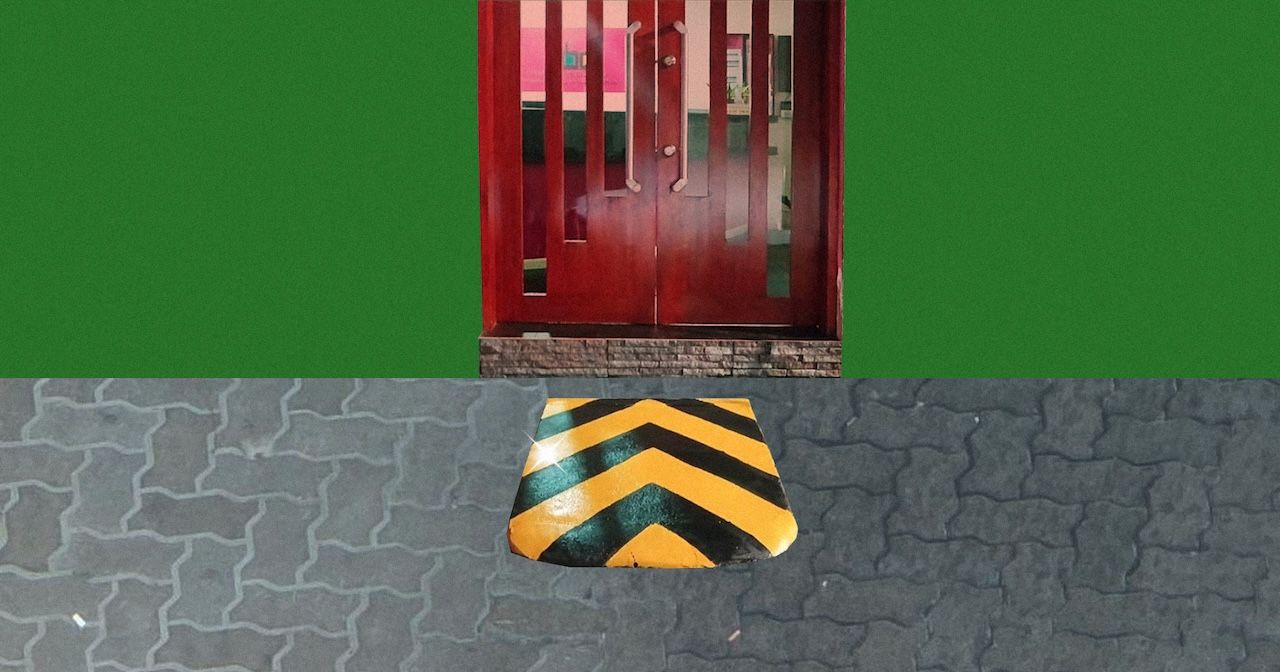
Artwork: Dosain
31 Mar, 17:18
At the Maldives Internet Governance Forum in 2024, Fathmath Ibrahim rose and told a panel of MPs that parliament's website was inaccessible. An MP replied that if she would just look, she would find that it was.
Faathun stood up again. She could not "look" at the website, she explained, because she is visually impaired.
Faathun was born with retinitis pigmentosa. She has never been able to see colours. Her elder sister is also visually impaired. Her mother recognised Faathun's condition when she was four months old. Her family, her mother especially, tried to give her a life free from discrimination, letting her play outside and participate in sports.
She described her school years as "sad days." The country had neither inclusive education policies nor facilities for students with visual impairments. She listened while others read things aloud. There was nothing else available to her.
Things changed when she got a smartphone. Read-aloud applications developed abroad gave her access to English documents for the first time. But Dhivehi remained locked behind a script her software could not process.
In 2019, Faathun and other visually impaired Maldivians joined the Miyaheli innovation camp run by UNDP. Out of it came Thaana Mallow, an application launched in 2020 that translates Thaana script into Latin characters, making Dhivehi documents readable through screen-reader software. For the first time, Faathun could read documents in her own language.
She now uses a combination of tools to navigate daily life: NVDA screen-reader software on her computer, Google voice search in Dhivehi, and AI tools for finding information. Google accepts Dhivehi voice commands to some extent, she said, but it requires "speaking in a way where the letters are emphasised." She uses TikTok, Facebook, and Instagram like anyone else.
"The more you use your knowledge to try and get information, you'll get things," she told the Maldives Independent. A visual impairment doesn't hold her back from "worldly happiness," she said.
But the physical world is less accommodating. Walking in Malé is a challenge. Vehicles are parked with no thought for blind pedestrians. Pavements are used "for keeping people's goods and rubbish," she said. As someone involved in advocacy, athletics, and the national disability council, she cannot constantly depend on family. Affording life in Malé requires everyone to work and earn to pay rent and make ends meet, she said.
For the past three years, Faathun has relied on taxis, which allow her to get places on time. But the cost is significant. A taxi from Malé to Hulhumalé Phase 1 costs MVR 85 (US$ 5.5); to Phase 2, MVR 100. As a para-athlete and president of the disability council, she makes the trip about six days a week.
A nationwide situation analysis completed in December 2024 – the first comprehensive assessment of disability rights in the Maldives – found that public buses lack accessible route displays, that information about stops is communicated only verbally and inconsistently, and that there are no accessible taxis in the country apart from vehicles operated by one disability organisation. Government websites and online portals, including the national digital identity platform eFaas, do not meet basic accessibility standards. The process of applying for a national identity card or passport requires blind citizens to hand over their account login details to someone else because the online forms cannot be navigated with assistive technology.
Earlier this month, disability organisations raised concerns over the Elections Commission's failure to make the April 4 council elections and public referendum accessible. Deaf voters received no sign language interpretation in official election materials. Blind and visually impaired voters face a "restrictive" pre-registration requirement to access ballot templates, the only way to cast a secret ballot unassisted. The requirement essentially asks voters whether they want to exercise their legal right or not, the groups said.
Finish line
In 2019, Faathun became the first visually impaired person to complete a half-marathon in the Maldives, setting a record at the TFG Run in Laamu Atoll. In 2020, she earned her PADI Open Water dive certification. She is now president of the disability council, the body mandated by law to monitor government compliance with disability rights, and sits on the board of the Blind and Visually Impaired Society of Maldives.
Her approach to every barrier she has encountered is the same. Instead of saying "this is within their mandate" and walking away, she said, the disability community should say: this is something we need, so either do it yourself, or at least get started. "Without this mindset, we will never find a solution," she said.
But the achievement she is proudest of predates all of these. In 2009, Faathun became the first visually impaired person to complete GCE O-Levels in the Maldives. She did it in a school system that had offered her almost nothing.
The table
In December 2022, UNDP invited Faathun to join the technical team developing what would become the country's first National Action Plan on Disability Inclusion.
The team met three to four times a week, working through every section. Every disability was represented. Faathun said what made her happiest about the process was that every comment was accepted. When she needed a document in audio format, the UNDP staff sent it in audio. When she needed it in Latin script, they sent it in Latin.
"The way they put together the action plan and got us thorough on the action plan to the extent we can take it to others and present it – that was truly unwavering support," she said. "The hard work they put in is something that cannot be expressed through the heart or in words."
The process itself was designed around the people in the room. Meetings were conducted in both Dhivehi and English. Sign language interpretation was provided throughout. Documents were made available in multiple formats – audio, Latin script, accessible digital versions – so that every member of the technical team could read and comment on them independently. Sessions were held in hybrid formats at times that worked for participants with different needs.
The team spent months researching the challenges faced by disabled people across the country, identifying the rights that had not been legally guaranteed for 30 years, and determining which institutions would be responsible for change. After polishing the plan, they took it to every major government body. In some of those meetings, Faathun herself presented sections of the plan.
She estimated that 80 to 90 percent of the plan was produced through the work of persons with disabilities. There is not a single member of the technical team who does not know the layout of the document, she said.
The plan was effectively completed by mid-2023. But getting input from government institutions proved difficult. The team adapted by meeting agencies directly and explaining the plan in person, but still struggled to get a second round of comments. The change of administration in late 2023 caused further delays. The technical team approached the new ministry, which eventually accepted the plan. A validation meeting was held in early 2025.
The National Action Plan on Disability Inclusion (NAPDI) was launched on February 4. It was the first action plan of its kind in the country. The five-year plan integrates disability inclusion across every sector, from health and education to climate resilience and disaster management. It was validated by 139 participants from 41 state bodies, disability organisations, and UN agencies, and aligns with the Disabilities Act, the Convention of the Rights of Persons with Disabilities, and the Sustainable Development Goals.
The scale
The 2022 census identified 24,401 people living with disabilities in the Maldives, about seven percent of the population. But only 15,236 are registered in the national disability registry, the gateway to government allowances and support services.
For those who are registered, the basic monthly disability allowance was MVR 3,000. When the situation analysis was conducted, the maximum available – only to those assessed as needing the most support – was MVR 7,000, equivalent to the public sector minimum wage. Most recipients collected far less.
Women with disabilities participated in the labour force at a rate of 28 percent, compared to 41 percent for men with disabilities. The analysis found that the lack of financial independence has left women with disabilities more vulnerable to violence and exploitation. Among children with disabilities, 60 percent have experienced sexual violence. Girls comprised the large majority of survivors, according to data from the Human Rights Commission.
The analysis flagged systemic gaps: schools without ramps or accessible toilets, hospitals where deaf patients cannot communicate with their doctors, a disability council with only one member who is a person with a disability, and a registration process so arduous that applicants have waited up to 12 months for approval. Some cases advanced only through political connections.
Sixty-five percent of the country's disabled population lives outside Malé, scattered across more than 180 inhabited islands. Specialist services – therapists, psychologists, sign language interpreters – are concentrated almost entirely in the capital.
The test
"When the activities stipulated are carried out and there are results from it – that will be having begun work," Faathun said. She identified education and health as two areas where the failure to coordinate has been most damaging.
"Education and health – if those two ministries are intertwined, great benefits will come for persons with disabilities," she said. "When we are studying, tests are conducted. But to get extra time on those tests, you need a medical report. So those two need to work together."
She said the full technical team remains committed to the five-year plan, and has offered to assist any institution that needs help. Some agencies may see working with disabled people as a new and difficult task but it will not be difficult, she said.
The UNDP told the Maldives Independent the implementation framework is built on a two-tier coordination mechanism: a National Steering Committee chaired by the Minister of Social and Family Development provides strategic oversight and policy direction, while Technical Committees for each policy goal handle day-to-day implementation, develop annual plans, and track progress against targets.
Ministries are required to submit quarterly progress reports through the Technical Committees, which are reviewed by the Steering Committee at least twice a year. A mid-term evaluation is scheduled for 2028 and a final evaluation for 2031.
The plan does not have a standalone budget. It is designed to be implemented through existing government budget lines. Lead agencies are expected to incorporate disability-inclusive actions into their sectoral plans. The UNDP described the plan as "not unfunded, but rather mainstreamed within government planning and resource allocation systems," with additional funding to be sought from development partners, bilateral donors, and the private sector where needed.
The UNDP said its role is to provide technical support and coordination rather than serve as the primary funder, an approach intended to embed disability inclusion within government systems rather than create dependence on external funding.
Whether that architecture holds will depend on the ability of ministries to deliver on implementation.
How far the shift still has to go was evident this week when the opposition Maldivian Democratic Party's President Abdulla Shahid described the current administration as "wandering the streets like a blind person going to Isha prayer" at a campaign rally. Shahid apologised on Monday after the disability council condemned the remarks as "derogatory and harmful" and unacceptable from a person in a position of influence.
The former minister and lawmaker said he did not use the idiom with intent to demean visually impaired persons. He called for such expressions to be removed from the Dhivehi dictionary.
"The disability community is like a linked chain," Faathun said. "When one matter is corrected, it will affect many persons with disabilities, and bring ease to various types of disabilities."
Discussion
No comments yet. Be the first to share your thoughts!
No comments yet. Be the first to join the conversation!
Join the Conversation
Sign in to share your thoughts under an alias and take part in the discussion. Independent journalism thrives on open, respectful debate — your voice matters.
Support Independent Journalism
Help us keep the news free and fearless
Give once
$
or
Become a memberfrom $5/month