
The hidden homeless of Malé
A generation adrift on rotating couches, invisible to official counts.
Artwork: Dosain
07 Jul, 16:12
When her landlord got comfortable with hostility, Barbara Riha* did what many young Maldivians in dire distress do. She fled. From the comforts of a home to homelessness in under a single night. With just a bag of bare essentials to her name, she now clings to the odd chance that someone, somewhere, has space to spare. Barely 22 and with no dependents, Barbara is a drop in the ocean of emerging adults experiencing hidden homelessness in the capital city.
Emerging adulthood – the years between 18 and 29, as the psychologist Jeffrey Arnett defined the life stage – is the time to weigh education, careers and family planning. But for many young Maldivians, the most basic choice of all, where to live, is slipping out of reach. Caught between fleeting adolescence and the impending arrival of full adulthood, they face a lesser-known form of homelessness, hidden in plain sight.
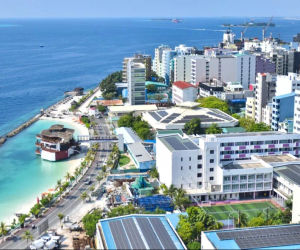
The public sphere of Malé is not yet decorated with homeless encampments, fleets of tents or bonfires under the Sinamalé bridge, nor a single government shelter for the homeless. There is no space, and little kindness, for anyone sleeping rough in this society. So the hidden homeless go to great lengths to avoid being perceived as such. They shelter in spaces conditionally offered by well-wishers, friends, family or acquaintances. These "homes" are a rotating circuit of borrowed spaces: spare rooms, relatives' couches and doubled-up households that can vanish without warning. The hidden homeless are theoretically housed but functionally homeless.
By official definition, a household in the Maldives is simply a unit of people living under the same arrangement, sharing the same space, living and eating together, as counted in national surveys. All members, temporary or permanent, are counted and considered equally. The definition has quietly absorbed the hidden homeless into the ranks of the "housed".
For many young people, "home" is little more than the place where they are seen at night and gone by morning, ghosts in their own supposed households. To understand homelessness, we must first ask what constitutes a home. The housing researcher Bill Edgar identified three domains that go beyond physical shelter:
Is the space sufficient for your needs and those of your dependents?
Does it honour your privacy and allow you to maintain social connections?
Is your name on the lease, as an equal partner and full tenant?
Short and simple questions. Yet many emerging adults in Malé would hesitate to answer yes to all three.
Homelessness is conventionally measured through shelter populations and classified by duration, in a typology developed by the researchers Randall Kuhn and Dennis Culhane. Transitional homelessness is brief, with a quick return to stability. Episodic homelessness is a recurring cycle in and out of temporary shelter, often repeatedly over a period of time. Chronic homelessness is prolonged, deeply entrenched and far harder to escape. In the Maldives, the categories collapse. There are no shelters through which to track the homeless population, few spaces to bridge the gap between transitions and fewer still that offer safe short-term accommodation. In their absence, young people in crisis turn to informal arrangements: couch surfing or doubling up in overcrowded homes.
Couch surfing is a euphemism for an uneasy reality. It means living without formal attachment to any household, a perpetual guest of circumstance. It is not a remedy for homelessness, only a temporary balm. For the couch surfer, housing is an unpredictable cycle: one friend's floor to another's couch, wave to wave, never reaching dry land. Faadhiree*, 25, recently moved back to the Maldives after several years studying abroad. He is engaged to a foreigner, though the wedding dates remain undecided. He has resolved to couch surf until he can raise the funds to relocate permanently to join his wife-to-be. In the meantime, he is another case among a growing population of young people in housing insecurity.
Doubling up is its own category of hidden homelessness. An established household temporarily absorbs extra people, often into already cramped conditions. Rooms burst at the seams and the bathrooms run on ever tighter schedules. It is a familiar scene for many, waking to find the floor covered with the sleeping bodies of visiting relatives. Some of them near strangers who once attended your third birthday.
One in eight households in Malé is overcrowded, and among overcrowded rented households, more than one in five routinely uses the kitchen, living room or storage room for sleeping.
The Maldives has long recorded one of the highest divorce rates in the world. Jeju's* marriage, like so many, dissolved. Newly single, with young dependents, her situation was dire. Escaping spousal abuse demanded sacrifice. Jeju's sacrifice was the home she had built, traded for imminent housing precarity. For many divorced or separated people, there is no childhood home to return to and no means of securing new housing mid-month on a single income. A civil servant in Malé earns around MVR 15,920 (US$ 1,000) per month (2019 figures), while average rents stood at MVR 14,364 in 2022, a generous lowball by 2026 standards. Stagnant incomes collide with untameable rental prices, especially in Malé, where 74 percent of households rent.
A household in the capital spends 35 percent of its income on rent on average, a share that rises to 68 percent for the poorest tenth. Dual-income households barely keep afloat; single-income households sink.
Rarely seen on the streets, Malé's young hidden homeless make their condition look almost effortless. They show up to work and obligations, spend time with friends and family, and are largely untouched by the deprivations traditionally associated with homelessness: joblessness, lack of income, lack of education. Equipped, on paper, with everything needed to overcome homelessness, they remain stuck in an un-housing limbo.
The absence of visible homelessness keeps society comfortable enough to pretend the problem does not exist. Hidden homelessness thrives behind closed doors; unseen, uncounted and therefore unaddressed. Couch surfing and doubling up may shield young people from sleeping outdoors, but they deny them the stability, security and dignity of a real home. A home that is more than four walls, a roof and a makeshift bed.
*Names have been changed to protect the identities of those who shared their experiences.
Discussion
No comments yet. Be the first to share your thoughts!
No comments yet. Be the first to join the conversation!
Join the Conversation
Sign in to share your thoughts under an alias and take part in the discussion. Independent journalism thrives on open, respectful debate — your voice matters.
Support Independent Journalism
Help us keep the news free and fearless
Give once
$
or
Become a memberfrom $5/month