
'Should I just do it for you?': how two volunteers got the rufiyaa into Unicode
The MVR symbol is no longer a dollar in disguise.
Artwork: Dosain
29 Sep, 13:55
When Naail Abdul Rahman asked contacts at the Maldives Monetary Authority (MMA) and the National Centre for Information Technology (NCIT) whether anyone had registered the rufiyaa sign with Unicode, the answer was no. They had not got round to it.
"Should I just do it for you?" he asked.
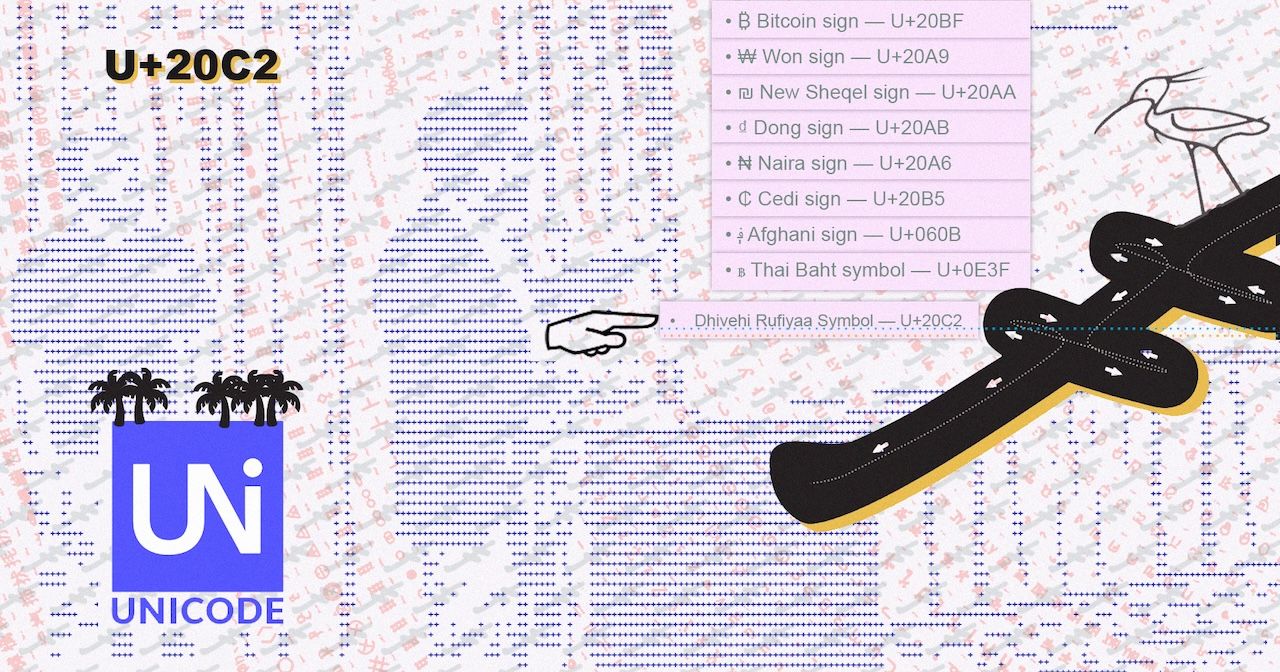
Unicode 18.0, released this month, gives the rufiyaa sign its own code point (U+20C2) in the global standard that tells phones and computers what each character connotes. Naail, known as Kuda Nai, wrote the proposal with type designer Abdulla Shafeeu, known as Abo, of Akuru Type, and the MMA endorsed it.
Until now, the symbol, in use since 2022, existed only through workarounds built into individual fonts. A fixed code point ensures that compliant systems will recognise it once they update. Naail expects this to begin within months.
The workarounds had a basic flaw, as Naail told MMA staff. "If you just put it in a font instead of the dollar sign…it will visually look like you want it to, but at the system level, it's still representing a dollar. So any machine or system that's looking at it can't distinguish it…rufiyaa will need its own distinct code point for that to happen," he explained.
The sign was designed by Hassan Shujau and introduced by the MMA in 2022 after a nationwide open competition. It is based on the Dhivehi letter "ރ" (raa), with two strokes through it representing the mathematical equals sign.
Naail said the gap was apparent almost from the start. "MMA did it around 2022 initially, they released the thing. I do have some experience working with text and Unicode… and input methods on iOS and Android. So it was immediately like, okay, the next step from a technical perspective needs to be this," he said.
Font-level workarounds followed, such as ligatures that turned a keystroke into the rufiyaa symbol. But "the technical limitation was still there," he noted.
The proposal was the latest in a run of unpaid standards work by Naail, which includes contributing Dhivehi voice data to Mozilla's Common Voice project and early Thaana work on Google's Noto Sans font.
He returned to the problem while chairing an unrelated ICANN effort to formalise rules for Thaana script in domain names, which reconnected him with contacts at the MMA and NCIT.
A formal submission needs local backing from computer societies, designers, universities, linguistic institutions and standards bodies, he said. The MMA's endorsement helped since "it wasn't just some guy proposing something."
The MMA's concern was narrower. "Their only concern was just making sure that the identity that MMA had approved and put forward is the thing that is being proposed," he said.
Naail drafted the proposal in November 2024 and submitted it in March 2025. The MMA sent a formal endorsement letter to Unicode's technical committee on 15 May 2025. Rounds of review then followed under what he called a very strict formal process. It was slowed by the size of the release. The rufiyaa sign is only one among 13,007 characters that Unicode 18.0 adds.
However, one problem the proposal flagged could not be fixed. Unicode conventions expect a currency symbol to sit to the left of a numeral. But Thaana runs right to left.
"There's actually no way to solve that," Naail said. "You just have to figure out when you're typing it…what looks correct."
He traced the root cause to Unicode's text-direction handling: "the bi-directional algorithm. It cannot determine… where to render left or right." The same limitation affects other right-to-left currency signs added in the same release. It had long affected the signs of Middle Eastern currencies.
"It's a long-standing limitation in Unicode itself… they themselves are like, okay, how do we fix this? We don't know yet."
On timing, Naail was optimistic: "Probably within some time in the next three to six months, I imagine, they will start showing up," he said.
He is also building a Thaana input engine with rufiyaa support, though its public release has been delayed. "I was hoping to do it before this Unicode launch, but yeah, I don't know. Maybe in a month or two."
In the near term, institutional adoption matters more than retail use. "It also corrects the historical record. These are things that will land on archives… so the archived documents start becoming correct at that point," he said. Formal adoption could also push accounting software with no built-in rufiyaa support to add it.
Abo said Akuru Type's fonts supported the symbol informally from the start. "We initially released ligature shortcuts and alternative ways to access the proper Rufiyaa symbol, and we also included the symbol in fonts launched through Akuru Type Marketplace after the symbol was introduced," he said.
Joining the Unicode proposal changed that.
"We decided to implement the new Rufiyaa Sign Unicode, U+20C2, into one of our existing typefaces, AK Rasmee," Abo said.
"There's something special about seeing a symbol that represents our own currency become part of the global digital character set, and then being able to bring that into a Dhivehi typeface and make it usable."
Discussion
No comments yet. Be the first to share your thoughts!
No comments yet. Be the first to join the conversation!
Join the Conversation
Sign in to share your thoughts under an alias and take part in the discussion. Independent journalism thrives on open, respectful debate — your voice matters.
Support Independent Journalism
Help us keep the news free and fearless
Give once
$
or
Become a memberfrom $5/month