
"Punitive approaches to health do not work": UN Special Rapporteur Tlaleng Mofokeng on her Maldives visit
On universal coverage, the medicine shortage, mental health and drug policy.
Artwork: Dosain
11 May, 13:14
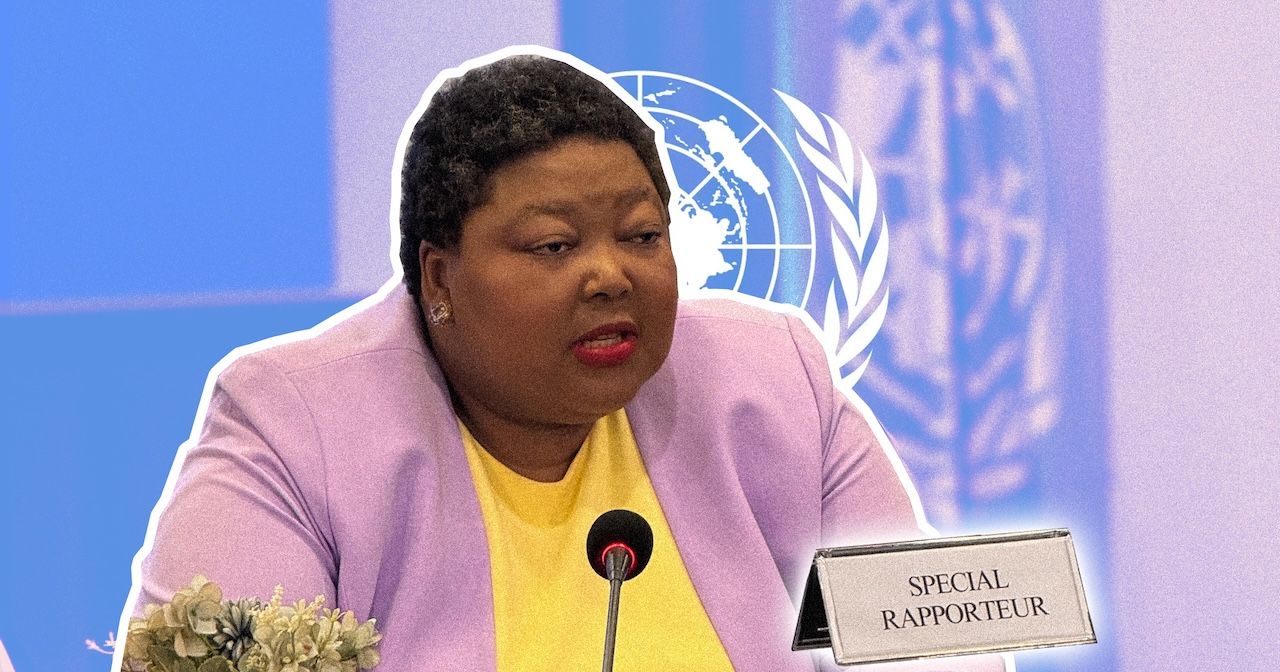
Dr Tlaleng Mofokeng, the UN Special Rapporteur on the right of everyone to the highest attainable standard of physical and mental health, concluded her final country visit at a press conference in Malé last Thursday (May 7), presenting preliminary observations after 12 days meeting government officials, parliamentarians, judiciary members, civil society, hospital staff and patients in Malé, Dhaalu atoll and Addu City.
Mofokeng praised the Aasandha universal health insurance scheme as a model that protects the right to health for all Maldivian citizens and singled out the country's "triple elimination" of mother-to-child transmission of HIV, syphilis and hepatitis B, alongside near-universal vaccination. She welcomed the draft mental health bill, the National Mental Health Strategic Action Plan 2025–2029, and the regional hospital optimisation programme under which five regional hospitals are scheduled for upgrades to tertiary level by the end of 2027.
But her preliminary statement flagged significant gaps. Healthcare delivery remains inequitable for those living on more remote or less populated islands. Mental health services are concentrated in the capital, with poor referral pathways and a shortage of trained psychiatrists, psychologists, counsellors and social workers. The right to health of migrant workers – who make up 26 percent of the population – is constrained by their immigration status. Many people still lack access to essential medicines, including psychiatric medication and medicines for drug harm reduction. Doctors told her of frustration with delays in equipment and supplies. The country's pharmaceutical bill, which by her account accounts for about a third of total government health spending, was "susceptible to private actor influence, conflicts of interest or irregularities in procurement tenders, contracts and wasteful expenditure."
In a statement issued after the press conference, the opposition Maldivian Democratic Party cited Mofokeng's observations in support of its critique of President Dr Mohamed Muizzu's handling of medicine supplies, describing the shortage as a crisis created by the administration through politically motivated, short-sighted policies. The MDP accused the government of taking the first delivery of a bulk medical procurement initiative inherited from the previous MDP administration but failing to continue it, undercutting Aasandha insurance prices for medicines while labelling the private sector a "medical mafia," and creating a new state-owned enterprise for medicine procurement that has failed to secure supplies even as the State Trading Organisation continues to sign with new suppliers.
The party pointed to testimony from Aasandha Managing Director Aminath Zeeniya to a parliamentary committee last week, in which she acknowledged stock-out complaints that arrive daily and conceded that the root cause of the supply situation has not been identified.
The government welcomed Mofokeng's recognition of progress on universal health coverage, vaccination, and regional healthcare delivery. Her conclusions would help the Maldives mobilise international technical and financial support, the foreign ministry said in a statement, adding that her recommendations would be reviewed, and reiterated commitment to ensuring the right to health for all people in the country, with a continued focus on strengthening primary care for prevention. The government noted that Mofokeng was the first UN Special Procedures mandate holder to visit the Maldives in 2026 under the Standing Invitation, which it reiterated in February 2024.
Mofokeng's full report will be presented to the UN Human Rights Council in June 2027 by her successor, after her mandate ends. The Maldives Independent sat down with her after the press conference. The conversation has been edited for length and clarity.
After 12 days and three locations – Malé, Addu and Dhaalu – what was the sharpest contrast you observed between the right to health as it exists on paper in the Maldives and how it's actually experienced, particularly outside the capital?
Before a visit like this you do background work – reading what the Maldives has submitted to the UN through the Universal Periodic Review and to treaty bodies, reviewing policies, plans and any health data online, working with WHO, UNFPA and other UN entities. You can't walk in thinking you already know what you'll find.
My interest with the Maldives was the extent to which universal health coverage has been implemented, and how successfully it has moved from a plan to a programme that is tangibly felt in people's lives. There are good plans here and significant investments in the health system that the country should be proud of. But do those investments yield quality, dignified care? That's where I look for gaps and disconnect.
You have to be physically present to see this. The internet can't show me a woman in a disability centre who has been there for more than 10 years simply because she has nowhere else to be. It can't show me whether new buildings are inclusive of people with disabilities, or whether occupational health and safety has been considered for the doctors and nurses you want to recruit to the atolls – including lodging, laundry, a kitchen, the working conditions that allow you to retain talent.
The contrast itself is in the sophistication of the space. Indira Gandhi Memorial Hospital is impressive – a cafe that integrates outdoor space into indoor space, signage everywhere, a fish pond providing background water therapy. Those things make the space more than one of sickness. They are good for workers and patients. By contrast, in smaller hospitals you find one ward subdivided by curtain – four beds for men, two for children, two for elderly or migrant patients no longer sick but unable to be discharged. Malé is already constrained for space, but on the islands everything contracts.
The transportation challenge isn't getting from someone's home to the atoll clinic; it's stepping up from atoll to a higher level of care – waiting for a sea ambulance or speedboat in non-emergencies. There is only one air ambulance. If you have a fractured leg and there's a storm at sea, that's not an ideal travel situation.
And because the UHC model finances care without gatekeeping, no one is denied anything. Someone can leave home from an atoll saying, 'I think I need an ophthalmologist.' Maybe what they actually need is an eye test – an allergy, more pollen, smoke from the haze. They need information on eye hygiene. Or they may need an optometrist on site and a proper referral to Malé, rather than travelling there and hoping the day they arrive is the day the ophthalmologist is in.
For those who do need immediate care, there must be proper referral pathways and networks. It cannot depend on me, as a doctor, knowing you at the hospital that day and saying, "I'm sending over a patient." It needs to be institutionalised practice with clinical protocols. In the bigger hospitals in Malé you can see the evidence-based clinical protocols on the walls. In other hospitals, they tell you, "we do what we've been doing." Continuing medical education is also a struggle – if a doctor must leave for two weeks of training in Malé, there is no one to cover. The reply is, "we can't retain staff, we can't compete with the salaries." But of course no one is leaving their homeland for a place where their child can't go to school. There are even islands with no schools, but health facilities are wanted there. Where will the doctors' and nurses' children go to school?
The health facility has to support a whole of society to thrive. Everything around the facility needs to be working too, if the people inside it are going to be at their best.
Your mandate places particular weight on marginalised groups and the intersectional determinants of health. Which populations in the Maldives do you think are most invisible in the current health system?
Every interlocutor I have spoken to has raised certain themes. Migrant workers are one. The nature of being undocumented makes it difficult to access civil services – health, banking, schooling, work. That places a tremendous burden on migrant people not to be found out, and so they delay seeking care. The risk of infectious disease rises, as does vulnerability to its complications, because they may not have safe housing or sustainable food. They can be alienated even from the migrant community, because if a community-based worker keeps coming to check on them, others worry the whole household will be exposed.
Mental health is another. It is compounded by stigma and discrimination, and by the things people associate with it – bullying, sexual abuse, gender-based violence, drug use. When the response to crisis is criminal law, that is incompatible with the right to health. It means the system has not screened, has not counselled, has not provided long-term support. People are self-medicating, doing what they can to survive. Suicidality is an emerging issue.
We should think of mental health not as a diagnosis for those we think are "crazy" – and I put that in inverted commas, because of ableism – but as a wellness plan for the country. Being mentally well is foundational to physical health, to sport, culture, schooling, economic participation, creativity, vision at any life stage. The plan has to go beyond diagnostics of disease.
Communities also lack physical space. It is either your house and your phone, or your workplace and a cafe. There is no multi-purpose community space. So hospitals and clinics end up being that – there is internet, lights, shade, water, other people. The need to be around people and create community is dignifying, and clinics are now part of that social system whether they were designed to be or not.
The climate crisis is more a current issue than a future possibility for the Maldives, and there is a stress about what the next crisis will be. People who experienced the tsunami were visibly distressed by a bad weather warning during my visit. They had been resettled to a different island, but they were originally from a place where the tsunami memorial now stands. The anticipation of disaster, the anticipation of the violence a child has already experienced – this is hard to function with. And without psychologists or community health workers you can talk to without a major diagnosis, much of everyday survival goes unsupported.
Speaking of marginalised communities, what are your thoughts on persons with disabilities?
Disability is a major one – and I am someone with disabilities myself, with mobility issues. Any time of day I can be okay, then five minutes later my legs cannot take me. Even for this visit I had to make my own arrangements in case I needed a wheelchair or a walking stick.
In every hospital I visited, there was an intentional approach to wheelchair access – in some, wheelchairs are lined up for whoever needs one. That's good. But mobility is more than the wheelchair. Is there a translator for someone who is deaf? Braille for someone who is blind? Disability is also mental and cognitive – the capacity to make decisions for yourself. Are we over-relying on institutionalisation because adult children can no longer take older parents to consultations to advocate for them? Granny is said never to take her pills, so something must be wrong with her. Maybe she just needs more advocating for, more support.
New disabilities are also evolving – arthritis, chronic pain, post-stroke care. Are mobility aids accessible? Can schools support and accommodate particular needs? In employment we know the discrimination – people assume those with mental illness will take more time off, that colleagues will have to subsidise it. There are children born with disabilities, and the question of whether neurodiversity is understood, whether early screening is happening. I met civil society organisations who have the content and the expertise but cannot get into the room with the Department of Education to train teachers. The neurodivergent clinic might pick up a child, but the school might also flag a struggling child to the clinic – that cross-referral needs the programme to exist in both spaces.
The Maldivian population is under 600,000. We are not asking the country to do this for 60 million people. That is the context that gives me hope. In most countries with 56 million people, only two percent of GDP goes to health. Here, it is nine percent. Those investments must yield results. What is needed is more coordination, more inter-ministerial collaboration, and proper monitoring and evaluation. The triple elimination – measles, hepatitis, mother-to-child transmission – is a sign the investments are working. There ought to be more measurement of the rest.
The other vulnerability cuts across age, class and gender: the climate does not care about those things, and neither will the next health crisis. Viruses don't know class. If you embed classism, racism and sexism in your policy, your response will be classist, racist and ableist when the moment comes. Then people are left behind saying, "we are not being cared for," and government is saying, "we implemented the plan exactly as we planned and spent all the money." Yes – because they were made invisible in the plan, in the budget line, and so in the programming.
That discrepancy comes from civil society not being in the room when policies are designed. Did the doctors and nurses sit and say what is currently not working? That this corner is so close to the door of the theatre that five of us have broken our elbows getting in? That is occupational hazard, and no one is talking about it. Once the hospitals being built in Malé are built, there is no other 20 kilometres of Malé to build on. We have to get this right. These are investments for a lifetime.
Mental health has grown in salience as an issue of public concern in recent weeks – long waitlists, no atoll-level psychiatric care, families paying out of pocket for private therapy. What did your delegation find, and what are the two or three concrete steps you'd urge the government to take first?
The helpline and service hotline are popular for people who don't go into hospital. I was told there is a lack of trust in that system because of privacy and confidentiality concerns, and because there isn't real coordination between the ministry of health, social services and hospitals. You still have to take the initiative to connect the things you need yourself, and self-build a team. At least someone picked up the phone and said, "don't do anything dangerous." But even when an ambulance arrives, if you have overdosed there are no drugs available to reverse it – basic essential medicines for managing overdose. Because of heavy reliance on criminal law, you cannot provide psychiatrists with the necessary medication, because it gets over-policed and treated as if it were illicit, even when used clinically.
There need to be more trained specialists – not just psychiatrists but clinical psychologists, child clinical psychologists, general psychologists, paediatric psychologists, psychologists who understand migrant populations. Specialist primary caregivers really matter.
Medication is critical. Even with a diagnosis, the combinations a psychiatrist wants to prescribe sometimes can't enter the country, because the quantities are so small that no company will go through the regulatory body's process. So my immediate recommendation to the government is to convene a task force on how to negotiate access to quality, efficacious medication. The state can already forecast – five years of trends tell you what you will need. It can pre-order. It can also negotiate maximum retail prices with pharmacies so out-of-pocket costs in the private sector become more affordable.
It can also disseminate public health information in every public space. If you don't know that what you have is a condition with a name, you won't know to seek help. People self-medicate, end up in chronic pain, use substances to make it through life, suicidality emerges, they lose jobs, become homeless, food-insecure, then come into conflict with the law. We need to react before that contact with the law begins.
Funding is important for sustainable programmes – for adolescents, youth, elderly – that focus on wellness and longevity even without a diagnosis. We all need music therapy, play, painting, a sense of community.
The draft mental health bill with the ministry of health and family welfare and the Attorney General's Office needs to be finalised. It supports the National Mental Health Strategic Plan 2025-2029. I visited the disability hub and the gender-based violence centre that are under construction – foundations are up, some rooms are nearly ready. What matters now is accessibility beyond the wheelchair, home care delivery, connection between hospitals and centres and other NGOs, regular physiotherapist visits to facilities for elderly people with disabilities and those with psychiatric illnesses, and improvements in teleconsultation with proper safeguards for data protection, security and accountability.
The Maldives runs Aasandha as universal coverage but is under severe fiscal pressure – debt repayments, currency strain, and a slowing tourism-dependent economy. If the government has to make cuts, what specifically should be ring-fenced, and where have you seen other states get this wrong?
I'm very aware of shrinking fiscal space – globally, full stop. So the Maldives needs a strong, sustainable national resource model. There is still important value in international solidarity – an MOU with another academic centre of excellence in the Global South can support the development of your training, allow your interns to do internships and specialist training abroad and come back to give the results to the Maldives. That doesn't require cost-cutting. It requires building relationships through right-to-health diplomacy.
The reason I keep coming back to the pharmaceutical bill – approximately 60 percent of health spending – is that if you are spending that much on pharmaceuticals, you need to be very clear about what you are getting for it. What I am hearing is, "we're not sure if the medicine is even safe; sometimes it's not labelled properly; sometimes it's out of stock," and in the private sector it is exorbitantly priced. What portion of that 60 percent is going directly to clinical outcomes and patient dignity? Transparency, supply chain management, contracts being negotiated with private pharmaceutical companies – those need to be examined very carefully. There is nothing wrong with spending that much if that's what you need. But can you show that it is doing what it's meant to do?
Before cutting things, decisions need to be informed by policy and by people's lived experience. That is why civil society matters – they do the research and the advocacy. There has to be a trust-based relationship between government and civil society where some of that resource can be channelled. The Maldivian government cannot set up a research institution for every disease and every atoll, but you have specialised NGOs doing good work. Trust-based relationships and trust-based monitoring allow for accountability. Then we know where to cut, where to ring-fence, and where to be smart in renegotiating partnerships.
At the moment, government, regional NGOs, international NGOs are all competing for tourist money, donations from businesses, multilateral funding – for the same pool. Of course there will never be enough. How we think about resource mobilisation has to look very different.
The point is, you cut nothing. You improve what needs to be improved, and you put money in where it makes sense to. It has to be evidence-informed for a particular outcome.
Drug dependence has been treated primarily as a criminal-justice problem in the Maldives for decades. You've argued globally for harm reduction and decriminalisation. What did you observe here?
Harm reduction applies, in my view, to areas under the right to health that are stigmatised, discriminated against and criminalised. It looks at how criminalisation, legal frameworks, medical practice and social norms either contribute to harm or can reduce it.
So if the Maldives finds there is a high rate of drug use, and you know the substances people are using, you provide information about those substances – their safety, what they do, safe doses, ways the drug can or cannot be taken, what an overdose looks like. Information is itself destigmatisation, because it puts the issue in the open. It removes the shame of saying, "I might have that." Someone can go to the hospital and say, "I saw a poster at the jetty and I think it speaks to me."
In several clinics I saw smoking cessation programmes – a whole room, nicely designed. I have never seen that in a public space anywhere else. Of 10 patients, six were successful and four were still in progress. That is amazing, and it is not in the private sector for those with private insurance – it is universally available. So we know harm reduction works, even if governments don't always want to call it that. And under UHC, everyone is covered. But stigma and shame may stop people taking up services.
Once someone is in chronic pain and self-managing, something happens and they come into conflict with the law. Often that incident is what triggers support for the underlying mental health or drug issue. But drug use is not the same as drug abuse, and not the same as drug dependence. Governments tend to lump them together, when each requires a different programme and approach.
When I met the judiciary, parliamentary staff and court members, there is only so much the law can do beyond delivering judgments. Those judgments must still be implementable, and there must be resources behind them. Putting more and more people in prison, when the prison health system is as bad as it is, only worsens outcomes.
There needs to be a paradigm shift in how we understand harm reduction, the law, and the things we do in medical practice that don't respect people's choices or pace. People come into the system with violence in their personal lives, with lost income, lost jobs, with a great deal of stress, and by the time they see a doctor, nurse, police officer or judge they are compounded by systemic challenges. Add being a migrant, an undocumented worker, an adolescent, a girl child, and it is stacked against them.
When someone walks in with a problem, there is a law, a practice, a norm making it worse. I am advocating for governments to think of their role not as punitive but as extending kindness, services, support, commodities – so people can move from surviving to thriving. Punitive approaches to health do not work. Not for HIV, not for anything. It is about placing people's needs at the centre, understanding they may need psychological support, financial support, a sense of community, the chance to relearn a skill – to read, to write. They might have been a high-functioning architect or a builder, and now they have broken an arm, and what then? – because all they have done is lay bricks. Catastrophic events happen to people all the time. Harm reduction means centring the person's needs, less punitive, more comprehensive and dignified – and understanding that social norms, medical practices and legal frameworks all directly criminalise, stigmatise or discriminate against people.
As you hand the mandate over, what have you learned about the right to health in small island developing states that you wish you'd understood at the start, and what's the one thing you'd want your successor to keep watching in countries like the Maldives?
What I know for sure is that being geographically located where you are, and as small as you are, does not mean there is no expertise here, or no formidable diplomatic influence and leadership. That is what I have always known, and that is why I focus on the colonial and extractive capitalist practices that have restricted the ability of countries like the Maldives to progress on their right-to-health obligations. People extract resources out of our economies that could have been used to invest back into health.
The risk now is the privatisation of human rights. That is why I am so deeply impressed by UHC in the Maldives, and why I need it to continue as a unifier in this country. It protects the right to health for everyone, and the more it improves, the more truly universal that coverage will be.
The trend I would urge my successor – and developing countries generally – to watch is the shift where big non-state actors, private for-profit companies, are starting to take over state capacity and make decisions on behalf of the state. This is slow. It is happening with data mining and breaches where there are no consequences. Do not allow the privatisation of the right to health.
For the Maldives specifically, UHC is the correct step, and the implementation is showing results. To progress to the next phase – where no one is left behind, where everyone goes from surviving to thriving – you will need a multi-coordinated approach and a foundational plan that gives everyone a common songbook to sing from. In fisheries and agriculture, you need to know how that work impacts the right to health, food security, pesticides, the tuna fish that has plastics in its belly. In tourism, you need to know the right-to-health outcomes of the migrant workers your economy relies on. In economy, finance, digitisation and revenue, you need to know how those decisions affect the right to health.
The common agenda for UHC in the Maldives is not only a ministry of health competency. It needs political leadership and support, and a plan that takes all of society and all departments forward together – for this year, the next, the next 10 and 20. The foundation has to be a functioning health system, and that foundation cannot keep changing. When changes are needed, they must be evidence-informed – an emergency, emerging data – but the health system has to have preparedness and resources mobilised in advance.
The leadership I saw in the local atoll hospitals, by administrators and staff, were amazing models of stewardship. We need that everywhere – to understand that the right to health and the functioning of the health system is non-negotiable. The Maldives is on the right track with UHC. The task now is to make sure no one is left behind.
Discussion
No comments yet. Be the first to share your thoughts!
No comments yet. Be the first to join the conversation!
Join the Conversation
Sign in to share your thoughts under an alias and take part in the discussion. Independent journalism thrives on open, respectful debate — your voice matters.
Support Independent Journalism
Help us keep the news free and fearless
Give once
$
or
Become a memberfrom $5/month